If you need reliable testing for batteries, USB chargers, or power banks, the right load tester makes a big difference. The best options combine accurate discharge control, clear readings, and enough power handling for your workflow.
This roundup of the best electronic loads with USB in 2026 focuses on practical features that matter: adjustable current, interface support, portability, and safety for everyday bench use.
Best 10 Electronic Loads with USB Picks for 2026
High-Power USB Load Tester
180W DC Electronic Load Tester

- 180W, 200V, 20A capacity
- CC/CV/CW/CR operating modes
- Color screen shows test data
Best For: High-power charger, cable, and battery testing
Fast-Charge Protocol Tester

- Triggers QC2.0/QC3.0/AFC/FCP
- USB, Micro USB, Type C ports
- Multiple safety protections built in
Best For: Fast-charge and charger/cable testing
Programmable Bench Load

- USB/RS232/RS485 with SCPI support
- 150V, 15A, 150W programmable range
- 5kHz dynamic testing and battery cycling
Best For: Automated bench testing and lab workflows
Protected 4-Wire Load Tester

- 4-wire system for more accurate readings
- CC, CP, CR, and CV modes
- Android, iOS, PC BT, and wired control
Best For: Accurate battery, charger, and adapter testing
Compact USB Load Tester

- Switches between 1A and 2A load modes
- Dual-color LEDs indicate the selected mode
- Compact PCB with added heat dissipation features
Best For: Quick, simple USB discharge testing on chargers and power banks
High-Power USB Electronic Load

- 4-wire system improves measurement accuracy
- Supports CC, CP, CR, and CV load modes
- High-power design with app and computer connectivity
Best For: Detailed bench testing of batteries, chargers, and cables
Adjustable USB Load Meter

- OLED display adds detailed test readouts
- Two knobs provide coarse and fine current control
- Includes QC2.0/QC3.0 trigger for fast-charge checks
Best For: Adjustable charger, cable, and power bank testing with capacity readout
USB Intelligent Load Tester
DROK 25W USB/Type-C Load Module
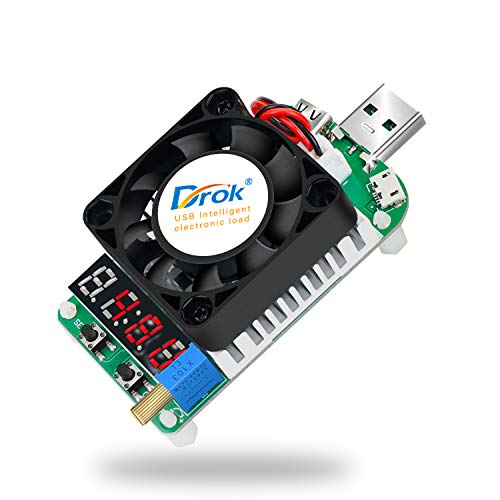
- 25W constant-current load for USB and Type-C testing.
- LED readout shows voltage, current, and power.
- Built-in fan plus OVP/OPP/OTP protections.
Best For: Charger and cable testing on a compact USB load module
Reversible USB Load Tester
35W LCD Constant Current Module

- Reversible USB input for easy plug-in orientation.
- LCD displays voltage, current, and capacity.
- Coarse and fine knobs help dial in current control.
Best For: Quick USB battery and capacity checks with simple controls
High-Power USB Load Tester – 180W DC Electronic Load Tester
If you need one of the more capable electronic loads with usb for charger, cable, and battery checks, this 180W unit is built for broad compatibility and heavier discharge work. It supports CC, CV, CW, and CR modes, so you can match the test style to the device and verify voltage, current, power, and capacity data on the built-in color display.
Best For: Users who want a high-power USB load tester for charger, cable, and battery discharge testing.
Pros:
- 180W, 200V, 20A output range for demanding test jobs
- Four operating modes: CC, CV, CW, and CR
- 2.4-inch color screen with on-screen test data and curves
- Supports Android, Type-C, Mini, and other cable testing
Cons:
- Primarily aimed at test and aging workflows, not everyday charging
- External temperature probe is mentioned as an added accessory
This model stands out for its mix of high power, multiple load modes, and practical data display. It is a strong fit when you want a USB load tester that can handle bigger devices and longer discharge sessions without giving up basic safety monitoring.
Fast-Charge Protocol Tester – UCTRONICS 35W USB Load Module
For compact electronic loads with usb, this UCTRONICS module focuses on practical charger and cable testing rather than raw power. It can act as an adjustable load and also trigger QC2.0, QC3.0, AFC, and FCP fast-charge outputs, making it useful when you want to see how adapters and power banks behave under different conditions.
Best For: Testing fast-charge protocols, chargers, cables, and smaller power bank setups.
Pros:
- Tests and triggers QC2.0/QC3.0/AFC/FCP fast-charge modes
- USB, Micro USB, Type C, and external wiring ports
- Built-in cooling fan and temperature control for safer operation
- Includes multiple protection features such as OVP, OCP, OPP, LVP, and OTP
Cons:
- 35W max discharging power is modest compared with larger bench loads
- Designed around DC 4.0-25.0V and 0.03-5.00A limits
This is a practical pick if your priority is protocol testing and everyday accessory checks rather than high-wattage discharge work. The broad port support and protection set make it a flexible bench tool for common USB charger diagnostics.
Programmable Bench Load – OWON OEL1515 USB DC Load
Among electronic loads with usb, this OWON programmable model is aimed at bench testing, automation, and deeper analysis. It offers USB, RS232, and RS485 control with SCPI support, plus CV, CC, CR, and CP modes, so it fits well into controlled test setups for power supplies, batteries, and other DC devices.
Best For: Bench users who need programmable USB control and automated test workflows.
Pros:
- USB, RS232, and RS485 interfaces with SCPI protocol support
- Up to 150W, 150V, and 15A operating range
- 5kHz dynamic testing with adjustable rise-rate control
- Battery charge/discharge testing supported through PC software
Cons:
- More complex than simple handheld USB load testers
- Best suited to bench or production environments
If you need precision, automation, and data-driven testing, this unit is the most capable option in the group. The high-resolution display and dynamic response features make it a strong match for lab work and repeatable performance measurements.
Protected 4-Wire Load Tester – 180W USB Battery Load Tester
This battery-focused option in the world of electronic loads with usb is built for accurate discharge testing and safer long runs. It combines a 4-wire system, four operating modes, and app connectivity, making it useful for checking chargers, power banks, batteries, and adapters with more precise voltage readings.
Best For: Users who want a high-power USB load tester with app control and 4-wire accuracy.
Pros:
- 180W, 200V, 20A performance for demanding discharge tests
- 4-wire system improves voltage measurement accuracy
- Supports CC, CP, CR, and CV modes
- Works with Android, iOS, PC BT, and wired connections
Cons:
- More specialized for testing than general-purpose use
- Protective casing adds size to the unit
For buyers who care about measurement accuracy and flexible control, this tester offers a strong blend of power and usability. The insulated shell and temperature-controlled fan also make it appealing when long discharge sessions are part of the workflow.
Compact USB Load Tester – 5V 1A/2A Switchable 6-Pack
If you want simple electronic loads with usb for quick charger and power bank checks, this 6-pack keeps the workflow straightforward. It offers switchable 1A and 2A discharge modes, clear status lights, and a compact PCB layout that fits neatly on a bench or in a test kit.
Best For: Basic USB charger, power bank, and battery discharge testing where quick mode switching matters.
Pros:
- Selectable 1A and 2A load modes for easy test control
- Dual-color indicators show the active setting at a glance
- Enlarged copper area and ventilation holes help with heat dissipation
- Compact design suits bench use and small test setups
Cons:
- Limited to two fixed load levels rather than adjustable current control
- Best suited to controlled USB testing within rated limits
This is a practical choice if you mainly need a simple resistive USB load for repeatable discharge checks. The six-piece pack also makes it useful for labs, classrooms, or shared workbenches where multiple testers are helpful.
High-Power USB Electronic Load – 150W 25A 4-Wire Tester
For more advanced electronic loads with usb, this MakerHawk tester adds the measurement depth and power handling needed for serious bench work. It combines a large color screen, multiple load modes, four-wire accuracy, and app or computer connectivity for detailed discharge and aging tests.
Best For: Users who need a high-power USB load tester for batteries, chargers, cables, and long-duration discharge testing.
Pros:
- Supports constant current, constant power, constant resistance, and constant voltage modes
- 4-wire system improves voltage measurement accuracy
- High ratings of 150W, 25A, and 200V broaden testing options
- Includes app remote control and computer data transmission support
Cons:
- More complex than a simple fixed-load tester
- Designed for bench-style use rather than ultra-compact portability
This model is best when you need one USB load tester to cover many test scenarios, from power banks to adapters and cables. Its cooling, safety protections, and multiple power input options make it suitable for longer sessions and higher-stress evaluations.
Adjustable USB Load Meter – 35W QC Trigger Tester
If you want electronic loads with usb that also act like a meter, this Eversame unit is built for practical charger and cable testing. It combines adjustable constant-current loading, OLED readouts, and a QC2.0/QC3.0 trigger, making it useful for checking fast-charging behavior and power bank capacity.
Best For: Testing USB chargers, cables, and power banks with adjustable load control and QC trigger support.
Pros:
- OLED display shows current, voltage, resistance, capacitance, temperature, and time
- Two knobs allow coarse and fine current adjustment up to 3A
- QC2.0/QC3.0 trigger included for fast-charge voltage testing
- Cooling fan and aluminum radiator help manage heat
Cons:
- 35W power limit is lower than higher-end bench loads
- QC trigger works only with QC 2.0/3.0 chargers
This is a flexible pick for users who want a compact USB load tester with more measurement detail than a basic resistor-style module. It is especially handy for comparing cable quality, checking fast-charging outputs, and logging capacity data in a small test setup.
USB Intelligent Load Tester – DROK 25W USB/Type-C Load Module
If you need electronic loads with usb for charger and cable testing, this DROK module is built for straightforward constant-current discharge work. It supports USB and Type-C interfaces, shows voltage/current/power on a 4-digit LED display, and adds temperature-controlled fan cooling for practical bench use.
Best For: Charger output checks, USB cable quality testing, and basic factory-style aging tests.
Pros:
- Adjustable constant current from 0.25A to 4A within a 25W / 25V limit.
- Displays voltage, current, and power for quick test feedback.
- Includes OVP, OPP, and OTP protection features.
- Temperature-controlled cooling fan helps manage heat during use.
Cons:
- No reverse polarity protection; incorrect connection can permanently damage it.
- Power, voltage, and current limits cannot be exceeded.
- Best suited to lighter USB testing rather than high-power discharge tasks.
Overall, this is a compact and capable option if your priority is simple USB load testing with visible readings and built-in safety controls. It fits well for bench checks where 25W is enough and USB/Type-C compatibility matters.
Reversible USB Load Tester – 35W LCD Constant Current Module
Among electronic loads with usb, this 35W tester stands out for its reversible USB input and simple LCD readout. It is designed for battery voltage and capacity testing, with coarse and fine knobs that make current adjustment easier during bench work.
Best For: Users who want a simple USB load tester for voltage, current, and capacity checks.
Pros:
- Reversible USB input makes plug-in orientation easy.
- LCD shows voltage, current, and capacity at a glance.
- Coarse and fine adjustment knobs support quicker, more precise control.
- Cooling fan engages above 55°C and stops below 45°C.
Cons:
- No detailed protection features are listed in the supplied notes.
- Limited to a 35W class load, so it is not for heavier discharge jobs.
- Best for USB-based testing rather than broader high-voltage applications.
This is a practical pick if you want a fuss-free USB load tester with easy connections and basic display feedback. The reversible port and dual knobs make it especially convenient for everyday testing tasks.
Best Simple Pick – MakerHawk 150W Battery Tester
If you want electronic loads with usb that can handle much heavier bench testing, this MakerHawk module offers a wide 0.00V to 200V measurement range and up to 150W discharge capability. It includes Micro USB power input support, current and power adjustment knobs, and data functions for capacity, power, and time tracking.
Best For: Higher-power battery testing and discharge work where flexible measurement ranges matter.
Pros:
- Up to 150W discharge power with 0.00V to 200V and 0.00A to 20A measurement ranges.
- Supports DC5.0 power plus DC6-12V Micro USB power supply.
- Includes capacity, power, and time reset functions for test logging.
- Can be calibrated and set for auto standby and discharge countdown behavior.
Cons:
- Must be started with current knobs set to minimum to avoid burnout risk.
- Discharge power cannot exceed 150W.
- More setup care is required than with simpler USB load testers.
This is the strongest option in the group when you need a more capable electronic load for demanding battery tests. Its broad range and power handling make it useful, but it also requires careful operation to avoid damaging the discharge stage.
How We Picked the Best Electronic Loads with USB
We focused on Electronic Loads with USB that offer a useful balance of power range, control precision, display clarity, and connectivity. Higher-wattage units suit larger battery packs and bench work, while compact USB load modules are better for quick checks on chargers and power banks. We also favored models with adjustable constant-current control, clear monitoring, and sensible protection features.
Quick Comparison
At a high level, the 10 products in this roundup fall into two groups: compact USB load testers for 5V accessory testing and more capable bench-style electronic loads for batteries and higher-voltage work. If your main job is checking phone chargers or power banks, a small USB tester is usually enough. If you need discharge testing, capacity measurements, or wider voltage support, a programmable bench unit is the better fit.
Key Buying Factors for Electronic Loads with USB
Power and Voltage Range
Match the tester to your highest expected voltage and wattage. A 25W or 35W USB load is fine for charger validation, but battery packs and larger DC sources often benefit from 150W to 180W class units.
Load Modes and Accuracy
For repeatable results, look for constant-current control at minimum. CV, CR, and CP modes are useful if you need broader testing flexibility. If you care about dynamic behavior, faster response and stable regulation matter more than extra display features.
USB Compatibility
Many Electronic Loads with USB are aimed at standard 5V output testing, but some also support Type-C or fast-charge trigger functions. Choose based on whether you need simple discharge testing or protocol-aware charger checks.
Connections, Display, and Safety
A clear LCD or color screen makes it easier to track voltage, current, capacity, and power in real time. For higher-current testing, look for good heatsinking, insulated housing, 4-wire sensing, and protection against overheating or overload.
Who Should Buy Which Electronic Loads with USB?
If you test USB chargers, cables, and power banks occasionally, a compact adjustable load module is the most affordable and convenient choice. If you work with battery packs, repair gear, or lab equipment, step up to a higher-wattage electronic load with more precise control and stronger thermal handling. For engineers and advanced hobbyists, programmable bench models offer the most flexibility and the best long-term value.
In short, the right choice depends on your source voltage, expected current, and how much control you need over the test process. Pick the simplest model that still covers your real-world use case, and you’ll get more accurate results with less frustration.