Portable Fuel Transfer Pump review is for buyers who want a simple, battery-powered way to move liquids without a wall outlet.
This model focuses on portability, long hose reach, and broad fuel-transfer use.
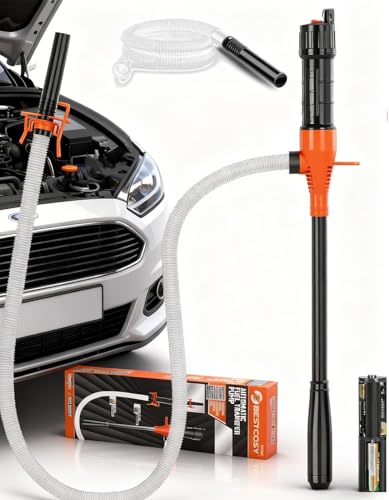
Portable Fuel Transfer Pump Review Summary
The Portable Fuel Transfer Pump makes the most sense for users who value convenience over complexity.
It is built for moving gasoline, water, light oil, kerosene, and diesel, and the listing positions it as a practical tool for DIY mechanics, outdoor use, and emergency situations where power may not be available.
The main reason to buy it is portability. The battery-powered design, combined with a 47-inch hose and a 16-inch suction tube, gives it a clear use case: quick transfer jobs from cans, jerrycans, pails, and similar containers.
If you need a compact pump you can keep in a vehicle, garage, or emergency kit, this is the kind of product that fits that role.
It is also a straightforward option for buyers who do not need a heavy-duty, permanently installed transfer system.
The listing emphasizes easy use and broad compatibility rather than industrial-grade construction, which is useful because it sets expectations correctly.
That said, buyers who want to move corrosive liquids, need rechargeable power, or want a premium-feeling pump should look elsewhere.
Review Scorecard
| Category | Score | Rationale |
|---|---|---|
| Portability | 9/10 | Battery-powered and designed for on-the-go use without a wall outlet. |
| Transfer Reach | 8/10 | The 47-inch hose helps with awkward container placement and basic reach. |
| Use Versatility | 8/10 | The listing supports gas, water, light oil, kerosene, and diesel. |
| Setup Simplicity | 8/10 | A compact siphon-style pump is easier to understand than a larger transfer system. |
| Power Independence | 9/10 | Runs on batteries, which is valuable for travel, outages, or remote work. |
| Material/Build Confidence | 6/10 | The listing claims durability and corrosion resistance, but gives limited detail. |
Key Features and Specifications of Portable Fuel Transfer Pump
This pump is marketed as a portable electric transfer pump with a battery-powered design.
The listing says it uses either 2 D-cell batteries or 6 AA batteries, both sold separately.
That matters because the user controls the power source and can choose the battery format that best matches their storage habits.
The transfer path is built around a 1/2-inch discharge tube and a 47-inch hose.
The suction tube is 16 inches long, which the listing says fits 3- to 5-gallon gas cans, jerrycans, pails, and buckets.
Those dimensions make the pump more useful for everyday containers than for large fixed tanks.
The listing also claims a pumping rate of 2.4 GPM and more than 1,000 gallons on a single set of batteries.
Those figures are useful as manufacturer claims, but buyers should treat them as listing claims rather than promises.
Still, they suggest that the product is meant to handle recurring light-duty transfer work instead of one-off novelty use.
The supported liquids are a central part of the product identity:
- Gasoline
- Water
- Light oil
- Kerosene
- Diesel
The listing specifically says corrosive liquids cannot be transported, so this is not a universal chemical pump.
That limitation is important because it narrows the best-fit use cases to common household, workshop, outdoor, and fuel-handling jobs.
The stated build intent is practical rather than fancy.
The listing describes the materials as high quality, non-toxic, tasteless, easy to use, corrosion-resistant, and durable.
Those are broad claims, but they do reinforce the idea that the product is aimed at convenience, safety, and basic day-to-day utility.
Pros and Cons of Portable Fuel Transfer Pump
Pros
- Battery-powered operation makes it useful when there is no outlet nearby.
- The 47-inch hose gives more flexibility than a short hand-transfer setup.
- Works across several common liquids, including gas, water, light oil, kerosene, and diesel.
- The 16-inch suction tube is sized for common portable containers.
- Easy to understand as a simple transfer tool rather than a complex system.
Cons
- Batteries are not included, so it is not ready to use out of the box.
- It does not support corrosive liquids.
- Build quality is described in broad marketing terms, with limited technical detail.
- The product is aimed at light-duty transfer, not industrial or high-spec applications.
Who Should Buy Portable Fuel Transfer Pump?
This pump is a good fit for people who want a portable, battery-run transfer tool for routine liquid-moving tasks.
It works especially well for DIY mechanics, campers, vehicle owners, and anyone who keeps fuel or water in portable containers and wants a simple way to move it.
It is also a sensible choice for emergency prep.
A battery-powered siphon pump has real value during outages or in places where electrical power is unavailable.
The listing’s emphasis on outdoor activity and emergency situations is believable because the design does not depend on a cord or plug.
Buy it if you want convenience, portability, and broad everyday compatibility. That is the strongest case for this product.
It is not trying to be a universal, professional, or chemical-heavy transfer solution.
Skip it if you need to move corrosive liquids, want a rechargeable battery system, or prefer a more robust pump with more detailed specifications and heavier-duty positioning.
In those cases, the limitations in the listing are more important than the portability benefit.
Practical Use Cases for Portable Fuel Transfer Pump
Fuel Can Transfers
The clearest use case is moving fuel between cans, jerrycans, and similar containers.
The 16-inch suction tube and 47-inch hose make more sense here than a shorter handheld siphon, especially when the receiving container is awkwardly placed.
Emergency and Outdoor Use
Because the pump runs on batteries, it is easy to see why the listing points to emergency situations and outdoor activities.
It can sit in storage until needed, then work without a plug or extension cord.
Light-Duty Multi-Liquid Work
The broader liquid compatibility adds flexibility for buyers who need one tool for several simple transfer jobs.
Water, light oil, kerosene, and diesel support means the product is not narrowly tied to one fuel-only task.
What Limits the Use
The most important constraint is the explicit warning against corrosive liquids.
That tells you this is a practical consumer tool, not a chemical-transfer pump.
Buyers should stay within the supported liquids and treat the product as a convenience device, not a universal transfer machine.
Alternatives to Portable Fuel Transfer Pump
If you want a more established brand in the same category, consider a Flojet transfer pump.
Flojet is a common search term for buyers looking for pump systems with a more industrial reputation.
For compact fuel movement, a Scepter siphon pump may appeal if you want a familiar fuel-container accessory rather than a battery-powered setup.
If you want a broader hand-pump option, a Groz fuel transfer pump is worth comparing because it often targets workshop-style use and straightforward liquid handling.
For buyers who prioritize a powered transfer tool, a 12V fuel transfer pump may be a better fit if you already have vehicle power or prefer a system that does not rely on disposable batteries.
Is Portable Fuel Transfer Pump Worth It?
Yes, if your priority is portable, battery-powered convenience for routine transfer jobs. The listing supports a clear buyer profile: someone who needs a compact pump for gasoline, water, light oil, kerosene, or diesel, and wants to use it away from an outlet.
The appeal here is not premium engineering or broad chemical compatibility.
It is the combination of battery operation, hose length, and simple utility.
That makes it worth considering for emergency kits, garages, outdoor storage, and light-duty fuel handling.
If you need a more specialized or heavy-duty transfer solution, this is probably not the right pick.
But for buyers who want a flexible, portable pump that solves basic transfer tasks without much setup, it is a practical option.