Choosing the right conductivity meter means matching measurement range, accuracy, durability, and calibration features to the water-testing job. The best waterproof conductivity meters make routine readings faster while reducing the risk of damage from splashes and spills.
This roundup compares ten options ranging from compact EC/TDS pocket testers to multiparameter instruments, helping you find a practical fit for hydroponics, aquariums, pools, nutrient solutions, and general water-quality checks.
Best 10 Waterproof Conductivity Meters Picks for 2026
Best Multi-Parameter Pick
Apera AI316 PC60 5-in-1 Tester

- Measures EC, pH, TDS, salinity, and temperature
- Replaceable probe and stability indicators
- Complete calibration kit with carrying case
Best For: All-in-one water-quality testing
Best for Hydroponics
Bluelab Truncheon Digital Nutrient Meter

- Reads EC, CF, and 500/700 ppm scales
- Waterproof and factory calibrated
- Automatic temperature compensation
Best For: Hydroponic nutrient monitoring
Best Compact EC Tester
Milwaukee C65 Waterproof Conductivity Meter

- 0–1999 µS/cm conductivity range
- Automatic temperature compensation
- Replaceable electrode and IP65 housing
Best For: Straightforward EC testing
Best Scale Flexibility
HM Digital COM-100 EC/TDS Meter
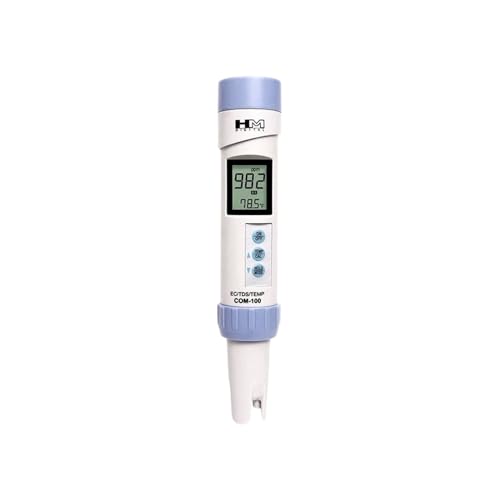
- Measures EC, TDS, and temperature
- Four scales plus three conversion factors
- IP67 housing with hold and auto-off
Best For: Multi-scale EC and TDS comparisons
Best Value Pocket Tester
Apera Instruments EC20 Conductivity Tester

- 0–20 mS/cm range with ±1% F.S. accuracy
- Auto calibration and temperature compensation
- Includes solutions, batteries, lanyard, and case
Best For: Portable routine conductivity testing
Best Multi-Parameter Meter
Extech EC500 Waterproof ExStik II

- Measures conductivity, TDS, salinity, pH, and temperature
- Offers nine units of measure
- Stores 25 labeled readings
Best For: Multi-parameter water-quality checks
Best for Fast TDS Checks
HM Digital COM-80 EC/TDS Hydro Tester

- Measures EC and TDS on four scales
- 1 ppm/µS resolution with 0.5-second response
- ATC, data hold, auto-off, and low-battery alert
Best For: Quick nutrient and dissolved-solids testing
Best Pocket Pen for Everyday Testing
Extech EC150 Conductivity/TDS Pen

- Measures conductivity, TDS, and temperature
- IP65 waterproof housing with data hold
- Adjustable conductivity-to-TDS ratio
Best For: Portable routine water, pool, and hydroponic checks
Best Feature-Rich Pocket Tester
Apera EC60 Waterproof Conductivity Tester

- Switches among EC, TDS, salinity, and temperature
- IP67 floatable housing with replaceable probe
- Includes calibration solutions and carrying case
Best For: Frequent testers who value easy calibration and serviceability
Best for Wide-Range Measurements
HORIBA LAQUAtwin EC-33 Conductivity Meter

- Measures conductivity up to 200 mS/cm
- Tests samples as small as 0.12 ml
- IP67 waterproof with replaceable sensor
Best For: Micro-sample testing and broad conductivity ranges
Best Multi-Parameter Pick – Apera AI316 PC60 5-in-1 Tester
For shoppers comparing waterproof conductivity meters, the Apera AI316 PC60 stands out as a versatile pocket tester that measures EC alongside pH, TDS, salinity, and temperature. Its replaceable probe, backlit display, and included calibration supplies make it well suited to routine water testing.
Best For: Users who want one compact meter for conductivity and several related water-quality measurements.
Pros:
- Measures pH, EC, TDS, salinity, and temperature.
- Replaceable multi-parameter probe simplifies future maintenance.
- Large backlit LCD shows temperature alongside the selected reading.
- Includes calibration solutions, storage solution, batteries, and a carrying case.
Cons:
- Its broad feature set may be more than needed for conductivity-only testing.
- The electrode has a shorter six-month warranty than the instrument.
The PC60 is a strong all-in-one choice when portability and measurement flexibility matter. Its complete kit and reading-stability indicators also make it approachable for regular testing.
Best for Hydroponics – Bluelab Truncheon Digital Nutrient Meter
Among waterproof conductivity meters, the Bluelab Truncheon is purpose-built for checking nutrient strength in hydroponic solutions. It reads EC, CF, and multiple ppm scales while mixing, with automatic temperature compensation for more consistent monitoring.
Best For: Hydroponic growers monitoring nutrient solution in reservoirs, tanks, and growing tents.
Pros:
- Measures EC, CF, and both 500- and 700-scale ppm values.
- Fully waterproof and factory calibrated, with no calibration required.
- Automatic temperature compensation helps maintain consistent readings.
- Five-year limited warranty with proof of purchase.
Cons:
- It focuses on nutrient conductivity rather than broader parameters such as pH.
- The probe care kit is sold separately.
The Truncheon is a specialized, low-fuss option for growers who need quick nutrient checks. Its button-free design and waterproof construction are practical for repeated reservoir measurements.
Best Compact EC Tester – Milwaukee C65 Waterproof Conductivity Meter
Milwaukee Instruments Waterproof Conductivity EC/Temp Tester with Replaceable Electrode - C65
Check Price On AmazonThe Milwaukee C65 is a straightforward option for shoppers seeking waterproof conductivity meters dedicated to EC measurement. It covers readings from 0 to 1999 µS/cm, adds automatic temperature compensation, and uses a replaceable electrode.
Best For: Users who want a simple EC and temperature tester with a replaceable electrode.
Pros:
- Measures conductivity from 0 to 1999 µS/cm.
- Automatic temperature compensation is built in.
- Replaceable electrode can extend the meter’s useful life.
- IP65-rated waterproof housing.
Cons:
- It provides EC and temperature testing rather than a broader set of water-quality functions.
- The supplied range is narrower than meters offering multiple conductivity scales.
The C65 makes sense when dedicated EC testing is the priority. Its replaceable electrode and waterproof design add practical durability without introducing unnecessary extra functions.
Best Scale Flexibility – HM Digital COM-100 EC/TDS Meter
The HM Digital COM-100 is one of the more flexible waterproof conductivity meters for users who need EC, TDS, and temperature readings across several scales. It offers S, mS, ppm, and ppt modes, plus selectable nonlinear EC-to-TDS conversion factors.
Best For: Users comparing conductivity and TDS results across different measurement scales.
Pros:
- Measures EC, TDS, and temperature.
- Supports S, mS, ppm, and ppt scales.
- Offers KCl, 442, and NaCl EC-to-TDS conversion factors.
- IP67 waterproof housing with hold, auto-off, and low-battery functions.
Cons:
- It does not measure pH or salinity as separate parameters.
- Its plastic housing may feel less substantial than a heavier-duty instrument.
- Only one AA battery is required, so battery replacement remains part of routine upkeep.
The COM-100 is a capable choice when scale selection and conversion flexibility matter. Its readable LCD and simultaneous temperature display make it convenient for quick field or indoor checks.
Best Value Pocket Tester – Apera Instruments EC20 Conductivity Tester
The Apera EC20 is a practical choice among waterproof conductivity meters for users who want a compact tester with automatic calibration, temperature compensation, and a broad 0 to 20 mS/cm measurement range. Its clear dual-display screen shows temperature alongside readings, while the included solutions and carrying case make it ready to use.
Best For: Routine conductivity testing where portability, included accessories, and simple calibration are priorities.
Pros:
- BPB probe supports consistent readings across a wide conductivity range.
- Auto calibration with buffer recognition and automatic temperature compensation.
- Large LCD displays temperature and readings, with stable-reading and calibration reminders.
- Complete kit includes calibration solutions, batteries, lanyard, and carrying case.
Cons:
- Temperature range is limited to 0–50°C.
- Designed for conductivity testing rather than a multi-parameter water analysis.
With its long stated battery life, waterproof construction, and ready-to-use kit, the EC20 is a well-rounded pocket option for everyday conductivity checks.
Best Multi-Parameter Meter – Extech EC500 Waterproof ExStik II
The Extech EC500 stands out among waterproof conductivity meters because it combines conductivity testing with pH, TDS, salinity, and temperature measurements. Its auto-ranging conductivity cell, nine measurement units, trend bargraph, and labeled memory make it useful when one handheld meter needs to cover several water-quality tasks.
Best For: Users who need conductivity readings alongside pH, TDS, salinity, and temperature measurements.
Pros:
- Measures five parameters with one electrode.
- Supports nine units, including pH, conductivity, TDS, salinity, and temperature formats.
- Analog bargraph shows trends at a glance.
- Stores up to 25 labeled readings for later reference.
Cons:
- Its broader feature set may be unnecessary for conductivity-only testing.
- The supplied notes do not specify conductivity accuracy or measurement range.
If versatility matters more than a dedicated conductivity-only design, the waterproof EC500 provides a convenient way to consolidate several common water measurements.
Best for Fast TDS Checks – HM Digital COM-80 EC/TDS Hydro Tester
The HM Digital COM-80 is a straightforward option among waterproof conductivity meters for quick EC and TDS checks. It offers four measurement scales, automatic temperature compensation, a 1 µS/ppm resolution, and a stated 0.5-second response time, making it suited to fast nutrient and dissolved-solids testing.
Best For: Rapid EC and TDS testing, especially for nutrient-related checks that benefit from a simple handheld format.
Pros:
- Measures both electrical conductivity and total dissolved solids.
- Provides EC in µS and mS, plus TDS in ppm and ppt.
- Automatic temperature compensation supports readings across changing conditions.
- Includes auto-off, data-hold, and low-battery indicator functions.
Cons:
- Water-resistant construction is specified rather than fully waterproof.
- It does not measure pH, salinity, or temperature as separate parameters.
- Accuracy is listed as ±2% of the readout.
The COM-80 keeps operation simple and quick, making it a practical fit when the main goal is checking conductivity or TDS without extra measurement modes.
Best Pocket Pen for Everyday Testing – Extech EC150 Conductivity/TDS Pen
If you want a compact option among waterproof conductivity meters, the Extech EC150 combines conductivity, TDS, and temperature readings in a pocket-sized pen. Its IP65 housing and adjustable conductivity-to-TDS ratio make it practical for routine hydroponics, pool, and water checks.
Best For: Buyers who want a straightforward, compact meter for general conductivity, TDS, and temperature testing.
Pros:
- Measures conductivity, TDS, and temperature with automatic temperature compensation.
- Offers ±1% full-scale accuracy for conductivity and TDS, with 1 µS/cm and 1 ppm resolution.
- IP65 waterproof housing includes data hold, auto power-off, and a low-battery indicator.
- Adjustable conductivity-to-TDS ratio from 0.4 to 1.0.
Cons:
- Its IP65 rating is lower than the IP67 protection offered by some competing models.
- Temperature measurement is limited to 0–50 °C.
- Uses LR44 button batteries rather than standard AAA cells.
The EC150 is a sensible value-focused choice when portability and basic multi-parameter testing matter more than advanced calibration features. Its clear 2000-count display and simple pen design suit quick checks, while the supplied sensor cap helps with storage.
Best Feature-Rich Pocket Tester – Apera EC60 Waterproof Conductivity Tester
The Apera EC60 is one of the more versatile waterproof conductivity meters for users who want conductivity, TDS, salinity, and temperature in one tester. Its replaceable probe, automatic calibration, and IP67 floatable housing add convenience for recurring field or water-quality work.
Best For: Users who want easier calibration, multiple measurement modes, and a replaceable probe in a durable pocket tester.
Pros:
- Measures conductivity, TDS, salinity, and temperature with one-tap mode switching.
- Provides automatic buffer recognition, one- to three-point calibration, and automatic temperature compensation from 0–50 °C.
- IP67 waterproof and dustproof housing is floatable, with a replaceable sensor.
- Includes calibration solutions, bottles, batteries, lanyard, and carrying case.
Cons:
- The complete kit is more involved than a basic conductivity-only pen.
- Backlighting can affect the stated battery-life figure, which is specified without backlight use.
- The electrode has a shorter six-month warranty than the instrument’s two-year warranty.
Choose the EC60 if calibration convenience and long-term serviceability are priorities. The backlit dual display, stable-reading indicator, and included accessories make it particularly well equipped for users who test regularly.
Best for Wide-Range Measurements – HORIBA LAQUAtwin EC-33 Conductivity Meter
HORIBA LAQUAtwin EC-33 Waterproof Pocket Conductivity/TDS/Temperature Meter - Range 0-199.9 mS/cm
Check Price On AmazonThe HORIBA LAQUAtwin EC-33 stands out among waterproof conductivity meters for its broad conductivity range and flexible sampling design. It can test tiny 0.12 ml samples or be immersed in a larger volume, making it useful when sample size varies.
Best For: Users who need wide-range conductivity measurement and the ability to test either micro-samples or larger containers.
Pros:
- Measures conductivity from 0 to 200 mS/cm and TDS up to 9900 ppm.
- Accepts samples as small as 0.12 ml or can be immersed in a larger sample.
- Supports up to three calibration points with automatic solution recognition and temperature compensation.
- IP67 waterproof design includes a replaceable sensor and backlit LCD.
Cons:
- Its stated precision is ±2% of the measured value, lower than the ±1% specification of the other listed meters.
- The sensor has a six-month warranty, compared with two years for the meter.
- The kit requires CR2 batteries.
The EC-33 is the strongest fit when measurement range and sample flexibility outweigh the need for the tightest stated accuracy. Its included calibration solutions, pipette, storage case, and replaceable sensor make it ready for varied testing workflows.
How We Picked the Best Waterproof Conductivity Meters
We focused on meters with water-resistant or waterproof construction, clear digital displays, useful conductivity or EC ranges, and practical features such as temperature measurement, TDS or salinity conversion, automatic temperature compensation, calibration support, and replaceable sensors. We also considered the needs of different users, from occasional home testing to frequent professional measurements.
Because specifications vary by model, check the manufacturer’s stated protection rating, accuracy, calibration method, and operating range before purchasing. Waterproof construction helps protect the instrument, but it does not eliminate the need for proper rinsing, storage, and routine maintenance.
Quick Comparison
| Best For | What to Look For |
|---|---|
| Hydroponics and nutrient solutions | EC range, temperature compensation, and repeatable calibration |
| Aquariums and water-quality checks | Simple operation, TDS or salinity readings, and compact size |
| Professional field testing | Higher durability, broad range, replaceable electrodes, and dependable calibration |
| Multiparameter testing | pH, EC, TDS, salinity, and temperature in one instrument |
Key Buying Factors for Waterproof Conductivity Meters
Measurement Range and Resolution
Choose a range that covers the solutions you test most often. Low-range meters suit drinking water and light nutrient solutions, while broader-range instruments are more versatile for concentrated solutions or commercial work. Resolution determines how finely changes appear on the display, but a smaller increment does not automatically mean greater accuracy.
Accuracy, Calibration, and Temperature Compensation
Look for clearly stated accuracy and a straightforward calibration process. Automatic temperature compensation is especially useful because conductivity changes with temperature. For dependable results, calibrate with the recommended standard, rinse the sensor between samples, and allow readings to stabilize.
Sensor Design and Maintenance
A replaceable electrode can extend the useful life of a frequently used meter. Consider whether the sensor is easy to clean, whether replacement parts are available, and how the probe should be stored. Never assume waterproofing applies equally to every component or to prolonged submersion.
Readouts and Extra Measurements
EC is the primary measurement, but TDS, salinity, pH, and temperature can make a meter more useful. A combination instrument may save time, while a dedicated conductivity tester can be simpler and more focused. Confirm how the device converts EC to TDS if you need results comparable with another meter.
Who Should Buy Which Waterproof Conductivity Meters?
Home growers and hobbyists should prioritize simple calibration, a readable display, and a suitable EC range rather than paying for unnecessary features. Users managing nutrient solutions may benefit from temperature compensation and a dedicated EC/TDS tester. Aquarium keepers and general water testers may prefer a compact model that adds TDS, salinity, or temperature readings.
For labs, service technicians, and frequent field users, prioritize accuracy, a broad range, rugged waterproof construction, replaceable sensors, and readily available calibration solutions. If you regularly need several water parameters, a multiparameter model can reduce the number of tools you carry. Whichever meter you choose, verify its readings against a known standard and follow the manufacturer’s cleaning and storage instructions.