USB switch boxes make it easier to share one keyboard, mouse, printer, scanner, or other USB peripheral between multiple computers without constantly unplugging cables.
This roundup compares 10 options across USB 2.0, USB 3.x, USB-C, multi-device switching, remote controls, and HDMI KVM functionality so you can choose the right setup for your desk.
Best 10 USB Switch Boxes Picks for 2026
Best High-Speed Multi-Device Pick
UGREEN USB 3.0 2-in-4-out Switch
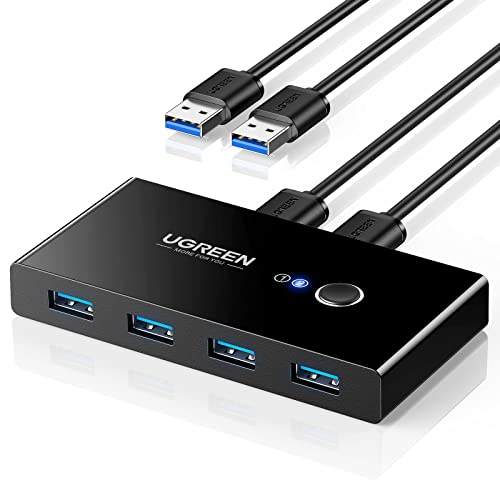
- Shares four USB devices between two computers
- Up to 5Gbps USB 3.0 transfers
- Includes two USB 3.0 cables
Best For: Two-computer workstations with multiple peripherals
Best Compact Bi-Directional Pick

- Works as 2-in-1-out or 1-in-2-out
- Supports up to 5Gbps transfers
- Compact aluminum design with LED
Best For: Simple one-peripheral sharing or source switching
Best Budget USB 2.0 Pick

- Shares four USB peripherals between two computers
- Includes two USB A-to-A cables
- One-button switching with LED indicator
Best For: Everyday office peripherals and basic two-computer setups
Best High-Capacity Mixed-Port Pick
UGREEN 2-in-7-out USB 3.0 Switch

- Shares up to seven USB-A and USB-C devices
- Includes USB-C-to-A adapter and power adapter
- Up to 5Gbps data transfer on USB 3.0 ports
Best For: Large mixed-port workstations with many peripherals
Best USB 3.0 Value

- Shares four USB devices between two computers
- USB 3.0 speeds up to 5Gbps
- Supports Windows, macOS, Linux, and Chrome OS
Best For: Basic two-computer peripheral sharing
Best High-Speed USB-C Option

- Shares seven USB-A and USB-C devices
- USB 3.2 Gen 2 speeds up to 10Gbps
- Includes cables and a power adapter
Best For: Mixed-port, high-speed peripheral setups
Best USB-and-Display Switching

- Controls two computers with one monitor and USB controls
- Supports 4K video at 60Hz
- Includes two HDMI and two USB cables
Best For: Two-computer desks needing video and USB switching
Flexible Dual-Computer Hub

- Shares four USB devices between two computers
- Provides one USB-C and three USB-A ports
- Offers 5Gbps transfers with remote and button switching
Best For: Two-computer peripheral-sharing setups
Warranty-Backed Switcher

- Shares four USB devices between two computers
- Adds remote control and LED status indicators
- Includes USB-C power input and an 18-month warranty
Best For: Two-computer desks prioritizing remote control
High-Speed Four-Computer Selector

- Shares four USB devices across four computers
- Delivers up to 10Gbps transfer speeds
- Combines USB-A and USB-C ports with remote switching
Best For: Four-computer workspaces needing faster USB transfers
Best High-Speed Multi-Device Pick – UGREEN USB 3.0 2-in-4-out Switch
For shoppers comparing USB switch boxes, this UGREEN model is a practical choice when two computers need to share several peripherals. It provides four USB 3.0 ports, one-button computer switching, and transfer speeds up to 5Gbps.
Best For: Workstations that share keyboards, mice, printers, scanners, storage drives, or other USB devices between two computers.
Pros:
- Lets two computers share four USB devices.
- Supports USB 3.0 transfer speeds up to 5Gbps and is backward compatible with USB 2.0.
- Includes two USB 3.0 cables and offers plug-and-play compatibility with Windows, macOS, Chrome OS, and Linux.
- Extra USB-C power input can improve stability with multiple or higher-power devices.
Cons:
- Does not support monitors or video transmission, so it is not a KVM switch.
- Power adapter is not included.
- USB-C-only computers may require a USB-C-to-A adapter.
This is a strong all-around USB switch box for users who prioritize multiple ports and faster file transfers. Add external power when connecting several demanding peripherals at once.
Best Compact Bi-Directional Pick – Aluminum USB 3.0 Switch
This compact aluminum option stands out among USB switch boxes because it works in either direction. Use it to let two computers share one USB peripheral, or to switch between two USB devices connected to one computer.
Best For: Simple setups that need flexible one-device sharing or source selection without a separate power supply.
Pros:
- Supports both 2-in-1-out and 1-in-2-out configurations.
- Offers USB 3.0 speeds up to 5Gbps and supports USB 2.0 and USB 1.1 devices.
- Compact aluminum housing with a blue LED status indicator.
- Plug-and-play operation without an extra power supply or driver installation.
Cons:
- USB 3.0 cables are not included.
- Only one shared USB peripheral can be connected in the two-computer configuration.
- Its listed compatibility is focused on computers and laptops rather than video switching.
Choose this model when you want a small, reversible USB switch box for a straightforward setup. Its lack of included cables should be factored into the purchase.
Best Budget USB 2.0 Pick – UGREEN 2-in-4-out Switch Box
If you need affordable USB switch boxes for everyday peripherals, this UGREEN model connects two computers to four USB 2.0 devices. Its one-button selector and LED indicator simplify switching without repeatedly moving cables.
Best For: Office setups sharing keyboards, mice, printers, scanners, card readers, or flash drives between two computers.
Pros:
- Allows two computers to share four USB 2.0 peripherals.
- Includes two USB A-to-A cables.
- Provides driver-free compatibility with Windows, macOS, Linux, and Chrome OS.
- Optional micro-USB power input can help support devices such as HDDs, SSDs, and digital cameras.
Cons:
- USB 2.0 is slower than USB 3.0 for large file transfers.
- It does not support monitors or video transmission.
- Power cable and charger are not included.
This is a sensible choice for peripheral sharing where maximum transfer speed is not essential. It offers broad compatibility and four-device capacity at the cost of USB 2.0 performance.
Best High-Capacity Mixed-Port Pick – UGREEN 2-in-7-out USB 3.0 Switch
For buyers who need USB switch boxes with broad port coverage, this UGREEN model lets two computers share up to seven USB devices. Its combination of four USB-A and three USB-C ports suits mixed-device workspaces, while an included adapter supports USB-A computer connections.
Best For: Large work or home workstations with a mix of USB-A and USB-C keyboards, mice, printers, and storage devices.
Pros:
- Supports up to seven shared devices through four USB-A and three USB-C ports.
- Four USB 3.0 ports provide transfer speeds up to 5Gbps and support USB 2.0 devices.
- Includes a USB-C-to-USB-A adapter and a power adapter.
- Offers onboard and external-controller switching with LED status indication.
Cons:
- It is not a KVM switch and does not transmit video or provide HDMI output.
- USB ports are intended primarily for data transfer and are not recommended for charging.
- The large port count may be unnecessary for simpler setups.
This is the most flexible option in the roundup for mixed USB-A and USB-C environments. It is especially appealing when seven shared devices and included power support can replace extra hubs or repeated cable changes.
Best USB 3.0 Value – BENFEI 2-Computer USB Switch
If you need straightforward usb switch boxes for sharing peripherals between a work computer and a personal PC, the BENFEI USB 3.0 Switch is a practical option. It connects two computers to four shared USB devices and switches between them with a single button.
Best For: Users sharing a keyboard, mouse, printer, scanner, or other USB peripherals between two computers.
Pros:
- Shares up to four USB devices between two computers.
- USB 3.0 supports data speeds up to 5Gbps and remains backward compatible with USB 2.0.
- Driver-free compatibility includes Windows, macOS, Linux, and Chrome OS.
- Includes an extra USB-C power input for higher-power devices.
Cons:
- Requires BENFEI USB-A-to-USB-A cables for connection.
- The power adapter for the extra USB-C input is not included.
- It switches USB peripherals only and does not provide video output.
With four USB 3.0 outputs, button control, and broad operating-system compatibility, this is a sensible choice for basic peripheral sharing. Plan for separate power if you will connect devices such as hard drives, cameras, or headphones that draw more power.
Best High-Speed USB-C Option – UGREEN 7-Port USB Switch
Among usb switch boxes, the UGREEN 2-in-7-out model stands out when you need more ports and faster transfers. It lets two computers share seven peripherals, combining USB-A and USB-C connections with included cables and a power adapter.
Best For: Mixed USB-A and USB-C workspaces that need to share several data peripherals between two computers.
Pros:
- Supports up to seven shared devices: four USB-A and three USB-C.
- USB 3.2 Gen 2 ports offer transfer speeds up to 10Gbps.
- Includes a USB-C-to-USB-A cable for mixed computer setups.
- Included power adapter helps support high-power devices such as external hard drives and printers.
Cons:
- It is not a KVM switch and does not support video output.
- Audio device connections are not recommended according to the supplied notes.
- Compatibility details list Windows 10 and macOS 10.15 or later as minimum versions.
The seven-port layout and 10Gbps performance make this a strong fit for a busy peripheral setup, especially when both USB-A and USB-C devices are involved. Its included power adapter is also useful for maintaining stable performance with higher-draw equipment.
Best USB-and-Display Switching – Jancane 4K HDMI KVM
If your setup requires both peripheral and monitor switching, this Jancane unit expands beyond typical usb switch boxes with HDMI KVM functionality. It controls two computers through one keyboard, mouse, and monitor, while supporting 4K video at 60Hz.
Best For: Office, gaming, or home-theater setups that need to switch two HDMI-equipped computers with one control set.
Pros:
- Controls two computers using one monitor, keyboard, and mouse.
- Supports UHD 4K at 60Hz, plus 4K at 30Hz, 3D, and 1080p resolutions.
- Includes two USB cables and two HDMI cables.
- Driver-free operation works with Windows, macOS, Linux, and Chrome OS.
Cons:
- It provides two computer connections rather than a larger multi-computer setup.
- Its USB connections are USB 2.0, so it is not intended for high-speed file transfers.
- It requires HDMI-compatible source devices and displays for video switching.
This is the most suitable choice here when video switching matters as much as USB peripheral sharing. The included cables, one-button control, and 4K@60Hz support make it convenient for a two-computer desk or entertainment setup.
Flexible Dual-Computer Hub – UGREEN 4-Port USB Switch
If you need usb switch boxes for sharing several peripherals between a work computer and a personal computer, the UGREEN CM662 offers four USB 3.0 device ports, including one USB-C port and three USB-A ports. It supports up to 5Gbps data transfer and can be controlled from the switch or the included wired controller.
Best For: Two-computer setups that share keyboards, mice, printers, scanners, headphones, or USB cameras without switching cables manually.
Pros:
- Lets two computers share four USB peripherals.
- Includes one USB-C and three USB-A device ports.
- Supports up to 5Gbps transfer and plug-and-play use across Windows, macOS, Chrome OS, and Linux.
- Optional USB-C power input helps stabilize higher-power devices.
Cons:
- It is not a KVM and cannot connect or switch a monitor.
- The USB-C port does not support video output.
- Extra power may be needed when using multiple or high-power devices.
The UGREEN is a practical choice when your main goal is peripheral sharing rather than display switching. Its two control methods and mixed USB-C/USB-A layout add flexibility, though users needing monitor support should choose a true KVM instead.
Warranty-Backed Switcher – BENFEI 4-Port USB Switch
The BENFEI is one of the more versatile usb switch boxes for a two-computer desk, combining three USB 3.0 ports with one USB-C port. It switches connected peripherals by button or remote control, supports up to 5Gbps transfers, and includes an 18-month warranty.
Best For: Users who want convenient remote switching for keyboards, mice, storage devices, printers, scanners, cameras, or headphones across two computers.
Pros:
- Allows two computers to share three USB 3.0 and one USB-C device.
- Offers both button and remote-control switching with LED status indicators.
- Supports up to 5Gbps data transfer and major Windows, Mac, Linux, and Chrome OS systems.
- Includes optional USB-C power input and an 18-month warranty.
Cons:
- Requires the supplied or compatible USB-A-to-USB-A cables for operation.
- High-power devices may require separate power input.
- The supplied notes do not indicate monitor or video switching support.
BENFEI stands out for its status indicators, remote control, and warranty coverage. It is a sensible peripheral switch for a two-computer workstation, provided your setup does not require display switching and you use the specified connection cables.
High-Speed Four-Computer Selector – USB 3.2 10Gbps Switch
For buyers comparing usb switch boxes by speed and computer capacity, this USB 3.2 selector supports four computers sharing four peripherals. Its three USB-A and one USB-C ports are rated for up to 10Gbps, and switching is available from the device button or remote control.
Best For: Multi-computer workspaces that need to share keyboards, mice, storage, printers, scanners, webcams, card readers, or gamepads.
Pros:
- Supports four computers sharing four USB peripherals.
- Provides three USB-A 3.2 ports and one USB-C 3.2 port.
- Offers up to 10Gbps transfer speeds.
- Includes a USB-C-to-USB-A adapter, remote control, and separate power input for demanding devices.
Cons:
- It is not a KVM and does not support monitors.
- The remote control does not include batteries.
- High-power devices require an independent power source for stable operation.
This selector is the strongest fit when four computers and faster USB transfers matter more than display support. Its mixed port selection and adapter improve compatibility, while the power requirement should be planned for when connecting hard drives or other demanding peripherals.
How We Picked the Best USB Switch Boxes
We compared these USB Switch Boxes by looking at the number of connected computers and shared devices, USB transfer speeds, port types, switching methods, compatibility, and overall usefulness in common home-office and workstation setups. We also separated basic peripheral switches from models that include video switching, since a USB selector alone does not usually control a monitor.
Priority went to practical layouts, clearly stated USB standards, support for modern USB-C devices where available, and designs that simplify switching between computers. A reliable power arrangement also matters, particularly when several bus-powered peripherals are connected at once.
Quick Comparison
| Best For | Look For | Typical Advantage |
|---|---|---|
| Basic keyboard and mouse sharing | 2-in/4-out USB switch | Simple, affordable switching |
| Fast storage and peripherals | USB 3.0 or USB 3.2, 5–10Gbps | Faster data transfers |
| Modern laptops and accessories | USB-C and USB-A ports | Broader device compatibility |
| Several computers | 4-input selector | More systems from one switch |
| One monitor plus peripherals | HDMI KVM switch | Video and USB switching together |
Key Buying Factors for USB Switch Boxes
Port Count and Layout
Check both sides of the connection: how many computers the switch supports and how many USB devices it can share. Four shared ports suit a keyboard, mouse, printer, and scanner, while seven-port models are better for fuller workstations. Confirm whether the ports are USB-A, USB-C, or a combination.
USB Speed
USB 2.0 is generally sufficient for keyboards, mice, and many printers. Choose USB 3.0 or USB 3.2 for external drives, webcams, high-speed card readers, or other devices that move substantial amounts of data. The connected computers, cables, and peripherals must also support the advertised speed.
Switching and Power
Physical buttons are convenient for a nearby desk, while wired remote controls help when the switch is tucked behind a monitor. Some demanding peripherals may need supplemental power; check the product’s power requirements rather than assuming every device will run from the computer’s USB port.
Video Requirements
A standard USB switch shares peripherals but does not switch your display. If you want one monitor controlled alongside the keyboard and mouse, choose an HDMI KVM model and verify its resolution, refresh-rate, and cable requirements.
Who Should Buy Which USB Switch Boxes?
Choose a compact USB 2.0 switch if you mainly share input devices and want the simplest low-cost setup. A USB 3.0 model is the better general-purpose choice for mixed office peripherals and occasional storage use. Pick a USB-C-equipped switch for newer laptops and accessories, especially if your desk uses both USB-A and USB-C devices.
For larger workstations, a seven-port model provides more flexibility, while a four-computer switch makes sense when you regularly move between several systems. Choose the HDMI KVM option if switching the monitor is as important as switching USB devices. Before ordering, confirm the number of computers, connector types, required data speed, and whether your peripherals need external power.