Printing shipping labels at home or in a small business is faster and simpler with a dedicated thermal printer. These models create crisp 4×6 labels without ink cartridges, helping frequent shippers reduce supply costs and keep orders moving.
We compared 10 Bluetooth-compatible options with attention to setup, label handling, device compatibility, footprint, and everyday usability. The right choice depends on your shipping volume, preferred devices, and workspace.
Best 10 Thermal Printers for Shipping Picks for 2026
Best for Support
Phomemo 241BT Bluetooth Label Printer

- Bluetooth and USB printing for phones and computers
- Supports 1- to 4.6-inch labels and major shipping platforms
- Technical help includes chat, phone, email, and remote desktop
Best For: Users who want compatibility and extensive setup assistance
Best Space-Saving Design
Omezizy D450BT Shipping Label Printer

- Built-in bin holds up to 250 4x6 labels
- Bluetooth and USB support for major devices and systems
- 203 DPI output at up to 72 labels per minute
Best For: Busy sellers who want integrated label storage
Best for Efficient Workflows
NULLTONEX Bluetooth 4x6 Label Printer

- Ink-free 203 DPI printing at up to 72 labels per minute
- Bluetooth and USB connectivity for mobile and desktop use
- Offline app with 1,800+ templates and 300 fonts
Best For: Small businesses seeking fast, low-maintenance label production
Best Wireless Value
Nelko Bluetooth 4x6 Label Printer

- Bluetooth and USB connectivity
- Prints up to 72 4x6 labels per minute
- Supports labels from 1.54 to 4.1 inches wide
Best For: Home offices and small businesses needing flexible label printing
Best for Quiet Workspaces
MUNBYN Bluetooth 4x6 Label Printer

- Automatic calibration helps reduce misalignment
- Rated for up to 970,000 labels
- Runs at approximately 60 dB
Best For: Quiet home offices and high-volume small-business shipping
Best Portable Design
TATTMUSE Bluetooth Shipping Label Printer

- Lightweight 0.97-pound design
- Supports labels from 1 to 4.6 inches wide
- Includes automatic calibration and anti-jam adapters
Best For: Mobile sellers and compact home shipping stations
Simple White Choice
Rongta RP425 Bluetooth Label Printer

- Bluetooth and USB connectivity
- 4x6-inch, 203 dpi thermal printing
- Compatible with major desktop and mobile platforms
Best For: Small businesses and home offices needing straightforward shipping labels
Fast Flexible Pick
Rongta RP425 Wireless Label Printer
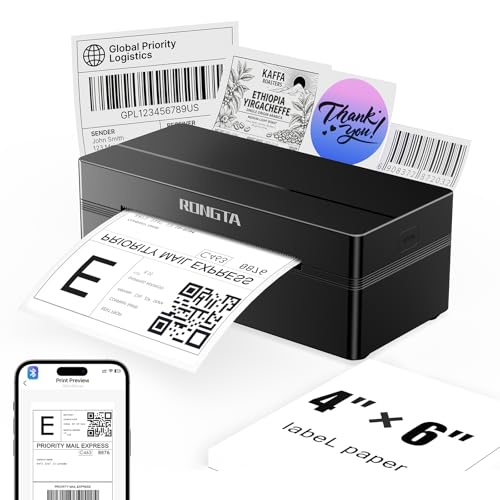
- Up to 150 mm/s printing speed
- Automatic label identification and feeding
- Supports labels from 0.98 to 4.37 inches wide
Best For: Frequent shippers using varied label sizes across desktop and mobile devices
Best App-Friendly Pick – KNAON Bluetooth 4×6 Label Printer
For shoppers comparing thermal printers for shipping, the KNAON stands out for its broad device support and flexible label customization. It prints through Bluetooth using the FlashLabel Pro app or through USB, supports labels from 1.5 to 4.2 inches wide, and works with common marketplaces and carriers.
Best For: Small businesses and home sellers that want mobile printing plus a large library of label templates.
Pros:
- Supports Bluetooth through the FlashLabel Pro app and USB connections to Windows, macOS, ChromeOS, and Linux.
- Includes more than 3,000 templates, 5,000 icons, and 100 fonts for customized labels.
- Prints at up to 180 mm/s and supports major services such as Amazon, Etsy, Shopify, USPS, and UPS.
- Includes 10 test shipping-label sheets and a built-in USB drive with drivers and tutorials.
Cons:
- Mobile devices must use the FlashLabel Pro app for Bluetooth printing.
- Marketplace labels need to be saved as PDFs and imported into the app.
The KNAON is a versatile choice when app-based design tools matter as much as basic 4×6 shipping-label printing. Its setup is especially appealing for sellers using phones, tablets, or multiple computer platforms.
Best for Support – Phomemo 241BT Bluetooth Label Printer
The Phomemo 241BT is a practical option among thermal printers for shipping, with Bluetooth and USB connectivity for phones, tablets, PCs, and Macs. It handles label widths from 1 to 4.6 inches and offers straightforward support for online marketplaces, carriers, barcodes, and QR codes.
Best For: Home users and small businesses that value broad compatibility and access to hands-on technical support.
Pros:
- Prints wirelessly from iOS and Android through the Labelife app.
- Supports USB printing on Windows, macOS, ChromeOS, and Linux.
- Prints up to 72 4×6 labels per minute at speeds up to 150 mm/s.
- Support includes live chat, phone, email, and remote desktop assistance.
Cons:
- Bluetooth printing requires the Labelife app on mobile devices.
- Printing is black and white only.
- PC users need to download the appropriate driver.
The Phomemo 241BT makes sense for buyers who want a flexible printer with a clearly documented setup process. Its support options can also reduce the frustration of troubleshooting a first shipping-label printer.
Best Space-Saving Design – Omezizy D450BT Shipping Label Printer
Among thermal printers for shipping, the Omezizy D450BT is designed to conserve desk space without giving up wireless connectivity. Its built-in bin holds up to 250 4×6 labels, while Bluetooth and USB connections support phones, computers, and major operating systems.
Best For: Small businesses that need an organized desktop setup and frequent 4×6 label printing.
Pros:
- Built-in compartment stores up to 250 internal-roll 4×6 labels.
- Supports Bluetooth and USB connections across iOS, Android, Windows, macOS, ChromeOS, and Linux.
- Prints at up to 72 labels per minute with 203 DPI clarity.
- Handles label widths from 1 to 4.6 inches and offers auto-alignment to help reduce paper waste.
Cons:
- The built-in holder is specified for internal rolls and rear-loaded folded paper, which may require planning for other media.
- Its compact design still occupies approximately 7.3 by 6.3 by 5.35 inches.
The D450BT is a strong fit when label storage and workspace organization are priorities. Its combination of a built-in paper bin, automatic alignment, and fast output makes it well suited to recurring shipping tasks.
Best for Efficient Workflows – NULLTONEX Bluetooth 4×6 Label Printer
The NULLTONEX combines direct thermal printing, dual connectivity, and an app with offline design tools, making it a capable choice among thermal printers for shipping. It supports standard 4×6 labels along with other sizes and includes 25 starter sheets for immediate use.
Best For: Small businesses that want fast black-and-white label production and app-based templates for recurring workflows.
Pros:
- Direct thermal printing eliminates the need for ink or toner.
- Produces 203 DPI output at up to 150 mm/s, or 72 labels per minute.
- Offers Bluetooth and USB connectivity, including a steadier wired workflow for computers.
- FlashLabel Pro includes more than 1,800 templates, 300 fonts, and offline storage for designs.
Cons:
- Prints in black and white only.
- Bluetooth printing requires the FlashLabel Pro app.
- Its supported label range is listed as approximately 1.57 to 4.3 inches wide, narrower than some competitors.
The NULLTONEX is a useful match for sellers who prioritize repeatable, low-maintenance printing. Its overheat protection, offline app features, and included starter labels add convenience for busy shipping stations.
Best Wireless Value – Nelko Bluetooth 4×6 Label Printer
The Nelko PL70E-BT is a practical choice among thermal printers for shipping if you want both Bluetooth and USB connectivity. It prints up to 72 4×6 labels per minute, supports common label sizes, and works with major marketplaces and carriers.
Best For: Home offices and small businesses that want flexible wireless or wired label printing.
Pros:
- Bluetooth printing through the NELKO app on iOS and Android, plus USB support for Windows, macOS, and Chrome OS.
- Fast 150 mm/s printing speed with 203 DPI output.
- Supports fanfold and roll labels from 1.54 to 4.1 inches wide.
- Compact design and no ink or toner requirements.
Cons:
- Mac computers support USB printing only, not direct Bluetooth printing.
- Mobile devices must print through the NELKO app rather than direct Bluetooth connection.
The Nelko stands out for connectivity and platform compatibility, making it a well-rounded option when your shipping setup includes both computers and mobile devices.
Best for Quiet Workspaces – MUNBYN Bluetooth 4×6 Label Printer
The MUNBYN RW403B is designed for buyers who want dependable thermal printers for shipping with automatic calibration and broad label support. It offers Bluetooth and USB connectivity, professional-grade monochrome output, and a claimed service life of up to 970,000 labels.
Best For: Small businesses and home offices that prioritize long-term durability, quiet operation, and accurate label alignment.
Pros:
- DAC technology automatically calibrates labels to help reduce misalignment.
- Supports direct thermal labels from 1.57 to 4.25 inches wide.
- Rated for up to 970,000 labels with a stated jam rate below 0.01%.
- Operates at approximately 60 dB and includes a two-year manufacturer warranty.
Cons:
- Prints monochrome labels only.
- Bluetooth status behavior on computers may be less intuitive because the indicator lights during data transfer.
Its alignment technology, extended rated lifespan, and relatively quiet operation make the MUNBYN a strong fit for recurring shipping workloads in shared or home workspaces.
Best Portable Design – TATTMUSE Bluetooth Shipping Label Printer
The TATTMUSE label printer is a compact option among thermal printers for shipping, combining Bluetooth setup through the Labelife app with USB support for Windows, macOS, and Chrome OS. Its automatic calibration, anti-jam adapters, and 203 DPI output are aimed at producing accurate, scannable labels.
Best For: Mobile entrepreneurs and small businesses that need a lightweight printer for shipping, inventory, and product labels.
Pros:
- Bluetooth printing through the Labelife app, with USB support for major desktop operating systems.
- Supports label widths from 1 to 4.6 inches, including common 4×6 shipping labels.
- Automatic calibration and anti-jam adapters help reduce alignment problems and wasted labels.
- Lightweight 0.97-pound design with templates, fonts, design elements, OCR, and voice input in the app.
Cons:
- Prints black-and-white labels only.
- Desktop users must download the printer driver from the official website.
The TATTMUSE is especially appealing when portability and app-based label creation matter as much as basic shipping performance.
Pink Wireless Pick – Rongta RP425 Shipping Label Printer
For shoppers comparing thermal printers for shipping, this pink Rongta RP425 is a compact option for home offices and small businesses. It prints monochrome labels without ink and supports Bluetooth printing from phones and tablets or USB printing from a computer.
Best For: Home users and small businesses wanting a pink, wireless 4×6 label printer.
Pros:
- Supports Bluetooth and USB connectivity across phones, tablets, laptops, and PCs.
- Uses inkless thermal printing for sharp monochrome labels.
- Supports 4×6-inch labels and multiple label sizes.
- Includes a one-year manufacturer warranty.
Cons:
- Prints in monochrome only.
- Wireless phone printing requires the RONGTA app.
- Computer printing requires downloading the driver.
This model is a practical choice if color and standalone copying are not priorities. Its Bluetooth and USB options make it flexible for shipping workflows, while the pink finish adds a distinctive look.
Simple White Choice – Rongta RP425 Bluetooth Label Printer
This white Rongta RP425 keeps the setup straightforward for shoppers seeking thermal printers for shipping. It handles 4×6-inch thermal labels, connects by Bluetooth or USB, and works with Windows, macOS, Android, and iOS devices.
Best For: Small businesses and home offices that want a basic white wireless shipping-label printer.
Pros:
- Works with smartphones, tablets, laptops, and PCs.
- Offers both Bluetooth and USB connectivity.
- Prints 4×6-inch labels at 203 x 203 dpi.
- Inkless thermal printing avoids traditional ink cartridges.
Cons:
- Monochrome printing does not support color labels.
- Requires the RONGTA app for phone Bluetooth printing.
- Computer users must install the driver.
The RP425 is best suited to routine shipping-label tasks rather than multifunction printing. Its broad device compatibility and two connection methods make it a convenient fit for a small packing station.
Fast Flexible Pick – Rongta RP425 Wireless Label Printer
Among thermal printers for shipping, this Rongta RP425 stands out for its stated speed and flexible label support. It connects to iOS and Android devices through the RONGTA app, supports Windows, macOS, and Chrome OS, and automatically identifies and feeds compatible labels.
Best For: Small businesses, offices, and mobile users handling varied label sizes and frequent shipping tasks.
Pros:
- Prints at speeds of up to 150 mm/s with 203 dpi resolution.
- Automatically detects, grabs, and feeds labels.
- Supports direct thermal labels from 0.98 to 4.37 inches wide.
- Works with Bluetooth and USB Type-C connections.
Cons:
- Mobile printing requires the RONGTA app.
- Prints monochrome labels only.
- Windows and Mac users need to install driver software.
This is the most flexible option of the three for users who print more than standard 4×6 shipping labels. Automatic feeding and broad operating-system support can simplify repeat jobs, while the compact design helps conserve workspace.
How We Picked the Best Thermal Printers for Shipping
We focused on the features that matter most when printing prepaid carrier labels: 4×6 format support, wireless connectivity, operating-system compatibility, print consistency, setup simplicity, and practical desk space requirements. We also considered included labels, built-in storage, app support, and whether a printer is better suited to occasional home use or higher-volume small-business workflows.
Because thermal printers use heat-sensitive labels rather than ink or toner, they can simplify routine shipping. However, compatibility and label quality still vary, so shoppers should confirm the printer works with their preferred marketplace, carrier, phone, tablet, or computer before buying.
Quick Comparison
- Best for compact workspaces: Choose a portable Bluetooth model with a small footprint and straightforward mobile setup.
- Best for frequent shipping: Prioritize reliable feed handling, consistent 4×6 output, broad compatibility, and easy access to replacement labels.
- Best for starting out: A package that includes sample labels can help verify sizing and workflow before purchasing supplies in bulk.
- Best for mixed devices: Look for support across Windows, mobile platforms, and commonly used shipping or ecommerce applications.
Key Buying Factors for Thermal Printers for Shipping
Connectivity and Compatibility
Bluetooth is convenient for phones and tablets, while USB can provide a dependable connection to a desktop or laptop. Check supported operating systems and confirm that your shipping platform can print to the selected model. Wireless convenience is useful only when pairing and app support are dependable.
Label Size and Supply Costs
Most shipping labels use the standard 4×6 format, but verify the printer’s supported dimensions and label type. Direct thermal labels eliminate ink costs, yet replacement-roll pricing can affect long-term value. Test sample labels for adhesive quality, darkness, and barcode clarity.
Speed, Resolution, and Daily Workload
Occasional sellers may not need the fastest printer. Higher-volume users should favor consistent output, smooth label feeding, and a design that can handle repeated print jobs without frequent adjustments.
Workspace and Maintenance
Measure the available desk space, including room for label rolls and cable routing. A built-in label bin can reduce clutter. Keep the print path clean and use compatible labels to limit jams and uneven printing.
Who Should Buy Which Thermal Printers for Shipping?
Casual online sellers should choose an affordable, easy-to-pair Bluetooth printer with included labels. Home-based businesses will benefit from a compact model that supports both mobile devices and computers. Busy small-business shippers should prioritize dependable feeding, broad software compatibility, and low-cost label availability over the smallest footprint. If several people print from different devices, select a model with flexible connectivity and simple setup for each user.