Long-exposure astrophotography puts every tracking error on display. The right guide camera can help your mount correct drift, periodic error, and small alignment issues before they soften the final image.
This roundup compares compact guide cameras, guide scopes, and bundled setups across sensor resolution, connection type, optical compatibility, and practical guiding flexibility.
Best 10 Telescope Guide Cameras for Long Exposures Picks for 2026
Best Guide Camera Bundle
SV165 Mini Guide Scope with SV905C

- Matched 30mm guide scope and 1.23MP color camera
- 80% peak QE and low read noise for guide stars
- ST4 and PHD2/NINA/SKY-X support
Best For: A ready-to-use autoguiding setup for long-exposure astrophotography
Best Wireless Telescope Camera

- 8MP sensor with 4K video support
- Built-in 2.8-inch IPS viewing screen
- Fits 23mm–60mm eyepieces and supports WiFi
Best For: Convenient lunar, planetary, and general telescope recording
Best Standalone Guide Scope
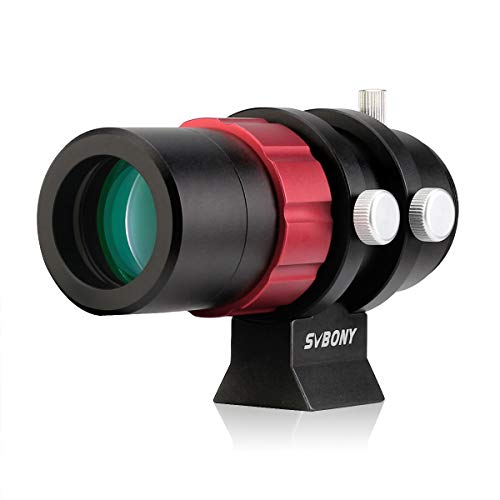
- 30mm achromatic optics with wide field of view
- 45mm back focus for manual focusing
- 1.25-inch and M42 camera interfaces
Best For: Adding a compact guide scope to an existing camera setup
Best High-Resolution Planetary Camera

- 7.05MP IMX415 color sensor
- Up to 30 fps at 2K in MJPG mode
- 1.25-inch USB camera for lunar and planetary imaging
Best For: High-resolution lunar and planetary video capture
Wide-Field Guide Scope
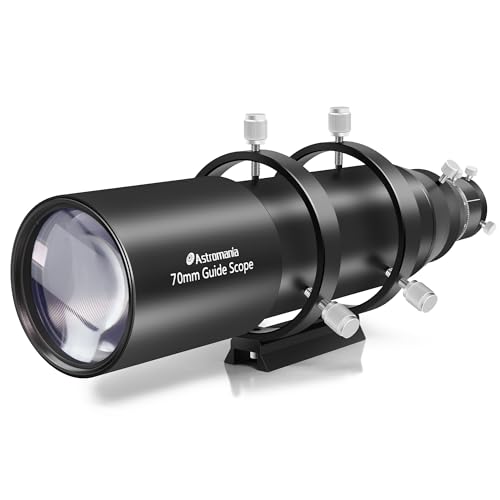
- 400mm focal length with bright, wide-field optics
- 1.25-inch helical focuser for manual precision
- Includes clamps and Synta-style mounting plate
Best For: Astrophotographers needing a substantial dual-purpose finder and guide scope
Entry-Level Guide Camera
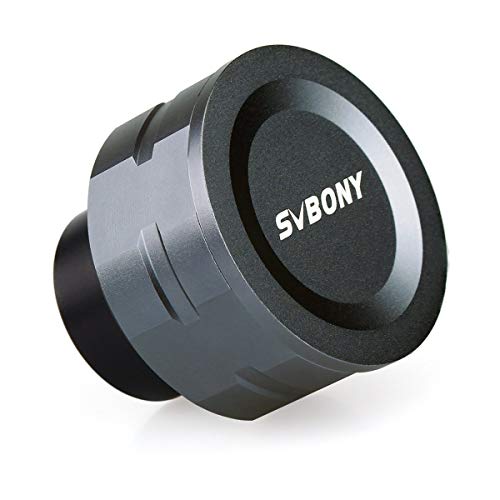
- 1/2.8-inch IMX307 color CMOS sensor
- Records 1920×1080 video at up to 30 fps
- 1.25-inch USB camera with filter thread
Best For: Beginners focused on lunar, planetary, and basic telescope imaging
Compact Wide-Field Guidescope

- 30mm F4 optics with fully multi-coated achromatic design
- Supports guide cameras through a T2 extension adapter
- Includes right-angle diagonal and Synta-style dovetail
Best For: Lightweight setups needing a compact finder and guide scope
Compact CMOS Autoguiding

- 1.23MP color CMOS sensor
- 80% peak QE and low read noise
- USB 2.0, ST4, and 1.25-inch body
Best For: Compact autoguiding and planetary imaging
Compact 40mm Guide Scope

- 40mm f/4 guide scope
- Recommended for focal lengths up to 700mm
- 1.25-inch and M42 camera interfaces
Best For: Compact guiding setups on shorter-focal-length telescopes
Wide-Aperture Guiding Bundle

- 60mm guide scope with helical focuser
- IMX662 sensor with 0.7e- readout noise
- Also suited to high-frame-rate planetary imaging
Best For: Larger-aperture guiding and planetary imaging
Best Guide Camera Bundle – SV165 Mini Guide Scope with SV905C
For shoppers comparing telescope guide cameras for long exposures, this SVBONY bundle combines a compact 30mm f/4 guide scope with the SV905C color guiding camera. Its sensitive 1.23MP sensor, small pixels, and stated 80% peak QE are aimed at helping an autoguiding setup track faint guide stars.
Best For: Beginners and intermediate astrophotographers who want a matched mini guide scope and camera package for autoguiding.
Pros:
- Includes both the SV165 guide scope and SV905C guiding camera.
- 1/3-inch, 1280×960 color sensor with 3.75-micron pixels.
- Supports ST4 guiding and software including PHD2, NINA, and SKY-X.
- Compact 1.25-inch camera design and 45mm guide-scope back focus.
Cons:
- Uses a USB 2.0 interface rather than a faster USB standard.
- The bundle is primarily designed for guiding and planetary imaging, not high-resolution deep-sky capture.
This is a practical all-in-one starting point for long-exposure tracking, especially if you do not already own a compatible guide scope. Its compact optics and software support make setup straightforward.
Best Wireless Telescope Camera – 4K WiFi Eyepiece Camera
This wireless eyepiece camera is a flexible observing and recording accessory, but buyers seeking telescope guide cameras for long exposures should note that its feature set centers on manual-focus imaging, video, and remote viewing rather than dedicated autoguiding.
Best For: Casual astrophotographers, beginners, and observers who want convenient lunar, planetary, wildlife, or outdoor recording with an integrated screen.
Pros:
- 8MP CMOS sensor supports 4K video and high-resolution image capture.
- Built-in rotatable 2.8-inch IPS screen provides real-time viewing.
- WiFi supports remote viewing within a stated 32-foot range.
- Universal mounting groove fits eyepieces from 23mm to 60mm.
Cons:
- It is not described as an ST4 or dedicated autoguiding camera.
- Manual focus may require more hands-on adjustment.
- Its wireless, screen-based design may be less suitable for automated long-exposure guiding workflows.
Choose this model for easy electronic observation and recording rather than precise mount guiding. The screen, app controls, battery, and broad eyepiece compatibility make it convenient for visual-style imaging.
Best Standalone Guide Scope – SV165 30mm f/4 Guide Scope
The SVBONY SV165 is a compact guide scope for building a telescope guiding system around a separate camera. For telescope guide cameras for long exposures, its 30mm aperture, f/4 optics, wide field of view, and 45mm back focus are useful specifications to consider.
Best For: Astrophotographers who already own, or plan to choose, a compatible 1.25-inch or M42 autoguiding camera.
Pros:
- Compatible with mainstream guiding cameras from SVBONY, Orion, ZWO, and QHY.
- 30mm achromatic optics with fully multilayer coating.
- 45mm back focus supports precise manual focusing.
- Mounting rings use nylon-tipped thumbscrews to help protect the tube.
Cons:
- This is a guide scope only; the guiding camera must be purchased separately.
- Some camera combinations may need additional focusing accessories.
- It cannot be used with a dielectric mirror star diagonal because it will not focus.
The SV165 is a sensible lightweight foundation for an autoguiding setup, particularly when paired with a compatible camera. Verify back-focus and mounting requirements before ordering.
Best High-Resolution Planetary Camera – SV205 IMX415 7.05MP Camera
The SVBONY SV205 is a USB 1.25-inch astronomy camera focused on lunar and planetary imaging. While it is not presented as a dedicated autoguiding camera for telescope guide cameras for long exposures, its sensitive 7.05MP IMX415 sensor and computer connectivity make it useful for real-time capture.
Best For: Imagers prioritizing high-resolution lunar and planetary video rather than dedicated long-exposure mount guiding.
Pros:
- 7.05MP IMX415 color sensor with 1.45-micron pixels.
- Records up to 30 frames per second at 2K in MJPG mode.
- Supports higher-resolution YUV capture at 3264×2160 and 15 fps.
- Machined aluminum 1.25-inch barrel and included USB 3.0 cable.
Cons:
- The supplied notes position it for lunar and planetary imaging, not autoguiding.
- It requires a computer or compatible device for viewing and capture.
- Apple laptops require AstroDMx Capture, and it is not compatible with Apple phones or tablets.
This camera is a stronger fit for detailed planetary video and live telescope views than for controlling a mount during long exposures. Choose it when resolution and frame-rate options matter more than dedicated guiding features.
Wide-Field Guide Scope – Astromania 70mm Deluxe
For telescope guide cameras for long exposures, this 400mm Astromania guide scope provides a wide, bright view intended to help you locate suitable guide stars. Its 1.25-inch helical focuser also supports use as a finder or visual scope.
Best For: Astrophotographers who want a substantial dual-purpose finder and guide scope with flexible manual focusing.
Pros:
- 400mm focal length and wide-field optics help place many potential guide stars in view.
- 1.25-inch worm-driven helical focuser helps prevent camera or eyepiece rotation.
- Includes matching tube clamps and a Synta-style mounting plate.
- Can be used for both visual observing and autoguiding.
Cons:
- At 2.5 pounds, it adds more weight than a mini guide scope.
- Manual focusing requires setup and adjustment.
- The supplied details do not identify a guide camera or electronic focusing system.
This is a practical choice when guide-star availability and a sturdy, adjustable setup matter more than minimizing payload. Its included mounting hardware makes it convenient for compatible astrophotography rigs.
Entry-Level Guide Camera – SVBONY SV105 IMX307
The SVBONY SV105 is a USB 2.0 1.25-inch color camera for beginners exploring telescope guide cameras for long exposures. Its IMX307 sensor records up to 1920×1080 video at 30 frames per second and is designed primarily for lunar, planetary, and terrestrial imaging.
Best For: Beginners who want an affordable plug-and-play camera for bright targets and basic telescope imaging.
Pros:
- 1/2.8-inch IMX307 color CMOS sensor supports 1920×1080 video at up to 30 fps.
- Standard 1.25-inch format and M28.5×0.6 filter thread offer straightforward telescope attachment.
- Plug-and-play operation with supported Windows, Linux, and macOS software options.
- Dark-light compensation is intended to improve clarity in low-light viewing.
Cons:
- The supplied notes position it mainly for lunar and planetary photography, not dedicated long-exposure guiding.
- It uses a fixed mount and manual focus.
- Requires separate capture software depending on the operating system.
This camera can be a simple starting point for electronic observing and bright-target imaging, but long-exposure users should verify guiding-software and compatibility requirements before treating it as a dedicated guide camera.
Compact Wide-Field Guidescope – Astromania 30mm F4
For telescope guide cameras for long exposures, this compact 30mm F4 guide scope offers a broad field for quick target acquisition while remaining easy to mount. It supports autoguider cameras through a T2 extension adapter and doubles as a right-angle finder.
Best For: Lightweight astrophotography setups that need a compact finder and guide scope with flexible mounting.
Pros:
- 30mm fully multi-coated achromatic optics provide a bright, wide-field view.
- F4 optics and a 45mm back focal length support quick focusing and target acquisition.
- Includes a 1.25-inch 90-degree diagonal for comfortable visual observing.
- Synta-style dovetail base fits finder bases from several common telescope brands.
Cons:
- Its 140mm focal length provides less image scale than a longer guide scope.
- Focusing is manual through the focus ring.
- A T2 extension adapter may be needed for guide cameras or DSLRs.
This is a convenient option when low weight, broad sky coverage, and simple installation are priorities. The included diagonal adds visual flexibility, while the T2 provision keeps it useful for compatible autoguiding cameras.
Compact CMOS Autoguiding – SV905C Guide Camera
For astrophotographers comparing telescope guide cameras for long exposures, the SVBONY SV905C offers a compact color-camera design with a 1.23MP, 1280×960 CMOS sensor. Its small pixels, high peak QE, and low read noise are intended to help maintain accurate tracking on faint guide stars.
Best For: Compact autoguiding setups and planetary imaging when you use compatible software such as PHD2, MDL, NINA, or SKY-X.
Pros:
- 1.23MP color CMOS sensor with 3.75-micron pixels.
- High peak QE of 80% and low read noise support faint-star guiding.
- Includes USB 2.0 output and an ST4 guide-star interface.
- 1.25-inch body, CS interface, and CS-C adapter ring offer flexible mounting options.
Cons:
- Not compatible with ASI AIR.
- USB 2.0 is an older interface.
- Camera-only design may require a separate guide scope or compatible optical setup.
The SV905C is a practical choice when you want a small, sensitive guide camera with broad software compatibility. Verify your mounting hardware and ASI AIR requirements before buying.
Compact 40mm Guide Scope – SV165 Mini Finder
The SVBONY SV165 is a 40mm, f/4 mini guide scope designed for telescope systems with focal lengths up to 700mm. For telescope guide cameras for long exposures, its multi-coated achromatic optics, adjustable guide ring, and camera-friendly interfaces provide a straightforward way to build a matched guiding setup.
Best For: Shorter-focal-length telescopes up to 700mm paired with 1.25-inch or M42-threaded guide cameras.
Pros:
- 40mm aperture and f/4 design suit compact guiding systems.
- Fully multi-coated achromatic optics provide a clearer, sharper view.
- 1.25-inch and M42 interfaces support cameras from SVBONY, Orion, ZWO, and QHY.
- Front focuser with scale, locking ring, and six-point guide ring help with repeatable alignment.
Cons:
- Recommended for telescopes with focal lengths within 700mm.
- Some camera-and-scope combinations may require adjusting or removing the red locking ring to reach focus.
- It is a guide scope rather than a complete camera package.
The SV165 makes sense if you need a compact optical guide path and already have a compatible guide camera. Check focal-length limits, thread requirements, and focusing clearance before pairing it with your equipment.
Wide-Aperture Guiding Bundle – SV106 with SV305C Pro
For users seeking telescope guide cameras for long exposures as a bundled setup, the SVBONY SV106 with SV305C Pro combines a 60mm guide scope and camera. The guide scope uses a built-in helical focuser for precise adjustment without rotating the attached device, while the IMX662 camera emphasizes sensitivity, low noise, and high frame rates.
Best For: Astrophotographers who want a larger-aperture guide scope and a supplied camera that can also handle planetary imaging.
Pros:
- 60mm-aperture guide scope offers a larger optical platform than compact mini guide scopes.
- Helical focuser adjusts focus while maintaining the camera’s orientation.
- IMX662 camera provides ultra-high sensitivity and low readout noise.
- Camera’s high frame rate supports sharper captures of fast-moving planets.
Cons:
- Manual helical focusing requires hands-on adjustment.
- The supplied camera is described as a planetary camera, so confirm your preferred guiding software and connection requirements.
- The larger 60mm guide scope may be less compact than a mini guide-scope setup.
This package is appealing when you want more aperture and a stable, orientation-preserving focusing mechanism in one purchase. Its dual guiding and planetary-imaging role may also reduce the need for separate cameras, provided the compatibility details fit your workflow.
How We Picked These Telescope Guide Cameras for Long Exposures
We focused on products that can serve as an autoguiding camera or part of a complete guide setup. The selection includes dedicated guide cameras, miniature guide scopes, camera-and-scope bundles, and higher-resolution astronomy cameras that may also support guiding. We considered sensor type, camera format, optical compatibility, focusing hardware, connection standards, and the practical needs of beginners and experienced imagers.
A guide camera does not need the highest megapixel count to work well. Sensitivity, reliable software connectivity, a suitable field of view, and easy focusing are usually more important than image resolution alone.
Quick Comparison
| What to Compare | Why It Matters | Best Fit |
|---|---|---|
| Guide camera only | Lets you match the camera to your existing guide scope | Astrophotographers upgrading a current setup |
| Camera and guide-scope bundle | Reduces compatibility and mounting guesswork | Beginners building a first guiding system |
| 30–40mm mini guide scope | Keeps weight and size low | Portable mounts and compact imaging rigs |
| Higher-resolution camera | Can provide more detailed views and broader use | Users wanting guiding plus planetary or lunar imaging |
| Helical or adjustable focuser | Makes precise focus easier to achieve | Users who frequently change cameras or targets |
Key Buying Factors for Telescope Guide Cameras for Long Exposures
Sensor Sensitivity and Usable Star Field
Guiding software needs to detect suitable stars consistently. A sensitive monochrome sensor is often preferred for demanding conditions, while color cameras can be more convenient for general-purpose use. Consider your light pollution, focal length, and typical exposure length before prioritizing resolution.
Camera and Telescope Compatibility
Many models use a standard 1.25-inch nosepiece, but confirm that your focuser, diagonal, extension tubes, and mounting hardware can accept it. Also check the camera’s USB connector and cable length. A modern Type-C connection may be convenient, but software and driver support remain essential.
Guide-Scope Focal Length and Mounting
A 30mm or 40mm finder-style scope is lightweight and often sufficient for short- to medium-focal-length imaging. Longer imaging scopes may benefit from a longer guide scope or an off-axis guider. Use rigid rings or a solid mounting bracket; flexure between the guide scope and imaging telescope can cause elongated stars even when guiding appears stable.
Focusing and Optical Quality
Adjustable focus, a helical focuser, and fully multi-coated optics can make setup faster and improve star visibility. A guide scope should reach sharp focus with your camera installed, without excessive adapters or loose extensions.
Who Should Buy Which Telescope Guide Cameras for Long Exposures?
New astrophotographers: Choose a camera-and-guide-scope bundle to simplify matching, mounting, and initial setup.
Portable-rig users: A compact 30mm or 40mm mini guide scope keeps weight low and is well suited to smaller equatorial mounts.
Existing guide-scope owners: Buy a dedicated guide camera that matches your current 1.25-inch interface and guiding software.
Multi-purpose imaging users: A higher-resolution telescope camera can be worthwhile if you also want lunar, planetary, or electronic-assisted observing capability.
Before ordering, verify operating-system support, astronomy software compatibility, mounting hardware, and whether the listing includes the camera, guide scope, cables, and adapters shown.