The right eyepiece can make a bigger difference to your observing experience than many telescope upgrades. A well-chosen set gives you useful magnification options for the Moon, planets, star clusters, and deep-sky targets.
We selected 10 telescope eyepieces and accessory kits covering beginner-friendly sets, zoom designs, wide-angle views, high-power planetary observation, and low-power browsing. Use the guide below to match barrel size, focal length, field of view, and accessories to your telescope and observing style.
Best 10 Telescope Eyepieces Picks for 2026
Best Starter Bundle
Celestron AstroMaster Accessory Kit

- Two 1.25-inch eyepieces
- 2x Barlow and three filters
- Foam-lined carrying case
Best For: Beginners building a basic viewing kit
Best Zoom Option
SVBONY SV135 7–21mm Zoom Eyepiece
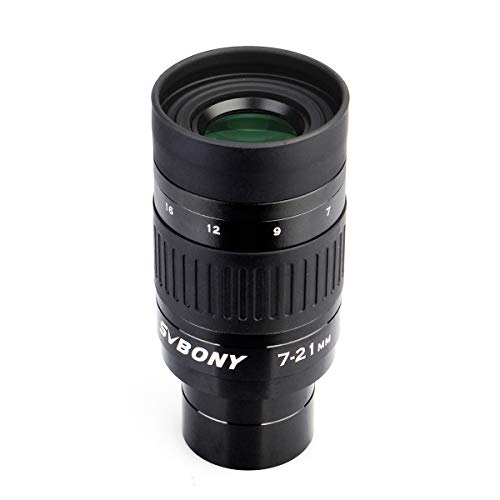
- Adjustable 7–21mm focal length
- 40–57° field of view
- Comfortable eye relief for glasses
Best For: Convenient variable-magnification viewing
Best for Planetary Detail
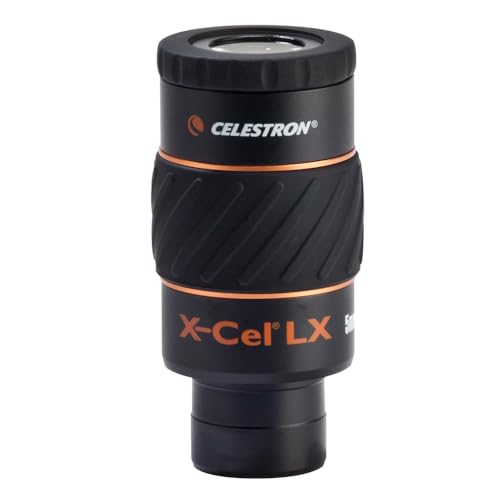
- Dedicated 5mm high power
- 60° field of view
- Threaded barrel accepts filters
Best For: High-power planetary observation
Best Complete Set
CelticBird 13-Piece Eyepiece Kit

- Five Plössl focal lengths
- 2x Barlow and seven filters
- Foam-lined metal case
Best For: Broad, all-in-one observing setups
Best Wide-View Eyepiece

- 60° field of view for broad low-power views
- Six-element fully multi-coated optics
- Twist-up eyeguard and filter-threaded 1.25-inch barrel
Best For: Wide-field observing with a comfortable single eyepiece
Best Complete Eyepiece Kit
Celestron 1.25-Inch Accessory Kit

- Five Plössl eyepieces from 6mm to 32mm
- Includes 2x Barlow, Moon Filter, and planetary filters
- Foam-lined hard-sided case with room to expand
Best For: Building a versatile first telescope accessory collection
Best Ultra-Wide Eyepiece Set
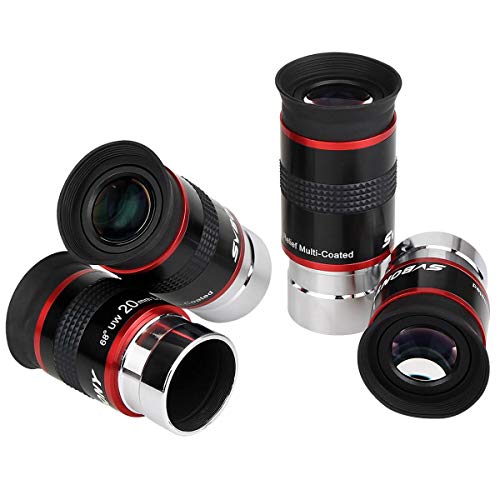
- 68° apparent field of view
- Four focal lengths: 6mm, 9mm, 15mm, and 20mm
- Fully multi-coated optics with fold-down eyeguards
Best For: Wide-angle viewing across several 1.25-inch eyepiece options
Best Flexible Zoom
Celestron 8-24mm Zoom Eyepiece

- Adjustable 8-24mm focal length
- Fully multi-coated optics
- Standard 1.25-inch fit with filter threads
Best For: Observers who want convenient variable magnification
Best Starter Set
SVBONY 4mm, 10mm and 23mm Eyepiece Set

- Includes three useful focal lengths
- Wide 62-degree apparent field
- Fully multi-coated aspherical optics
Best For: Beginners building a versatile 1.25-inch eyepiece collection
Best for Wide Views
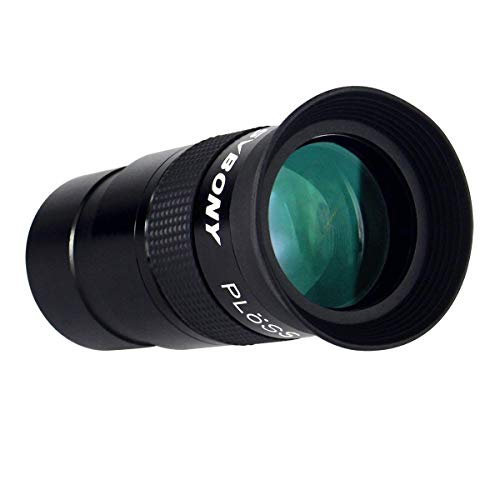
- 40mm focal length for broad views
- Four-element fully multi-coated optics
- Fold-down eyeguard and filter thread
Best For: Low-power viewing of clusters, nebulae, and lunar scenes
Best Starter Bundle – Celestron AstroMaster Accessory Kit
If you need more than standalone telescope eyepieces, this eight-piece Celestron kit adds useful magnification and viewing accessories in one package. It includes 15mm and 6mm eyepieces, a 2x Barlow lens, three filters, a cleaning cloth, and a foam-lined case.
Best For: Beginners who want a practical telescope eyepiece and filter bundle for lunar and planetary viewing.
Pros:
- Includes two 1.25-inch eyepieces with different focal lengths.
- 2x Barlow lens doubles magnification and includes T-threads for optional DSLR attachment.
- Moon, red, and blue filters support lunar and planetary observation.
- Foam-lined carrying case keeps the accessories organized.
Cons:
- The kit offers fewer eyepiece focal lengths than larger accessory sets.
- A DSLR T-ring is required separately for camera attachment.
This is a convenient entry-level choice when you want telescope eyepieces plus filters and storage without assembling a kit piece by piece. Its 2-year US warranty and included support add reassurance for new observers.
Best Zoom Option – SVBONY SV135 7–21mm Zoom Eyepiece
The SVBONY SV135 is a flexible telescope eyepiece for observers who want adjustable magnification without carrying several fixed eyepieces. Its 7–21mm zoom range, fully multi-coated six-element design, and standard 1.25-inch barrel suit lunar, planetary, and general astronomical viewing.
Best For: Observers who value convenience and variable magnification, including eyeglass wearers who appreciate generous eye relief.
Pros:
- 7–21mm adjustable focal length can replace multiple fixed eyepieces.
- 40–57° field of view provides a useful range as magnification changes.
- Fully multi-coated, six-element optical design is intended to improve edge and center sharpness.
- Rubber eye guard and 18–16.3mm eye relief support comfortable viewing.
Cons:
- It is a single zoom eyepiece rather than a complete accessory set.
- The listed field of view varies with the zoom setting.
This is a sensible space-saving pick for telescope owners who want one adaptable eyepiece for different targets. The metal body and standard 1.25-inch barrel make it a straightforward addition to compatible telescopes.
Best for Planetary Detail – Celestron X-Cel LX 5mm
For high-power planetary observation, the Celestron X-Cel LX 5mm is a focused telescope eyepiece choice. Its six-element fully multi-coated optical system provides a 60° field of view, while the 1.25-inch threaded barrel accepts filters.
Best For: Planetary viewers seeking a dedicated 5mm eyepiece with a wider field and comfortable handling.
Pros:
- 5mm focal length is designed for high-power views.
- 60° field of view offers more viewing area than a narrow-field design.
- Six-element fully multi-coated lens system supports planetary viewing.
- Pop-up rubber eyeguard and textured grip improve handling and viewing comfort.
Cons:
- Its high power may be less versatile than a mid-range or zoom eyepiece.
- It is sold as a single eyepiece without included filters or accessories.
This model makes the most sense when planetary viewing is your priority and your telescope can use a 1.25-inch eyepiece. The threaded barrel also leaves room to add compatible filters later.
Best Complete Set – CelticBird 13-Piece Eyepiece Kit
This CelticBird set gives telescope owners a broad selection of telescope eyepieces and filters in one package. Five Plössl eyepieces range from 40mm to 6mm, while the 2x Barlow, seven filters, and metal carrying case expand its usefulness for lunar, planetary, deep-sky, and daytime viewing.
Best For: Beginners and hobbyists who want wide focal-length coverage and a large selection of viewing accessories.
Pros:
- Five Plössl eyepieces cover 40mm, 20mm, 12.5mm, 8mm, and 6mm focal lengths.
- 2x Barlow lens provides another magnification option and includes T2 threads for DSLR use with an adapter.
- Seven filters include color, polarizing, and Moon filters.
- Sturdy foam-lined metal case includes extra space for small accessories.
Cons:
- The wide selection may be more than a casual observer needs.
- A suitable T-ring or adapter is needed for DSLR photography.
- The set is compatible with telescopes using 1.25-inch accessories.
Choose this kit if you want variety rather than a single specialized eyepiece. Its spread of focal lengths makes it easier to experiment with different targets, while the filters and case provide a more complete observing setup.
Best Wide-View Eyepiece – Celestron X-Cel LX 25mm
The Celestron X-Cel LX 25mm is a practical choice for telescope owners who want wide, low-power views. Its 60° field of view, six-element fully multi-coated optics, and 1.25-inch filter-threaded barrel make it a versatile option for everyday observing.
Best For: Observers seeking comfortable, wide-field views with a single upgraded telescope eyepiece.
Pros:
- 60° field of view supports broad low-power views.
- Six-element, fully multi-coated lens system is designed for planetary viewing.
- Twist-up rubber eyeguard improves comfort and can help increase contrast.
- Textured rubber grip and filter-compatible 1.25-inch barrel are practical for regular use.
Cons:
- Provides one 25mm focal length rather than a range of magnifications.
- Its 1.25-inch barrel may not suit telescopes requiring a different eyepiece size.
This telescope eyepiece is a focused upgrade rather than an all-in-one kit. Choose it when a 25mm, wide-view eyepiece and comfortable handling matter most.
Best Complete Eyepiece Kit – Celestron 1.25-Inch Accessory Kit
The Celestron Accessory Kit is built for telescope owners who need several magnification options in one purchase. It combines five Plössl telescope eyepieces, a 2x Barlow lens, colored planetary filters, a Moon Filter, and a protective case.
Best For: Beginners and observers who want a broad telescope eyepiece and filter collection with room to expand.
Pros:
- Includes 32mm, 17mm, 13mm, 8mm, and 6mm Plössl eyepieces.
- The 2x Barlow lens doubles the magnification of the included eyepieces or other compatible 1.25-inch eyepieces.
- Moon and colored planetary filters support varied astronomical viewing.
- Foam-lined hard-sided case keeps accessories organized and protected.
Cons:
- The kit is limited to telescopes using 1.25-inch accessories.
- A multi-piece kit may be more equipment than users seeking only one replacement eyepiece need.
With five focal lengths and added filters, this is the most flexible option of the three. It is especially useful when building a first accessory collection rather than refining a single viewing style.
Best Ultra-Wide Eyepiece Set – SVBONY 68° Eyepiece Set
The SVBONY 68° set gives telescope owners four focal lengths for different observing needs. Its fully multi-coated optics, wide apparent field of view, and internally blackened housings are designed to support sharp, contrasty views through a standard 1.25-inch mount.
Best For: Observers who want a compact set of wide-angle telescope eyepieces for compatible 1.25-inch telescopes.
Pros:
- 68° apparent field of view provides broad viewing coverage.
- Includes 6mm, 9mm, 15mm, and 20mm focal lengths.
- Fully multi-coated optics and multi-element design support light transmission, color correction, and contrast.
- Fold-down soft rubber eyeguards can help block stray light and accommodate eyeglass wearers.
Cons:
- Compatibility is limited to telescopes with a standard 1.25-inch eyepiece mount.
- The set does not include a Barlow lens or filters.
This telescope eyepiece set is a strong fit for users prioritizing field width and several medium-to-high magnification choices. Its included focal lengths complement observing sessions that do not require a low-power 32mm option.
Best Flexible Zoom – Celestron 8-24mm Zoom Eyepiece
For telescope eyepieces that adapt quickly to changing targets, the Celestron 8-24mm Zoom offers adjustable magnification in one compact 1.25-inch barrel. Twist smoothly from 24mm to 8mm to find a useful view without repeatedly swapping fixed focal-length eyepieces.
Best For: Observers who want one versatile eyepiece for experimenting with different magnifications.
Pros:
- Variable 8-24mm focal length provides a broad range of magnifications.
- Fully multi-coated optics are designed to improve brightness, color, and contrast.
- Fits telescopes and spotting scopes with standard 1.25-inch eyepiece holders.
- Includes filter threads, a removable rubber eyecup, and T-threads for astrophotography.
Cons:
- Its 1.25-inch barrel limits compatibility with telescopes using other eyepiece sizes.
- A zoom eyepiece may not replace every specialized fixed focal-length option.
The Celestron is a practical choice when convenience matters more than building a large collection of fixed eyepieces. Its 55-degree field of view and smooth 3:1 zoom range make it especially useful for adjusting the view while observing.
Best Starter Set – SVBONY 4mm, 10mm and 23mm Eyepiece Set
This three-piece set gives telescope eyepiece shoppers three fixed focal lengths for different observing situations. The 4mm, 10mm, and 23mm lenses cover detailed views of bright objects as well as wider views of star clusters, nebulae, and other deep-space targets.
Best For: Beginners who need a varied set of 1.25-inch eyepieces for lunar, planetary, and deep-sky viewing.
Pros:
- Three focal lengths support high-, medium-, and lower-power observing.
- 62-degree apparent field of view makes locating and framing objects easier.
- Aspherical, fully multi-coated optics are designed to reduce aberrations and improve light transmission.
- Compatible with refractor, reflector, and catadioptric telescopes using 1.25-inch focusers.
Cons:
- Compatibility depends on having a standard 1.25-inch focuser.
- The 4mm eyepiece may require careful magnification matching to the telescope.
- Users should calculate magnification before ordering and avoid exceeding the recommended limit.
For shoppers assembling a first collection, this SVBONY set offers more focal-length variety than a single eyepiece. The wide-angle design and internal matte finish are useful features for scanning the sky and minimizing stray-light reflections.
Best for Wide Views – SVBONY 40mm Plossl Eyepiece
Among telescope eyepieces designed for broad views, this 40mm SVBONY Plossl emphasizes comfortable, lower-power observing. Its four-element optical design and 40-degree apparent field suit lunar scenes, medium star clusters, nebulae, and other deep-sky targets.
Best For: Wide-field visual observing with a 1.25-inch telescope, especially for clusters and extended objects.
Pros:
- 40mm focal length supports broad-field viewing of the Moon, clusters, and nebulae.
- Four-element, fully multi-coated optics are designed for contrast and clarity.
- Fold-down rubber eyeguard improves comfort for eyeglass wearers and helps block stray light.
- Metal construction, filter threading, and included storage case add practical value.
Cons:
- It is a fixed 40mm eyepiece, so changing magnification requires another lens.
- The standard 1.25-inch barrel is not compatible with telescope holders of other sizes.
- Its 40-degree apparent field is narrower than the 62-degree field of some wide-angle alternatives.
This Plossl is a sensible addition for observers who want a dedicated low-power eyepiece rather than a zoom. The fold-down eyeguard and durable metal body make it well suited to comfortable, portable visual use.
How We Picked the Best Telescope Eyepieces
We focused on practical options for common 1.25-inch telescope focusers, including individual eyepieces, zoom models, multi-piece kits, and sets with filters or Barlow lenses. Our comparison considers focal-length coverage, stated field of view, optical coatings, versatility, included accessories, portability, and suitability for different experience levels.
Because telescope performance depends on aperture, focal length, atmospheric conditions, and the target being viewed, no single eyepiece is ideal for every observer. The strongest choices are those that provide useful magnification without leaving large gaps between viewing options.
Quick Comparison
| Best For | Look For | Typical Advantage |
|---|---|---|
| Beginners | Accessory kits or balanced sets | Several focal lengths and useful extras |
| Planetary viewing | Short focal lengths, such as 4–6mm | Higher magnification for lunar and planetary detail |
| Deep-sky observing | Longer focal lengths and wider fields | Easier framing of clusters and nebulae |
| Flexible observing | Zoom eyepieces | Adjustable magnification without changing eyepieces |
| Expanding an existing kit | A focal length you do not already own | More useful coverage instead of duplicates |
Key Buying Factors for Telescope Eyepieces
Focal Length and Magnification
Magnification is calculated by dividing your telescope’s focal length by the eyepiece focal length. Shorter eyepieces produce higher magnification, while longer ones provide lower-power, wider views. Very high power can soften the image when seeing conditions are poor, so a balanced range is usually more useful than the strongest possible magnification.
Barrel Size and Compatibility
Confirm whether your focuser accepts a 1.25-inch barrel before buying. Most products in this roundup use that common format. Also check available back focus, diagonal compatibility, and whether a kit includes accessories that fit your telescope.
Field of View and Eye Relief
A wider apparent field of view can make targets easier to locate and track, particularly with manually operated mounts. Eye relief matters if you wear glasses; generous eye relief is generally more comfortable, especially at higher magnification.
Optical Quality and Accessories
Fully multi-coated optics can improve light transmission and reduce unwanted reflections. Filters may enhance lunar or planetary viewing, while a Barlow lens can increase the magnification of multiple eyepieces. However, accessories should complement good focal-length coverage rather than replace it.
Who Should Buy Which Telescope Eyepieces?
New telescope owners: Choose a coordinated accessory kit if you need several focal lengths, filters, and a Barlow lens in one purchase.
Planetary observers: Add a short focal-length eyepiece, but select a magnification your telescope and local seeing conditions can realistically support.
Deep-sky viewers: Prioritize a longer focal length and a broad field of view for star fields, open clusters, and larger nebulae.
Travelers and casual observers: A zoom eyepiece reduces the number of accessories to carry and lets you adjust magnification while observing.
Experienced owners: Compare your current eyepieces first, then buy the focal length, field of view, or eye relief that fills the biggest gap in your existing setup.