Choosing the right solar system model can turn an astronomy lesson into a hands-on learning experience. The best kits help students visualize planetary order, scale, motion, and the relationship between the Sun, Earth, and Moon.
We selected 10 options for different classroom needs, including collaborative craft projects, interactive teaching aids, display-ready models, and age-appropriate STEM activities.
Best 10 Solar System Models for Science Lessons Picks for 2026
Best Space-Saving Pick
Pllieay Solar System Model Kit

- Wall-mountable felt display
- Includes paints and project supplies
- Teaches planet positions
Best For: Ages 8+, classrooms, and compact display areas
Best Complete Painting Kit
wookidel 64-Piece Solar System Project Kit

- Includes foam balls, paints, and supports
- Designed for school or home projects
- Combines astronomy and craft skills
Best For: Introductory planet projects for ages 6 to 12
Best Build-Your-Own Framework
Pllieay Foam Ball Solar System Model
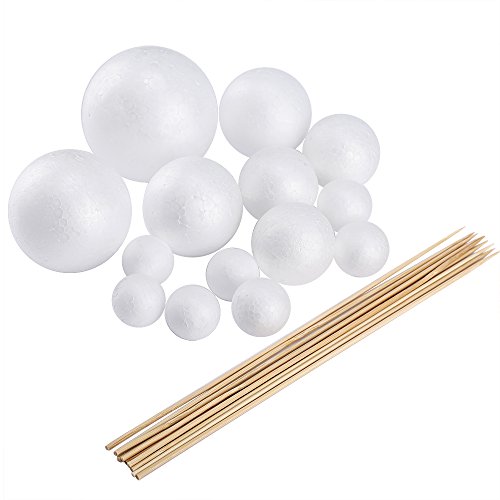
- 14 mixed-size foam spheres
- Includes bamboo construction sticks
- Supports flexible craft designs
Best For: Older students and teacher-guided custom projects
Best Interactive Learning Model
Science Can Talking Solar System
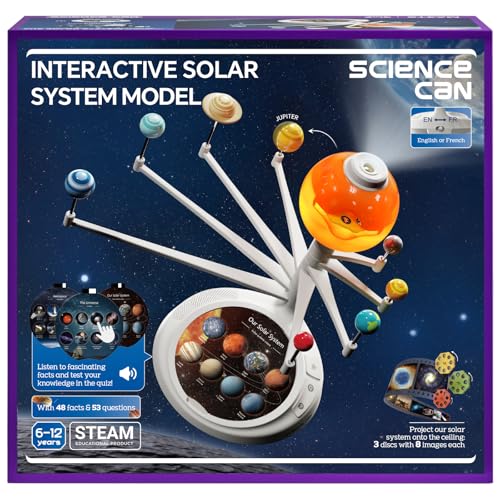
- 48 facts and 53 quiz questions
- Bilingual English/French options
- Projects colorful space images
Best For: Interactive STEM review at home or in class
Creative Display Pick

- Starry display box for finished projects
- Includes paints, brushes, foam planets, and labels
- Hands-on astronomy and craft activity
Best For: Kids’ science projects and craft-based lessons
Glow-in-the-Dark STEM Pick
National Geographic Solar System Model

- Builds and paints all eight planets and the sun
- Movable arms enable display adjustments
- Includes glow paint and a solar system fact poster
Best For: Ages 8+ astronomy projects and interactive displays
Wall Display Classroom Pick
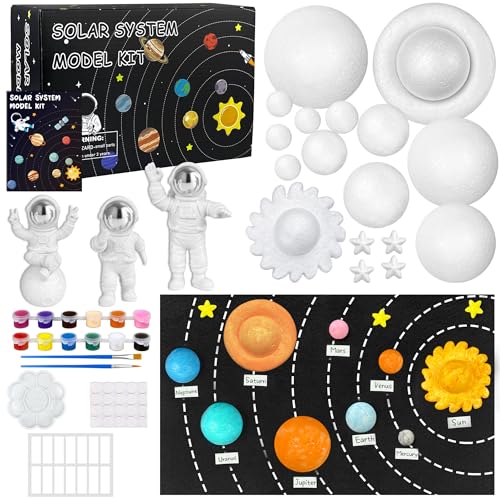
- Foam pieces, paints, brushes, hooks, and ornaments included
- Designed for a compact wall display
- Instructions cover orbital positions
Best For: Ages 8–10 classroom and small-space projects
Hands-On Builder
Smartivity DIY Solar System Kit

- Gear-driven model children assemble and rotate
- Supports basic astronomy and STEM learning
- Designed for ages 8–14
Best For: Hands-on STEM activities and young builders
Orbital Demonstrator

- Shows seasons, eclipses, and moon phases
- Explains Earth and Moon orbital movement
- Includes a seasonal information plate
Best For: Earth science lessons and guided demonstrations
Glow Science Project

- Snap-together planets need no glue
- Rotating display with glow-in-the-dark paint
- Includes facts, instructions, and wall chart
Best For: Creative science projects for ages 8–14
Best Space-Saving Pick – Pllieay Solar System Model Kit
For classrooms or homes where display space matters, this kit is a practical choice among solar system models for science lessons. Children paint the foam pieces, follow the orbital-position instructions, and create a wall-mounted presentation.
Best For: Ages 8 and up, classroom projects, and learners who want a hands-on model that can be displayed on a wall.
Pros:
- Includes a felt background plate, foam pieces, paints, brushes, palette, labels, and hanging supplies.
- Instructions support learning planet names and orbital positions.
- Wall-hanging design helps conserve desk and shelf space.
- Encourages hands-on work, hand-eye coordination, and color recognition.
Cons:
- Children must paint and assemble the model before it can be used.
- The manufacturer recommends it for ages 8 to 17.
This is a well-equipped DIY option when the finished project needs to serve as both a science activity and a compact classroom display.
Best Complete Painting Kit – wookidel 64-Piece Solar System Project Kit
This wookidel set is a convenient choice for solar system models for science lessons because it combines foam pieces, bamboo supports, flags, paints, and instructions in one project kit. Students can color and build a model at school or at home.
Best For: Children ages 6 to 12 working on introductory astronomy projects, classroom activities, or family science time.
Pros:
- Includes 13 mixed foam balls, a sun, stars, bamboo sticks, toothpick flags, 12 colors, brushes, and a palette.
- Foam surfaces are described as smooth and easy to paint.
- Instructions introduce details about the solar system and planets.
- Supports hand-eye coordination, focus, scientific knowledge, and artistic skills.
Cons:
- The model requires painting and construction rather than providing a ready-to-use display.
- The notes list differing age references, including ages 6 to 12 and a separate 3-to-5 product highlight.
With its broad supply list and approachable construction format, this kit works well when you want students to learn through both crafting and basic astronomy.
Best Build-Your-Own Framework – Pllieay Foam Ball Solar System Model
For educators who want students to design the display themselves, this basic set provides a flexible foundation for solar system models for science lessons. It includes mixed-size foam spheres and bamboo sticks that can be painted, cut, or combined with other craft materials.
Best For: Older children, structured school projects, and teachers seeking a customizable modeling framework rather than a fully supplied kit.
Pros:
- Provides 14 polystyrene spheres in six different diameter sizes.
- Includes 10 bamboo sticks for supports and model construction.
- Lightweight balls can be decorated with paint, collage materials, paper mache, or modeling dough.
- Useful for mathematical, spatial, and scientific demonstration models.
Cons:
- Paints, brushes, labels, and instructions are not listed among the included components.
- Cutting the bamboo sticks requires tools.
- The notes prohibit children under 10 from cutting the bamboo.
This is the most open-ended option in the group, making it a good fit for guided lessons where students supply the artistic materials and plan the construction approach.
Best Interactive Learning Model – Science Can Talking Solar System
This electronic model takes a different approach to solar system models for science lessons, using spoken facts, quizzes, lighting, and projection instead of a paint-and-assemble project. It is designed to make astronomy practice more interactive for children ages 6 to 12.
Best For: Interactive home or classroom STEM activities, bilingual English/French learning, and children who benefit from quizzes and visual demonstrations.
Pros:
- Offers 48 space facts through three knowledge cards and includes 53 quiz questions.
- Supports English and French language options.
- Projects 24 full-color space images from three disks onto walls or ceilings.
- Uses a lit sun and hands-on features to explore planetary positions, orbits, and sunlight.
Cons:
- Requires three AA batteries, which are not included.
- It is a plastic electronic model rather than a student-built craft project.
- The projector and quiz functions may be more technology than needed for a simple display lesson.
Choose this model when engagement and repeated review are priorities. Its quiz, audio, lighting, and projection features offer more interactive instruction than a conventional painted foam model.
Creative Display Pick – Pllieay 3D Solar System Model
The Pllieay 3D Solar System Model is a hands-on option for solar system models for science lessons, combining planet painting with a starry display box. Its foam components, printed planet introduction, paints, brushes, and assembly supplies make it suitable for guided classroom activities or at-home projects.
Best For: Kids ages 8 and up, school science projects, craft classes, and parent-child astronomy activities.
Pros:
- Includes foam balls, stars, paints, brushes, palette, labels, sticks, and display materials.
- The starry display box creates a ready-to-showcase space scene.
- Lightweight foam construction and straightforward assembly support independent use.
- Painting and assembling encourage hands-on learning about the eight planets.
Cons:
- The foam model may be less durable than a plastic construction.
- It requires painting and craft assembly before it can be displayed.
Choose this kit when the lesson benefits from a creative build-and-display activity rather than a preassembled teaching model. The included display box adds presentation value for classrooms or bedrooms.
Glow-in-the-Dark STEM Pick – National Geographic Solar System Model
The National Geographic Glow in the Dark Solar System Model adds movement and nighttime display appeal to solar system models for science lessons. Students build and paint the sun and eight planets, then use movable arms to adjust the arrangement and explore the model hands-on.
Best For: Children ages 8 and up who want a buildable astronomy project with glow-in-the-dark room display potential.
Pros:
- Includes the planets, sun, paints, glow-in-the-dark accent paint, brush, palette, decals, and fact poster.
- Movable arms allow the planetary display to be rearranged.
- Combines construction, painting, and space facts in one activity.
- Glow-in-the-dark details make the finished model engaging as room decor.
Cons:
- It is recommended for ages 8 and up, so it may not suit younger learners.
- Students must assemble and paint the model before using it as a display.
This is a strong choice for lessons that pair astronomy facts with creative construction. The movable design supports interactive display, while the glow paint adds an extra incentive for continued interest after the project is complete.
Wall Display Classroom Pick – 35PCS Solar System Model Kit
The 35PCS Solar System Model Kit is a flexible choice for solar system models for science lessons, with multiple foam ball sizes, a felt background plate, paints, brushes, hooks, and instructions. The completed project can hang on a wall, making it useful when desk or shelf space is limited.
Best For: Learners ages 8–10, classrooms, small-space displays, and DIY astronomy projects involving painting and planet placement.
Pros:
- Includes 35 listed pieces, including foam balls, stars, paints, brushes, hooks, and astronaut ornaments.
- Felt background plate supports a compact wall-mounted presentation.
- Instructions introduce orbital positions and encourage astronomy learning.
- Painting and assembly help develop hand-eye coordination and color discrimination.
Cons:
- The foam construction requires careful handling.
- The kit involves a craft-building process rather than immediate use.
- The listed manufacturer age range is relatively narrow at 8–10 years.
Consider this kit when the finished model needs to occupy minimal space or serve as a classroom wall display. Its broad collection of craft components also makes it suitable for a structured, instructor-led project.
Hands-On Builder – Smartivity DIY Solar System Kit
For solar system models for science lessons, this Smartivity kit emphasizes construction and movement. Children ages 8–14 assemble a gear-driven model that rotates, offering a practical way to discuss planets, orbits, day, night, and basic astronomy.
Best For: Hands-on STEM activities and learners who enjoy building their own science project.
Pros:
- Combines assembly, creativity, and basic astronomy concepts.
- Rotating design supports discussion of planetary movement and orbits.
- Designed for ages 8–14 and made with child-safe, eco-friendly materials.
Cons:
- It is a single model kit, so it may not cover detailed eclipse or seasonal demonstrations.
- Assembly is intended for children 8 and up rather than very young learners.
This is a strong choice when the lesson benefits from building and interaction rather than a purely decorative model. Its compact MDF construction and STEM focus make it suitable for a guided classroom or home activity.
Orbital Demonstrator – Sun Earth Moon Orbital Model
Among solar system models for science lessons, this Sun–Earth–Moon kit is especially focused on motion and relationships. Its orbital mechanism can help demonstrate seasons, solar and lunar eclipses, moon phases, and the Earth’s rotation and orbit.
Best For: Earth science instruction, school projects, and teacher-led demonstrations of orbital phenomena.
Pros:
- Demonstrates Earth’s orbit, the Moon’s orbit, seasons, eclipses, and moon phases.
- Includes a seasonal plate with season names, dates, and traditional Chinese solar terms.
- Provides an approximately 15.2 × 7.87 × 11.02-inch assembled display.
Cons:
- Assembly involves screws, a wrench, gears, alignment, and several setup steps.
- Its focus is the Sun, Earth, and Moon rather than a complete multi-planet model.
This model offers more targeted teaching value than a general planet display when the lesson covers eclipses, seasons, or lunar phases. Plan for adult guidance during assembly and alignment.
Glow Science Project – 4M Solar System Planetarium
For solar system models for science lessons that combine crafting with display appeal, the 4M Solar System Planetarium is a practical project option. Children snap together and paint the planets, then use the rotating stand and glow paint to create an approximately 11.8-inch model.
Best For: Creative home or classroom projects that reinforce planet recognition and basic space facts.
Pros:
- Snap-together planets require no glue, simplifying assembly.
- Rotating arms create an interactive display.
- Includes glow paint, painting supplies, fun facts, instructions, and a bonus wall chart.
Cons:
- Painting and finishing add time beyond the initial snap-together assembly.
- The kit is recommended for ages 8–14, so younger children may need support.
- Its emphasis is a rotating planet display rather than detailed orbital demonstrations.
This kit is a good fit when the goal is an engaging science-and-craft assignment. The glow-in-the-dark finish can make the completed model memorable, while the included facts and wall chart add classroom reference value.
How We Picked These Solar System Models for Science Lessons
We focused on educational usefulness, age suitability, project format, and the amount of hands-on learning each kit supports. The selection includes paint-and-build sets, predesigned display models, glow-in-the-dark planetariums, gear-driven mechanisms, and interactive talking models.
We also considered whether a kit can support a complete lesson rather than simply decorate a classroom. Useful features include labeled or paintable planets, orbit demonstrations, included instructions, display components, and materials that allow students to participate in construction.
Quick Comparison
| Model type | Best for | What to look for |
|---|---|---|
| Foam-ball craft kit | Group projects and creative lessons | Ball sizes, paint, brushes, and instructions |
| Interactive talking model | Guided demonstrations | Clear audio, controls, and age-appropriate content |
| Gear-driven model | Teaching planetary motion | Durable gears, assembly guidance, and stable construction |
| Display model | Long-term classroom reference | Sturdy base, display box, and readable planet details |
| Glow-in-the-dark kit | Extension activities and home learning | Glow elements, safe assembly, and suitable room conditions |
Key Buying Factors for Solar System Models for Science Lessons
Age and Assembly Difficulty
Match the kit to students’ fine-motor skills and attention span. Younger learners may benefit from larger components and simpler assembly, while older students can handle painting, labeling, gears, and more detailed construction.
Learning Objective
Decide whether the lesson emphasizes planet identification, orbital order, relative size, the Earth-Moon-Sun relationship, or creative project work. A static model is useful for labeling and display, while a moving or interactive design can make motion easier to demonstrate.
Materials and Classroom Practicality
Check what is included before purchasing. Paint, brushes, adhesive, stands, backgrounds, batteries, and instructions can affect preparation time and total cost. For group work, count the number of complete components and consider whether students can share materials without delays.
Durability and Storage
Foam models are lightweight but may dent or lose paint. Moving models need stronger construction and careful handling. If the project will be reused, prioritize stable bases, replaceable parts, and storage options that protect small planets and connectors.
Who Should Buy Which Solar System Models for Science Lessons?
Choose a foam-ball project kit for classrooms that want students to paint, assemble, and explain their own models. It is a strong choice for collaborative science-fair work and lessons that combine astronomy with art.
Choose an interactive talking model for teacher-led demonstrations or younger learners who benefit from audio prompts. A gear-driven model is better for students studying rotation and orbital movement, while a display-ready kit suits classrooms that need a durable reference model with minimal preparation.
For an engaging extension activity, glow-in-the-dark models can reinforce planet recognition after the main lesson. Before ordering, verify the recommended age range, component count, required tools, and whether the finished model is intended for active demonstration or stationary display.