The best resin printers can produce exceptionally fine details, smooth surfaces, and accurate small parts, but the right model depends on more than resolution alone. Build volume, automation, print speed, materials support, and cleanup requirements all affect the ownership experience.
We compared 10 notable resin 3D printers across compact entry-level options, high-resolution machines, larger-format models, and feature-rich systems to help you choose with confidence.
Best 10 Resin Printers Picks for 2026
Best Fast Detail
- 9K mono LCD with 18 μm XY resolution
- Tilt-release printing up to 150 mm/h
- AI camera and Wi-Fi cluster printing
Best For: Detailed, speed-focused hobby and small production workflows
Best Beginner Value

- 7-inch 10K mono LCD with 17 μm pixels
- Beginner-friendly four-point leveling
- 153.4 × 87 × 165 mm build volume
Best For: Beginners seeking detailed, straightforward resin printing
Best Large Detail

- 10-inch 12K mono LCD
- Large 218.88 × 122.88 × 250 mm build volume
- Uniform Fresnel-collimated light source
Best For: Larger models and detailed batch printing
Best Production Scale

- 18.3-liter build volume for large batches
- 14-inch 12K screen with 24.8 μm pixels
- Heated 1,900 ml tank and automatic leveling
Best For: Large prototypes and high-volume production workflows
Best High-Resolution Pick

- 16K LCD with 14 x 19 μm XY resolution
- Automatic heated resin tank
- 150 mm/h printing with AI monitoring
Best For: Detailed, larger models with automated monitoring
Best Dual-Material Option

- Dual-color and dual-material printing
- Automatic leveling and AI inspection
- Supports viscosity up to 8,000 cps
Best For: Creative multicolor projects and industrial resins
Best Professional Speed Pick

- 566:1 high-contrast amber screen
- One-click repair, slicing, and supports
- Force-based failure detection and diagnostics
Best For: Precise, monitored professional resin printing
Easy-Start Pick
- One-click automatic leveling
- 4K mono LCD for detailed prints
- Self-check and residue detection
Best For: Beginners and hobbyists prioritizing simple setup
High-Resolution Workhorse

- 16K mono LCD with 14×19 μm pixels
- Up to 170 mm/h printing speed
- Automated heating, RFID, and resin monitoring
Best For: Detailed, higher-throughput printing and automated resin handling
Smart Speed Choice

- Tilt release printing up to 150 mm/h
- 12K detail with automatic leveling
- AI monitoring and print-resume support
Best For: Enthusiasts seeking fast, monitored resin printing
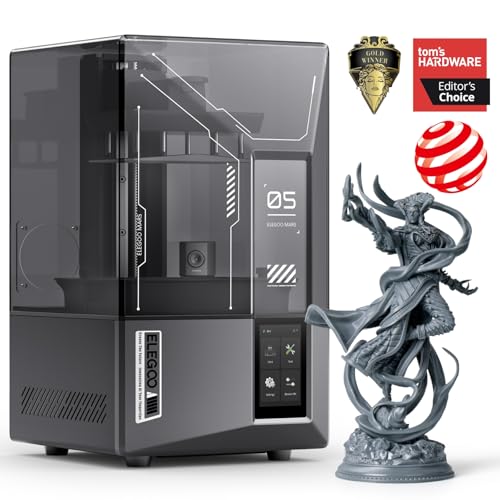
Best Fast Detail – ELEGOO Mars 5 Ultra
The ELEGOO Mars 5 Ultra is a strong choice for resin printers buyers who want fine detail alongside fast production. Its 9K mono LCD, 18 μm XY resolution, and tilt-release technology are designed for detailed prints at speeds of up to 150 mm/h.
Best For: Hobbyists and small production workflows that prioritize detailed prints, speed, and convenient monitoring.
Pros:
- 9K LCD and 18 μm XY resolution reproduce intricate details.
- Tilt-release technology supports printing speeds up to 150 mm/h.
- AI camera can detect issues such as warping and empty build plates.
- Supports residue detection, resin shortage alerts, and Wi-Fi cluster printing.
Cons:
- AI detection results can vary with the environment, model, and resin type.
- Its listed features may be more than needed for basic resin printing.
The Mars 5 Ultra stands out for combining high-resolution output with automation and speed. It is particularly appealing when reducing failed prints and managing multiple printers are important to your workflow.
Best Beginner Value – ANYCUBIC Photon Mono 4
The ANYCUBIC Photon Mono 4 is a practical entry point for resin printers shoppers seeking high resolution without a complicated setup. Its 7-inch 10K screen, uniform LighTurbo light source, and four-point leveling system support detailed and consistent everyday printing.
Best For: Beginners and everyday users who want a compact printer with detailed output and straightforward leveling.
Pros:
- 10K resolution provides 17 × 17 μm pixels for fine model detail.
- LighTurbo matrix lighting helps reduce layer lines and rasterization.
- 153.4 × 87 × 165 mm build volume accommodates many daily projects.
- Four-point leveling needs no repeat leveling after the initial setup and tightening.
Cons:
- The Anycubic app is not supported.
- Its build volume is smaller than the larger-format options in this roundup.
With a stable light source, easy leveling process, and useful build area, the Photon Mono 4 offers a balanced starting point. It is best suited to users who value simplicity and detail over oversized prints or app-based control.
Best Large Detail – ELEGOO Saturn 3 MSLA
The ELEGOO Saturn 3 is a capable option for resin printers buyers who need more room for larger models or multiple prints. Its 10-inch 12K mono LCD, generous build volume, and uniform Fresnel-collimated light source are designed for detailed and consistent results.
Best For: Makers printing larger models, intricate parts, or multiple pieces in one batch.
Pros:
- 10-inch 12K LCD delivers detailed output across a large print area.
- 218.88 × 122.88 × 250 mm build volume supports larger projects.
- COB and Fresnel optics provide over 90% light uniformity.
- Laser-carved build plate promotes adhesion, while Tango offers multiple print modes.
Cons:
- At 33 pounds, it is less convenient to move than smaller printers.
- Its listed print speed is up to 70 mm/h, below the Mars 5 Ultra’s stated maximum.
The Saturn 3 makes a strong case when build space matters as much as detail. Its larger footprint and weight are reasonable trade-offs for users who want to print bigger or batch multiple models.
Best Production Scale – ANYCUBIC Photon P1 Max
The ANYCUBIC Photon P1 Max is built for resin printers users who need substantial capacity for oversized prototypes or high-volume batch production. Its 18.3-liter build volume, 14-inch 12K screen, heated resin tank, and automatic leveling target stable, repeatable operation.
Best For: Production-oriented users printing large prototypes or densely packed batches in a single cycle.
Pros:
- 285.5 × 214 × 300 mm build volume supports oversized and batch prints.
- 14-inch 12K screen provides 24.8 μm square pixels for smooth detail.
- 1,900 ml heated tank maintains resin temperatures up to 35°C.
- Auto-Leveling 3.0 and C7-grade ball screws support easier setup and ±0.01 mm repeat positioning accuracy.
Cons:
- Its 68.9-pound weight and large dimensions require substantial workspace.
- The large-format design may be excessive for small, occasional prints.
The Photon P1 Max is the most capacity-focused choice here. Its size, heating system, and automated calibration make it better suited to dedicated workspaces and demanding production schedules than casual desktop use.
Best High-Resolution Pick – ELEGOO Saturn 4 Ultra 16K
If you want detailed, dependable resin printers for larger models, the ELEGOO Saturn 4 Ultra 16K combines a high-resolution LCD with automatic resin heating, monitoring tools, and fast printing. Its 8.33 x 4.66 x 8.66-inch build area is useful for intricate figures and sizable projects.
Best For: Makers who prioritize fine detail, larger prints, and automated print monitoring.
Pros:
- 16K LCD provides 15120 x 6230-pixel resolution and 14 x 19 μm XY resolution.
- Automatic resin-tank heating activates below 25°C to help maintain printing conditions.
- 150 mm/h printing, Wi-Fi transfer, automatic leveling, and power-on resume simplify operation.
- AI camera and built-in sensors monitor prints, resin levels, leveling, and foreign objects.
Cons:
- At 35.4 pounds, it is a substantial printer to position.
- The advanced features may be more than beginners need for simple projects.
The Saturn 4 Ultra 16K is a strong all-around choice when resolution and convenience matter equally. Automatic heating and monitoring are particularly useful in environments where resin temperature or unattended print reliability can be concerns.
Best Dual-Material Option – ANYCUBIC Photon P1
Among resin printers, the ANYCUBIC Photon P1 stands out for dual-color and dual-material printing. It also adds factory-calibrated automatic leveling, AI inspection, and support for high-viscosity resins, making it suited to creative and professional workflows.
Best For: Users who want dual-material experimentation or need to work with high-viscosity industrial resins.
Pros:
- Prints with two colors or materials simultaneously and can reduce resin use on small models.
- Factory-calibrated Smart Leveling 3.0 checks and fine-tunes the build plate automatically.
- AI monitoring checks build-plate installation, layer separation, resin level, and vat residue.
- Handles resins with viscosity up to 8,000 cps and includes pre-configured Anycubic settings.
Cons:
- Its 39-pound weight and 28 x 14 x 13-inch dimensions require a sturdy, dedicated setup.
- Dual-material functionality may add complexity for users who only print single-material models.
The Photon P1 is the most versatile choice here for multicolor concepts and demanding resin types. Its automatic checks reduce setup work, while the rigid motion system is designed to support consistent detail.
Best Professional Speed Pick – Reflex RS Turbo
The Reflex RS Turbo targets demanding resin-printing work with a high-contrast amber screen, automated model preparation, force-based failure detection, and precision motion hardware. It is designed for users who value repeatability, speed, and process control over a simpler entry-level setup.
Best For: Professional users who need precise, monitored printing with optimized workflows for different resins.
Pros:
- High-contrast 566:1 amber screen supports sharp details and faster curing.
- One-click slicing repairs common model defects and generates supports automatically.
- Force sensors detect residue as fine as 0.2 mm and can pause prints for protection.
- C5 ball screw provides up to 2 μm repeat positioning accuracy, with calibrated light uniformity.
Cons:
- At 50.6 pounds, it is the heaviest option in this roundup.
- Its professional controls and process features may be excessive for casual printing.
- The supplied notes do not specify the build volume or screen resolution.
The RS Turbo is geared toward controlled, repeatable production rather than basic hobby use. Its adaptive process packages, diagnostic reporting, and dynamic motion controls make it especially compelling for experienced operators working across multiple resin types.
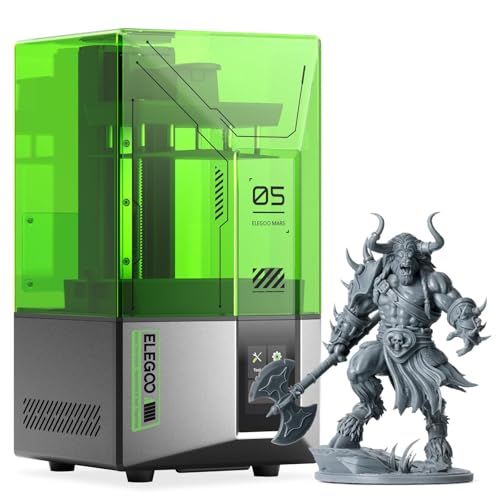
Easy-Start Pick – ELEGOO Mars 5
The ELEGOO Mars 5 is a practical entry point for resin printers, combining one-click automatic leveling with a 4K monochrome LCD. Its self-check and warning systems are designed to reduce setup friction and help prevent avoidable printing problems.
Best For: Beginners and hobbyists who want straightforward setup, detailed prints, and built-in safety checks.
Pros:
- One-click automatic leveling simplifies initial setup.
- 4K mono LCD and COB light source support detailed prints.
- Residue detection, resin shortage alerts, and self-check features help reduce waste.
- Overheat protection pauses printing if LED temperature exceeds 80°C.
Cons:
- Its 4K resolution is lower than the higher-resolution models in this roundup.
- The supplied notes do not specify print speed or build volume.
Choose the Mars 5 if ease of use matters more than maximum resolution or advanced resin-management automation. It is a focused, safety-conscious option for getting started with resin printing.
High-Resolution Workhorse – Creality Halot-X1 Combo
The Creality Halot-X1 Combo stands out among resin printers for its 16K mono LCD, fast claimed print speed, and automated resin handling. Its fixed build plate and integrated management features aim to make production more consistent from setup through cleanup.
Best For: Users who want professional-grade detail, a generous build volume, and automated resin workflows.
Pros:
- 16K resolution with 14×19 μm pixel size supports highly detailed prints.
- Print speeds reach up to 170 mm/h, with a 211.68 × 118.37 × 200 mm build volume.
- AFU system heats resin, recognizes RFID parameters, monitors weight, and manages leftover resin.
- Fixed build plate design eliminates leveling, while dual rails and lead screws support 0.01 mm Z-axis positioning.
Cons:
- At 38 pounds, it is substantially heavier than the smaller Mars 5.
- The listed dimensions require considerable vertical and overall workspace.
- Its advanced automation may be more than casual users need.
The Halot-X1 Combo is the strongest fit when resolution, speed, and resin automation are central buying criteria. Its larger, heavier design is the tradeoff for the feature set and build capacity.
Smart Speed Choice – ELEGOO Saturn 4 Ultra 12K
The ELEGOO Saturn 4 Ultra is a capable choice among resin printers for users who want fast release technology, 12K detail, and monitoring features. Automatic leveling, failure detection, and print-resume functionality make it well suited to longer or more demanding projects.
Best For: Enthusiasts who need fast printing, high detail, and extra oversight during unattended jobs.
Pros:
- Tilt release technology supports fast printing at speeds up to 150 mm/h.
- One-touch automatic leveling reduces manual setup work.
- AI camera provides real-time monitoring, failure detection, and time-lapse capture.
- Resume printing, resin shortage alerts, foreign-object detection, and self-check improve reliability.
Cons:
- AI detection results can vary with the environment, model, and resin type.
- The supplied notes do not specify build volume.
- At 40 pounds, it is a substantial machine for a hobby workspace.
The Saturn 4 Ultra balances speed and detail with a strong set of safeguards. Consider it when automated monitoring and quick release are more valuable than choosing the smallest or lightest resin printer.
How We Picked the Best Resin Printers
We evaluated these Resin Printers by balancing print quality, build volume, operating convenience, speed, feature set, and overall value. Resolution matters for fine text and miniature details, but it is only useful when paired with dependable exposure control, accurate motion, a stable build platform, and software that is straightforward to use.
We also considered practical differences between compact desktop printers and larger machines. A small printer may suit occasional hobby use and require less workspace, while a larger model can produce bigger parts or more items in one batch. Features such as auto-leveling, failure detection, vat heating, air filtration, and multi-material capability may justify a higher price for frequent users.
Quick Comparison
| Priority | What to look for | Best fit |
|---|---|---|
| Lowest space requirement | Compact chassis and smaller build plate | Miniatures, prototypes, and home workshops |
| Fine detail | High-resolution monochrome LCD and precise exposure control | Figures, jewelry patterns, and intricate models |
| Large batches | Generous build volume and dependable leveling | Production work and multiple parts per print |
| Convenience | Auto-leveling, monitoring, guided setup, and easy vat handling | New users and frequent printing |
| Specialty output | Multi-color or multi-material support | Decorative models and experimental projects |
Key Buying Factors for Resin Printers
Resolution and Real-World Detail
LCD resolution and pixel size influence how sharply a printer can reproduce small features, but resin choice, exposure settings, orientation, supports, and post-processing are equally important. Do not choose solely by the largest advertised resolution.
Build Volume
Check the actual build dimensions rather than relying on the printer’s name or screen size. More volume gives you room for taller models and larger batches, but it also increases resin usage, workspace needs, and the potential cost of failed prints.
Speed and Reliability
Fast printing is valuable only when the machine maintains consistent layers. Look for a rigid Z-axis, stable platform, dependable release film, and useful monitoring or failure-detection features. Auto-leveling can make setup easier, though correct calibration and a clean build plate still matter.
Materials, Ventilation, and Cleanup
Resin printing requires gloves, washing, curing, careful spill control, and suitable ventilation. Confirm that the printer supports the resin types you plan to use and budget for a wash-and-cure setup, replacement films, protective equipment, and consumables.
Who Should Buy Which Resin Printers?
Choose a compact Mars 5, Mars 5 Ultra, or Photon Mono 4 if you are starting out, have limited space, or mainly print miniatures and small functional parts. Their smaller footprint can also make material costs easier to manage.
Consider a Saturn-series printer or the Halot-X1 Combo when detailed output and a larger working area are priorities. These models are better suited to demanding hobbyists, batch printing, and users who want room to grow.
Choose a larger-format Photon P1 Max for oversized parts or higher-volume work. The Photon P1 is the more appropriate choice for shoppers specifically interested in dual-color or dual-material experimentation, while the Reflex RS Turbo may appeal to users seeking an alternative high-contrast display design. Before buying, verify current bundle contents, supported accessories, software compatibility, and local resin availability.