Choosing among the best resin printers for miniatures means balancing fine detail, build volume, print reliability, and the time required for washing and curing. A high-resolution screen can capture tiny facial features and armor details, but workflow and support quality matter just as much.
This roundup compares 10 selected resin printers and one compatible resin option to help painters, tabletop gamers, and hobby makers find a setup that matches their experience, budget, and typical print size.
Best 10 Resin Printers for Miniatures Picks for 2026
Best Value Detail

- 22-micron XY resolution with an 8K mono LCD
- Compact build volume for tabletop models
- Compatible with Lychee, Chitubox, and other slicers
Best For: Beginners and hobbyists printing detailed miniatures
Premium High-Resolution Pick

- 16K resolution for highly detailed models
- 30 °C smart tank heating supports consistent resin flow
- Auto-leveling, AI monitoring, and tilt release
Best For: Detail-focused users wanting a feature-rich workflow
Lightweight Everyday Choice

- 10K mono LCD with 17-micron XY pixels
- Uniform LighTurbo light source for smooth surfaces
- Power-resume feature and tested out-of-box setup
Best For: Hobbyists wanting detailed prints in a lighter machine
Smart Fast Miniature Printer

- Up to 150 mm/h with tilt-release printing
- 9K LCD with 18-micron XY resolution
- AI camera, sensors, and Wi-Fi file transfer
Best For: Users prioritizing speed and connected printing features
Best for Dual-Material Creativity

- Dual-color and dual-material printing
- Automatic leveling and AI monitoring
- Supports resins up to 8,000 cps
Best For: Creators seeking flexible, monitored miniature printing
Best Beginner-Friendly Pick
- One-click automatic leveling
- 4K mono LCD for fine details
- Built-in checks and overheat protection
Best For: New users who want a simpler miniature-printing workflow
Best for High-Speed Precision

- High-contrast amber screen
- Automated slicing and support generation
- Precision Z-axis and real-time monitoring
Best For: Advanced users focused on fast, repeatable detail
Best with Extra Features

- Automatic leveling simplifies setup
- 6.6-inch 4K monochrome screen
- Built-in safety and self-check features
Best For: Beginners printing detailed miniatures
Best Detail-Focused Pick
- 7-inch 10K high-resolution screen
- 17×17μm pixel precision
- Power-failure recovery and upgraded build plate
Best For: Detailed miniatures and smoother surface quality
Best Resin Value

- Low-shrinkage standard resin
- Smooth, paint-ready surface
- 365–405nm LCD, DLP, and SLA compatibility
Best For: Affordable everyday miniature printing
Best Value Detail – Phrozen Sonic Mini 8K
For shoppers comparing resin printers for miniatures, the Phrozen Sonic Mini 8K combines a compact footprint with 22-micron XY resolution. Its open software compatibility and moderate build volume make it a practical option for detailed models, miniatures, and action figures.
Best For: Beginners and hobbyists who want high-detail miniature printing in a compact machine.
Pros:
- 22-micron XY resolution and an 8K monochrome LCD support fine details.
- Compact 16.5 × 7.2 × 17 cm printing volume suits tabletop projects.
- Works with open-source software and slicers including Lychee and Chitubox.
- Precise Z-axis calibration supports consistent printing.
Cons:
- Its build volume is smaller than larger-format resin printers.
- The supplied notes do not list automated monitoring or tank heating features.
The Sonic Mini 8K is a focused choice for miniature makers who prioritize surface detail, software flexibility, and approachable operation over maximum capacity.
Premium High-Resolution Pick – ELEGOO Saturn 4 Ultra 16K
The ELEGOO Saturn 4 Ultra 16K is designed for miniature makers who want very fine detail alongside convenience features. Its heated resin tank, automatic leveling, AI monitoring, and tilt-release system target smoother, more efficient printing with less hands-on supervision.
Best For: Experienced hobbyists and detail-focused users who want a large, feature-rich resin printer for miniatures.
Pros:
- 16K resolution is designed for smooth surfaces and fine model textures.
- Smart tank heating maintains resin at 30 °C for better fluidity and adhesion.
- Automatic leveling and tilt release simplify setup and model separation.
- AI camera, chamber light, residue detection, and resin alerts add monitoring support.
Cons:
- Its 35.5-pound weight and larger dimensions require substantial workspace.
- AI detection results may vary with the environment, model, and resin type.
With its combination of ultra-high resolution and automation, the Saturn 4 Ultra 16K is a strong premium option when print oversight and workflow features matter as much as miniature detail.
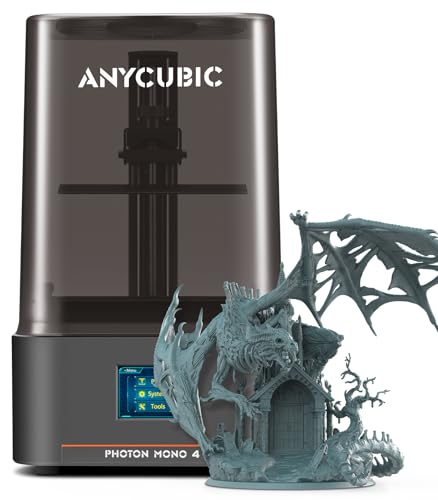
Lightweight Everyday Choice – ANYCUBIC Photon Mono 4
The ANYCUBIC Photon Mono 4 offers a practical balance for resin printers for miniatures, pairing a 10K monochrome LCD with a compact, lightweight design. Its uniform LighTurbo light source, pre-tested setup, and power-resume function make it suitable for routine hobby printing.
Best For: New and experienced hobbyists seeking detailed prints, simple setup, and a relatively light machine.
Pros:
- 10K resolution and 17 × 17-micron XY pixels support detailed miniatures.
- LighTurbo illumination is designed to reduce rasterization and visible layer lines.
- 153.4 × 87 × 165 mm build volume accommodates everyday projects.
- Power-resume printing and a pre-assembled, tested design help reduce wasted work.
Cons:
- Its build volume is more limited than larger-format models.
- The supplied notes do not mention built-in camera monitoring or automatic leveling.
The Photon Mono 4 is an appealing all-around pick for makers who want strong miniature detail without moving to a heavier, more elaborate printer setup.
Smart Fast Miniature Printer – ELEGOO Mars 5 Ultra 9K
The ELEGOO Mars 5 Ultra 9K targets miniature makers who value speed and connected features. Tilt release, resin calibration, an AI camera, smart sensors, and Wi-Fi transfer give it a convenience-focused workflow while the 9K LCD is built for detailed models.
Best For: Users who want fast miniature printing with remote file transfer and automated issue alerts.
Pros:
- Printing speeds reach up to 150 mm/h with fast and slow modes.
- 9K monochrome LCD and 18-micron XY resolution support detailed models.
- Smart sensors can flag low resin, foreign objects, and temperature issues.
- AI monitoring, Wi-Fi transfer, cluster printing, and OTA updates add convenience.
Cons:
- The supplied notes do not provide the printer’s build volume.
- AI camera detection may require user verification when identifying print problems.
The Mars 5 Ultra is a compelling choice for miniature workflows where speed, network control, and print monitoring are more important than having the largest stated capacity.
Best for Dual-Material Creativity – Photon P1
For shoppers comparing resin printers for miniatures, the Anycubic Photon P1 stands out for dual-color and dual-material printing. Its sturdy motion system, automatic leveling, and release-assistance technology are designed to make detailed model printing more consistent, while its resin compatibility extends to high-viscosity professional materials.
Best For: Creators who want to experiment with two colors or materials in one print and value automated setup and monitoring.
Pros:
- Dual-color and dual-material printing supports more creative miniature designs.
- Factory-calibrated automatic leveling reduces manual setup.
- Wave Release Technology lowers release force to help reduce failed prints.
- AI monitoring checks installation, separation, resin levels, and vat residue.
Cons:
- Its 39-pound weight and larger 28 x 14 x 13-inch footprint may require a dedicated workspace.
- The advanced dual-material capability may be more than needed for straightforward single-resin projects.
The Photon P1 is a feature-rich choice for miniature makers who want automated safeguards and unusual material flexibility. It is especially appealing if dual-material work or high-viscosity resin printing is part of your plan.
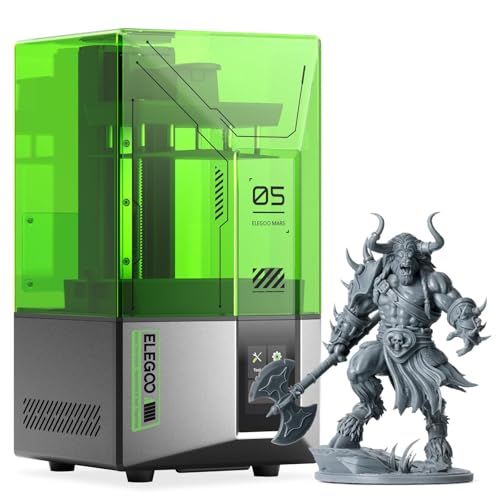
Best Beginner-Friendly Pick – ELEGOO Mars 5
The ELEGOO Mars 5 is a practical entry point for resin printers for miniatures, combining one-click automatic leveling with a 4K mono LCD and COB light source. Its self-check, residue detection, resin-shortage alerts, and overheat protection are useful for reducing setup errors and protecting the printer during routine projects.
Best For: Beginners and hobbyists who want detailed miniature prints without manual leveling and complicated initial calibration.
Pros:
- One-click automatic leveling simplifies setup for new users.
- 4K mono LCD and COB lighting support intricate details and textures.
- Self-check and mechanical residue detection can help prevent avoidable problems.
- Overheat protection pauses printing if LED temperature exceeds 80°C.
Cons:
- The supplied notes do not list dual-material or dual-color printing.
- Its feature set is focused on ease of use rather than specialized high-viscosity resin capability.
With a relatively light 14.52-pound design and straightforward automation, the Mars 5 is well suited to hobbyists building confidence with resin miniatures. Its 4K display prioritizes fine detail while the built-in checks help make the workflow less stressful.
Best for High-Speed Precision – Reflex RS Turbo
For experienced makers evaluating resin printers for miniatures, the Reflex RS Turbo emphasizes speed, dimensional accuracy, and automated process control. Its high-contrast amber screen, industrial-grade Z-axis, one-click slicing, and real-time force monitoring are aimed at producing consistent detail while reducing common print failures.
Best For: Advanced hobbyists and professional users who prioritize fast, repeatable prints and precise miniature details.
Pros:
- High-contrast amber screen is designed for crisp details and faster curing.
- One-click slicing can repair model defects and generate supports automatically.
- Force sensors detect fine residue and can automatically pause a print.
- C5 ball-screw Z-axis and calibrated LCD support precise, consistent positioning.
Cons:
- At 50.6 pounds, it is substantially heavier than the other listed options.
- The advanced systems may be excessive for casual users seeking a basic miniature printer.
- Its 15 x 23 x 15-inch dimensions call for considerable workspace.
The Reflex RS Turbo is built around controlled, high-performance production rather than minimalism. Its sophisticated monitoring and motion systems make it a strong candidate when print consistency, speed, and precision matter more than portability.
Best with Extra Features – ELEGOO Mars 5
The ELEGOO Mars 5 is a practical choice for shoppers seeking resin printers for miniatures without wanting to manage repeated manual leveling. Its automatic setup, self-check tools, and 6.6-inch 4K monochrome screen make it approachable for everyday detailed printing.
Best For: Beginners who want automated setup and dependable safety features for miniature printing.
Pros:
- Automatic leveling helps simplify initial setup.
- 6.6-inch 4K monochrome LCD offers 35×35μm resolution for detailed prints.
- Mechanical sensing, one-click self-checks, and overheat protection add useful safeguards.
Cons:
- The 6.6-inch screen may offer less printing area than larger-format alternatives.
- Its feature set is focused on daily printing rather than specialized materials or workflows.
Choose the Mars 5 if ease of use matters as much as detail. Automatic leveling and built-in diagnostics reduce common setup frustrations, while the 4K screen supports miniature-sized features.
Best Detail-Focused Pick – ANYCUBIC Photon Mono 4
For shoppers comparing resin printers for miniatures, the ANYCUBIC Photon Mono 4 stands out for its 10K screen and 17×17μm pixel precision. Its stabilized light source, upgraded build plate, and factory calibration are designed to make high-detail printing easier to start.
Best For: Miniature makers prioritizing fine detail, smoother surfaces, and a quick setup.
Pros:
- 7-inch 10K display provides 9024×5120 resolution and 17×17μm pixel precision.
- LighTurbo matrix lighting supports stable curing and 1.5-second exposures.
- Factory calibration, four-point leveling checks, and power-failure recovery improve convenience.
- Laser Engraving Platform 2.0 is designed to improve adhesion and reduce shedding or warping.
Cons:
- The feature set is centered on high-detail resin printing rather than broader printer versatility.
- A quick leveling check is still required before printing.
The Photon Mono 4 is a strong fit when miniature detail is the main priority. Its high-resolution screen is the headline feature, while the calibrated setup and recovery function help reduce avoidable interruptions.
Best Resin Value – SUNLU Standard Resin Plus
The SUNLU Standard Resin Plus is a budget-conscious consumable for owners of resin printers for miniatures. Its low shrinkage, smooth post-processing, broad 365–405nm compatibility, and 1KG size make it useful for regular model production.
Best For: Hobbyists who want an affordable, easy-to-clean standard resin for routine miniature printing.
Pros:
- Low shrinkage supports accurate part dimensions and shapes.
- Hard, smooth surfaces are easy to post-process and paint.
- Compatible with LCD, DLP, and SLA printers using 365–405nm wavelengths.
- Light odor, easy cleaning with isopropyl alcohol or ethanol, and a leak-proof bottle design add convenience.
Cons:
- It is standard resin, so the notes do not indicate specialized toughness or flexible performance.
- The product is a consumable rather than a printer, so printer setup and calibration remain separate.
SUNLU Standard Resin Plus makes sense for miniature painters and hobbyists who need a dependable everyday material at a lower cost. Its compatibility and easy post-processing are especially helpful when producing multiple models.
How We Picked These Resin Printers for Miniatures
We focused on the features that most affect miniature printing: XY resolution, screen type, exposure consistency, build volume, ease of leveling, monitoring and safety features, and overall usability. The selection includes compact beginner machines, larger-format printers for batches, high-resolution models for intricate sculpts, and a resin option designed for common LCD, DLP, and SLA wavelengths.
Resolution is only one part of the decision. A printer with dependable mechanics, clear controls, and readily available replacement parts can be a better long-term choice than a technically sharper model with a more difficult workflow.
Quick Comparison
| Best For | What to Prioritize | Shortlist Types |
|---|---|---|
| First-time users | Simple setup, reliable leveling, manageable size | Beginner-focused Mars and Photon models |
| Maximum fine detail | High pixel density and consistent exposure | 8K, 9K, 10K, and 16K printers |
| Batch printing | Larger build plate and dependable throughput | Saturn-class printers |
| Flexible material workflows | Compatible resin profiles and curing control | Standard LCD resin and dual-material options |
Key Buying Factors for Resin Printers for Miniatures
Resolution and Miniature Detail
For small figures, XY resolution affects how cleanly the printer reproduces faces, textures, weapons, and other narrow features. Higher resolutions can reduce visible pixel structure, but model orientation, supports, exposure settings, and resin quality still have a major effect on the finished surface.
Build Volume and Batch Size
A compact printer is often sufficient for individual figures and uses less workspace. Choose a larger build plate if you regularly print squads, terrain accessories, or multiple parts in one job. More volume can improve productivity, but it also increases resin use and may require more room for ventilation and cleanup.
Workflow and Maintenance
Look for practical features such as a stable build platform, straightforward leveling, a responsive interface, and sensors that help detect common problems. Resin printing still requires washing, post-curing, vat maintenance, screen protection, and careful handling of uncured resin.
Resin Compatibility and Safety
Confirm that the printer supports the resin wavelength and follow the manufacturer’s exposure recommendations. Wear suitable gloves and eye protection, provide ventilation, and keep uncured resin away from children, pets, food-preparation areas, and skin.
Who Should Buy Which Resin Printers for Miniatures?
Beginners: Choose a compact model with simple setup, clear controls, and accessible replacement parts. A smaller machine is easier to learn on and less demanding to clean.
Detail-focused miniature painters: Prioritize high pixel density, stable exposure, and reliable support settings. High-resolution 8K or better models are appealing when tiny surface detail is the main goal.
Gamers printing armies: Select a larger-format printer with enough plate space for repeated batches. Faster production can matter more than maximum resolution when printing many standard-sized figures.
Experienced hobbyists: Consider advanced monitoring, dual-material capability, or a higher-end build platform if those features solve a specific workflow problem. Regardless of model, plan for a wash-and-cure station, ventilation, spare release film, and a tested resin profile.