Digitizing family albums, prints, slides, and negatives takes the right scanner, not just the fastest one. The best picks balance image quality, handling flexibility, and speed.
This roundup of photo scanners for archival collections focuses on dependable options for preserving memories with cleaner files, easier organization, and less rework later.
Best 10 Photo Scanners for Archival Collections Picks for 2026
Fast bulk photo digitizing

- Scans thousands of photos quickly, up to 1 photo per second.
- Batch-scans up to 36 photos and captures backs in duplex.
- Offers 300 dpi, 600 dpi TIFF, and 1200 dpi options.
Best For: Large archival photo projects and stacks of printed photos
Film and slide conversion made simple
Magnasonic FS71 24MP Film Scanner

- Scans 35mm, 110, 126, and Super 8 film plus slides.
- Creates 24MP JPEG files without needing a computer.
- Has a 5-inch LCD and SD card support for easy saving.
Best For: Film negatives and slides in a simple standalone workflow
High-detail flatbed archiving

- 4800 dpi resolution for detailed photo scans and enlargements.
- High-rise removable lid helps with books and photo albums.
- Easy Photo Fix restores faded photos with one click.
Best For: Detailed scanning of albums, books, and loose archival prints
Speed-focused photo stack scanning

- Scans a 4x6 photo in about 2 seconds.
- Supports 3x5, 4x6, 5x7, 8x10, letter, and A4 sizes.
- Includes auto crop, deskew, and enhancement tools.
Best For: Fast digitizing of large piles of printed photos
Flatbed Precision Pick
Epson Perfection V39 II for Detailed Photo Scans

- 4800 dpi optical resolution for sharp detail
- Easy Photo Fix helps revive faded photos
- Compact flatbed handles photos, books, and documents
Best For: Careful home archival scanning with restoration needs
Portable Travel Pick
Handheld Photo Scanner for Simple Archiving

- Portable handheld scanner runs on 2 AA batteries
- Saves JPG/PDF files directly to micro SD card
- Offers 300, 600, and 900 dpi scan modes
Best For: On-the-go scanning where portability matters most
Compact Standalone Scanner
ClearClick QuickConvert 2.0 Photo Scanner
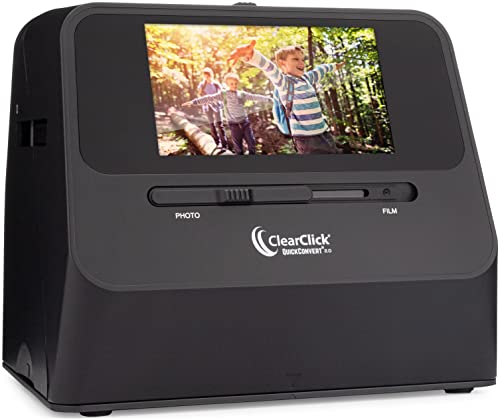
- Scans 4x6 photos or smaller, plus 35mm/110/126 film
- No computer required; saves JPEGs to SD card
- Rechargeable battery and 5" preview screen
Best For: Quick no-computer digitizing of small prints, slides, and negatives
Portable Sheetfed Option
HP Small USB Photo & Document Scanner

- Portable USB-powered sheetfed scanner
- Works with Windows and Mac via HP WorkScan
- Handles photos, receipts, cards, and paper
Best For: Travel-friendly scanning of photos and mixed paper documents
Archival Detail Scanner
AMBIR Photo Scanner Bundle with Cleaning Kit

- 300/600 DPI scanning for archival-quality output
- Supports many print sizes up to panoramic images
- Includes cleaning kit, carrier sheet, and editing software
Best For: Restoring, organizing, and digitizing printed photo archives
Fast bulk photo digitizing – Epson FastFoto FF-680W
If you need photo scanners for archival collections and want to move a large backlog quickly, the Epson FastFoto FF-680W is built around speed and convenience. It can scan thousands of photos as fast as 1 photo per second at 300 dpi, batch-scan up to 36 photos at once, and preserve fronts and backs in a single duplex pass.
Best For: Large photo archives, family history projects, and anyone digitizing boxes of prints with handwritten notes.
Pros:
- Scans up to 36 photos at a time for fast batch work.
- Duplex scanning captures handwritten notes on the back in one pass.
- Flexible output options include 300 dpi, 600 dpi TIFF for archiving, and 1200 dpi for enlarging.
- Includes auto enhancement, color restoration, red-eye reduction, de-skew, crop, and rotate tools.
Cons:
- Designed for photos and documents rather than slides or film negatives.
- Best results depend on using the right software and scan settings for each task.
For high-volume preservation work, this scanner stands out because it combines speed, duplex capture, and archiving-friendly file options. It is a strong fit when the main goal is getting an entire print collection digitized efficiently without losing annotations.
Film and slide conversion made simple – Magnasonic FS71 24MP Film Scanner
For photo scanners for archival collections that include negatives and slides, the Magnasonic FS71 offers a simple standalone workflow. It converts 35mm, 110, 126, and Super 8 film as well as 135, 126, and 110 slides into 24MP JPEG files, and it does not require a computer to operate.
Best For: Home archive projects focused on film negatives and slides with a straightforward no-PC setup.
Pros:
- Converts multiple film and slide formats, including 35mm, 110, 126, and Super 8.
- Produces 24MP digital JPEG files.
- Built-in 5-inch LCD and HDMI output make reviewing scans easy.
- SD card support lets you save images directly without computer software.
Cons:
- Limited to film and slides rather than loose paper photos.
- Expandable SD storage requires a card, which is not included.
This is a practical choice if your archival work centers on older film media and you want a fast, self-contained scanner. The built-in display and manual adjustments keep the process simple, though it is less versatile than a flatbed for mixed collections.
High-detail flatbed archiving – Epson Perfection V19 II
If you need photo scanners for archival collections that include albums, books, artwork, and loose prints, the Epson Perfection V19 II offers the detail of a 4800 dpi flatbed in a compact USB-powered design. Its high-rise removable lid makes it easier to scan thicker items such as photo albums and books, while Easy Photo Fix helps restore faded images with one click.
Best For: Detailed scanning of photos, albums, books, and mixed paper archives in a compact footprint.
Pros:
- 4800 dpi optical resolution supports detailed photo enlargements.
- High-rise removable lid is useful for books and photo albums.
- Easy Photo Fix can restore color to faded photos with one click.
- USB-powered and lightweight for portable archive work.
Cons:
- Single-item flatbed scanning is slower than bulk-feed photo scanners.
- Standard sheet capacity is 1, so large batches take more time.
This scanner is a strong pick when image quality matters more than speed, especially for fragile albums or mixed archival materials. It is less efficient for large stacks, but the flatbed format gives you more control over delicate originals.
Speed-focused photo stack scanning – Plustek ePhoto Z300
Among photo scanners for archival collections, the Plustek ePhoto Z300 is aimed at fast scanning of loose prints with minimal fuss. It scans a 4×6 photo in about 2 seconds, handles common print sizes up to 8×10, and includes auto crop, deskew, and image enhancement to help clean up old photos as you go.
Best For: Quickly digitizing large piles of printed photos on Mac or PC.
Pros:
- Scans a 4×6 photo in about 2 seconds and an 8×10 in about 5 seconds.
- Supports common photo sizes from 3×5 to 8×10, plus letter and A4 paper.
- Auto crop, deskew, and enhancement tools help streamline cleanup.
- Compatible with both Mac and PC.
Cons:
- Single-sheet feed means you insert photos one at a time.
- Maximum resolution is 600 dpi, so it is less suited to ultra-high-detail archival enlargements.
This model is best when your priority is throughput rather than maximum flatbed-style flexibility. It can be a strong archive tool for large print collections, especially if you want quick digitizing without spending extra time on manual corrections.
Flatbed Precision Pick – Epson Perfection V39 II for Detailed Photo Scans
If you want photo scanners for archival collections that prioritize detail and simple handling, the Epson Perfection V39 II is a strong flatbed option. Its 4800 dpi optical resolution is aimed at clear enlargements, and the included ScanSmart and Easy Photo Fix tools make it practical for restoring faded prints and managing mixed scan jobs.
Best For: Home archivists, family photo projects, and users who want a compact flatbed for photos, books, and documents.
Pros:
- 4800 dpi optical resolution for detailed photo captures
- Easy Photo Fix can restore color to faded photos with one click
- ScanSmart supports oversized image stitching and cloud storage
- High-rise removable lid helps with books and thick originals
Cons:
- Flatbed design is slower than feeder-based scanners for large batches
- Standard sheet capacity is only 1, so it is built for one-at-a-time scanning
- Best for careful archival work rather than high-volume throughput
Overall, this is a practical choice when image quality and restoration matter more than speed. It fits well for users building a careful digital archive of photos, artwork, and household documents.
Batch-Speed Pick – Canon imageFORMULA RS40 for Mixed Photo Archives
For photo scanners for archival collections that need speed and batch handling, the Canon imageFORMULA RS40 is built around an automatic feeder. It scans old and new photos in varying sizes, includes enhancement software for common photo cleanup tasks, and supports both Windows and Mac for a straightforward digitizing workflow.
Best For: Users digitizing stacks of mixed-size photos and documents who want faster, feeder-based scanning.
Pros:
- Automatic feeder supports faster batch scanning up to 40 items per minute
- Scans both sides at the touch of a button
- Bundled software adds red-eye correction and digital face smoothing
- Handles photos, Polaroids, receipts, cards, and documents of various sizes
Cons:
- Less suited to fragile originals than a flatbed scanner
- Uses interpolated resolution figures up to 1200 dpi rather than a high flatbed optical spec
- Requires more desk space than a compact handheld scanner
This is the most efficient option here when volume and variety matter. It makes sense for users who want to move through a collection quickly while still having software support for photo cleanup.
Portable Travel Pick – Handheld Photo Scanner for Simple Archiving
If you need photo scanners for archival collections that can travel anywhere, this handheld model focuses on portability and direct file storage. It scans to JPG or PDF, offers 300/600/900 dpi options, and saves straight to the included memory card without software installation, which is handy for lightweight archiving on the go.
Best For: Travelers, field users, and casual archivists who want a compact scanner for photos and documents away from a desk.
Pros:
- Portable handheld design powered by 2 AA batteries
- Supports 300, 600, and 900 dpi scan modes
- Saves directly to an included 16GB micro SD card
- No software installation required for basic use
Cons:
- Handheld scanning is less consistent than a flatbed for careful archival work
- Requires batteries and a memory card to operate
- Best for simple capture, not advanced restoration features
This model is about convenience first, not perfection. It is a reasonable fit when you want a lightweight way to capture photos and documents immediately and keep them portable.
Compact Standalone Scanner – ClearClick QuickConvert 2.0 Photo Scanner
If you want photo scanners for archival collections that focus on speed and simplicity, the ClearClick QuickConvert 2.0 is built for one-at-a-time conversion of prints, slides, and negatives. It scans 4×6 photos or smaller, 35mm, 110, and 126 film, and saves JPEG files directly to an SD memory card without needing a computer or drivers.
Best For: Quick standalone digitizing of small photo prints, slides, and negatives when you want a simple no-computer workflow.
Pros:
- Scans 4×6 photos or smaller, plus 35mm, 110, and 126 film
- No computer or drivers required; saves JPEGs to SD memory card
- Built-in rechargeable battery supports cord-free scanning
- 5″ LCD preview makes it easy to review scans on the device
Cons:
- Scans one item at a time, with no autofeeder
- Does not support 5×7 photos
- Designed for smaller originals rather than mixed batch jobs
For basic archival work where convenience matters more than batch speed, this scanner keeps the process straightforward. Its strong fit is converting small-format prints and film directly to digital files with minimal setup.
Portable Sheetfed Option – HP Small USB Photo & Document Scanner
Among photo scanners for archival collections, the HPPS100 is best suited to users who also need a lightweight sheetfed scanner for mixed document and image jobs. It supports photos along with receipts, cards, and paper, connects by USB, and works with Windows and Mac through HP WorkScan software.
Best For: Portable scanning of photos and documents when you need a lightweight USB scanner for home, office, or travel.
Pros:
- Portable, compact design with USB power and included cable
- Works with Windows and Mac and includes HP WorkScan software
- Supports photos, receipts, cards, and other paper documents
- Offers 1200 dpi resolution and PDF/JPG output options
Cons:
- Simplex one-sided scanning only
- 300 dpi listed in the details, so resolution specs vary by source
- Sheetfed design is less ideal for fragile loose originals than dedicated photo scanners
This model makes sense if your archive work is part of a broader scanning workflow. It is less specialized for photo restoration than dedicated photo scanners, but it is very practical when portability and versatility matter.
Archival Detail Scanner – AMBIR Photo Scanner Bundle with Cleaning Kit
If you are comparing photo scanners for archival collections, the AMBIR bundle stands out for higher-resolution photo digitizing and cleanup tools. It scans printed photos in seconds, supports sizes from 1″x1″ up to panoramic images, and gives you 300 or 600 DPI options for archival-quality output.
Best For: Archival photo scanning with editing and cleanup tools for restoring and organizing printed images.
Pros:
- 300/600 DPI scanning supports higher-detail archival work
- Handles a wide range of print sizes, including panoramas up to 12″
- Includes cleaning kit and protective carrier sheet for delicate photos
- Software adds auto crop, deskew, restore, organize, and editing tools
Cons:
- Focused on printed photos rather than slides or negatives
- Requires USB-connected scanning to a Mac or PC
- More software-oriented workflow may be more involved than basic one-button scanners
For preservation projects where image quality and organization matter, this is the most feature-rich option in the group. It is especially useful when you want both scanning and post-scan cleanup in one package.
How We Picked These Photo Scanners for Archival Collections
We prioritized scan quality, media compatibility, ease of use, and workflow speed. For archival work, the ability to preserve fine detail and handle mixed photo sizes matters more than raw megapixels or marketing claims.
We also considered whether a scanner is better suited to loose prints, albums, film, or mixed home archives, since no single model is ideal for every collection.
Quick Comparison: Which Scanner Type Fits Your Archive?
Sheetfed photo scanners are best for large batches of loose prints and fast sorting. Flatbeds are better for fragile prints, scrapbook pages, and items that need careful placement. Dedicated film scanners and all-in-one film units are the better choice if slides and negatives are a major part of the archive.
Portable and handheld scanners can help with on-the-go jobs, but they usually make the most sense as secondary tools rather than primary archival scanners.
Key Buying Factors for Photo Scanners for Archival Collections
Resolution and Detail
Look for enough optical resolution to preserve text, faces, and print texture. For prints, a good flatbed or high-quality sheetfed scanner is usually sufficient; for film, higher-quality capture and clean optics matter even more.
Media Handling
Think about what you actually own: loose 4×6 prints, panoramas, mounted slides, negatives, or oversized scrapbook pages. The best scanner is the one that matches your archive without forcing constant compromises.
Dust, Skew, and Color Recovery
Automatic crop, deskew, and color enhancement can save time, especially on older prints. Still, manual control is valuable when originals are faded, curled, or especially precious.
Speed Vs. Care
Fast duplex scanners are excellent for high-volume jobs, but delicate originals may need the gentler pace of a flatbed. For archival collections, efficiency should never come at the cost of damaging originals.
Who Should Buy Which Photo Scanners for Archival Collections?
If your priority is scanning stacks of family photos quickly, choose a sheetfed model. If you need the most careful handling for heirlooms, pick a flatbed. If slides and negatives are central to the collection, go with a dedicated film scanner or combo unit.
For mixed archives, the most practical approach is often one primary scanner for prints plus a separate film solution. That combination gives you better results across different materials than trying to force one device to do everything.