Reliable grain moisture testing helps prevent spoilage, storage losses, rejected loads, and inaccurate pricing. The best moisture balance depends on whether you need quick field checks or repeatable laboratory analysis.
We selected 10 moisture-testing instruments spanning portable grain meters, probe testers, and halogen analyzers, so you can match testing speed, accuracy, capacity, and workflow to your operation.
Best 10 Moisture Balances for Grains Picks for 2026
Field Grain Checks
MT-PRO+ Portable Grain Moisture Meter

- Reads across 40 grain scales
- Averages selectable test counts
- Backlit multilingual display
Best For: Portable, multi-grain field testing
Precision Lab Testing
110g 1mg Halogen Moisture Analyzer

- 1 mg weight readability
- 0.01% moisture measurement
- 15 methods and RS-232 output
Best For: Repeatable laboratory and production testing
Hay Bale Monitoring

- 20-inch reinforced probe
- Reads moisture and temperature
- Includes calibration clip and carry bag
Best For: Deep checks of hay and forage bales
Routine Sample Analysis
110g 5mg Halogen Moisture Analyzer
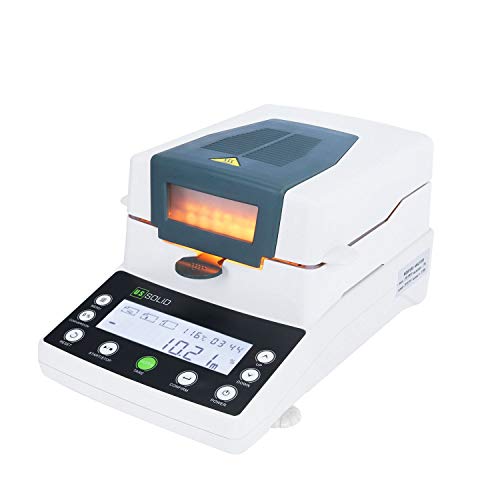
- 5 mg weight readability
- 0.1% moisture readability
- 15 methods and 50 sample pans
Best For: Routine benchtop grain and material testing
Practical Lab Pick
Touchscreen Grain Moisture Analyzer

- 110 g capacity with 0.05% moisture readability
- Three drying modes and up to 160°C operation
- 20-method memory, RS-232, and 50 pans included
Best For: Small labs needing easy touchscreen testing and repeatable workflows
High-Resolution Choice
UXILAII 1 mg Moisture Analyzer

- 0.001 g weight and 0.01% moisture readability
- 450 W halogen heating from 40–185°C
- Stores 32 methods with multilingual touchscreen controls
Best For: Research and agricultural labs needing fine resolution and flexible programming
Workflow-Focused Option
GS110 Rapid Halogen Moisture Balance

- 1 mg accuracy with 40–160°C adjustment
- 1–99 minute timed testing with automatic monitoring
- Stores 20 results and supports printer output
Best For: Production and lab users needing quick, documented moisture tests
Precision Lab Pick
120g Halogen Moisture Analyzer
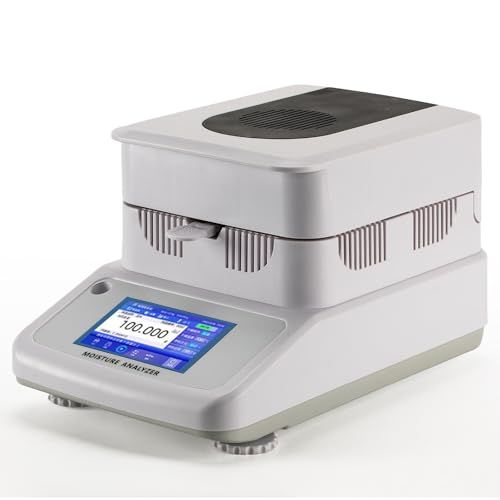
- 0.01% moisture readability and 0.002g weight readability
- Stores up to 100 records with RS232 output
- Four heating programs from 40–180°C
Best For: Laboratories and industrial grain-testing workflows
Portable Testing Value
- 40–160°C temperature range with 1°C adjustment
- 1–99 minute programmable heating duration
- Stores 20 results and supports printer output
Best For: Portable grain, food, plant, and general sample testing
Method-Storage Choice
120g Touchscreen Moisture Analyzer
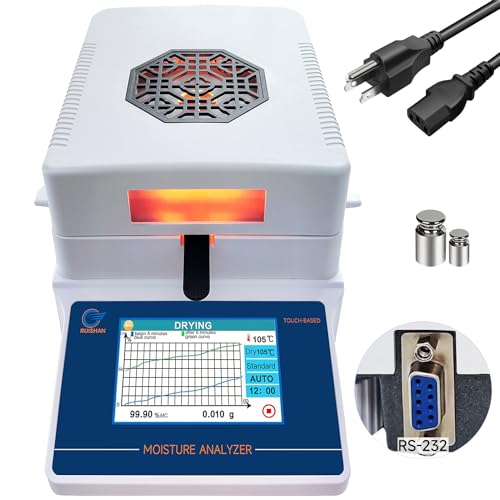
- Stores up to 32 preset research methods
- Three drying modes and two ending modes
- 0.01% readability with RS232 connectivity
Best For: Repeatable grain and laboratory testing procedures
Field Grain Checks – MT-PRO+ Portable Grain Moisture Meter
For quick moisture balances for grains in the field, the AgraTronix MT-PRO+ offers direct readings across 40 grain scales in a portable, easy-to-carry design. Automatic averaging, a backlit interface, and a multilingual display make it practical for repeated checks in changing working conditions.
Best For: Farmers, grain handlers, and field users who need portable testing across multiple grain types.
Pros:
- Supports direct readings for 40 grain scales.
- Automatically averages a selectable number of tests.
- Backlit, multilingual display supports low-light use.
- USB connectivity allows personalization and firmware or diagnostic updates.
Cons:
- Its supplied notes do not specify a measurement accuracy or moisture range.
- Battery operation and the included carrying case are more suited to portable checks than fixed laboratory workflows.
The MT-PRO+ is a versatile choice when portability and broad grain-scale coverage matter more than laboratory-style sample drying. Its averaging and update features can also support consistent routine testing.
Precision Lab Testing – 110g 1mg Halogen Moisture Analyzer
For controlled moisture balances for grains, this U.S. Solid analyzer combines 1 mg weighing readability with 0.01% moisture measurement. Its 450 W halogen heater, adjustable drying range, stored methods, and RS-232 output make it suited to repeatable testing in lab, food, and industrial settings.
Best For: Laboratories and production environments that need repeatable, data-exportable grain and material moisture testing.
Pros:
- Handles samples up to 110 g with 1 mg readability.
- Measures moisture to 0.01% using simultaneous drying and weighing.
- Offers standard, fast, and soft drying modes up to 199°C.
- Stores 15 methods and includes RS-232 connectivity plus 50 sample pans.
Cons:
- It is a 110V AC analyzer rather than a portable field meter.
- The supplied notes describe general-purpose testing, so users may need to establish appropriate methods for specific grains.
This is the strongest fit of the group for precision-oriented, repeatable sample testing. Method storage and result-display options help standardize workflows, while RS-232 supports recordkeeping or printing.
Hay Bale Monitoring – 20-Inch Probe Moisture Tester
For moisture balances for grains and forage-related materials, this hay tester is designed to reach deep into dense square or round bales. It reads hay moisture from 8% to 45% and temperature from 32°F to 210°F, helping with checks before storage, transport, or handling.
Best For: Hay producers and farm users checking bale conditions in fields, barns, trailers, or storage areas.
Pros:
- 20-inch reinforced stainless steel probe reaches into dense bales.
- Measures both moisture and temperature.
- Backlit LCD and large buttons support field and low-light use.
- Includes a calibration clip and carry bag.
Cons:
- It is designed specifically around hay, alfalfa, forage, and mixed hay rather than broad grain-scale coverage.
- The required 9V battery is not included.
- Its stated moisture range is limited to 8%–45%.
This is a practical bale-focused option when deep probing matters more than laboratory precision. The temperature readout and included calibration clip add useful context for storage decisions.
Routine Sample Analysis – 110g 5mg Halogen Moisture Analyzer
For routine moisture balances for grains, this U.S. Solid halogen analyzer provides 5 mg weight readability and 0.1% moisture readability while drying and weighing samples together. Preset methods, selectable drying modes, and RS-232 output support repeatable food, grain, chemical, and laboratory testing.
Best For: Users who want a benchtop analyzer for repeatable grain and general material testing without the higher stated readability of the 1 mg model.
Pros:
- Supports samples up to 110 g with 5 mg readability.
- Measures moisture to 0.1% with a 450 W halogen heater.
- Offers standard, fast, and soft drying modes up to 199°C.
- Stores 15 method groups and includes RS-232 plus 50 sample pans.
Cons:
- Its stated readability is lower than the 1 mg analyzer in this roundup.
- It requires 110V AC power and is not intended as a field-portable meter.
- The supplied notes do not specify grain-specific calibration procedures.
This analyzer balances useful repeatability with a straightforward feature set for routine work. It is a sensible choice when 0.1% moisture readability is adequate and stored methods are more important than handheld portability.
Practical Lab Pick – Touchscreen Grain Moisture Analyzer
For routine moisture balances for grains, the U.S. Solid analyzer combines 0.05% moisture readability with a 110 g capacity and halogen drying. Its touchscreen controls and multiple result displays make it a practical option for labs testing grain alongside food, plastics, textiles, or chemicals.
Best For: Small laboratories that want straightforward touchscreen operation, multiple drying modes, and basic data export.
Pros:
- Measures up to 110 g with 0.005 g weight readability and 0.05% moisture readability.
- Offers standard, fast, and soft drying modes with temperatures adjustable up to 160°C.
- Stores up to 20 methods and includes RS-232 connectivity plus 50 sample pans.
Cons:
- Its 160°C maximum is lower than some competing analyzers.
- Manual calibration requires a 100 g calibration weight.
This is a well-rounded choice when ease of use and included accessories matter as much as measurement precision. The 20-method memory and sample-pan supply are especially useful for repeat testing.
High-Resolution Choice – UXILAII 1 mg Moisture Analyzer
When moisture balances for grains require fine weight resolution, the UXILAII offers 0.001 g readability and 0.01% moisture readability. Its 450 W halogen heater reaches 185°C, while stored methods and multilingual controls support repeated laboratory testing.
Best For: Food, agriculture, pharmaceutical, and research labs that prioritize fine readability and flexible method storage.
Pros:
- Provides 0.001 g weight readability and 0.01% moisture readability.
- Uses 450 W heating from 40–185°C with standard, fast, and soft drying modes.
- Stores up to 32 methods, supports four languages, and connects to a printer or computer through RS-232.
Cons:
- The heating unit and container become hot after testing and require careful handling.
- Aluminum pans are not listed as included and may need to be purchased separately.
- Calibration with weights is required before testing.
The UXILAII stands out for its finer stated readability and higher heating range. It is a strong fit for users who need more stored procedures and broader control over lab workflows.
Workflow-Focused Option – GS110 Rapid Halogen Moisture Balance
For moisture balances for grains where faster results and recordkeeping are priorities, the GS110 uses halogen heating and real-time weight monitoring to complete tests in minutes. Adjustable temperature, timed runs, historical storage, and printer support make it suitable for laboratory or production workflows.
Best For: Food, grain, plant, chemical, soil, wood, paper, and building-material testing where quick documented results are useful.
Pros:
- Offers 1 mg accuracy with adjustable heating from 40–160°C in 1°C increments.
- Supports heating durations from 1 to 99 minutes and automatically monitors the test.
- Stores up to 20 historical results and includes printer connectivity with adjustable baud rates.
Cons:
- The supplied notes do not state a moisture-readability percentage.
- Its 160°C maximum is below the UXILAII’s 185°C range.
- The included accessory set may be more than needed for occasional testing.
This model is compelling for users who value a guided, time-controlled process and organized result output. The included 20 pans, calibration weight, and printer interface help support regular testing from the outset.
Precision Lab Pick – 120g Halogen Moisture Analyzer
For laboratories and production environments that need detailed moisture balances for grains, this analyzer combines a 450W halogen lamp, PT-100 temperature sensor, and 0.002g weight readability. Its touchscreen controls and selectable heating programs make it practical for repeatable testing across different sample types.
Best For: Labs and industrial users needing high-resolution measurements, multiple drying modes, and onboard test records.
Pros:
- Offers 0.01% moisture readability and 0.002g weight readability.
- Stores up to 100 test records and supports RS232 data output.
- Provides standard, mild, fast, and slow heating programs from 40–180°C.
- Includes a touchscreen, calibration weight, sample tray, and windproof cover.
Cons:
- Its laboratory-oriented feature set may be more than occasional users need.
- The unit is designed for 110V operation.
This is the strongest option here for users who value recordkeeping and precise control over testing conditions. The 120g capacity and flexible drying settings also suit grain-related work alongside broader laboratory applications.
Portable Testing Value – GS110 Halogen Moisture Meter
If you want portable moisture balances for grains and other materials, the GS110 offers quick halogen drying with adjustable temperature and test duration. It monitors weight changes in real time and displays moisture results after a test that can be completed in minutes.
Best For: Users who need compact, straightforward moisture testing for grains, food, plants, and varied lab or production samples.
Pros:
- Adjusts temperature from 40–160°C in 1°C increments.
- Supports heating durations from 1 to 99 minutes.
- Stores up to 20 historical results and includes a printer interface.
- Includes 20 aluminum weighing pans, a calibration weight, and a wind cover.
Cons:
- Its 20-record storage is smaller than the capacity of some competing models.
- The listed readout accuracy is 0.01g, rather than the finer 0.002g specification of the first model.
The GS110 is a practical choice when speed, portability, and simple operation matter more than extensive onboard storage. Its broad sample compatibility makes it useful beyond grain testing, though users needing detailed long-term records may prefer a larger database.
Method-Storage Choice – 120g Touchscreen Moisture Analyzer
For repeat grain testing, this 120g analyzer provides moisture balances for grains with three drying modes, two ending modes, and storage for up to 32 research methods. Its halogen lamp and touchscreen interface are designed to streamline quick measurements while preserving customizable test settings.
Best For: Grain, food, and materials testing where users need saved procedures, flexible drying controls, and RS232 connectivity.
Pros:
- Provides 0.01% moisture readability with a 120g maximum capacity.
- Stores up to 32 preset research methods for repeatable testing.
- Offers standard, fast, and soft drying modes plus automatic or timed endings.
- Supports RS232 connection to a printer or computer.
Cons:
- Its method storage is smaller than the 100-record database of the first model.
- The listed heating range begins at 50°C, which may be less flexible for some low-temperature samples.
This model stands out for operators who repeatedly run established procedures and want to recall them quickly. Its 50–180°C range, 120g capacity, and included calibration weight make it a well-rounded fit for grain and general laboratory samples.
How We Picked the Best Moisture Balances for Grains
We focused on the specifications that matter most in real grain-testing workflows: measurement precision, sample capacity, drying or testing range, portability, operating controls, and repeatability. Portable meters are useful for checking loads in the field, truck, bin, or receiving area, while halogen moisture analyzers are better suited to controlled testing with weighed samples.
We also considered practical features such as temperature measurement, reinforced probes, touchscreen controls, drying modes, built-in data storage, RS232 connectivity, and included sample dishes. Because listed specifications vary across models, confirm the manufacturer’s calibration guidance and supported grain types before purchase.
Quick Comparison
- Best for rapid field checks: Portable grain moisture meters with simple displays and compact designs.
- Best for hay and bale testing: A long reinforced probe with temperature readings and sufficient reach.
- Best for laboratory work: Halogen analyzers with controlled heating, programmable drying, and fine readability.
- Best for repeatable workflows: Models with touchscreen controls, databases, multiple drying modes, or RS232 output.
- Best for occasional testing: A straightforward analyzer that offers adequate capacity without unnecessary connectivity features.
Key Buying Factors for Moisture Balances for Grains
Accuracy and Readability
Readability is not the same as guaranteed accuracy. A display showing 0.001 g or 0.01% can be useful for precise laboratory comparisons, but results also depend on calibration, sample preparation, temperature, and the grain’s uniformity. For trading or compliance decisions, prioritize documented accuracy and calibration support.
Testing Method and Speed
Portable meters typically provide quick readings with minimal preparation. Halogen balances heat a weighed sample and calculate moisture loss, which can offer more controlled results but requires sample handling and a drying cycle. Look for adjustable temperatures, automatic shutoff, and multiple drying modes when testing different grains or sample conditions.
Capacity and Sample Preparation
A capacity around 110 g is common among the analyzers in this roundup and is adequate for many routine samples. Check pan size, included dishes, and whether the instrument can accommodate your typical sample volume. Consistent grinding, mixing, and sample weighing are essential for comparable readings.
Portability and Durability
Choose a portable meter for inspections across fields, bins, elevators, and receiving docks. For a fixed lab bench, a halogen analyzer may provide better control and documentation. If testing hay or bales, probe length and construction matter as much as display precision.
Data Handling and Controls
Touchscreens, stored test methods, built-in databases, and RS232 interfaces can reduce transcription errors and support quality-control records. These features are most valuable when multiple operators perform frequent tests.
Who Should Buy Which Moisture Balances for Grains?
Farmers and grain buyers should generally choose a portable grain meter for fast decisions at harvest, delivery, or storage. Hay producers need a dedicated probe tester designed for bales and longer sampling reach. Feed mills, elevators, and quality-control teams may benefit from a halogen analyzer with repeatable heating programs and data connectivity. Laboratories and research users should prioritize fine readability, stable temperature control, calibration options, and a documented operating procedure.
Whichever model you choose, verify its supported grain or material modes, maintain calibration, test representative samples, and follow the manufacturer’s sample-preparation instructions. Those practices often have a greater effect on useful results than choosing the smallest advertised increment.