Microcontroller kits with sensors make it easier to learn electronics by combining a development board, plug-in modules, wiring, and project ideas in one package. The right kit can help beginners build useful prototypes faster while giving experienced makers a broad testing platform.
We selected these 10 kits for their sensor variety, platform compatibility, included accessories, documentation, and suitability for Arduino, ESP32, Raspberry Pi, and other popular boards.
Best 10 Microcontroller Kits with Sensors Picks for 2026
Best Sensor Module Variety

- 37 sensor, display, timing, and control modules
- Works with several Arduino-compatible and other boards
- Tutorials, wiring diagrams, and example code included
Best For: Expanding an existing compatible microcontroller setup
Best Connected Camera Kit
ESP32 Camera Ultimate Starter Kit

- ESP32 camera board with Wi-Fi and Bluetooth
- 240 components and 122 guided projects
- MicroPython, C, and Processing examples
Best For: ESP32 camera and connected electronics projects
Best Organized Sensor Assortment

- 37 modules for sensing, control, and beginner projects
- Online Wiki includes wiring diagrams and test code
- Organized case with component identification card
Best For: Arduino or Raspberry Pi learning projects
Best Complete Beginner Bundle

- Includes UNO R3 board, breadboard, power module, and wiring
- 22-plus guided projects with sensors and motors
- Solderless setup with pre-soldered LCD header
Best For: First Arduino projects and structured STEM learning
Most Versatile Sensor Collection

- 46 labeled modules with displays, inputs, and sensors
- Works with ESP32, Pico, STM32, and other boards
- Includes tutorials and a storage case
Best For: Broad STEM and maker experimentation
Best Connected Learning Platform

- ESP-32 board includes Wi-Fi and Bluetooth 4.2
- 35+ modules and components for varied projects
- 30+ guided Arduino IDE projects included
Best For: IoT-focused beginners and progressing makers
Best Arduino Sensor Variety

- 48 sensors and modules for interactive projects
- Includes motion, gas, pressure, sound, and display parts
- Arduino wiring guides and example code provided
Best For: Arduino users with an existing controller board
Most Versatile
SunFounder Universal Maker Sensor Kit

- Works with Arduino, Raspberry Pi, Pico W, and ESP32
- Includes 25+ modules and 169 guided projects
- Supports C/C++, Python, and MicroPython learning
Best For: Multi-platform learners and advanced makers
Largest Sensor Assortment

- Includes 37 sensor and module types
- Covers light, sound, motion, magnetic, and touch inputs
- Designed for Arduino and Raspberry Pi projects
Best For: Experimenters who want maximum module variety
Beginner-Focused Pick
UMLIFE 22-in-1 Sensor Module Kit
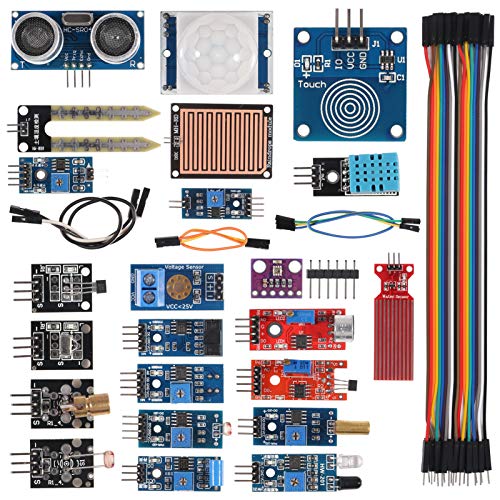
- Targets common beginner sensor projects
- Works with Arduino, Raspberry Pi, and STM32
- Includes 22 modules plus a DuPont cable
Best For: New makers learning core sensor concepts
Best Sensor Module Variety – 37-in-1 Sensor Modules Kit
If you want to explore microcontroller kits with sensors without committing to a single project, this ELEGOO set offers a broad module library. It includes inputs for motion, distance, light, sound, temperature, touch, and more, plus displays and control components for prototyping and classroom experiments.
Best For: Makers, students, and educators who already have a compatible UNO, MEGA, Nano, ESP-32, or STM32 board and want a wide selection of plug-in modules.
Pros:
- Includes 37 common sensor, display, timing, and control modules.
- Supports experiments involving motion, temperature, humidity, ranging, light, sound, and touch.
- Digital tutorials, datasheets, wiring diagrams, and example code are available.
Cons:
- Controller board, USB cable, breadboard, and jumper wires are not included.
- Users must verify pin requirements and observe the stated 6.5–9 V DC limit.
This is a flexible expansion kit rather than a complete starter bundle. Its strongest advantage is the variety of modules, making it useful when you want to test many sensor concepts with hardware you already own.
Best Connected Camera Kit – ESP32 Camera Ultimate Starter Kit
For microcontroller kits with sensors that also introduce wireless and camera projects, the Freenove ESP32 kit is a substantial all-in-one option. Its ESP32 camera board combines Wi-Fi, Bluetooth, onboard imaging, and a large collection of components for guided builds ranging from basic circuits to more advanced projects.
Best For: Learners and makers who want to study ESP32 development, camera projects, wireless connectivity, and multiple programming approaches in one kit.
Pros:
- ESP32 board includes a camera, 2.4 GHz Wi-Fi, Bluetooth 4.2 LE, 4 MB flash, and 8 MB PSRAM.
- Includes 240 components, modules, sensors, wires, and related items.
- Offers 122 guided projects with schematics, wiring diagrams, explanations, and complete code.
- Supports MicroPython, C, and Processing-based project examples.
Cons:
- The tutorial is online or downloadable rather than a paper manual.
- Processing projects require a computer for graphical interfaces.
This kit stands out for breadth and connectivity. It is more ambitious than a basic sensor assortment, so it suits buyers who want a structured path into ESP32, camera, wireless, and software projects.
Best Organized Sensor Assortment – KEYESTUDIO 37-in-1 Kit
This KEYESTUDIO kit is a practical choice among microcontroller kits with sensors for learners who want project-focused experimentation. The 37 modules cover common inputs and outputs, while the organized case, identification card, and online Wiki help reduce setup time when working with Arduino or Raspberry Pi projects.
Best For: Beginners, educators, and makers who want clearly organized modules for projects such as weather stations, security systems, line tracking, and basic automation.
Pros:
- Includes 37 sensors and modules, including PIR, flame, ultrasonic, joystick, buzzer, relay, and temperature/humidity modules.
- Online KEYESTUDIO Wiki provides wiring diagrams and test code for projects.
- Organized case and component identification card support easier part selection.
- Compatible with Arduino and Raspberry Pi setups.
Cons:
- Main controller board and wires are not included.
- The listed warranty is one month.
Its emphasis on labeling and real-world project ideas makes this a useful learning toolbox. Just budget for a compatible controller and wiring before expecting a complete build-ready setup.
Best Complete Beginner Bundle – UNO R3 Project Starter Kit
If you are new to microcontroller kits with sensors, this ELEGOO bundle provides the controller, breadboard, wiring, sensors, motors, and output components needed to follow guided lessons. Its solderless setup and 22-plus projects cover foundational Arduino concepts such as inputs, displays, motor control, timing, and environmental sensing.
Best For: First-time builders, families, homeschool learners, coding clubs, and STEM classrooms seeking a complete UNO-based project kit.
Pros:
- Includes an UNO R3 controller, breadboard, USB cable, jumper wires, and power supply module.
- Offers 22-plus guided projects using ultrasonic, DHT11, joystick, IR, motor, servo, relay, and display components.
- Solderless construction and a pre-soldered LCD1602 make initial wiring more approachable.
- Supports lessons covering digital input/output, analog sensing, timing, and motor control.
Cons:
- Power-module input should not exceed 9 V.
- Beginners must still check polarity, breadboard rows, board selection, and computer port settings.
Unlike module-only kits, this package includes the core UNO hardware needed to start immediately. It is the most straightforward choice here for a learner building foundational Arduino skills through sequential projects.
Most Versatile Sensor Collection – 46-in-1 Tinkerblock Kit
If you want broad experimentation across several boards, this is one of the more flexible microcontroller kits with sensors. It includes 46 labeled modules covering displays, input devices, detectors, memory, and multiple interface types, while standard 2.54mm jumper connections keep setup solder-free.
Best For: Beginners, STEM classrooms, makerspaces, and hobbyists working with ESP32, Raspberry Pi Pico, STM32, or Arduino-compatible boards.
Pros:
- Includes 46 sensor and display modules in an organized storage case.
- Compatible with major 3.3V and 5V microcontroller platforms.
- Modules are labeled with pin names and interface information.
- Reference code, wiring diagrams, and step-by-step tutorials are included.
Cons:
- Development board and jumper wires are not included.
- The large selection may be more than needed for a single focused project.
The strongest advantage here is identification and variety: each board is marked rather than presented as a collection of mystery modules. It is a practical choice when you want to explore many sensor types without buying parts individually.
Best Connected Learning Platform – ELEGOO ESP-32 Starter Kit
This ELEGOO kit combines a dual-core ESP-32 development board with more than 35 modules and components, making it a strong all-in-one option among microcontroller kits with sensors. Built-in Wi-Fi and Bluetooth 4.2 support projects that move beyond standalone circuits into connected devices.
Best For: Beginners and intermediate learners who want guided Arduino IDE projects involving IoT, displays, motors, sensors, and wireless connectivity.
Pros:
- Includes an ESP-32 board with dual-core processing, Wi-Fi, and Bluetooth.
- Provides more than 35 modules and components, including an OLED, servo, and keypad.
- Offers 30+ guided projects with code, diagrams, and step-by-step instructions.
- Supports Arduino IDE and includes technical support resources.
Cons:
- Its ESP-32-centered design may be less suitable if you need a board-neutral kit.
- The extensive project range can require a learning progression rather than immediate advanced builds.
Choose this kit when the development board matters as much as the components. The included ESP-32 and guided curriculum provide a clearer path from basic electronics to wireless and smart-home experiments.
Best Arduino Sensor Variety – KEYESTUDIO 48-Module Kit
For learners who already have a compatible controller, the KEYESTUDIO kit offers a large selection of components for hands-on sensor practice. Its 48 modules include sound, motion, pressure, gas, relay, LCD, LED, infrared, and other project-building parts.
Best For: Arduino learners, students, educators, and tinkerers who want many sensor exercises with wiring instructions and example code.
Pros:
- Includes 48 mainstream sensors and modules for robots and interactive projects.
- Works with several microcontrollers and Raspberry Pi devices.
- Provides Arduino-focused wiring guidance, test code, and project tutorials.
- Comes in an organized package suitable for different experience levels.
Cons:
- Arduino controller board is not included.
- The supplied instructions are specifically for Arduino projects.
This is a component-first kit rather than a complete starter bundle. It makes the most sense for buyers who already own an Arduino-compatible board and want a broad, tutorial-supported collection of sensors and modules.
Most Versatile – SunFounder Universal Maker Sensor Kit
For shoppers comparing microcontroller kits with sensors across several platforms, the SunFounder Universal Maker Sensor Kit stands out for its broad compatibility and extensive project support. It includes more than 25 sensors, actuators, and display modules, plus 169 projects covering Arduino, Raspberry Pi, Pico W, and ESP32.
Best For: Beginners and experienced makers who want one kit for environmental monitoring, smart-home experiments, robotics, and game-controller projects.
Pros:
- Supports Arduino boards, Raspberry Pi computers, Pico W, and ESP32.
- Includes more than 25 sensor, actuator, and display modules.
- Offers step-by-step tutorials in C/C++, Python, and MicroPython.
- Includes 169 projects and ongoing community and technical support.
Cons:
- The large range of platforms and components may feel overwhelming to absolute beginners.
- Its broad feature set may be more than needed for a single-board project.
This is the strongest all-around choice when platform flexibility and guided learning matter most. Its included displays, motion sensors, temperature sensors, and connectivity-oriented modules give users plenty of room to progress beyond basic experiments.
Largest Sensor Assortment – HiLetgo 37-in-1 Sensor Kit
HiLetgo 37 Sensor Assortment Kit for Arduino & Raspberry Pi - 37 in 1 Robot Project Starter Kit
Check Price On AmazonThe HiLetgo 37-in-1 kit is a straightforward option for shoppers seeking microcontroller kits with sensors for broad Arduino and Raspberry Pi experimentation. Its assortment covers light, sound, temperature, magnetic, motion, touch, and obstacle-detection functions in a compact project starter set.
Best For: Arduino and Raspberry Pi users who want many individual sensor modules for robot projects, classroom exercises, and basic electronics experiments.
Pros:
- Provides 37 sensor and module types in one assortment.
- Includes practical components such as a joystick, microphone, relay, ultrasonic-related obstacle module, and temperature-humidity sensor.
- Covers diverse inputs including infrared, magnetic, vibration, flame, touch, and heartbeat detection.
Cons:
- The supplied notes do not indicate included step-by-step tutorials or a project count.
- The assortment is focused on modules rather than a broader multi-platform learning system.
Choose this kit when variety is the priority. With 37 listed modules, it is well suited to trying different sensor categories, though buyers looking for structured lessons may prefer a kit with more explicit tutorial support.
Beginner-Focused Pick – UMLIFE 22-in-1 Sensor Module Kit
The UMLIFE 22-in-1 kit is aimed at beginners who want a focused selection of microcontroller kits with sensors for Arduino, Raspberry Pi, and STM32 projects. It emphasizes commonly used modules such as temperature and humidity, ultrasonic, soil moisture, water level, tracking, and infrared sensing.
Best For: New makers learning foundational sensor projects with UNO R3, Nano V3.0, Mega 2560, Mega 328, Raspberry Pi, or STM32 hardware.
Pros:
- Includes 22 carefully selected modules for common beginner projects.
- Supports Arduino boards, Raspberry Pi, and STM32 projects.
- Covers practical applications including weather, moisture, obstacle avoidance, tracking, and human-presence sensing.
- Includes a male-to-female DuPont cable for connecting modules.
Cons:
- Includes fewer modules than the 37-in-1 and SunFounder kits.
- The supplied notes do not specify a detailed tutorial library or project count.
This is a sensible starting point for learners who prefer a curated set over a very large assortment. Its selection targets familiar beginner exercises while still offering enough variety to move from simple readings to practical automation and tracking projects.
How We Picked These Microcontroller Kits with Sensors
We evaluated each kit for the practical features that matter when learning, prototyping, or expanding a maker workbench. Our comparison considers the number and variety of modules, compatibility with common boards, documentation quality, included project guidance, and the likelihood that the components can support more than one type of build.
We also considered whether a kit is aimed primarily at beginners, ESP32 users, multi-platform makers, or users who want a large assortment of individual sensors and output modules. Component counts can vary by listing and revision, so check the current contents before ordering.
Quick Comparison
| Best For | Look For | Recommended Kit Type |
|---|---|---|
| First-time learners | Clear tutorials, an included board, and basic wiring parts | UNO R3 starter kit |
| Wireless and camera projects | ESP32 support, Wi-Fi, Bluetooth, or camera hardware | ESP32 starter or camera kit |
| Broad sensor experimentation | Large module assortment and multiple output devices | 37-in-1, 46-in-1, or 48-module kit |
| Multi-board makers | Arduino, Raspberry Pi, Pico, ESP32, or STM32 compatibility | Universal or cross-platform sensor kit |
Key Buying Factors for Microcontroller Kits with Sensors
Board Compatibility
Confirm that the kit works with the board you own or plan to buy. Arduino modules often use simple digital or analog connections, while ESP32 and some 3.3V boards may require extra care with voltage levels. A kit advertised for several platforms is useful, but compatibility does not guarantee that every module is plug-and-play on every board.
Module Variety and Usefulness
A higher module count is not automatically better. Prioritize kits that include a practical mix of input sensors, displays, relays, motors, LEDs, buzzers, and communication-related parts. Gas, pressure, sound, light, temperature, motion, and distance modules can support a wider range of projects than a collection made mostly of similar basic sensors.
Documentation and Included Hardware
Beginners should look for wiring diagrams, example code, tutorials, and a compatible controller board. Also check whether the package includes a breadboard, jumper wires, resistors, USB cable, and storage case. Experienced users may prefer a sensor-only assortment if they already have these essentials.
Electrical Requirements
Check operating voltage, pin requirements, current limits, and connector style before connecting a module. Some relays, motors, servos, and gas sensors need more power than a microcontroller pin should provide directly. Use suitable drivers, external supplies, and common-ground wiring when required.
Who Should Buy Which Microcontroller Kits with Sensors?
Choose an UNO-based starter kit if you are new to electronics and want guided projects with familiar Arduino examples. These kits usually offer the smoothest learning curve.
Choose an ESP32 kit for connected devices, wireless control, Bluetooth projects, or camera experiments. Verify whether the included examples match your preferred development environment.
Choose a larger sensor assortment if you already own a compatible board and want maximum variety for experimentation. This is often the best value for makers who can troubleshoot wiring and write or adapt their own code.
Choose a universal kit if your projects span Arduino, Raspberry Pi, Pico, or STM32 boards. It offers flexibility, but you should be comfortable checking voltage and library requirements for each platform.