Choosing the right LCR meter can make component testing faster, more accurate, and far less frustrating. Whether you need a bench instrument for lab work or a handheld tester for field repairs, the best option depends on your measurement range, accuracy needs, and workflow.
Below, we’ve rounded up 10 of the best picks for 2026, from precision instruments to compact smart testers, so you can quickly find the right fit for capacitors, inductors, resistors, ESR, and more.
Best 10 Lcr Meters Picks for 2026
Bench-Ready Auto LCR
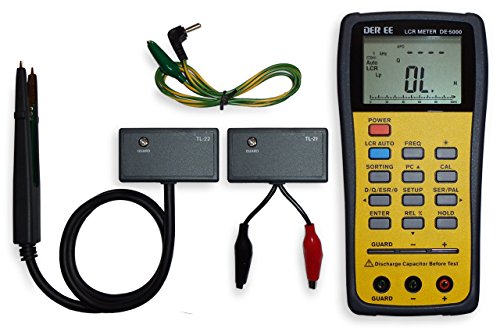
- AUTO-LCR smart mode with auto-ranging
- Measures L/C/R, D, Q, phase angle, ESR/Rp
- Five test frequencies plus sorting mode
Best For: Hands-on users who want a versatile handheld meter for fast component screening
Color-Screen Sorting Meter
FNIRSI LC1020E 100kHz LCR Meter

- Dual-parameter display with ESR, Q, D, and theta
- Sorting/comparison mode for tolerance screening
- Color TFT screen with calibration and Type-C charging
Best For: Users who want a feature-rich meter for component sorting and detailed bench testing
Compact Precision Pick
Peak Atlas LCR45 LCR and Impedance Meter
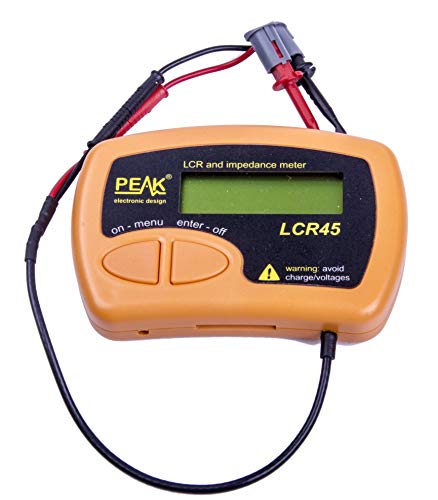
- High-resolution readings down to 0.2uH/0.2pF/0.2 ohms
- Manual or automatic component and frequency selection
- Hold function with simple menu controls
Best For: Users who want a compact, high-resolution meter with straightforward controls
Budget Component Tester
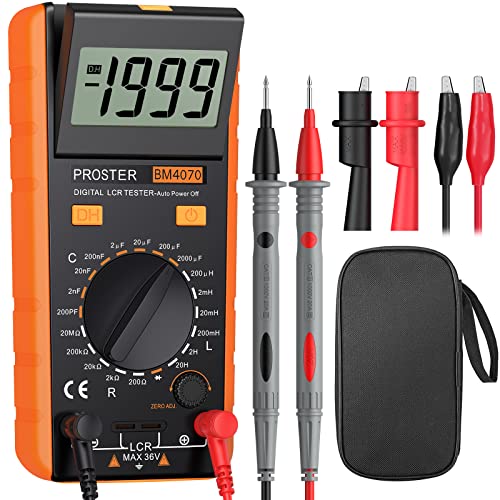
- Measures L, C, and R in a compact design
- Rotatable LCD with data hold and auto power off
- Includes leads, clips, battery, and storage bag
Best For: Hobbyists who need an affordable meter for routine component checks
Bench Precision LCR Meter
GW INSTEK LCR-6002 2kHz Bench Meter

- Bench LCR meter with 2 kHz max test frequency
- Measures inductance, capacitance, and resistance
- RoHS compliant and bench-focused
Best For: stationary lab testing and general component checks
Portable Tweezer Tester
FNIRSI LCR-ST1 10kHz LCR Tweezers

- Tweezer-style LCR meter for SMD testing
- Auto recognizes components and reads ESR
- Saves records and exports data to PC
Best For: SMD repairs and quick board-level component checks
High-Frequency Digital Bridge
Handheld LCR Meter 4080, 100Hz-100kHz

- Handheld meter with frequencies up to 100 kHz
- Measures L, C, R plus multimeter functions
- Includes PC remote control and recording mode
Best For: engineers needing wider frequency coverage in a portable meter
Precision Tweezer LCR Meter
FNIRSI LCR-ST2 100kHz Component Tester
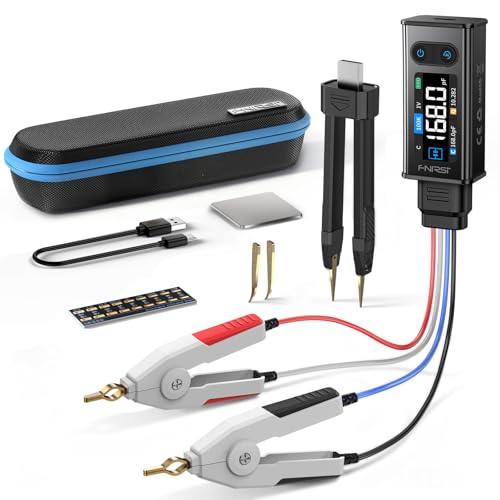
- Tweezers-style testing for SMD and through-hole parts
- 100 Hz to 100 kHz scan range with auto sorting
- Includes Kelvin clips, hooks, pouch, and Type-C charging
Best For: Fast portable component checks on mixed boards
High-Accuracy Handheld LCR Meter
DE-5000 Handheld LCR Meter with TL-21/TL-22

- 100 Hz to 100 kHz test frequencies
- Supports Ls/Lp/Cs/Cp/Rs/Rp, DCR, D, Q, phase, and ESR
- Includes TL-21 lead, TL-22 SMD leads, and case
Best For: Detailed handheld testing with broad mode selection
Budget LCD LCR Meter
CAMWAY Capacitance Inductance Resistance Tester

- Measures L/C/R, continuity, and diodes
- Large flip LCD with data hold and auto power off
- Wide stated ranges for common troubleshooting
Best For: Basic electrical diagnostics on a budget
Bench-Ready Auto LCR – DE-5000 Handheld LCR Meter
If you want an LCR meter that feels built for serious component work, the DE-5000 stands out for its AUTO-LCR smart mode, dual display, and multiple test frequencies. It measures inductance, capacitance, resistance, and secondary values like D, Q, phase angle, and ESR/Rp, making it a practical choice for sorting and verifying parts.
Best For: Users who want a handheld, high-accuracy LCR meter with automatic measurement mode and frequency selection.
Pros:
- Measures L/C/R plus D, Q, phase angle, and ESR/Rp
- Auto-ranging AUTO-LCR mode simplifies component testing
- Selectable test frequencies: 100Hz, 120Hz, 1kHz, 10kHz, and 100kHz
- Includes sorting mode for quickly screening component batches
Cons:
- IR-to-USB cable is listed as optional and not included
- Battery-powered design may be less convenient than a bench unit for some users
This is a flexible pick if you need a handheld meter that goes beyond basic LCR readings. The automatic serial/parallel selection and broad test-frequency support make it especially useful when working with a variety of real-world components.
Color-Screen Sorting Meter – FNIRSI LC1020E 100kHz LCR Meter
The FNIRSI LC1020E is one of the more feature-rich LCR meters here, with dual-parameter display, open/short calibration, adjustable test voltage, and a color TFT screen. It covers capacitance, resistance, and inductance while also showing values like ESR, Q, D, theta, and X, so it works well when you need more than a simple go/no-go reading.
Best For: Buyers who want a modern LCR meter with sorting tools, a color display, and calibration features.
Pros:
- Dual-parameter display shows main and secondary measurements together
- Sorting and comparison mode helps screen parts by tolerance
- Open/short calibration and adjustable test voltage improve measurement control
- 2.8-inch color TFT display with brightness adjustment and Type-C charging
Cons:
- Requires open/short calibration before measurement
- Users must avoid live circuits and fully discharge capacitors and inductors first
For component sorting and detailed testing, this model offers a strong mix of convenience and control. Its Kelvin-style fixture support, storage-friendly data hold, and wide measurement ranges make it a practical choice for more demanding bench use.
Compact Precision Pick – Peak Atlas LCR45 LCR and Impedance Meter
The Peak Atlas LCR45 is a straightforward LCR meter for users who value precision and a simple interface. It supports automatic or manual component selection, automatic or manual test frequency, and offers DC plus 1kHz, 15kHz, and 200kHz test options, which makes it a capable tool for impedance and component checks.
Best For: Users who want a compact meter with high resolution and manual control over test settings.
Pros:
- Enhanced resolution down to 0.2uH, 0.2pF, and 0.2 ohms
- Automatic or manual component type selection
- Automatic or manual test frequency selection
- Hold function and easy menu system support routine lab work
Cons:
- Corded electric power limits portability compared with battery-powered models
- Fewer extra features than some more modern display-heavy rivals
If your priority is measurement resolution and a no-nonsense workflow, the LCR45 is a strong fit. It keeps the focus on accurate readings and user control rather than packed-in extras.
Budget Component Tester – Proster LCR Meter Multimeter
The Proster LCR meter is a practical entry-level option for measuring capacitance, inductance, and resistance without moving up to a more complex bench unit. It adds a rotatable LCD, data hold, auto power off, and a compact kit of leads and clips, so it is easy to keep on hand for quick component checks.
Best For: Hobbyists and repair users who want an affordable, easy-to-use LCR meter for routine part testing.
Pros:
- Measures capacitance, inductance, and resistance in a compact body
- Rotatable LCD makes readings easier to see at different angles
- Data hold, auto power off, and low-power indication add convenience
- Includes leads, crocodile clips, mini alligator clip, battery, manual, and storage bag
Cons:
- Lower-count 3 1/2 digit display is less advanced than premium meters
- Inductance and capacitance accuracy is listed at 2%+5, which may be limiting for finer work
This model makes sense when you want a dedicated component tester rather than a full-featured lab instrument. The wide capacitance and inductance ranges are especially helpful for everyday troubleshooting and matching parts.
Bench Precision LCR Meter – GW INSTEK LCR-6002 2kHz Bench Meter
If you want a bench-style LCR meter for careful component testing, the GW INSTEK LCR-6002 is built for measured, lab-oriented work. It supports a 2 kHz maximum test frequency and covers a wide range of inductance, capacitance, and resistance values, making it a practical fit for general electronics evaluation.
Best For: bench testing where broad measurement ranges and a straightforward precision setup matter
Pros:
- Bench LCR meter with a 2 kHz max test frequency
- Wide measurement ranges for inductance, capacitance, and resistance
- RoHS compliant
- Compact bench form factor with 4 kg weight
Cons:
- Not a handheld design
- No warranty description listed
- Lower max frequency than handheld models in this roundup
Overall, this is the most traditional lab-style option in the group: simple, precise, and aimed at bench workflows rather than field portability. If your priority is a stationary LCR meter with broad range coverage, it fits that role well.
Portable Tweezer Tester – FNIRSI LCR-ST1 10kHz LCR Tweezers
The FNIRSI LCR-ST1 is a compact LCR meter in tweezer form, designed for quick SMD component checks and board-level troubleshooting. With 100 Hz, 1 kHz, and 10 kHz test frequencies, it covers the practical needs of electronics repair while adding auto recognition and ESR-related readings.
Best For: fast SMD inspection, repair work, and handheld component sorting
Pros:
- Portable tweezer-style LCR meter for SMD work
- Supports resistance, capacitance, inductance, and diode testing
- Auto recognition plus D, Z, Q, R, and ESR readings
- Can save records and export data to PC via Excel
Cons:
- Fixed screen does not rotate or flip
- Battery-powered, so it depends on charging and runtime
- Less suitable for bench-style workflows than a larger meter
This is a strong choice if you need a compact tool for identifying and checking small components quickly. Its tweezer format and data export features make it especially useful for repair benches and SMD-heavy tasks.
High-Frequency Digital Bridge – Handheld LCR Meter 4080, 100Hz-100kHz
This handheld LCR meter is built for users who want more frequency coverage and a classic portable form factor. It measures capacitance, inductance, and resistance across test frequencies from 100 Hz up to 100 kHz, and it adds remote PC communication for data acquisition and control.
Best For: engineers and technicians who need a handheld meter with wider test-frequency options
Pros:
- Handheld LCR meter with test frequencies up to 100 kHz
- Supports capacitance, inductance, resistance, and multimeter use
- Includes open/short correction and recording mode
- 2.8-inch backlit TFT display for easier reading
Cons:
- Bulkier than tweezer-style testers
- Requires a 5V DC minimum operating voltage
- Feature set may be more than needed for simple spot checks
Among these lcr meters, this model stands out for its wider frequency range and PC connectivity. It makes the most sense when you want a portable instrument with more measurement flexibility than a basic tester.
Precision Tweezer LCR Meter – FNIRSI LCR-ST2 100kHz Component Tester
If you want a compact lcr meter for mixed SMD and through-hole work, the FNIRSI LCR-ST2 stands out for its tweezers-style handling and broad test coverage. It measures resistors, capacitors, inductors, diodes, continuity, and voltage, while the 100 Hz to 100 kHz scan range makes it useful for everything from RF parts to large electrolytics.
Best For: Technicians and hobbyists who need a portable tweezers-style tester for fast component identification and verification.
Pros:
- Measures R/C/L, diodes, continuity, and voltage in one tool.
- Full-range scan from 100 Hz to 100 kHz helps with a wide variety of parts.
- Four RMS test levels and series/parallel mode help reduce parasitic effects.
- Includes Kelvin clips, tweezer tips, hooks, pouch, and Type-C charging.
Cons:
- Best suited to component testing rather than bench-style general measurement.
- Small 1.47″ display may be less convenient than larger handheld meters.
- Battery-powered design may not suit users wanting mains operation.
Overall, the LCR-ST2 is a practical choice when you want quick, portable checks on a bench or in the field. Its auto-sorting and secondary parameters add useful depth for diagnosing questionable parts without adding much setup time.
High-Accuracy Handheld LCR Meter – DE-5000 Handheld LCR Meter with TL-21/TL-22
The DE-5000 is a handheld lcr meter built for users who want more measurement flexibility and frequency coverage. With test frequencies from 100 Hz to 100 kHz, multiple measurement modes, and a backlit high-resolution display, it suits serious component checking where accuracy and repeatability matter.
Best For: Users who want a versatile handheld meter with strong frequency options and detailed measurement modes.
Pros:
- Supports Ls, Lp, Cs, Cp, Rs, Rp, DCR, plus D, Q, phase angle, and ESR.
- Test frequencies cover 100 Hz, 120 Hz, 1 kHz, 10 kHz, and 100 kHz.
- Includes TL-21 alligator lead, TL-22 SMD leads, and a protective case.
- Series/parallel modes, sorting, and selectable tolerance settings improve workflow.
Cons:
- Handheld form factor is less specialized for tiny SMD parts than tweezers-style tools.
- More features may be more than casual users need.
- Bulkier than compact pocket testers at 1.3 pounds.
If you need a reliable meter for deeper component analysis, the DE-5000 offers a strong feature set without sacrificing portability. Its included leads and case make it a ready-to-use option for bench, field, or repair work.
Budget LCD LCR Meter – CAMWAY Capacitance Inductance Resistance Tester
This CAMWAY lcr meter is a straightforward digital tester for people who want basic measurement functions at an accessible level. It covers inductance, capacitance, resistance, continuity, and diodes, with a large LCD and simple extras like data hold and auto power off.
Best For: Budget-minded users who want a simple all-in-one tester for everyday electrical troubleshooting.
Pros:
- Measures inductance, capacitance, resistance, continuity, and diodes.
- Wide stated ranges: 200pF to 2000uF, 200uH to 20H, and 200Ω to 200MΩ.
- Large LCD with flip capability and data hold makes readings easier to manage.
- Includes crocodile clips, a 9V battery, and troubleshooting-focused accessories.
Cons:
- Accuracy and range are more modest than higher-end LCR meters.
- Requires a 9V battery, which some users may not prefer.
- Feature set is basic compared with advanced test frequency meters.
For simple diagnostics, the CAMWAY delivers the core functions most users need without a complicated interface. It makes sense if you want a practical meter for household or automotive troubleshooting rather than advanced component analysis.
How We Picked These Lcr Meters
We focused on real-world usefulness: measurement accuracy, test frequency options, ease of reading results, and support for common component checks such as capacitance, inductance, resistance, ESR, and impedance. We also considered whether each meter is better suited to bench testing, field troubleshooting, or quick SMD identification.
Quick Comparison
In general, bench-style Lcr Meters offer more stable readings, better repeatability, and stronger low-value measurement performance. Handheld models are more portable and easier for repair work, while tweezer-style testers are ideal for SMD parts and cramped boards. If you need frequent capacitor sorting or detailed component characterization, higher-frequency units usually provide more flexibility.
Key Buying Factors for Lcr Meters
Test Frequency
Frequency matters because some components behave differently at different test points. Lower-frequency meters are often fine for basic component checks, while 10 kHz to 100 kHz options are better for evaluating real-world capacitor behavior, ESR, and inductor performance.
Accuracy and Resolution
If you work with tight tolerances or matching parts, look for strong accuracy specs and enough display resolution to show small changes clearly. For repair use, consistency and readability may matter more than ultra-high precision.
Form Factor
Choose a bench meter if you want stability, repeatable measurements, and more advanced testing. Choose a handheld model if portability matters. Tweezer testers are the fastest choice for tiny SMD components and quick in-circuit checks.
Component and Extra Test Functions
The best Lcr Meters often do more than measure basic L, C, and R values. Useful extras can include ESR, D/Q/θ/X measurements, auto component detection, overrange indication, and self-discharge or leakage-related functions for capacitor work.
Who Should Buy Which Lcr Meters?
If you’re a lab technician, designer, or advanced hobbyist, a precision bench or high-accuracy handheld meter is usually the best investment. For service work and general diagnostics, a versatile handheld tester is often the sweet spot. If you mainly handle SMD parts, tweezer-style models save time and reduce setup hassle. For budget-conscious buyers, a simpler meter can still handle everyday component checks well, provided its frequency range and accuracy match your needs.
For most buyers, the best choice is the meter that matches the parts you test most often and the way you actually work. That balance matters more than chasing the longest spec sheet.