Choosing among benchtop LCR meters comes down to accuracy, test frequency range, and the kinds of components you measure most often.
This roundup highlights ten strong options for electronics labs, repair benches, and production workflows, so you can quickly narrow down the right meter for your needs.
Best 10 Benchtop Lcr Meters Picks for 2026
Bench-Ready Precision Tester
ET4401 Benchtop LCR Meter with SCPI

- 0.1% accuracy for L/C/R testing
- Supports SCPI remote control
- Benchtop digital bridge design
Best For: Precision component testing in labs and automated setups
Wide-Range Measurement Workhorse
ET4510 10-100kHz TFT LCR Meter

- 0.1% accuracy with wide L/C/R ranges
- 10 Hz to 100 kHz adjustable test frequency
- Displays ESR, Q, D, and theta
Best For: Broad passive-component testing with flexible frequency control
Portable Passive Component Pick

- Measures L, C, R plus Q, D, phase, ESR
- Five test frequencies up to 100 kHz
- Battery-powered with built-in test fixture
Best For: Portable passive-component testing and troubleshooting
Automation-Friendly Analyzer
Upgraded ET4401 Benchtop LCR Meter

- 0.2% accuracy with 10 test frequencies
- RS232, USB Device, and SCPI support
- Comparator sorting for batch testing
Best For: QC, production, and automated bench testing
Compact Dual-Mode LCR Meter
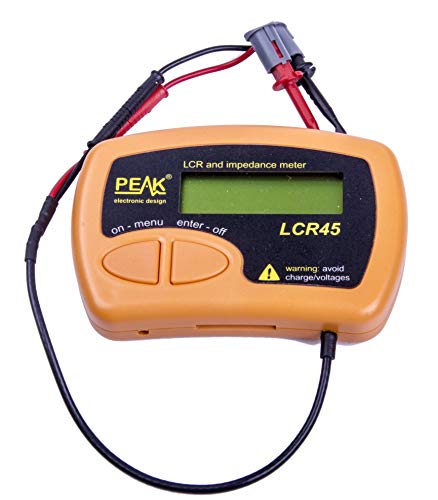
- Measures LCR and impedance with hold
- Auto or manual component type selection
- Selectable DC, 1kHz, 15kHz, and 200kHz
Best For: Compact component testing with simple controls
High-Accuracy Benchtop Tester
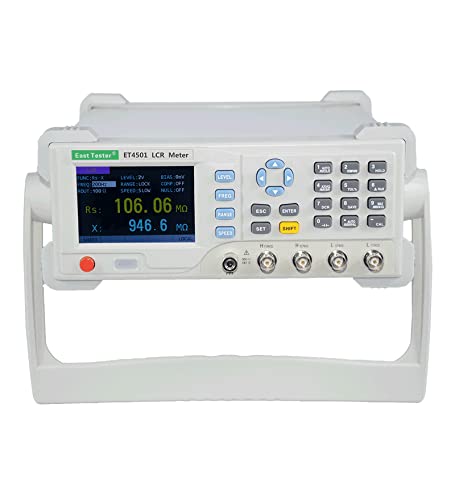
- 10Hz to 10kHz testing in 1Hz steps
- 5-digit L/C/R/Z display and broad ranges
- Open/short calibration with comparator
Best For: Lab and production testing with fine control
Precision Bench Instrument

- Bench-style meter with 2kHz max frequency
- Wide inductance, capacitance, and resistance limits
- 4 kg precision-oriented bench instrument
Best For: Precision bench testing with large measurement ranges
Compact Bench LCR Meter

- L/C/R/Z plus X, D, Q, theta, and ESR
- 10 fixed frequencies from 100Hz to 10kHz
- RS232, USB Device, and calibration support
Best For: Basic bench testing of passive components and electrolytic capacitors
Precision Bench LCR Meter
- 10Hz to 100kHz frequency range
- 0.05% basic accuracy
- 3.5-inch color LCD with fast test speed
Best For: Precision bench testing with wide frequency coverage
Feature-Rich Bench LCR Meter

- 40Hz to 100kHz with 38 frequency points
- Reads L, C, R, |Z|, D, Q, X, ESR, and phase
- Comparator mode plus file save and USB storage
Best For: Component inspection, sorting, and users who want extra workflow features
Bench-Ready Precision Tester – ET4401 Benchtop LCR Meter with SCPI
If you’re comparing benchtop LCR meters for component validation, the ET4401 is built for accurate capacitor, inductor, and resistor testing with 0.1% precision. It also supports SCPI remote control, making it a practical fit for lab setups and automated test workflows.
Best For: Engineers and labs that need a high-precision benchtop component tester with remote-control support.
Pros:
- 0.1% accuracy for detailed L/C/R measurement
- Supports SCPI for remote control and automation
- Designed as a benchtop digital bridge component tester
Cons:
- Requires open and short calibration before use
- Notes provide limited detail beyond core measurement function
Overall, the ET4401 is a straightforward choice when measurement precision matters more than extra features. Its calibration requirement is normal for this class of instrument, but it’s worth factoring into your setup time.
Wide-Range Measurement Workhorse – ET4510 10-100kHz TFT LCR Meter
Among benchtop LCR meters, the ET4510 stands out for its wide measurement range and adjustable test frequency from 10 Hz to 100 kHz in 1 Hz steps. The 3.5-inch TFT LCD and 0.1% accuracy make it a practical choice when you want clear readings and flexible component analysis.
Best For: Technicians and labs needing a versatile benchtop meter for broad L/C/R testing.
Pros:
- Wide L, C, and R measurement ranges
- Adjustable test frequency from 10 Hz to 100 kHz
- 3.5-inch TFT LCD with clear 5-digit display
- Includes secondary measurements like ESR, Q, D, and theta
Cons:
- More feature-rich than a basic bench meter, so setup may take more time
- Solar-powered listing may not suit every bench environment at a glance
This is a strong option if you need one benchtop instrument to handle a broad range of passive-component checks. Its mix of display clarity, frequency control, and extended measurement functions makes it especially useful for detailed diagnostics.
Portable Passive Component Pick – Extech LCR200 Meter
If you want an LCR meter for checking passive parts without committing to a bench-only setup, the Extech LCR200 offers a compact, battery-powered approach. It measures inductance, capacitance, and resistance, while also showing secondary values like Q, D, phase, and ESR.
Best For: Users who want a portable passive-component tester with built-in test fixture support.
Pros:
- Measures L, C, and R plus Q, D, phase, and ESR
- Five selectable test frequencies from 100 Hz to 100 kHz
- Dual backlit display with built-in test fixture
- Includes open/short calibration and test leads
Cons:
- Battery-powered design is less bench-like than a corded analyzer
- Lower count display than some newer benchtop models
The LCR200 makes sense if portability and simplicity matter more than a fixed lab instrument. It covers the essential passive-component checks well and adds enough frequency options for practical troubleshooting.
Automation-Friendly Analyzer – Upgraded ET4401 Benchtop LCR Meter
For buyers comparing benchtop LCR meters in a production or lab environment, this upgraded ET4401 focuses on measurement control and batch efficiency. It combines 0.2% accuracy, 10 selectable frequencies, comparator sorting, and SCPI/USB/RS232 support for more structured testing.
Best For: R&D, QC, and production teams that need a bench analyzer with sorting and remote-interface support.
Pros:
- 0.2% basic accuracy for precise component checks
- 10 selectable test frequencies from 100 Hz to 10 kHz
- Comparator sorting with customizable tolerance limits
- RS232, USB Device, and SCPI support for automation
Cons:
- Test frequency range is narrower than some higher-frequency models
- Advanced functions may be more than casual users need
This model is best when the goal is repeatable testing and workflow integration rather than just a basic readout. The sorting features and interface support make it especially useful for batch inspection and automated test systems.
Compact Dual-Mode LCR Meter – Peak Atlas LCR45
If you want one of the more portable benchtop LCR meters for quick component checks, the Peak Atlas LCR45 focuses on ease of use and practical measurement flexibility. It supports automatic or manual component selection, lets you choose automatic or manual test frequency, and covers DC, 1kHz, 15kHz, and 200kHz testing.
Best For: Engineers and hobbyists who need a compact LCR and impedance meter with simple controls and selectable frequencies.
Pros:
- Measures LCR and impedance with a hold function.
- Automatic or manual component type selection.
- Selectable test frequencies: DC, 1kHz, 15kHz, and 200kHz.
- Fine resolution down to 0.2uH, 0.2pF, and 0.2 Ohms.
Cons:
- Lower maximum feature set than larger bench instruments.
- No display size or advanced sorting features are listed.
Overall, the LCR45 is a straightforward choice when you value compact size, manual control, and solid resolution over heavy-duty bench automation.
High-Accuracy Benchtop Tester – ET4501 Benchtop LCR Meter
The ET4501 stands out among benchtop LCR meters for its wide measurement range and fine adjustment options. It offers 10Hz to 10kHz testing in 1Hz steps, a 5-digit display for L/C/R/Z readings, and strong resolution for demanding component analysis.
Best For: Labs, production testing, and R&D work that need wide-range measurements with precise control over test conditions.
Pros:
- Wide frequency range from 10Hz to 10kHz with 1Hz step control.
- 5-digit display for L/C/R/Z measurements.
- Very broad measurement ranges for inductance, capacitance, and resistance.
- Built-in open/short calibration, tolerance limits, and 5-group comparator.
Cons:
- Solar powered design may not suit every bench setup.
- Frequency ceiling is lower than some higher-end lab instruments.
For users who need a flexible benchtop LCR meter with calibration tools and batch-testing support, the ET4501 is the most feature-rich option in this group.
Precision Bench Instrument – GW INSTEK LCR-6002
For buyers comparing benchtop LCR meters, the GW INSTEK LCR-6002 is the most traditional bench-style instrument here. It is built for precision work, with a bench form factor, a 2kHz maximum test frequency, and wide measurement limits for inductance, capacitance, and resistance.
Best For: Test benches that need a precision-oriented LCR meter with large measurement ranges and a full bench footprint.
Pros:
- Bench LCR type with a substantial 4 kg build.
- Measures up to 9.99999kH inductance, 9.99999F capacitance, and 99.9999Mohm resistance.
- RoHS compliant.
- Designed as a precision LCR meter for bench use.
Cons:
- Maximum test frequency is limited to 2kHz.
- No warranty is listed.
The LCR-6002 makes sense when broad measurement limits and a conventional bench instrument are more important than frequency range or extra convenience features.
Compact Bench LCR Meter – 100Hz to 10KHz Tester
If you want a practical benchtop lcr meters option for general component checks, this compact unit covers the core measurements without adding a lot of complexity. It offers L/C/R/Z plus X, D, Q, theta, and ESR readings, with fixed test points from 100Hz to 10kHz and a 5-digit display for routine lab or bench work.
Best For: Basic bench testing of passive components, electrolytic capacitors, and users who want RS232/USB connectivity.
Pros:
- Measures L, C, R, Z, X, D, Q, theta, and ESR.
- 10 fixed test frequencies from 100Hz to 10kHz.
- Supports open/short calibration and electrolytic capacitor mode (DCR).
- Includes RS232 and USB Device communication support.
Cons:
- Frequency range is limited compared with high-end benchtop meters.
- Basic accuracy is 0.10%, which is lower than precision lab models.
- SCPI protocol details require contacting the seller.
This is a straightforward bench meter for users who need common LCR measurements, calibration support, and computer connectivity in a compact format. It makes the most sense when you want essential functions rather than a wide frequency sweep.
Precision Bench LCR Meter – GW INSTEK LCR-6100 100kHz
For buyers comparing benchtop lcr meters, the GW INSTEK LCR-6100 stands out for its precision-focused specs and broader test-frequency coverage. It measures from 10Hz to 100kHz, includes a 3.5-inch color LCD, and advertises 0.05% basic accuracy with test speeds as fast as 25ms.
Best For: Precision bench testing where wide frequency coverage and faster measurement speed matter.
Pros:
- Wide 10Hz to 100kHz test frequency range.
- 0.05% basic accuracy for precision measurements.
- 3.5-inch color LCD for easier bench use.
- Fast test speed up to 25ms max.
Cons:
- Heavier and larger than compact bench meters.
- Only the supplied notes are limited on included accessories and operating features.
This model is a strong fit when measurement quality and frequency range are more important than portability. Its precision specs make it a sensible choice for labs or benches that need dependable LCR testing across a wide span.
Feature-Rich Bench LCR Meter – MATRIX MCR-5100 100kHz
The MATRIX MCR-5100 is a feature-rich option in benchtop lcr meters, built around a 4.3-inch TFT display and a 40Hz to 100kHz test range. It combines 0.1% accuracy, a 32-bit core processor, and support for L, C, R, |Z|, D, Q, X, ESR, and phase readings, making it a versatile tool for component evaluation.
Best For: Users who want a bench LCR meter with broad parameter support, frequency flexibility, and storage/recall functions.
Pros:
- 40Hz to 100kHz test range with 38 frequency points.
- Measures L, C, R, |Z|, D, Q, X, ESR, and phase in degrees or radians.
- Includes 30Ω and 100Ω source output impedance options.
- Supports comparator mode, file saving, and U disk storage.
Cons:
- Less compact than smaller bench meters.
- Accuracy is 0.1%, which is not as tight as top precision models.
- Requires corded power rather than battery operation.
This model offers a very practical mix of measurement breadth and workflow features for incoming inspection or production sorting. If you want more than basic LCR readings, it brings useful storage, comparator, and frequency-point flexibility to the bench.
How We Picked These Benchtop Lcr Meters
We focused on practical buying factors that matter in real testing environments: measurement accuracy, frequency flexibility, display clarity, Kelvin connectivity, SCPI or remote-control support, and overall suitability for bench use. We also favored models that cover the core LCR use cases without unnecessary complexity.
Quick Comparison
When comparing Benchtop Lcr Meters, the biggest trade-offs are usually precision versus price, and simplicity versus advanced control. Entry-level units are often best for general component checks, while higher-end instruments are better for calibration, validation, and tighter tolerance work. Frequency range matters too, since many capacitors and inductors behave differently depending on the test frequency.
Key Buying Factors for Benchtop Lcr Meters
Accuracy and Resolution
If you test tight-tolerance parts, look for high stated accuracy and a stable display resolution. Small differences matter when verifying production batches or matching components.
Test Frequency Range
Broader frequency coverage helps reveal how a part behaves under different conditions. A wider range is especially useful for capacitors, inductors, and impedance measurements where readings can shift significantly by frequency.
Measurement Functions
Most buyers need more than basic capacitance testing. Look for support for L, C, R, and impedance, plus dissipation factor, Q, D, and ESR if you work with passive components regularly.
Fixtures, Leads, and Kelvin Connections
Good fixtures and Kelvin-style connections reduce lead resistance and contact errors, which is especially important for low-ohm resistance and small inductance measurements.
Display, Interface, and Automation
A clear multi-digit display helps on the bench, while SCPI or other remote-control options are valuable for automated test setups and repeatable workflows.
Who Should Buy Which Benchtop Lcr Meters?
If you need a reliable all-purpose lab meter, choose a midrange model with solid accuracy and flexible frequency settings. For repair work and hobby use, a simpler benchtop unit may be enough as long as it supports the component types you test most often. For calibration labs, QA teams, or production testing, prioritize precision, remote control, and fixture quality over extra convenience features.
In short, the best Benchtop Lcr Meters are the ones that match your measurement range, accuracy needs, and workflow—not just the highest spec sheet numbers.