Managing two computers from one office desk is easier when a KVM switch lets you share your monitors, keyboard, mouse, and USB accessories without constantly moving cables.
This roundup compares 10 KVM switches for office monitors, from straightforward single-display models to dual- and triple-monitor setups with USB-C, HDMI, DisplayPort, 4K, and 8K support.
Best 10 Kvm Switches for Office Monitors Picks for 2026
Best for High-Resolution Dual Displays

- Supports up to 8K@60Hz and 4K@120Hz
- Shares two monitors and four USB 3.0 devices
- Includes wired controller and 12V power supply
Best For: High-resolution desktop workstations with two HDMI-equipped computers
Best All-in-One Docking Solution
AV Access Dual-Laptop KVM Dock

- Combines dual-monitor KVM and 12-in-1 docking
- Charges two laptops at up to 60W each
- Switches between laptops in about 2–3 seconds
Best For: USB-C laptop workspaces needing docking and monitor sharing
Best Value HDMI Setup

- Supports two monitors at up to 4K@60Hz
- Provides four USB 3.0 sharing ports
- Includes cables, power adapters, and desktop controller
Best For: HDMI-based home and office dual-monitor desks
Best for Mixed HDMI and DisplayPort Desktops
Unitek HDMI/DisplayPort Dual-Monitor KVM

- Supports HDMI and DisplayPort dual-monitor connections
- Offers 4K@60Hz video and USB 3.0 sharing
- Includes wired controller and 5V/2A power adapter
Best For: Desktop workstations using mixed HDMI and DisplayPort outputs
Best DisplayPort Value

- 8K@60Hz DisplayPort output
- Four USB 3.0 peripheral ports
- Button and desktop-controller switching
Best For: Single-monitor DisplayPort office setups
Best for Laptop Desks
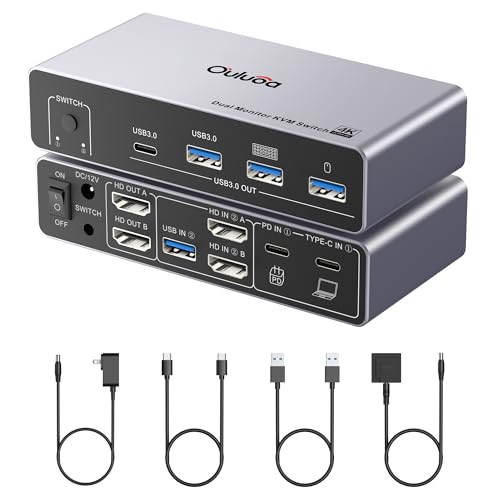
- Supports two HDMI monitors
- 100W PD laptop charging
- Four USB expansion ports
Best For: Desktop-and-laptop dual-monitor workstations
Best Triple-Monitor Setup
UGREEN 8K KVM for Three Monitors

- Switches two computers across three displays
- Supports 8K@60Hz and high refresh rates
- Includes display, USB, and control cables
Best For: Triple-monitor offices and creator workstations
Best Value 4K Pick

- Shares one 4K60 monitor between two computers
- Includes two HDMI and two USB cables
- Driver-free, one-button switching
Best For: Single-monitor office desks with two computers
Best for Triple-Screen Setups

- Controls three monitors from two computers
- Supports 8K and 4K144Hz capabilities
- Shares USB 3.0 peripherals
Best For: High-performance triple-monitor workstations
Best Dual-Monitor Office Choice

- Shares two monitors between two computers
- Includes four USB 3.0 peripheral ports
- Supports 4K60 and wired switching
Best For: Dual-monitor offices with mixed HDMI and DisplayPort outputs
Best for High-Resolution Dual Displays – 8K HDMI Dual-Monitor KVM
For demanding office setups, this KVM switch for office monitors combines dual-monitor control with support for up to 8K at 60Hz or 4K at 120Hz. It lets two computers share two HDMI monitors and four USB devices, with copy and extended display modes available when the computers support dual HDMI outputs.
Best For: Users who need high-resolution dual-monitor switching and shared USB peripherals between two desktop computers.
Pros:
- Supports up to 8K@60Hz and 4K@120Hz, with lower-resolution compatibility.
- Offers four USB 3.0 ports for peripherals such as printers, scanners, webcams, keyboards, and mice.
- Includes panel-button and wired-controller switching plus a 12V power supply for stable USB performance.
Cons:
- Requires each computer to provide two HDMI outputs for extended dual-monitor operation.
- Does not support keyboard-shortcut switching.
This is a strong fit when image quality and dual-screen productivity matter most, but verify your computers have the required HDMI outputs before buying.
Best All-in-One Docking Solution – AV Access Dual-Laptop KVM Dock
This KVM switch for office monitors is designed for two-laptop workspaces, combining dual-monitor switching with a 12-in-1 docking station. It provides HDMI outputs, USB ports, Ethernet, audio, SD storage, USB-C connectivity, and charging support without requiring repeated cable changes.
Best For: Hybrid workers and professionals managing two compatible USB-C laptops from one dual-monitor desk.
Pros:
- Combines KVM switching and docking with HDMI, USB, Ethernet, audio, SD, and USB-C ports.
- Supports up to 60W charging for each of two laptops and includes a 20V/10A power adapter.
- Uses EDID emulation and automatic wake-up for switching in about 2–3 seconds.
Cons:
- Requires laptops with USB-C DP Alt Mode and DP MST support.
- Mac models support mirrored displays only because of macOS limitations.
- Is not compatible with 5K monitors, FreeSync/G-Sync, or Dell Display Manager.
Choose this model if you want to consolidate a laptop docking station and dual-monitor KVM into one device. Confirm laptop and monitor compatibility first, especially for Mac or ultrawide setups.
Best Value HDMI Setup – UGREEN 4K Dual-Monitor KVM
For straightforward dual-computer office setups, this HDMI KVM switch for office monitors supports two monitors, four USB 3.0 peripherals, and resolutions up to 4K at 60Hz. Switching is handled through the unit’s button or included desktop controller, with no software or drivers required.
Best For: Home and office users who want practical 4K HDMI switching with shared USB accessories.
Pros:
- Supports dual-monitor extend or mirror modes at up to 4K@60Hz.
- Includes three USB-A and one USB-C USB 3.0 ports for peripherals and storage.
- Package includes four HDMI cables, two USB cables, power adapters, and a desktop controller.
Cons:
- Uses HDMI rather than DisplayPort and does not support keyboard hotkeys.
- Does not provide EDID emulation.
- Both monitors display video from the selected computer rather than mixing sources from both PCs.
This is a sensible choice for a conventional HDMI office desk where 4K at 60Hz is sufficient. Check that each computer can support two displays and connect both HDMI and USB cables as required.
Best for Mixed HDMI and DisplayPort Desktops – Unitek HDMI/DisplayPort Dual-Monitor KVM
This Unitek KVM switch for office monitors supports HDMI and DisplayPort connections for two desktop computers, while sharing two monitors and USB peripherals. It offers up to 4K at 60Hz, USB 3.0 data speeds, and button or wired-controller switching for a cleaner workstation.
Best For: Desktop users who need HDMI and DisplayPort support in a dual-monitor office configuration.
Pros:
- Supports mixed HDMI and DisplayPort connectivity with up to 4K@60Hz output.
- Provides four USB-A ports, including USB 3.0 support up to 5Gbps.
- Includes a wired controller, USB cables, and a 5V/2A power adapter.
Cons:
- Designed for desktop hosts and explicitly not compatible with laptops.
- Both computers require the necessary HDMI, DisplayPort, and USB connections for simultaneous video output.
- Switching is limited to the physical button or desktop controller.
This model is useful when office desktops use different video standards and you want to share displays and peripherals. It is not the right fit for a laptop-based desk, so confirm your host devices before purchase.
Best DisplayPort Value – 8K Dual-Computer KVM
For office setups using a DisplayPort monitor, this two-port KVM switch lets two computers share one display, keyboard, mouse, and other USB peripherals. It supports up to 8K at 60Hz and switches via a button or wired desktop controller.
Best For: DisplayPort office workstations that need simple two-computer switching and fast USB peripheral access.
Pros:
- Supports DisplayPort resolutions up to 8K at 60Hz.
- Four USB 3.0 ports support peripherals at up to 5Gbps.
- Includes a desktop controller, two USB cables, and a 12V power adapter.
Cons:
- Supports one monitor rather than a multi-monitor setup.
- Keyboard shortcut switching is not supported.
- An appropriate DisplayPort 1.4 cable is required for 8K and is not included.
This is a practical choice among kvm switches for office monitors when your setup centers on one DisplayPort display. External power also helps provide stable operation for connected USB devices.
Best for Laptop Desks – Dual-Monitor USB-C KVM
This USB-C KVM switch is designed for an office with one desktop, one laptop, and two HDMI monitors. It combines KVM switching with docking features, including 100W PD charging, three USB 3.0 ports, one USB-C port, and a wired remote.
Best For: Dual-monitor workstations that alternate between a desktop and a USB-C laptop.
Pros:
- Supports two HDMI displays in extended or mirrored mode.
- 100W PD charging helps keep a compatible laptop powered.
- Provides three USB 3.0 ports and one USB-C port for shared peripherals.
Cons:
- Windows supports MST extended display mode, while macOS works in SST mode only.
- The laptop connection provides up to 4K at 60Hz via USB-C; the listed 8K output applies to PC2.
- HDMI cables within 6.56 feet are recommended for stable transmission.
Among kvm switches for office monitors, this model stands out for users who need a laptop-friendly setup rather than a basic switch. Its external power adapter and PD port can reduce cable swapping at a shared desk.
Best Triple-Monitor Setup – UGREEN 8K KVM for Three Monitors
For demanding multi-screen offices, this UGREEN KVM switch connects two computers to three monitors using two DisplayPort inputs and one HDMI input per computer. It also shares four USB 3.0 ports and supports high refresh rates, HDR10+, VRR, FreeSync, and G-Sync.
Best For: Triple-monitor offices, content creators, and IT users whose computers support three simultaneous displays.
Pros:
- Supports three monitors with up to 8K at 60Hz per output and high refresh rates up to 4K at 240Hz.
- Offers mirror and extended display modes.
- Includes required DP, HDMI, and USB cables, plus a desktop controller and power adapter.
Cons:
- Both computers must support triple-monitor output and the specified port configuration.
- Keyboard hotkey switching and EDID emulation are not supported.
- Longer cables, converters, or docking stations may cause compatibility issues; cables within 2 meters are recommended for 8K.
This is the most capable option here for a three-screen office, but it requires careful compatibility checks before purchase. Verify each computer’s display outputs and ensure the monitors and cables support the desired resolution.
Best Value 4K Pick – 2-Port HDMI KVM Switch
If you need a straightforward option among kvm switches for office monitors, this 2-port HDMI model lets one keyboard, mouse, and monitor control two computers. It supports 4K at 60Hz, includes two HDMI cables and two USB cables, and switches with a physical button.
Best For: Office users who want to share one 4K HDMI monitor and a set of USB peripherals between two computers.
Pros:
- Supports UHD 4K at 60Hz, as well as 4K at 30Hz and 1080p.
- Includes two HDMI cables and two USB cables for a simpler setup.
- Driver-free compatibility with Windows, macOS, Linux, and Chrome OS.
- Works with one-button switching and requires no external power.
Cons:
- Limited to one shared monitor.
- Uses USB 2.0 rather than USB 3.0 for shared peripherals.
- Switching is through the unit’s button rather than a wired desktop controller.
Choose this model when simplicity and included cables matter more than multi-monitor expansion or high-speed USB connectivity. Its 4K60 support makes it a practical fit for a conventional single-monitor office desk.
Best for Triple-Screen Setups – 3-Monitor KVM Switch
For demanding workstations, this model stands out among kvm switches for office monitors by connecting two computers to three monitors. Each computer uses two DisplayPort connections and one HDMI connection, while the switch also shares USB 3.0 peripherals and supports physical-button or wired-controller switching.
Best For: Traders, designers, programmers, and multitaskers using two computers with triple-monitor workstations.
Pros:
- Supports a full three-monitor setup for two computers.
- Supports 8K and high refresh rates up to 4K at 144Hz, when the connected equipment supports them.
- Offers extended or mirrored display modes.
- Includes USB 3.0 peripheral sharing and a wired control option.
Cons:
- Requires three video connections per computer: two DisplayPort and one HDMI.
- Keyboard shortcut switching is not supported.
- Does not include a detailed set of connection cables in the supplied package information.
This is the most capable choice here for a three-screen office or gaming setup, but its connection requirements are substantial. Confirm that both computers, all three monitors, and the cables support your intended resolution and refresh rate.
Best Dual-Monitor Office Choice – HDMI and DisplayPort KVM
This dual-monitor model is a strong option among kvm switches for office monitors when two computers need to share two screens and several USB devices. It supports 4K at 60Hz, includes four USB 3.0 ports, and provides both panel-button and wired-controller switching.
Best For: Dual-monitor office users who need to share a keyboard, mouse, printer, scanner, or other USB peripherals between two computers.
Pros:
- Supports two shared monitors with extended or copy modes.
- Provides four USB 3.0 ports with data rates up to 5Gbps.
- Supports 4K at 60Hz and is backward compatible with 4K30 and 1080p60.
- Includes an external wired controller and a 12V/1A power adapter.
Cons:
- Each computer must connect using both DisplayPort and HDMI; signal conversion is not supported.
- Keyboard shortcut switching is not supported.
- Both computers must support dual displays.
Consider this switch if your office setup needs two monitors and faster shared USB connectivity than a basic HDMI KVM provides. Check port matching carefully before purchase, especially if either computer uses a dock or adapter.
How We Picked the Best Kvm Switches for Office Monitors
We focused on the connection standards, display configurations, refresh-rate claims, and USB features most relevant to office work. The selection includes switches for one, two, or three monitors; two-computer setups; HDMI, DisplayPort, and USB-C connections; and shared peripherals such as keyboards, mice, storage devices, and printers.
We also considered practical differences between basic KVM boxes and docking-station-style models. A switch may advertise high resolution but still require compatible cables, graphics outputs, and computers to achieve that performance.
Quick Comparison
- Single-monitor desks: Choose a compact HDMI or DisplayPort KVM if you only need one shared screen.
- Dual-monitor offices: Look for two independent video outputs and confirmation that extended desktop mode—not mirrored output—is supported.
- Triple-monitor workstations: Select a three-display model and verify the exact HDMI and DisplayPort arrangement.
- Laptop-and-desktop setups: USB-C KVM or docking-station designs can reduce adapters, but check laptop charging and video-output support.
- High-resolution work: 4K at 60Hz suits most office productivity, while 4K at 120Hz or 8K support is more relevant to high-refresh displays and specialized workflows.
Key Buying Factors for Kvm Switches for Office Monitors
Monitor Outputs and Extended Mode
Count the displays you plan to use and match their inputs to the KVM’s outputs. For two monitors, confirm that both computers can drive two external displays and that the switch supports independent extended desktops. Some inexpensive products mirror one signal instead.
Resolution and Refresh Rate
Match the KVM’s limits to your monitors and workload. Office applications generally work well at 4K and 60Hz, while smoother scrolling or video benefits from higher refresh rates. An 8K label does not guarantee 8K at every output or through every cable.
USB Sharing and Switching
Check the number and type of USB ports. USB 3.0 is preferable for external drives and other high-speed devices, while basic keyboards and mice need less bandwidth. Confirm whether switching is controlled by a button, wired remote, hotkey, or software.
Compatibility and Cabling
Review the required HDMI, DisplayPort, USB upstream, and USB-C cables before buying. Features such as audio switching, EDID management, HDCP support, and reliable wake-from-sleep behavior can matter in a busy office.
Who Should Buy Which Kvm Switches for Office Monitors?
Choose a simple single-monitor HDMI or DisplayPort model for a two-PC desk with modest display needs. A dual-monitor HDMI KVM is the better fit for most productivity users who want one keyboard and mouse across two computers. Mixed HDMI and DisplayPort models suit offices with different monitor inputs or computers.
Choose a USB-C docking KVM when a laptop is part of the setup and minimizing adapters is important. Triple-monitor models are appropriate for analysts, developers, traders, and creators who need a wide desktop, but they require careful graphics-output planning. Finally, prioritize 8K or high-refresh specifications only when your monitors, computers, and cables support them; otherwise, a dependable 4K 60Hz switch may provide better value and simpler setup.