The best globes for homeschool turn geography lessons into something children can see, touch, and explore. The right model can support map skills, country recognition, science activities, and independent discovery.
This roundup compares interactive, tactile, decorative, and budget-friendly options so you can match a globe to your child’s age, learning style, available space, and homeschool goals.
Best 10 Globes for Homeschool Picks for 2026
Interactive Exploration Pick
LeapFrog Magic Adventures Globe
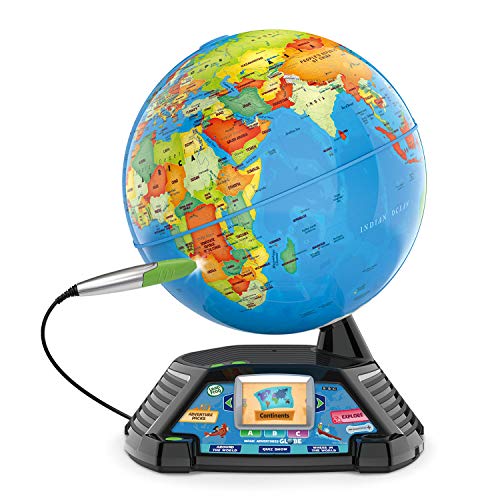
- 2.8-inch screen with BBC videos and animations
- Games, quizzes, and thousands of geography facts
- Designed for ages 5–12; requires four AA batteries
Best For: Interactive geography lessons for children ages 5–12
AR Discovery Pick
PlayShifu Orboot Earth Interactive Globe

- Augmented-reality globe with 1,000+ facts
- Includes games, quizzes, passport, and stickers
- Designed for ages 4–10 and app-supported learning
Best For: App-assisted geography and STEM exploration
Classic Reference Pick
Replogle Student Educational Globe
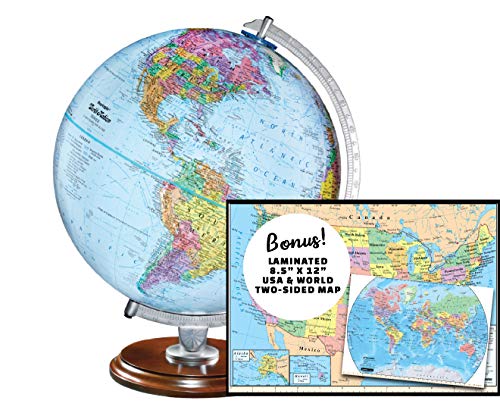
- 12-inch political globe with readable map details
- Raised relief shows mountain features
- Includes tilted axis, time dial, and population centers
Best For: Traditional homeschool geography reference and map practice
Hands-On Starter Pick
Learning Resources Puzzle Globe

- Color-coded continent pieces support hands-on learning
- Builds fine motor skills and shape recognition
- Includes labels, ocean names, and a 30+ fact guide
Best For: Preschool and early-elementary geography activities
Classic Geography Pick

- 12-inch raised-relief political globe
- More than 4,000 location names
- Gold-colored base and semi-meridian
Best For: Traditional homeschool geography lessons and desktop study areas
Large Map Learning Tool

- Large 13-inch high-definition display
- 4,000-plus cities and current boundaries
- Waterproof, markable, and erasable surface
Best For: Visual homeschool demonstrations and hands-on map activities
Interactive STEM Choice
SMART WALLABY Illuminated Globe

- Political globe, constellation map, and card game
- Displays 88 constellations with LED lighting
- Includes constellation guide for hands-on learning
Best For: Interactive geography and STEM-focused homeschool activities
Compact Classroom Explorer
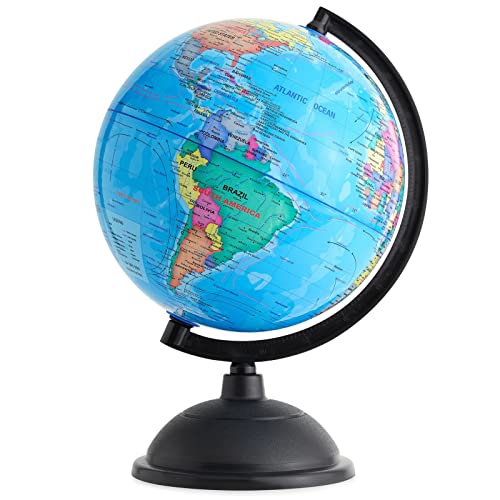
- Detailed map of countries, continents, and oceans
- Rotates for hands-on geography learning
- Compact plastic design for desks and storage
Best For: Homeschool desks and small learning spaces
Classic Geography Study Aid

- English political map is designed for easy reading
- Smooth swivel action supports viewing from all angles
- Sturdy stand and 12.2-inch overall height
Best For: Homeschool geography learners aged 8 and up
Interactive Map Learning Tool

- Colorful political map includes capitals and physical features
- Spins for tactile, hands-on exploration
- Removable base and frame add flexibility
Best For: Interactive homeschool lessons and demonstrations
Interactive Exploration Pick – LeapFrog Magic Adventures Globe
For homeschool families seeking globes for homeschool lessons with multimedia support, the LeapFrog Magic Adventures Globe combines a physical world map with a stylus, games, facts, and a 2.8-inch video screen. It covers countries and capitals as well as animals, habitats, cultures, landmarks, and more.
Best For: Children ages 5–12 who learn well through interactive games, videos, and guided activities.
Pros:
- Includes BBC videos, animations, and thousands of facts.
- Explores geography alongside animals, habitats, cultures, flags, and landmarks.
- Offers three interactive games with quizzes and mysteries.
Cons:
- Requires four AA batteries for regular use.
- The screen is relatively small at 2.8 inches.
This is a strong choice when you want a globe that can add visual and game-based variety to homeschool geography. Its battery-powered, single-player design is best suited to individual study or guided parent-child exploration.
AR Discovery Pick – PlayShifu Orboot Earth Interactive Globe
The PlayShifu Orboot Earth is one of the more technology-focused globes for homeschool, using augmented reality to turn a 10-inch globe into an exploration tool. Its app-based activities cover animals, places, monuments, cultures, geography, and STEM-oriented learning.
Best For: Children ages 4–10 who enjoy app-supported exploration, quizzes, and hands-on discovery.
Pros:
- Provides access to more than 1,000 facts and interactive games.
- Supports geography, problem-solving, memory, and early STEM learning.
- Includes a passport, visa stamp, stickers, and flag activities.
Cons:
- Interactive features depend on the free Orboot app.
- The product is made primarily from plastic.
Orboot Earth works well for homeschoolers who want geography to feel like an interactive adventure rather than a static reference activity. The included travel-themed materials can also help extend lessons into imaginative play.
Classic Reference Pick – Replogle Student Educational Globe
For families who prefer a traditional reference tool, the Replogle Student is a 12-inch globe suited to everyday globes for homeschool lessons. Its political map includes an accurately tilted axis, time dial, population centers, differentiated U.S. states, and raised relief for mountain ranges.
Best For: Students who need a durable-looking, non-electronic globe for map reading and ongoing reference.
Pros:
- Large 12-inch diameter offers a readable world map.
- Raised relief adds tactile texture to mountain areas.
- Includes a time dial, tilted axis, population centers, and color-separated U.S. states.
Cons:
- It does not provide games, videos, or other interactive electronics.
- Its approximately four-pound weight may make it less portable.
This Replogle globe is a practical centerpiece for geography discussions, map skills, and quick location reference. Choose it when you value classic cartography and physical map features over digital enrichment.
Hands-On Starter Pick – Learning Resources Puzzle Globe
The Learning Resources Puzzle Globe offers a tactile introduction to geography for younger learners. Rather than relying on screens, it uses color-coded continent pieces, detachable labels, and ocean names to make early globes for homeschool activities hands-on and approachable.
Best For: Preschool and early-elementary learners developing fine motor skills, shape recognition, and basic geography vocabulary.
Pros:
- Includes seven continent puzzle pieces and detachable continent name plates.
- Builds shape matching, problem-solving, and fine motor skills.
- Illustrations of landmarks and wildlife encourage discussion about places and ecosystems.
- Comes with a multilingual activity guide featuring more than 30 facts.
Cons:
- Its beginner-focused design offers less detailed mapping than a traditional globe.
- The manual puzzle format does not include electronic games or videos.
This puzzle globe is a good starting point for short, interactive geography sessions and tabletop learning. It can grow with a child through age 12, but its strongest fit is preschool and early-elementary instruction.
Classic Geography Pick – Replogle Explorer World Globe
For families seeking dependable globes for homeschool lessons, the Replogle Explorer offers a traditional political map with raised relief and more than 4,000 location names. Its 12-inch desktop size fits naturally into a study area while providing enough detail for geography discussions.
Best For: Homeschoolers who want a classic, desktop-sized political globe for country, boundary, and landform lessons.
Pros:
- Raised-relief surface supports hands-on geography learning.
- Includes more than 4,000 location names and clear political boundaries.
- Gold-colored base and semi-meridian provide a polished desktop presentation.
- Made in the USA.
Cons:
- Its 12-inch diameter may provide less viewing area than larger classroom-style globes.
- The political map design is focused on geography rather than illuminated or interactive features.
The Replogle Explorer is a straightforward choice when map clarity, raised relief, and a durable-looking desktop presentation matter more than added technology.
Large Map Learning Tool – BSHAPPLUS 13-Inch World Globe
The BSHAPPLUS 13-inch globe is designed for homeschoolers who want a highly readable display. Its current political boundaries, 4,000-plus labeled cities, and additional geographic features make it useful for studying countries, landforms, waterways, and global events.
Best For: Homeschool families needing a large, easy-to-read globe for demonstrations, reference, and geography projects.
Pros:
- 13-inch diameter provides a spacious viewing area.
- Shows more than 195 countries, 4,000-plus cities, rivers, seas, deserts, and ocean currents.
- Waterproof, markable, and erasable surface supports hands-on activities.
- Metal base and frame are designed for stable positioning.
Cons:
- The larger size may require more desk or shelf space.
- Its feature-rich political map may be more information than younger learners need at first.
With its larger format and markable surface, this BSHAPPLUS model stands out for active homeschool instruction where students need to see, discuss, and revisit map details.
Interactive STEM Choice – SMART WALLABY Illuminated Globe
For families looking beyond standard globes for homeschool, the SMART WALLABY combines a 9-inch spinning world globe with LED illumination, a constellation mode, and an interactive geography card game. It can support country and ocean study by day, then display 88 constellations as a night-light-style learning feature.
Best For: Homeschoolers who prefer hands-on STEM activities and a globe that combines geography, constellations, and room décor.
Pros:
- Three-in-one design includes a political globe, constellation map, and interactive card game.
- Illuminated mode displays 88 constellations.
- Includes a constellation guide and geography game for hands-on learning.
- Sturdy base and vibration-resistant internal assembly support regular use.
Cons:
- At 9 inches, it offers less map surface than the larger 12- and 13-inch options.
- The LED feature requires attention to the supplied maintenance and bulb-replacement guidance.
- The product emphasizes interactive and celestial learning, which may not suit families wanting only a conventional political globe.
This SMART WALLABY model is a versatile pick for homeschool rooms where learning activities, visual engagement, and an illuminated display are equally important.
Compact Classroom Explorer – Juvale 8-Inch World Globe
For families comparing globes for homeschool, the Juvale 8-inch model offers a compact, hands-on way to study countries, continents, and oceans. Its rotating design and lightweight plastic construction make it practical for desks, small learning spaces, or classroom use.
Best For: Homeschool desks, geography activities, and compact classroom displays.
Pros:
- Detailed world map includes countries, continents, and oceans.
- Rotating design supports hands-on geography exploration.
- Compact 8-inch size is easy to store and transport.
- Plastic construction is designed for frequent handling.
Cons:
- Plastic base and globe may offer a less premium feel than heavier materials.
- Its compact size may provide less map detail than a larger globe.
The Juvale globe is a straightforward choice when space, portability, and interactive learning matter. It works especially well as an everyday visual aid for homeschool geography lessons.
Classic Geography Study Aid – EXERZ 8-Inch Political Globe
For learners seeking globes for homeschool with clear political geography, the EXERZ 8-inch world globe presents an English-language map in an easy-to-read format. Its smooth swivel action and stable stand make it convenient for lessons and independent exploration.
Best For: Homeschool students aged 8 and up who are learning political geography.
Pros:
- Clear English political map identifies countries, continents, and oceans.
- Smooth swivel action allows viewing from different angles.
- Sturdy stand supports stable desktop use.
- At 12.2 inches tall, it provides a visible tabletop learning aid.
Cons:
- The supplied age recommendation makes it less suited to younger children.
- The 8-inch sphere may limit the amount of map detail available.
The EXERZ is a practical option for structured geography study, especially when an English political map and steady tabletop presentation are priorities.
Interactive Map Learning Tool – KISEER 8-Inch Blue Globe
Among globes for homeschool, the KISEER 8-inch model stands out for its colorful political map and removable base and frame. Children can spin and touch the globe while studying countries, capitals, boundaries, oceans, islands, rivers, and deserts.
Best For: Interactive homeschool geography lessons, demonstrations, and flexible display use.
Pros:
- Colorful, detailed map includes countries, capitals, and physical features.
- Rotating design encourages tactile exploration.
- Removable base and frame support demonstrations and storage flexibility.
- Plastic construction is designed for long-term use.
Cons:
- The political map may be less suitable when a purely physical geography map is preferred.
- Its glossy finish may produce reflections under some lighting.
The KISEER combines broad map coverage with an interactive spinning format. Its removable stand makes it a flexible pick for homeschool lessons that move between desk study, demonstrations, and display.
How We Picked These Globes for Homeschool
We focused on features that make a globe useful during everyday lessons rather than treating it as room decor alone. Our selection includes interactive technology, raised relief, illuminated designs, puzzle-based learning, readable political maps, and straightforward desktop models.
We also considered practical details such as diameter, stand stability, spinning functionality, English-language labeling, educational extras, and suitability for desks, shelves, classrooms, and shared family learning spaces. Because homeschool needs vary, the list includes both child-focused activity globes and more traditional models that can remain useful as students advance.
Quick Comparison
| Best For | Look For | Featured Types |
|---|---|---|
| Interactive learning | AR content, facts, games, or companion cards | LeapFrog, PlayShifu, SMART WALLABY |
| Traditional geography | Readable labels, current cartography, stable stand | Replogle, EXERZ, KISEER |
| Hands-on activities | Puzzles, raised relief, or tactile surfaces | Learning Resources, Replogle |
| Decor and lessons | Illumination, attractive finish, and desktop size | BSHAPPLUS, Juvale, SMART WALLABY |
Key Buying Factors for Globes for Homeschool
Age and Learning Style
Young learners often benefit from bright colors, simplified labels, games, and interactive prompts. Older students may need accurate political boundaries, current place names, physical terrain, and enough detail for independent research. A globe with raised relief can reinforce the difference between mountains, plains, and oceans.
Map Accuracy and Readability
Check whether the globe emphasizes political or physical geography and whether labels can be read from a child’s usual viewing distance. Up-to-date cartography matters for long-term use, especially when students are studying countries, borders, or current world regions.
Size, Stability, and Construction
An 8- to 9-inch globe is convenient for a small desk, while a 12- to 13-inch model generally offers better label visibility. Look for a stable base, a smooth rotating axis, and materials that can tolerate frequent handling. Measure the intended shelf or table before buying.
Technology and Extras
AR apps, audio content, quizzes, flags, cards, and puzzles can increase engagement, but they may require a compatible device or ongoing app support. Choose technology when it complements your curriculum—not simply because it adds features.
Who Should Buy Which Globes for Homeschool?
Choose an interactive AR or activity globe for children who learn best through games, discovery, and short self-directed sessions. A raised-relief Replogle model is a stronger fit for families prioritizing traditional geography and tactile terrain. Puzzle and card-based options work well for younger children who need repeated practice with countries and continents.
For a shared homeschool workspace, consider a 12-inch or larger globe with clear labels and a dependable stand. If the globe will double as bedroom or classroom decor, an illuminated or polished desktop model may offer the best balance. Budget-friendly 8-inch options are suitable for introductory lessons, compact desks, or adding a globe to multiple learning areas.