Wet filament can cause popping, stringing, rough surfaces, weak layers, and inconsistent extrusion. A dedicated dryer helps protect moisture-sensitive materials while keeping everyday PLA and PETG ready to print.
We compare 10 filament dryers for home workshops, covering compact spool dryers, dual- and four-spool systems, sealed storage boxes, and larger-capacity cabinets.
Best 10 Filament Dryers for Home Workshops Picks for 2026
Multi-Printer Pick

- Holds and dries four 1kg spools
- 350W heater with three circulation fans
- Eight outlets and 0–99-hour timer
Best For: Multi-printer home workshops
Integrated Storage Pick

- Dries, stores, and feeds without breaking the seal
- Includes hygrometer and desiccant support
- Supports common filaments including PA Nylon and TPU
Best For: Moisture-conscious everyday printing
Compact Everyday Option

- Adjusts from 35–70°C with a 0–99-hour timer
- Rotating spindle supports even drying
- Transparent lid and touch controls simplify use
Best For: Single-spool home workshops
Best Dual-Spool Pick
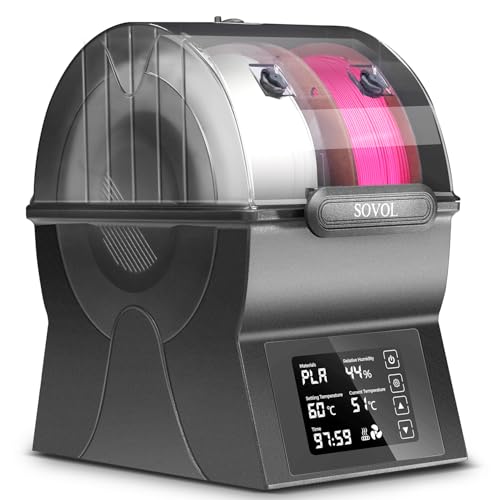
- Dries two 1 kg spools at once
- Heats to 50°C in about 7 minutes
- Presets for nine filament types
Best For: Home workshops needing higher drying capacity
Best Simple Storage Pick

- Stores two 1 kg spools
- Supports 1.75 mm and 2.85 mm filament
- Offers 40°C–50°C drying control
Best For: Basic two-spool drying and sealed storage
Best with Extra Features

- Dries up to 12 one-kilogram spools
- Five-layer safety system for extended operation
- Auto, Stay-Dry, and Manual modes
Best For: High-volume home workshops and multi-spool drying
Best Two-Spool Touchscreen Option

- Fits two one-kilogram spools
- 160W PTC heating with 360° airflow
- 4-inch touchscreen and 12 filament presets
Best For: Small workshops needing guided two-spool drying
Best Compact Everyday Dryer

- Fits one-kilogram spools
- Reaches 65°C within 15 minutes
- Humidity monitoring and 0–24-hour timer
Best For: Individual makers drying one spool at a time
High-Capacity Choice – Creality Space Pi X4
For home workshops that need to manage several spools at once, this Creality model is a high-capacity option among filament dryers for home workshops. Its dual chambers, 200W heating, and sealed storage design support drying and continued moisture protection while printing.
Best For: High-volume users who need space for four 1kg spools or two 2kg spools.
Pros:
- Holds four standard 1kg spools or two 2kg spools.
- Dual independent heating chambers reach up to 85°C.
- Can maintain dry storage during printing pauses with a silicone-sealed enclosure.
- Supports 1.75mm and 2.85mm filament, with temperature settings for common and advanced materials.
Cons:
- Its four-spool capacity requires more workspace than a compact dryer.
- The supplied notes do not specify a timer range.
The Space Pi X4 stands out when capacity and storage continuity matter more than a small footprint. The illuminated window and touch interface add convenience for workshop users managing multiple materials.
Multi-Printer Pick – SUNLU S4
The SUNLU S4 is built for busy home workshops running several printers or drying multiple materials together. It combines four-spool capacity, a 350W PTC heater, three circulation fans, and multiple filament outlets in one large enclosure.
Best For: Multi-printer setups and users who want adjustable drying for up to four 1kg spools.
Pros:
- Dries up to four 1kg spools simultaneously.
- Three fans and 360-degree surrounding heating promote more even temperature distribution.
- Offers eight filament exit holes for different printer layouts.
- Temperature adjusts from 35–70°C, with a timer from 0–99 hours.
Cons:
- Its large 460 × 220 × 310mm exterior and 4kg weight may be substantial for smaller benches.
- The 70°C maximum is lower than some dryers designed for higher-temperature materials.
With broad material compatibility and flexible outlet placement, the S4 is a practical shared drying station. Its size makes it best suited to a dedicated workshop area rather than a compact desktop.
Integrated Storage Pick – Polymaker PolyDryer
The Polymaker PolyDryer takes a storage-first approach to filament dryers for home workshops. Its Dry Dock and PolyDryer Box combine heated drying, sealed storage, desiccant support, and direct feeding so filament can stay enclosed between and during prints.
Best For: Makers who want one modular system for drying, monitoring, storing, and feeding filament.
Pros:
- Supports drying, sealed storage, and printing without breaking the seal.
- Built-in hygrometer helps monitor storage conditions.
- Uses heat, sealing, and desiccant protection together.
- Works with PA Nylon, PLA, PVB, PETG, ABS, ASA, and TPU in several filament diameters.
Cons:
- The supplied notes do not state the maximum temperature or timer range.
- Its modular box-and-dock design may be more involved than a basic single-purpose dryer.
Choose the PolyDryer if ongoing moisture control is as important as the initial drying cycle. The integrated design is especially useful for workshops that frequently move between print sessions.
Compact Everyday Option – SUNLU S2
The SUNLU S2 is a straightforward choice for home workshops that need to revive damp filament and keep a spool dry during printing. Its adjustable 35–70°C range, 0–99-hour timer, touch controls, and transparent lid make routine drying easy to manage.
Best For: Individual makers who want a simple dryer and spool holder for common filament types.
Pros:
- Supports 1.75mm, 2.85mm, and 3.00mm filament.
- Adjustable temperature and drying time suit different materials and conditions.
- Built-in spindle rotates the spool for even drying.
- Translucent lid allows inspection without opening the enclosure.
Cons:
- Its single-spool design is less suitable for high-volume drying.
- The 70°C maximum may not cover every high-temperature drying requirement.
The S2 favors simplicity and everyday usability over large capacity. It is a sensible starting point for makers who mainly dry one spool at a time and want to keep filament enclosed while printing.
Best Dual-Spool Pick – Sovol SH02 Filament Dryer
For home workshops that need to dry more than one spool, the Sovol SH02 is a practical choice among filament dryers for home workshops. It holds two 1 kg rolls, reaches 50°C in about seven minutes, and offers adjustable drying from 40°C to 70°C.
Best For: Users drying two spools at once or switching among several filament types.
Pros:
- Dual-spool capacity supports two 1 kg rolls simultaneously.
- 150W PTC heater and circulating fan provide faster, more even heating.
- One-key presets cover nine filament types, including PLA, PETG, TPU, ABS, and nylon.
- Improved sealing helps protect filament even when the unit is off.
Cons:
- Desiccant bags are not included.
- Its dual-spool design may be more capacity than a single-printer user needs.
The SH02 stands out for combining two-spool capacity, broad temperature control, and simple material presets. Its safety cutoff and fan alarm are useful additions for a busy workshop.
Best for Everyday Use – Creality Space Pi X4L
The Creality Space Pi X4L is designed for demanding home workshops that run multiple materials or colors. Its four-spool capacity, two independent drying chambers, and heating up to 75°C make it one of the more capable filament dryers for home workshops.
Best For: Multi-spool and multi-material setups that need independent chamber control.
Pros:
- Dries and feeds up to four spools at once.
- Independent PTC heaters allow separate temperature control for each chamber.
- Dual 200W heaters reach temperatures up to 75°C.
- LCD touchscreen includes auto-drying and real-time humidity monitoring.
Cons:
- The supplied version is for US-standard 110V; connecting it to 220V can damage the unit.
- Its four-spool capacity may be excessive for smaller setups.
Choose the X4L when throughput and flexibility matter more than compactness. Dual-layer insulation is intended to keep the exterior at or below 60°C while the interior reaches higher drying temperatures.
Best Simple Storage Pick – Comgrow SH01 Filament Dryer
The Comgrow SH01 is a straightforward option for home workshops that need enclosed filament storage with basic drying support. It holds two 1 kg spools, supports 1.75 mm and 2.85 mm filament, and combines adjustable temperature and timer controls with a sealed design.
Best For: Users who want two-spool storage and moderate-temperature drying for common materials.
Pros:
- Stores two 1 kg spools in its large interior.
- Works with standard 1.75 mm and 2.85 mm filament diameters.
- LCD screen displays temperature and humidity information.
- Sealed outlet and cover help protect filament when the box is not in use.
Cons:
- Temperature is limited to 40°C–50°C.
- Drying time is limited to six- to 12-hour settings.
- The outlet should be opened during drying and closed afterward.
The SH01 suits users who prioritize uncomplicated operation and enclosed storage over high-temperature drying. Its modest temperature range is best matched with materials that do not require more intense heat.
Best with Extra Features – Hydryer H2O 12-Spool Dryer
For home workshops that need filament dryers for home workshops with substantial batch capacity, the Hydryer H2O is built to handle up to 12 one-kilogram spools. Its circulating hot air, stainless-steel construction, and safety-focused controls make it suited to overnight or extended drying.
Best For: Makers who regularly dry multiple spools or need a larger dry-storage cabinet.
Pros:
- Holds up to 12 one-kilogram spools.
- Five-layer safety system supports unattended operation.
- Offers Auto, Stay-Dry, and Manual modes with a 100–220°F range.
- Quiet 40 dB operation and durable stainless-steel construction.
Cons:
- Its 17.5 × 14.4 × 24.19-inch footprint requires more workspace.
- The humidity display on early batches may read slightly higher than actual chamber humidity.
- The set temperature is a maximum ceiling, so users may need to set it 10–15°F above the desired chamber temperature.
The Hydryer H2O is a specialized choice for high-volume printing environments. It costs workspace and capacity is likely unnecessary for occasional users, but its multi-spool design and long-duration operation make it particularly practical for busy home workshops.
Best Two-Spool Touchscreen Option – Creality Space Pi Plus
The Creality Space Pi Plus is a practical middle ground for filament dryers for home workshops: it handles two one-kilogram rolls while adding 360° hot-air circulation and a 4-inch touchscreen. One-key presets simplify drying across common and specialty filament types.
Best For: Makers who want two-spool capacity, guided settings, and straightforward touchscreen control.
Pros:
- Dries two one-kilogram spools at once.
- Double 160W PTC heating and 360° circulation promote uniform heating.
- One-key presets support up to 12 filament types.
- Temperature is adjustable from 45–70°C with Celsius/Fahrenheit switching.
Cons:
- It is limited to two rolls, so it is not suited to large batch drying.
- The supplied notes do not specify a humidity display or storage mode.
- Its advanced presets may still require selecting appropriate settings for each filament.
For most small to medium home setups, the Space Pi Plus offers a useful balance of capacity and convenience. Its touchscreen and presets reduce setup effort, while the dual-spool layout supports running material for two printers or preparing a couple of rolls together.
Best Compact Everyday Dryer – Creality Space Pi SE
The Creality Space Pi SE is a compact option among filament dryers for home workshops, designed for one-kilogram spools and everyday filament preparation. Its PTC heater reaches 65°C within 15 minutes, while the display tracks humidity and remaining drying time.
Best For: Individual makers who typically dry one spool and want simple knob-based controls.
Pros:
- Heats to 65°C within 15 minutes according to the supplied specifications.
- 360° hot-air circulation and inner-wall insulation support even, efficient heating.
- Adjustable temperature from 45–65°C and timer from 0–24 hours.
- Supports 1.75mm and 2.85mm filament, including PLA, PETG, TPU, ABS, ASA, PP, PC, and PA.
Cons:
- Designed for one-kilogram spools rather than multi-spool batches.
- Its temperature range tops out at 65°C, below the range of the larger Hydryer H2O.
- The listed warranty is six months.
The Space Pi SE is a sensible starter or supplemental dryer for a home printer setup. It provides the core controls most users need without the larger capacity of a cabinet-style unit, though frequent multi-spool users may outgrow it.
How We Picked These Filament Dryers for Home Workshops
We focused on practical features that matter in a home printing environment: usable spool capacity, stated temperature range, heating design, drying control, storage protection, noise and footprint considerations, and compatibility with common 1kg spools. The selection includes compact units for occasional printing, multi-spool models for busy workbenches, and larger systems for makers who need extended dry storage.
Because filament types have different drying requirements, temperature control and monitoring are more important than maximum heat alone. A good dryer should make it easy to select an appropriate setting, track progress, and feed filament to the printer without unnecessary handling.
Quick Comparison
| Best For | Look For | Typical Capacity |
|---|---|---|
| Occasional home printing | Compact design and simple controls | One spool |
| Multiple active printers | Dual or four-spool heating | Two to four spools |
| Moisture-sensitive materials | Higher temperature range and reliable sensing | One or more spools |
| Long-term filament management | Dry storage, seals, and large capacity | Four to 12 spools |
Key Buying Factors for Filament Dryers for Home Workshops
Capacity and Spool Fit
Check both the advertised spool count and the actual chamber dimensions. Wide, tall, or specialty spools may not fit even when a dryer claims multi-spool capacity. If you print with several materials at once, choose a model that can dry and feed the required number of spools without crowding.
Temperature Control
PLA, PETG, TPU, nylon, and polycarbonate do not all need the same treatment. Adjustable settings are preferable to a single high-temperature mode. Look for clear controls, useful presets, and a temperature sensor that helps prevent overheating.
Drying Versus Storage
A dryer removes moisture; a sealed storage box helps keep filament dry afterward. If your workshop is humid or you print infrequently, prioritize models with effective seals, desiccant compatibility, or continuous dry storage. A feed-through design is useful when the spool will remain in the box during printing.
Heat Distribution and Convenience
PTC heating, circulating airflow, and even chamber temperatures can improve consistency. Also consider noise, viewing windows, cable placement, cleaning access, and whether the unit fits beside your printer.
Who Should Buy Which Filament Dryers for Home Workshops?
Choose a compact single-spool dryer if you have one printer, limited bench space, or mostly need occasional filament recovery. A dual-spool model is a sensible middle ground for regular printing and lets you prepare a second spool while another is in use.
Four-spool dryers suit households, classrooms, and workshops running several materials or printers. For serious material management, nylon-heavy workflows, or long-term storage, consider a higher-capacity cabinet with stronger sealing and dedicated dry-storage features. Whichever model you choose, match its temperature range to your filament manufacturer’s recommendations and allow adequate drying time rather than relying only on the highest setting.