Digital rain gauges make it easier to track rainfall without checking a manual tube or estimating precipitation from nearby weather reports. The best models collect rain automatically, display totals clearly, and preserve useful history for gardening, irrigation, storm planning, and general weather monitoring.
We compared wireless rain gauges and complete weather stations for measurement features, display quality, installation convenience, alerts, sensor range, and overall practicality. The guide below explains which features matter most and which type of gauge fits different households.
Best 10 Digital Rain Gauges Picks for 2026
Best for Rain Alerts
AcuRite 00899 Wireless Digital Rain Gauge

- Programmable rain-rate and flood-watch alerts
- Self-emptying collector for lower maintenance
- Indoor LCD includes rainfall history, date, and time
Best For: Gardeners and homeowners who want rainfall alerts
Best Smart Weather Station
Sainlogic WiFi Digital Rain Gauge

- Tracks rainfall plus broad indoor and outdoor conditions
- Wi-Fi enables remote monitoring and data storage
- Stores up to two years and exports data to Excel
Best For: Connected homes, gardens, farms, and weather tracking
Best Simple Rainfall History
AcuRite 02446M Digital Rain Gauge

- Tracks rainfall across daily, weekly, monthly, and yearly periods
- Self-emptying collector needs no daily maintenance
- Audible alert sounds at a selected rainfall total
Best For: Gardeners and casual weather-watchers
Best for Rain and Humidity
La Crosse 724-1415BL Rain Station

- Reports rainfall from one-hour through yearly totals
- Includes indoor and outdoor temperature and humidity
- Self-emptying bucket with rain-day indicator
Best For: Homes wanting precipitation and basic climate readings
Best for Storm Alerts
AcuRite Self-Emptying Wireless Rain Gauge
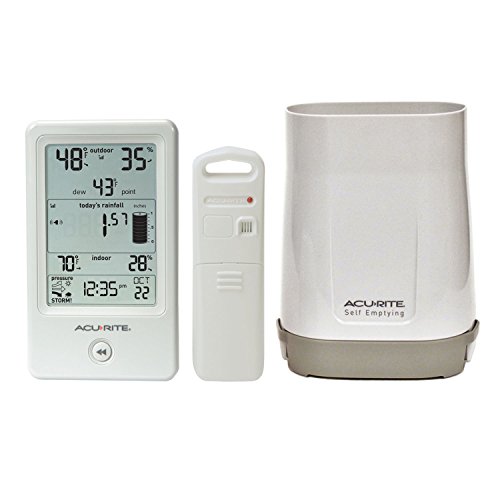
- Tracks rainfall across multiple time periods
- Provides storm and programmable rain alarms
- Adds wireless temperature and humidity readings
Best For: Home weather monitoring with rainfall alerts
Best Full Weather Station
Wireless Weather Station with Rain Gauge

- Combines rain, wind, and atmospheric measurements
- Uses an 8.5-inch adjustable color LCD
- Offers up to 328 feet of wireless range
Best For: Comprehensive indoor and outdoor weather monitoring
Best Rainfall History
Self-Emptying Wireless Digital Rain Gauge

- Displays eight rainfall measurement periods
- Includes a programmable rain alarm
- Adds temperature, clock, calendar, and backlight functions
Best For: Detailed household rainfall tracking and garden watering decisions
Easy Rainfall Tracking Pick
BIUWING Self-Emptying Rain Gauge

- Self-emptying sensor reduces maintenance
- Eight rainfall timeframes, including total accumulation
- Rain alerts plus indoor and outdoor temperature
Best For: Low-maintenance garden and home precipitation tracking
Large-Display Weather Station Pick
BIUWING Weather Station with Rain Gauge

- 7.5-inch full-color display with adjustable brightness
- Rainfall, temperature, humidity, pressure, and forecast data
- Supports up to three sensors; one is included
Best For: Households wanting readable weather data and expandable monitoring
Best for Rain Alerts – AcuRite 00899 Wireless Digital Rain Gauge
For gardeners and homeowners who want straightforward digital rain gauges with useful warnings, the AcuRite 00899 combines a self-emptying outdoor collector with an easy-to-read indoor display. It transmits rainfall totals every 60 seconds and can alert you to a chosen rain rate or flood-watch condition.
Best For: Lawns, gardens, and households that want rainfall history plus programmable alerts.
Pros:
- Programmable rain-rate and flood-watch alarm.
- Self-emptying collector requires little maintenance.
- Indoor LCD shows rainfall information, date, and time.
- Wireless transmission is designed to provide strong signal penetration.
Cons:
- Battery powered, requiring five AA batteries.
- Operating temperature range is limited to 32°F–120°F.
The 00899 is a focused choice if rainfall alerts matter more than broader weather measurements. Its self-emptying design and indoor display make routine monitoring convenient, while the tipping-bucket sensor supports regular rain-rate tracking.
Best Smart Weather Station – Sainlogic WiFi Digital Rain Gauge
The Sainlogic weather station is a good fit for shoppers seeking digital rain gauges as part of a broader connected weather system. Along with rainfall, it tracks temperature, humidity, pressure, wind, moon phase, and forecasts, with Wi-Fi access for smartphone monitoring and historical data review.
Best For: Farms, gardens, and tech-focused homes that want remote monitoring and extensive weather history.
Pros:
- Monitors rainfall alongside temperature, humidity, wind, pressure, and forecasts.
- Wi-Fi connectivity supports phone access, cloud storage, and compatible platforms.
- Stores up to two years of data locally and supports Excel export.
- Outdoor sensor offers a stated range of up to 443 feet in open areas.
Cons:
- More involved than a rain-only gauge because it includes many weather functions.
- Requires three AA batteries for the sensor and Wi-Fi setup for remote access.
This is the most capable option for buyers who want rainfall readings integrated with detailed weather analysis. Its long-term storage and export tools are particularly useful for gardening, property maintenance, and reviewing weather trends.
Best Simple Rainfall History – AcuRite 02446M Digital Rain Gauge
The AcuRite 02446M keeps digital rain gauges simple and practical. Its outdoor collector wirelessly sends readings to a vertical indoor display, while the self-emptying design and selectable rainfall periods make it easy to monitor precipitation without daily emptying.
Best For: Casual weather-watchers and gardeners who want clear rainfall totals and a customizable alarm.
Pros:
- Displays rainfall for today, yesterday, the past week, month, and year.
- Self-emptying collector reduces routine maintenance.
- Customizable audible alarm signals when a chosen rainfall total is reached.
- Wireless outdoor-to-indoor transmission simplifies placement.
Cons:
- Focused on rainfall rather than temperature, humidity, or other weather readings.
- Battery powered and limited to the listed 50°C upper temperature range.
Choose the 02446M when rainfall history is the priority and you prefer an uncomplicated display. It offers useful time-period comparisons and an alert function without the broader setup of a complete weather station.
Best for Rain and Humidity – La Crosse 724-1415BL Rain Station
La Crosse Technology 724-1415BL Wireless Rain Station with Temperature and Humidity
Check Price On AmazonThe La Crosse 724-1415BL expands beyond basic digital rain gauges by combining precipitation tracking with indoor and outdoor temperature and humidity readings. Its self-emptying rain bucket reports several time intervals, while the LCD station also provides a calendar and clock.
Best For: Homes that want rainfall totals together with basic temperature and humidity monitoring.
Pros:
- Reports current, hourly, 24-hour, seven-day, monthly, yearly, and total rainfall.
- Self-emptying bucket uses internal tilting cups and draining vents.
- Measures indoor and outdoor temperature and humidity.
- Dynamic icon indicates days with or without rainfall.
Cons:
- Requires six AA batteries.
- Time is manually set rather than automatically synchronized.
- Does not list Wi-Fi or smartphone monitoring.
The La Crosse station is a balanced choice for household monitoring when you want more context than rainfall alone. Its wide range of precipitation summaries is useful for tracking patterns, while temperature and humidity readings add everyday practical value.
Best for Storm Alerts – AcuRite Self-Emptying Wireless Rain Gauge
If you want digital rain gauges that combine rainfall tracking with useful household weather data, this AcuRite model is a practical choice. Its self-emptying outdoor collector wirelessly sends readings to an indoor monochrome display from up to 100 feet, while the separate temperature and humidity sensor has a range of up to 330 feet.
Best For: Homeowners who want rainfall history, storm warnings, and indoor access to outdoor conditions.
Pros:
- Tracks rainfall for the current day, previous day, week, month, year, and previous year.
- Includes an oncoming-storm alert and a programmable rain alarm for possible flooding or sprinkler timing.
- Displays outdoor temperature and humidity, plus indoor readings and high/low records with timestamps.
- Self-emptying collector and wireless indoor display simplify routine monitoring.
Cons:
- The monochrome LCD display is less visually rich than a color weather station.
- It requires three AAA batteries.
- The rain gauge and display have a shorter stated transmission range than the temperature and humidity sensor.
This is a focused digital rain gauge rather than a full weather station, making it a strong fit when rainfall totals and alerts matter more than wind, barometric pressure, or forecast features.
Best Full Weather Station – Wireless Weather Station with Rain Gauge
For shoppers seeking digital rain gauges with broader environmental coverage, this wireless weather station adds rainfall measurement to a large set of weather readings. Its 8.5-inch color LCD receives data from the outdoor sensor at distances up to 328 feet and works without Wi-Fi.
Best For: Users who want rain, wind, temperature, humidity, pressure, and related weather information on one console.
Pros:
- Measures rainfall, wind speed and direction, temperature, humidity, barometric pressure, UV index, dew point, and moon phase.
- Large color display has adjustable brightness and shows weather information in real time.
- Outdoor sensor offers a stated wireless range of up to 328 feet and includes an adjustable mounting bracket.
- Includes a 2-year warranty and Florida-based customer support according to the supplied notes.
Cons:
- Its many readings may be more than needed if rainfall is your only priority.
- The station does not use Wi-Fi, so the supplied notes do not indicate app or remote internet access.
- Installation involves assembling and mounting the integrated outdoor sensor.
This model is best viewed as a complete home weather station with a rain gauge, not a simple precipitation-only monitor. Choose it when wind and atmospheric data are as important as rainfall totals.
Best Rainfall History – Self-Emptying Wireless Digital Rain Gauge
This digital rain gauge is designed for straightforward precipitation tracking around the home. The self-emptying outdoor sensor wirelessly connects to an indoor console, where you can view current rainfall, historical totals, temperature readings, and a graphical rainfall display.
Best For: Gardeners and homeowners who want detailed rainfall intervals, indoor viewing, and simple alarm-clock features.
Pros:
- Provides eight rainfall views: current, one hour, 24 hours, today, seven days, month, year, and total.
- Self-emptying design supports low-maintenance outdoor use and automatic connection after batteries are installed.
- Includes indoor and outdoor temperature readings, a programmable rain alarm, and a cylindrical rainfall graph.
- Blue backlight, calendar, dual alarm, snooze, and WWVB radio-controlled time add household convenience.
Cons:
- The supplied notes do not specify the wireless transmission range.
- It focuses on rainfall and temperature rather than wind, pressure, or other advanced weather measurements.
- The backlight stays on for only 15 seconds after activation.
With eight precipitation views and a visual history graph, this is a useful option for deciding when to water or reviewing changing rainfall patterns. It keeps the feature set centered on everyday rain monitoring.
Professional Monitoring Pick – Sainlogic Wireless Weather Station
For shoppers comparing digital rain gauges, the Sainlogic stands out as a full weather station with rainfall history, wind data, pressure, humidity, and forecasting. Its wireless outdoor sensor sends readings to a large color display, making it practical for detailed home, garden, farm, or environmental monitoring.
Best For: Homeowners, gardeners, farmers, and users who want broad weather data with rainfall records.
Pros:
- Records rainfall by hour, day, week, month, and total accumulation.
- Offers claimed accuracy of ±1 mm below 15 mm and ±7% across its full stated range.
- Large 6.5-inch HD color LCD with adjustable backlight and oversized fonts.
- Also displays temperature, humidity, barometric pressure, wind speed, wind direction, dew point, and moon phase.
Cons:
- No Wi-Fi connectivity is included.
- The system provides many readings, which may be more than casual users need.
This is the strongest choice of the three for users who want a comprehensive monitoring setup rather than rainfall totals alone. The wireless installation and multiple historical views add useful context for weather-aware planning.
Easy Rainfall Tracking Pick – BIUWING Self-Emptying Rain Gauge
This BIUWING model is a straightforward option among digital rain gauges, combining wireless rainfall measurement with indoor and outdoor temperature readings. Its self-emptying design and indoor console make it convenient for routine garden monitoring without manually clearing the collector.
Best For: Gardeners and homeowners who want simple rainfall history, temperature readings, and customizable alerts.
Pros:
- Self-emptying outdoor sensor is designed for low-maintenance operation.
- Tracks rainfall for now, 1 hour, 24 hours, day, 7 days, month, year, and total accumulation.
- Provides programmable rain alerts that can help with watering and flood awareness.
- Indoor console includes temperature readings, a clock, calendar, dual alarms, and snooze.
Cons:
- The display backlight stays on for only 15 seconds after activation.
- The supplied notes do not specify a rainfall accuracy rating or transmission range.
Choose this unit if easy operation and broad rainfall-history views matter more than advanced meteorological measurements. The self-emptying sensor is especially useful for users who prefer minimal upkeep.
Large-Display Weather Station Pick – BIUWING Weather Station with Rain Gauge
Product not found.For buyers seeking digital rain gauges with a broad household information display, this BIUWING weather station combines rainfall monitoring with temperature, humidity, pressure history, forecasting, and alerts. Its 7.5-inch full-color LCD is designed for clear viewing, while support for up to three sensors allows monitoring across different indoor locations.
Best For: Families and households that want a large, readable display and expandable indoor monitoring.
Pros:
- Measures rainfall alongside indoor and outdoor temperature and humidity.
- Displays air-pressure history, moon phase, weather forecast, trends, and outdoor index information.
- 7.5-inch full-color display offers wide viewing angles and five adjustable brightness levels when powered by the adapter.
- Can connect with up to three sensors, although only one sensor is included.
Cons:
- Only one sensor is included in the package.
- Additional sensors may be needed to use all three available channels.
- The supplied notes do not provide a specific rainfall accuracy figure.
This model is a good fit when display readability and whole-home information are priorities. It offers more than a basic rain meter, but buyers should account for the single included sensor if they plan to monitor multiple locations.
How We Picked the Best Digital Rain Gauges
We focused on Digital Rain Gauges that offer more than a basic one-time rainfall reading. Important considerations included self-emptying collectors, wireless communication, readable indoor displays, rainfall history, storm alerts, temperature and humidity data, and the ability to monitor conditions from inside the home.
We also considered complete weather stations that add wind, pressure, forecast, or moon-phase information. These can be a better value for buyers who want broader outdoor data, but they may require more setup and provide more information than a simple rain-focused device.
Quick Comparison
| Best For | Look For | Potential Trade-Off |
|---|---|---|
| Simple rainfall tracking | Self-emptying collector and clear totals | Fewer weather measurements |
| Garden and irrigation planning | Rainfall history and resettable records | May require careful sensor placement |
| Storm monitoring | Rain alerts and current-condition displays | Alert settings can vary by model |
| Complete home weather data | Wind, temperature, humidity, pressure, and forecast readings | More installation and calibration |
Key Buying Factors for Digital Rain Gauges
Collector Design and Accuracy
A self-emptying collector reduces the need to empty the gauge manually after heavy rainfall. Check whether the design is freeze resistant if you plan to leave it outside year-round, and place the collector on a level, unobstructed surface away from roofs, trees, and walls.
Wireless Range and Signal Reliability
Wireless range is measured under favorable conditions, so walls, metal siding, dense foliage, and elevation changes can reduce performance. Choose a model with more range than your minimum requirement and confirm that the outdoor sensor can reach the indoor display from its intended location.
History, Alerts, and Display
Rainfall history helps compare daily, weekly, monthly, or storm totals, while alerts can provide a quick warning when precipitation reaches a selected threshold. Prioritize a display with large, easy-to-read numbers if you will check it from across a room.
Power and Maintenance
Review battery requirements for both the outdoor sensor and indoor console. Solar-assisted or low-maintenance designs may reduce battery changes, but all outdoor collectors still need occasional cleaning to remove leaves, dirt, and insects.
Who Should Buy Which Digital Rain Gauges?
Choose a dedicated wireless rain gauge if your main goal is dependable rainfall measurement with minimal setup. It is a practical choice for gardeners, homeowners managing irrigation, and anyone who wants precipitation totals without a full weather station.
Choose a weather station with rain measurement if you also want wind speed, wind direction, temperature, humidity, air pressure, or forecast information. These models suit weather enthusiasts and households that want a broader view of local conditions.
For storm-prone areas, prioritize rainfall history, threshold alerts, strong wireless range, and a freeze-resistant outdoor collector. For casual monitoring, a simple self-emptying model with a clear display should provide the best balance of convenience and cost.