Stable conductivity helps aquarists monitor dissolved minerals, salinity, and overall water consistency. The right meter can make routine checks faster and reveal changes before they affect fish, corals, or invertebrates.
We selected 10 options ranging from simple TDS pens to dedicated EC testers and seawater refractometers, with choices for freshwater, marine, planted, and reef aquariums.
Best 10 Conductivity Meters for Aquariums Picks for 2026
Versatile Digital Tester
HoneForest TDS, EC & Temperature Meter
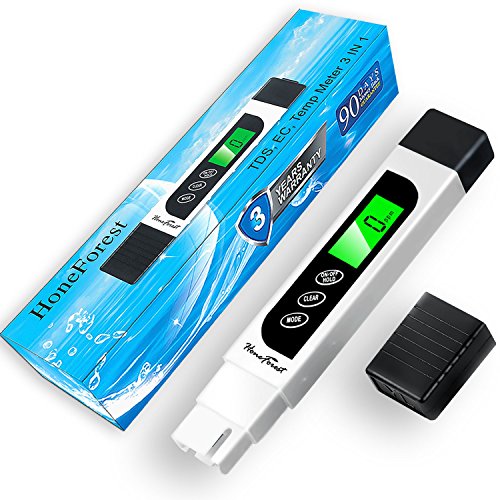
- Measures EC, TDS, and temperature
- Backlit LCD with auto-lock
- Includes portable carrying case
Best For: Multipurpose aquarium and water testing
Marine Salinity Specialist
Agriculture Solutions Seawater Refractometer

- Measures 0–100 ppt salinity
- Reads specific gravity and ppt
- Includes ATC and hard case
Best For: Marine fishkeeping and saltwater monitoring
EC-Focused Hydro Tester
HM Digital COM-80 EC/TDS Meter

- Displays EC and TDS on four scales
- Automatic temperature compensation
- 1 ppm/µS resolution with ±2% accuracy
Best For: EC and TDS-focused water testing
Dual-Parameter Monitor
pH/EC Conductivity Meter with ATC

- Measures pH and EC together
- Includes automatic temperature compensation
- Comes with calibration solutions
Best For: Aquarium users monitoring both pH and conductivity
Best Value TDS Meter

- 0–9,990 ppm range with 1 ppm resolution
- Includes case with belt clip
- Hold function and built-in thermometer
Best For: Simple, portable TDS checks
Best Premium Option
Apera EC60 Conductivity Tester

- Tests EC, TDS, salinity, and temperature
- Automatic temperature compensation
- IP67 waterproof with replaceable probe
Best For: Multifunction aquarium water testing
Best Easy-Read Combo Meter

- Measures TDS, EC, and temperatures
- Large backlit LCD for readability
- Factory calibrated with hold and auto-lock
Best For: Accessible routine aquarium testing
Best Dedicated EC Tester

- Measures EC and temperature
- 0–9999 µS range with 1 µS resolution
- Water-resistant with digital calibration
Best For: Routine aquarium EC and temperature checks
Best Multi-Function Value

- Tests pH, TDS, EC, and temperature
- Includes ATC and auto calibration
- Protective case and calibration buffers included
Best For: Multi-purpose home and aquarium water testing
Best Premium Conductivity Pen

- Measures EC, CF, and two PPM scales
- Waterproof and floats in solution
- Factory calibrated with ATC
Best For: Frequent aquarium and hydroponic conductivity testing
Versatile Digital Tester – HoneForest TDS, EC & Temperature Meter
For shoppers comparing conductivity meters for aquariums, the HoneForest provides a compact way to check EC alongside TDS and temperature. Its titanium alloy probe, backlit LCD, auto-lock function, and automatic shutoff make routine water checks straightforward.
Best For: Aquarium owners who also want one tester for RO/DI systems, drinking water, hydroponics, pools, or spas.
Pros:
- Measures EC, TDS from 0–9990 ppm, and temperature.
- Backlit LCD and auto-lock support quick readings.
- Compact battery-powered design includes a carrying case.
Cons:
- It is a TDS/EC tester rather than a dedicated pH meter.
- The supplied notes do not specify calibration solutions or a stated EC range.
This is a practical multipurpose choice when aquarium conductivity checks are only part of your water-testing routine. The included case and simple operation add convenience for regular maintenance.
Marine Salinity Specialist – Agriculture Solutions Seawater Refractometer
For marine aquarium keepers, this refractometer offers a focused alternative to general conductivity meters for aquariums. It measures seawater salinity on both specific-gravity and parts-per-thousand scales, with automatic temperature compensation for more convenient monitoring.
Best For: Marine fishkeeping and aquarium owners who need to monitor saltwater salinity.
Pros:
- Measures salinity from 0–100 ppt.
- Displays both specific gravity and parts per thousand.
- Includes automatic temperature compensation and a hard case.
- Package includes a dropper, screwdriver, manual, and cleaning cloth.
Cons:
- It is designed for salinity measurement, not general EC, TDS, or pH testing.
- The supplied notes do not list a digital display or electronic conductivity reading.
This is best viewed as a dedicated marine salinity tool rather than an all-purpose water meter. Its dual scales and included accessories make it well suited to saltwater monitoring.
EC-Focused Hydro Tester – HM Digital COM-80 EC/TDS Meter
The HM Digital COM-80 is a focused option for shoppers seeking conductivity meters for aquariums, especially when EC and dissolved-solids readings are the priority. It offers multiple EC and TDS scales, automatic temperature compensation, a hold function, and a 1 ppm/µS resolution.
Best For: Aquarium, nutrient, and water-testing routines that require EC and TDS readings across several display scales.
Pros:
- Measures EC in µS and mS plus TDS in ppm and ppt.
- Provides automatic temperature compensation.
- Offers 1 µS/ppm resolution and a stated ±2% readout accuracy.
- Includes data hold, auto-off, low-battery indication, and water resistance.
Cons:
- It does not measure pH or temperature as a displayed test category.
- Its TDS range is limited to 0–5000 ppm.
- It requires three LR44 batteries.
With its dedicated EC/TDS design and several measurement scales, the COM-80 suits users who want more display flexibility than a basic single-scale tester. It is less suitable if pH testing is also required.
Dual-Parameter Monitor – pH/EC Conductivity Meter with ATC
This pH/EC meter is a useful alternative to single-purpose conductivity meters for aquariums when both acidity and conductivity matter. It combines pH testing from 0.00–14.00 with EC measurement up to 19.99 mS/cm, and includes automatic temperature compensation and a replaceable pH electrode.
Best For: Aquarium, hydroponic, agricultural, and horticultural users who need pH and EC in one compact instrument.
Pros:
- Combines pH and EC measurement in one device.
- Provides a 0.00–14.00 pH range and 0–19.99 mS/cm EC range.
- Includes automatic temperature compensation and a replaceable pH electrode.
- Comes with pH 4.003, pH 6.864, and EC 12.88 calibration solutions.
Cons:
- It requires a 6V DC power supply.
- The supplied notes do not specify TDS measurement.
- Its listed weight is 135 g, making it less lightweight than pen-style testers.
This model is a strong fit when aquarium water checks extend beyond conductivity. Its included calibration solutions and replaceable pH electrode add practical value for users maintaining both pH and EC measurements.
Best Value TDS Meter – HM Digital TDS-3
If you want a straightforward option among conductivity meters for aquariums, the HM Digital TDS-3 focuses on TDS readings with a 0–9,990 ppm range and 1 ppm resolution. Its compact design, included case, hold function, and built-in thermometer make routine water checks convenient.
Best For: Aquarium keepers who primarily need simple TDS monitoring and portability.
Pros:
- Measures TDS from 0–9,990 ppm with 1 ppm resolution.
- Includes a carrying case with belt clip.
- Hold function saves readings for recording.
- Built-in thermometer adds a basic temperature check.
Cons:
- Measures TDS rather than offering the broader EC, salinity, and temperature modes found on combination testers.
- Battery life is listed at 3 hours.
The TDS-3 is a practical, no-frills choice for tracking dissolved solids, especially if you value an included case and uncomplicated operation over multifunction testing.
Best Premium Option – Apera EC60 Conductivity Tester
For more complete aquarium water testing, the Apera EC60 is one of the more capable conductivity meters for aquariums. It switches between conductivity, TDS, and salinity, adds automatic temperature compensation, and uses a replaceable platinum-black probe for consistent readings.
Best For: Aquarists who want a durable, multifunction tester with guided calibration and replaceable sensing hardware.
Pros:
- Measures conductivity, TDS, salinity, and temperature.
- Automatic temperature compensation operates from 0–50°C.
- Auto calibration recognizes buffers and supports one- to three-point calibration.
- IP67 waterproof, floatable design with a replaceable probe.
Cons:
- Likely more functionality than needed for users who only track TDS.
- Requires calibration solutions and routine probe care for best results.
The EC60 stands out when measurement flexibility and repeatability matter. Its backlit display, stable-reading indicator, and replaceable probe make it a strong long-term testing tool for aquarium maintenance.
Best Easy-Read Combo Meter – MEXYBE 4-in-1 TDS Tester
The MEXYBE 4-in-1 is a convenient choice among conductivity meters for aquariums if you prefer a large display and quick operation. It measures TDS, EC, and temperature in both Celsius and Fahrenheit, with a factory-calibrated design, hold function, and automatic shutoff.
Best For: Aquarium owners who want an accessible multipurpose meter for routine EC, TDS, and temperature checks.
Pros:
- Combines TDS, EC, Celsius temperature, and Fahrenheit temperature readings.
- 0–9,999 ppm TDS range supports general water-quality checks.
- 25% larger backlit LCD is designed for easier reading.
- Auto-lock, hold function, and two-minute auto-off simplify use.
Cons:
- The supplied notes do not specify a waterproof rating or replaceable probe.
- Its factory-calibrated approach may offer less calibration control than premium testers with multi-point calibration.
This meter is a sensible everyday option for aquarists who want several basic measurements in one compact tester. The larger backlit screen is particularly useful during quick maintenance checks.
Best Dedicated EC Tester – HM Digital AP-2 AquaPro
If you want a straightforward option among conductivity meters for aquariums, the HM Digital AP-2 focuses on electrical conductivity and temperature readings. Its 0–9999 µS range, 1 µS resolution, and push-button digital calibration make it practical for routine water checks.
Best For: Aquarium keepers who want a dedicated EC and temperature tester with simple controls.
Pros:
- Measures both electrical conductivity and temperature.
- Wide 0–9999 µS measurement range with 1 µS resolution.
- Includes automatic temperature compensation, digital calibration, and data hold.
- Water-resistant housing with auto-off and low-battery functions.
Cons:
- Measures EC and temperature rather than pH or TDS.
- Readout accuracy is specified as ±2%.
The AP-2 is a focused, no-frills choice when conductivity is the main measurement you need. Its compact design and dedicated EC features make it easy to add to a regular aquarium testing routine.
Best Multi-Function Value – VIVOSUN pH, TDS & EC Meter
For shoppers comparing conductivity meters for aquariums with broader water-testing tools, the VIVOSUN combines pH, TDS, EC, and temperature measurements. It offers a 0–9990 ppm and 0–9990 µS/cm range, plus automatic temperature compensation and a protective case.
Best For: Home users who want one handheld kit for aquarium, pool, and general water-quality testing.
Pros:
- Combines pH, TDS, EC, and temperature testing.
- Provides a full pH range of 0–14 and ±0.01 pH accuracy specification.
- Includes ATC, auto calibration, LCD display, and hold function.
- Comes with calibration buffers and a protective case.
Cons:
- The notes state that it cannot test seawater.
- Its multi-function design may be more than needed for EC-only testing.
The VIVOSUN is a versatile choice if aquarium testing is only part of your water-care routine. Its combination of pH and conductivity-related measurements offers more coverage than a dedicated EC pen, while remaining portable.
Best Premium Conductivity Pen – Bluelab Conductivity Pen
The Bluelab Conductivity Pen is a durable option for users who want conductivity meters for aquariums that can also support nutrient and water monitoring elsewhere. It measures EC, CF, PPM 500, and PPM 700, with automatic temperature compensation and a waterproof, floating design.
Best For: Aquarium and hydroponic users who want a reusable conductivity pen with multiple unit options.
Pros:
- Supports EC, CF, PPM 500, and PPM 700 units.
- Automatic temperature compensation helps account for temperature fluctuations.
- Waterproof design floats in solution and is built for repeated use.
- Ships factory calibrated and includes an AAA battery.
Cons:
- A separate probe care kit is sold separately.
- Regular cleaning is recommended to maintain accurate readings.
- It does not provide pH testing on its own.
With flexible unit settings and a waterproof floating body, the Bluelab pen is suited to frequent testing across aquarium and growing applications. Its factory calibration makes setup simple, while the one-year limited warranty adds support for the purchase.
How We Picked the Best Conductivity Meters for Aquariums
We compared these testers by measurement range, resolution, stated accuracy, supported units, temperature compensation, waterproofing, calibration features, and intended use. We also considered whether each device measures conductivity directly or estimates dissolved solids from an EC reading. That distinction matters because TDS values are calculated and can vary according to the conversion scale used.
The selection includes compact meters for quick maintenance checks, multifunction testers that also measure pH or temperature, and a salinity refractometer for marine aquariums. Product specifications and included accessories were weighed alongside ease of use and likely value for the target aquarist.
Quick Comparison
- Freshwater and planted tanks: Choose a TDS or EC pen with temperature measurement for routine consistency checks.
- Marine and reef aquariums: Use a salinity refractometer or a conductivity meter that reports suitable seawater units.
- pH plus conductivity testing: A combination pH/EC meter can reduce the number of separate tools required.
- Frequent testing: Favor waterproof construction, replaceable batteries, automatic temperature compensation, and simple calibration.
- Highest precision: Look for a stated accuracy specification, fine resolution, and calibration solutions or standards that match the meter.
Key Buying Factors for Conductivity Meters for Aquariums
Measurement Type and Range
Conductivity, EC, TDS, and salinity are related but not interchangeable readings. EC measures the water’s ability to conduct electricity, while TDS estimates dissolved material from that reading. Freshwater aquariums often need a relatively low EC or TDS range; saltwater setups require a range and scale designed for much higher conductivity or salinity.
Accuracy, Resolution, and Calibration
Resolution describes how small a change the display can show, while accuracy describes how close the reading is to the true value. A 1-ppm display does not automatically make a meter highly accurate. Calibration is essential, particularly after replacing batteries, cleaning the probe, or moving between different water types. Follow the manufacturer’s calibration procedure and use appropriate standard solutions.
Temperature Compensation and Maintenance
Conductivity changes with temperature, so automatic temperature compensation can make readings more consistent. Rinse the probe with clean water after testing, avoid contaminating calibration solution, and store the sensor according to its instructions. Waterproof housing is useful, but it does not eliminate the need for careful probe care.
Who Should Buy Which Conductivity Meters for Aquariums?
Beginner freshwater keepers should start with a straightforward TDS or EC meter that includes temperature measurement and a readable display. Planted-tank owners may prefer a model with finer resolution and repeatable EC readings for tracking nutrient and mineral changes. Marine and reef aquarists should prioritize a dedicated salinity tool or a conductivity tester designed for seawater rather than relying on a basic freshwater TDS pen. Advanced hobbyists who monitor several water parameters may benefit from a pH/EC combination meter or a premium waterproof tester with stronger accuracy specifications. Whatever the choice, use conductivity as a trend-monitoring tool alongside water changes, aquarium observations, and other tests appropriate to the species being kept.