A compact 3D printer enclosure can help contain dust, reduce drafts, manage odors, and keep your printer area more organized without requiring a dedicated workshop. The right model depends on your printer’s dimensions, material choice, and ventilation needs.
This roundup compares 10 enclosure options for popular Creality, Bambu Lab, Prusa, and resin printers, including simple protective tents and models with LED lighting or filtration-ready ventilation.
Best 10 Compact 3d Printer Enclosures Picks for 2026
Best Value Ender 3 Tent
Fireproof Constant-Temperature Cover

- Broad compatibility with Creality and other printers
- Flame-resistant, dust-reducing construction
- Foldable frame with observation sides and tool pockets
Best For: Ender 3 owners seeking a portable, versatile enclosure
Best A1 Combo Enclosure

- Designed for Bambu Lab A1 with AMS Lite
- Integrated LED lighting and clear viewing window
- Fire-resistant design with tested noise reduction
Best For: A1 Combo users wanting visibility and quieter printing
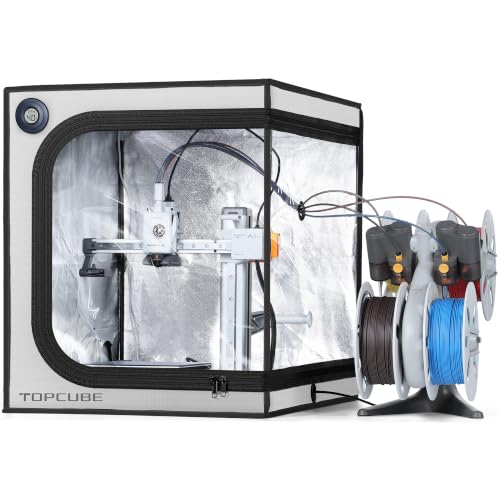
Most Versatile Large Tent

- Broad compatibility across several printer brands
- Ports for exhaust kits and external filament feeding
- Six-sided structure helps reduce dust and noise
Best For: Makers needing flexible accessories and generous printer clearance
Best A1 Mini Fit
LED-Lit Quiet Printing Enclosure
- Designed for the Bambu Lab A1 Mini Combo
- LED strip and extra-large viewing window
- AMS Lite access with fire-resistant construction
Best For: A1 Mini users wanting dedicated lighting and noise control
Filtered Resin Protection
YOOPAI Resin Printer Enclosure

- Carbon filter and exhaust ventilation
- Large window for monitoring prints
- Fully enclosed, insulated design
Best For: Compatible resin printers and odor-conscious workspaces
Adjustable Ventilation
Multifunctional Resin Printer Tent

- Speed-controlled 12V fan system
- Three-layer filtration
- UV-blocking viewing window
Best For: Small LCD/resin printers needing adjustable airflow
Best DIY Cabinet Kit
DELACK IKEA Lack Enclosure Kit

- Compact plexiglass IKEA Lack design
- LED strip and power adapter included
- Ventilation and HEPA-filter ready
Best For: DIY users building a customizable IKEA Lack printer cabinet
Best for Resin Workstations
YOOPAI Dual Resin Printer Enclosure

- Fits a resin printer and curing machine
- Carbon filter and exhaust ventilation
- Clear window for closed monitoring
Best For: Resin users needing a contained two-device printing setup
Best Value Ender 3 Tent – Fireproof Constant-Temperature Cover
This compact 3d printer enclosures option is a practical fit for popular Creality and similar printers. Its enclosed, flame-resistant construction helps create a steadier printing environment while providing dust protection, observation access, and foldable storage.
Best For: Ender 3 owners who want broad compatibility, temperature stability, and a portable enclosure.
Pros:
- Compatible with several Creality, Anycubic, and ELEGOO models.
- Flame-resistant construction and aluminum-film interior.
- Foldable design with tool pockets and multiple viewing sides.
- Large 23.62 x 18.9 x 28.35-inch enclosure footprint.
Cons:
- Its relatively large footprint may not suit very tight workspaces.
- Compatibility still depends on the printer and spool-holder dimensions.
Choose this model if you value broad printer compatibility and simple portability. It is especially appealing for users printing materials that benefit from a more consistent enclosure environment.
Best A1 Combo Enclosure – LED-Lit Noise-Reducing Cover
Designed specifically for the Bambu Lab A1 Combo with AMS Lite, this compact 3d printer enclosures pick combines temperature control, lighting, visibility, and noise isolation. Its sturdy enclosed structure is intended to help maintain print quality while keeping dust, particles, and accidental contact at bay.
Best For: Bambu Lab A1 Combo users who want an integrated LED light and a quieter, more controlled setup.
Pros:
- Purpose-built dimensions and access for the Bambu Lab A1 with AMS Lite.
- Integrated LED strip and large transparent observation window.
- Fire-resistant, dustproof construction with claimed noise reduction from 60 to 40 decibels.
- Quick five-minute installation and convenient disassembly.
Cons:
- Model-specific sizing limits its suitability for other printers.
- The enclosure measures 23.62 x 21.65 x 26.38 inches, so it needs dedicated space.
This is a strong match for A1 Combo owners who want more than basic coverage. The built-in lighting and observation window make monitoring easier, while the enclosed structure supports a cleaner and quieter workspace.
Most Versatile Large Tent – DIY-Ready Dustproof Enclosure
With generous dimensions and wide model support, this compact 3d printer enclosures option suits users who need flexibility around a Creality, Anycubic, or ELEGOO printer. It provides a temperature-controlled, dust-resistant enclosure with openings for external filament feeding and fan-based exhaust accessories.
Best For: Multi-printer households and makers who want accessory ports and room for larger compatible setups.
Pros:
- Supports a broad selection of Creality, Anycubic, and ELEGOO printers.
- Dedicated side openings support DIY exhaust kits and external filament feeding.
- Six-sided enclosure helps reduce dust, accidental contact, and printing noise.
- Quick installation and a sturdy structure designed for repeated use.
Cons:
- At 29.5 x 25.6 x 21.6 inches, it requires substantial desk or floor space.
- It is not water resistant.
- Users must measure the printer, including spool-holder height, before ordering.
This enclosure stands out for adaptability rather than a printer-specific fit. The external-filament and exhaust openings are useful additions, but careful measurement is essential because the listed size refers to the supported printer dimensions.
Best A1 Mini Fit – LED-Lit Quiet Printing Enclosure
Made for the Bambu Lab A1 Mini Combo, this compact 3d printer enclosures model adds a controlled enclosure environment without the larger footprint of many general-purpose tents. It includes an LED light strip, oversized viewing window, fire-resistant materials, and access for the AMS Lite connection.
Best For: Bambu Lab A1 Mini users who want a dedicated, compact cover with lighting and noise isolation.
Pros:
- Purpose-designed for the Bambu Lab A1 Mini Combo.
- Integrated LED lighting and extra-large transparent viewing window.
- Fire-resistant, dustproof construction with claimed noise reduction from 60 to 40 decibels.
- Five-minute setup with AMS Lite cable and pneumatic-interface access.
Cons:
- Its model-specific design may not fit other printers.
- The enclosure is still 18.11 x 18.11 x 21.65 inches, so it needs a dedicated space.
For A1 Mini owners, this is a focused option that balances a smaller enclosure format with useful convenience features. Confirm the printer and accessory clearances before buying, especially if using the full AMS Lite setup.
Filtered Resin Protection – YOOPAI Resin Printer Enclosure
For resin users comparing compact 3d printer enclosures, this YOOPAI model emphasizes odor control, ventilation, and visibility. Its six-sided cover includes a carbon filter sheet, exhaust fan, expandable pipe, and a large transparent front window for monitoring prints without opening the enclosure.
Best For: Resin printing setups using compatible ELEGOO Photon, Saturn, Mars, or Halot-series printers.
Pros:
- Carbon filter sheet helps adsorb resin odors and emissions.
- Exhaust fan and expandable pipe support ventilation.
- Fully enclosed design helps limit dust and resin splashes.
- Insulated interior is designed to help maintain a steadier temperature.
Cons:
- The enclosure is intended for resin printers and may not suit larger machines.
- Its 28 × 18 × 17-inch dimensions should be checked against the printer before ordering.
This is a practical pick when odor management and enclosed observation matter most. Confirm your printer’s complete dimensions, including any accessories, before buying.
Illuminated Large Format – YOOPAI Ender 3 Enclosure
This YOOPAI enclosure is a useful option for shoppers seeking compact 3d printer enclosures with extra room for selected larger printers. It combines a built-in LED light strip with a six-sided, fire-resistant cover designed to reduce dust, stabilize the printing environment, limit noise, and help prevent accidental contact.
Best For: Compatible Ender, ELEGOO Neptune, and other printers measuring less than 29.5 × 25.6 × 21.6 inches, including spool-holder height.
Pros:
- Built-in LED lighting improves visibility during printing.
- Fire-resistant materials and an enclosed structure add protection from dust and accidental touches.
- Designed to help maintain a consistent printing temperature.
- Advertised as quick to install and easy to disassemble for moving.
Cons:
- It is not compatible with CR-10 MAX, CR-10 S4, or CR-10 S5 models.
- Compatibility depends on the printer’s full dimensions and spool-holder height.
Choose this model if integrated lighting and broad compatibility are more important than a small footprint. Measure carefully, especially for tall printers and top-mounted spool holders.
Adjustable Ventilation – Multifunctional Resin Printer Tent
For buyers exploring compact 3d printer enclosures for resin equipment, this tent focuses on adjustable airflow and layered filtration. It includes a 12V fan system with speed control, a three-layer filter, a UV-blocking viewing window, and fire-resistant fabric for a more controlled printing area.
Best For: Small LCD or resin printers and wash machines, including compatible Photon Mono, Mars, Saturn, and Halot-series models.
Pros:
- Adjustable fan speed lets you tune ventilation to your setup.
- Three-layer filtration is designed to capture dust and harmful gases.
- UV-blocking window supports viewing while helping protect resin prints.
- Stainless-steel pipe construction is described as lightweight and durable.
Cons:
- The printer is not included.
- Installing the ventilation setup may require printing a replacement plastic adapter.
- It is not water resistant, and fit must be confirmed before ordering.
This enclosure suits users who want more control over airflow than a basic cover provides. Review the required adapter process and measure the entire printer before committing.
Best All-Around Enclosure – YOOPAI Ender 3 Enclosure with LED
If you want a practical compact 3d printer enclosure for a compatible FDM printer, this YOOPAI model combines built-in lighting, environmental monitoring, ventilation-ready protection, and a six-sided structure. Its 25.6 by 21.6 by 29.5-inch footprint makes it worth considering for a dedicated workbench, but measure your printer—including the spool holder—before ordering.
Best For: Ender 3 users who want lighting, temperature and humidity readings, noise reduction, and a protective enclosure in one setup.
Pros:
- Built-in LED strip improves visibility while monitoring prints.
- Temperature and humidity monitoring helps track printing conditions.
- Six-sided enclosure helps reduce noise, dust, and accidental contact.
- Designed for quick installation and easy disassembly.
Cons:
- Its relatively tall 29.5-inch exterior requires careful clearance planning.
- Compatibility depends on staying within the listed printer dimensions, including spool-holder height.
The YOOPAI is a versatile choice for users who want more than a basic cover. Confirm the measurements first, then consider it if visibility, monitoring, and a quieter, cleaner printing area are priorities.
Best DIY Cabinet Kit – DELACK IKEA Lack Enclosure Kit
This DELACK kit is a strong option for a modular compact 3d printer enclosure built around an IKEA Lack table. It includes plexiglass panels, hardware, and an LED strip, while its 21.65 by 19.13 by 17.72-inch enclosure is sized for desks, workbenches, and hobby stations. Note that this is a kit only: printed connectors and accessories are not included.
Best For: DIY-minded users with an IKEA Lack setup who want customizable lighting, ventilation options, and downloadable accessories.
Pros:
- Includes plexiglass panels, hardware, LED light strip, and 5V adapter.
- Supports optional 120mm fans, HEPA filtration systems, and external ducting.
- Modular design offers a removable top panel and more than 20 printable accessory options.
- Compact dimensions fit desks and workbenches.
Cons:
- Printed parts are not included, so connectors and accessories must be printed separately.
- It is engineered for an IKEA Lack table setup rather than a standalone universal enclosure.
The DELACK makes sense when customization is part of the appeal. It offers a more tailored cabinet than a ready-made cover, but factor in the additional printing and IKEA Lack table requirements before buying.
Best for Resin Workstations – YOOPAI Dual Resin Printer Enclosure
For resin users who need room for both a printer and curing equipment, this YOOPAI model is a larger compact 3d printer enclosure solution with a 30 by 19.7 by 28.3-inch interior. It combines carbon filtration, exhaust fans, expandable pipes, LED lighting, and a clear viewing window, though you should verify that both machines fit before ordering.
Best For: Resin-printing setups that need space for two devices while prioritizing odor control, visibility, and a fully enclosed workspace.
Pros:
- Interior is designed to accommodate a resin printer and curing machine.
- Built-in carbon filter sheet helps adsorb resin odors.
- Exhaust fans and expandable pipes support removal of emissions.
- Large transparent front window allows observation without opening the cover.
Cons:
- Larger interior and 27.56-inch exterior height require more space than a small single-printer cover.
- Airflow slows when exhaust passes through activated carbon, so odor discharge may take time.
- Both the printer and curing machine must be measured for fit.
This enclosure is best viewed as a compact dual-device resin station rather than a minimal desktop cover. Its filtration and viewing features are useful for contained resin workflows, provided your available space and equipment dimensions match.
How We Picked These Compact 3d Printer Enclosures
We focused on enclosure designs that suit compact home, office, and workshop setups. The selection includes models for common FDM printers such as the Creality Ender 3 series, Bambu Lab A1 and A1 Mini, and Prusa machines, plus dedicated resin-printer enclosures. We considered printer compatibility, usable interior space, access panels, visibility, lighting, cable routing, ventilation options, and how easily each enclosure can fit into an existing workspace.
Because enclosure performance depends on the printer and materials being used, features such as “fireproof,” “constant temperature,” or “odor control” should not be treated as a substitute for safe operation. Always follow the printer manufacturer’s instructions and use suitable ventilation for the material.
Quick Comparison
| Best For | Look For |
|---|---|
| Basic dust and draft control | Compatible dimensions, durable fabric, clear viewing panels |
| FDM printing with frequent monitoring | Front access, large windows, interior LED lighting |
| Odor-sensitive spaces | Exhaust ports, duct compatibility, or replaceable filtration |
| Resin printing | Ventilation, chemical-resistant construction, and sufficient clearance |
| Small desks and shelves | Compact footprint, cable openings, and easy setup |
Key Buying Factors for Compact 3d Printer Enclosures
Printer Fit and Interior Clearance
Measure the printer, spool holder, power supply, and any external accessories before buying. Leave room for the print bed’s full movement and for opening doors or removing completed prints. An enclosure that technically fits may still be inconvenient if the printer sits tightly against the walls.
Ventilation and Filtration
Passive fabric enclosures can contain dust and help reduce drafts, but they do not automatically remove fumes or particles. If you print resin or odor-producing materials, prioritize a model with ventilation ports, a duct connection, or a compatible filtration system. Place the exhaust where it can safely discharge, and avoid recirculating contaminated air into the room.
Temperature, Access, and Visibility
A warmer enclosure can benefit some materials, but excessive heat may affect electronics or flexible components. Look for viewing windows, wide front openings, and adjustable vents so you can monitor and service the printer without dismantling the enclosure.
Lighting, Storage, and Cable Management
Built-in LED lighting is useful in dim work areas, while cable openings help prevent crushed or tangled wires. Check whether the enclosure includes the light, ventilation hardware, or only the mounting points. These details can significantly change the real value of a low-cost enclosure.
Who Should Buy Which Compact 3d Printer Enclosures?
Choose a basic protective tent if your main goals are dust control, draft reduction, and a cleaner-looking printer station. Models made for specific Creality or Bambu Lab machines are usually the easiest fit, but confirm the exact printer version before ordering.
Choose an enclosure with LED lighting if you inspect prints regularly or keep the printer in a darker corner. For resin printing, select a resin-focused enclosure with ventilation or filtration support rather than relying on a general-purpose FDM cover. If you use an IKEA Lack table or want a more permanent installation, a ventilation-ready kit may be the better long-term choice.
Finally, prioritize safe placement over maximum enclosure temperature. Keep adequate clearance around electrical components, use the correct ventilation setup, and never leave a heated printer unattended unless its safety guidance specifically permits it.