The best chemistry sets for homeschool turn abstract concepts into hands-on lessons students can see, measure, and discuss. The options in this roundup range from guided experiment kits for younger learners to molecular modeling tools and curriculum-focused sets.
Use the guide below to match a kit with your student’s age, chemistry level, available supervision, and preferred learning style.
Best 10 Chemistry Sets for Homeschool Picks for 2026
Best Overall
National Geographic Amazing Chemistry Set

- 100+ experiments, including 15 with included materials
- Bonus guide uses common household items
- Includes test tubes, beakers, and pipettes
Best For: Ages 8+ seeking a broad, hands-on homeschool chemistry kit
Best for Younger Kids
Beaker Creatures Liquid Reactor Super Lab
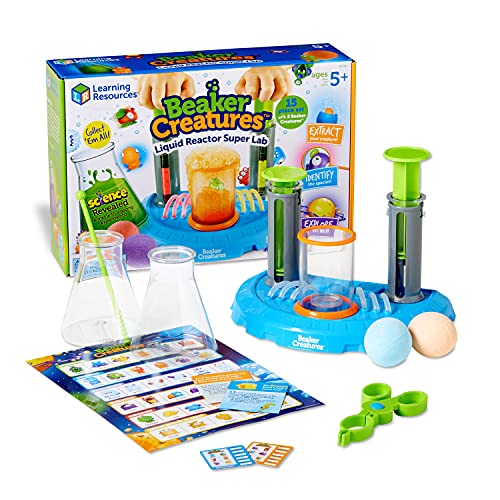
- Designed for ages 5+
- Uses fizzing reactions to reveal mystery creatures
- Overflow tray helps catch spills
Best For: Early elementary learners needing engaging, contained science play
Best Early Learning Kit
National Geographic Junior Chemistry Set

- Includes 50 experiments for ages 4+
- Illustrated instructions support young learners
- Comes with 20+ child-friendly lab tools
Best For: Young children beginning structured homeschool science activities
Best Lab-Station Design

- 57-piece kit with a dedicated lab station
- Includes cards and a full-color experiment manual
- Uses non-hazardous chemicals for varied activities
Best For: Ages 6+ wanting a substantial, organized homeschool lab setup
All-in-One Exploration
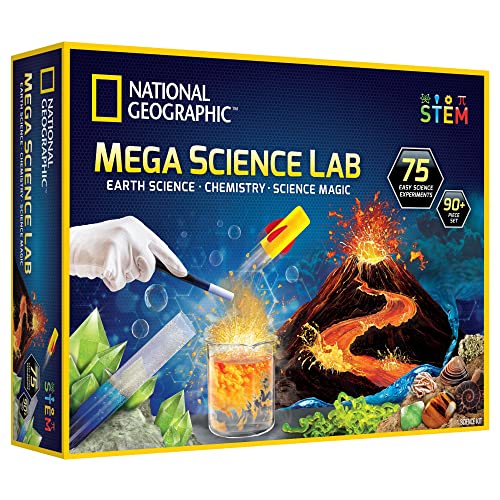
- 75 total experiments across chemistry, Earth science, and science magic
- Includes real rock, mineral, and crystal specimens
- Suitable for children ages 8 and up
Best For: Varied homeschool STEM lessons
Molecular Modeling Focus

- 240 pieces with 86 atoms and 153 bonds
- Represents 12 elements and multiple bond types
- Includes a removal tool and storage box
Best For: Older students learning molecular structure
Hands-On Lab Basics

- Includes beakers, test tubes, rack, flask, droppers, and pipettes
- Also provides goggles, gloves, funnel, and measuring tools
- Colorful plastic tools are designed for home or classroom use
Best For: Basic homeschool lab equipment
Advanced Model-Building Pick
Swpeet Organic Chemistry Molecular Model Kit

- 122-piece set for organic and inorganic structures
- Color-coded atoms with multiple bond types
- Includes storage case and link-remover tool
Best For: Advanced homeschool chemistry students studying molecular structures
Hands-On Experiment Pick
National Geographic Chemistry Set

- Includes 45 kid-friendly experiments
- Features volcano, geyser, and rocket activities
- Illustrated guide introduces reactions and safety
Best For: Beginning chemistry exploration for children ages 8 and up
Complete High School Course Pick
Discovering Design with Chemistry

- College-preparatory course for students after Algebra I
- Covers core chemistry concepts and mathematical applications
- Includes textbook, answer key, and tests
Best For: Structured independent-study chemistry at the high school level
Best Overall – National Geographic Amazing Chemistry Set
For families looking for chemistry sets for homeschool, the National Geographic Amazing Chemistry Set offers a broad mix of hands-on activities for children ages 8 and up. It includes materials for 15 experiments, plus a guide with 85 additional projects using common household items.
Best For: Homeschoolers ages 8 and up who want a wide variety of chemistry activities and real lab-style tools.
Pros:
- Includes 100+ experiments in total.
- Comes with materials for 15 experiments, including crystal growing and color-changing reactions.
- Uses test tubes, beakers, and pipettes for hands-on STEM learning.
Cons:
- Only 15 experiments include the kit’s dedicated materials; the bonus projects use household items.
- Designed for ages 8 and up, so it may be too advanced for younger learners.
This is a strong all-around choice when variety and authentic-looking equipment matter. Its bonus guide also helps extend the kit beyond the initial activities.
Best for Younger Kids – Beaker Creatures Liquid Reactor Super Lab
Among chemistry sets for homeschool, the Beaker Creatures Liquid Reactor Super Lab stands out for introducing younger children to reactions through colorful, contained play. The 15-piece set uses reactor pods, water, and fizzing reactions to reveal collectible creatures while practicing observation and classification.
Best For: Children ages 5 and up who benefit from visual, guided science activities with minimal spill concerns.
Pros:
- Introduces color mixing, reactions, observation, and classification.
- Includes a reactor base, hydroplungers, beakers, tongs, stir rod, and experiment guide.
- Overflow tray helps contain spills during supervised play.
Cons:
- Includes only two reactor pods, limiting the supplied reaction activities.
- More focused on creature-reveal play than a broad chemistry curriculum.
The contained reactor design makes this a particularly approachable option for early elementary homeschool lessons. It works well as an engaging introduction rather than a comprehensive chemistry lab.
Best Early Learning Kit – National Geographic Junior Chemistry Set
The National Geographic Junior Chemistry Set is a practical starting point for families comparing chemistry sets for homeschool for children ages 4 and up. Its 50 experiments use common household items such as baking soda and vinegar, while illustrated instructions and more than 20 lab tools support independent exploration.
Best For: Young homeschool learners who need simple, illustrated experiments and child-friendly equipment.
Pros:
- Offers 50 hands-on experiments for early learners.
- Illustrated, step-by-step instructions are designed for accessibility.
- Includes 20+ lab tools, including test tubes and goggles.
Cons:
- Many activities rely on common household ingredients, so supplies beyond the kit may be needed.
- The age-4-and-up design may provide less depth for older students.
This kit fits families building an introductory science routine around short, accessible activities. It provides more structure than a simple demonstration set while remaining suitable for young children.
Best Lab-Station Design – Ooze Labs Chemistry Station
For homeschoolers who want a dedicated workspace, the Ooze Labs Chemistry Station provides a colorful, functional setup for chemistry sets for homeschool. The 57-piece kit supports activities such as glowing slime, fizzing reactions, bubbles, and chromatography, with experiment cards and a full-color manual for guidance.
Best For: Children ages 6 and up who want a substantial lab setup with multiple vessels and repeatable experiment activities.
Pros:
- Includes 57 pieces and a large chemistry station.
- Supports varied activities including slime, fizzing reactions, bubbles, and chromatography.
- Includes experiment cards, a 16-page manual, and non-hazardous chemicals.
Cons:
- The larger station requires more storage space than a basic kit.
- Experiment activities may require careful setup and supervision.
This is a good fit when presentation and equipment variety help keep learners engaged. The built-in station and reference materials make it feel more like a dedicated home laboratory.
All-in-One Exploration – Mega Science Lab
For families comparing chemistry sets for homeschool, this National Geographic kit offers a broad, experiment-focused option for children ages 8 and up. It combines chemistry, Earth science, and science-magic activities, making it useful when you want one kit with varied STEM projects.
Best For: Homeschoolers seeking a versatile, multi-topic science kit with 75 total experiments.
Pros:
- Includes 45 featured experiments plus 30 additional household-item activities.
- Covers chemistry projects such as bubbling reactions, gooey worms, gas-powered rockets, and crystal fireworks.
- Adds Earth science activities, real specimens, and science-magic demonstrations for variety.
- Designed for ages 8 and up with no batteries required.
Cons:
- Its broad focus may be less suitable for students wanting a dedicated chemistry curriculum.
- Some bonus experiments rely on common household items not included in the kit.
This is a strong pick for activity-rich homeschool lessons, especially when chemistry is one part of a larger elementary STEM rotation rather than the sole subject.
Molecular Modeling Focus – Organic Chemistry Model Kit
For homeschool students moving into molecular structure, this 240-piece model kit provides a hands-on way to visualize atoms, bonds, and geometry. It is better suited to older learners than experiment-based chemistry sets for homeschool, with components intended for organic and inorganic structure modeling.
Best For: Students ages 13 and up studying molecular geometry, organic chemistry, or introductory higher-level chemistry.
Pros:
- Includes 86 atom pieces representing 12 different elements.
- Provides 153 links, including flexible links for double and triple bonds.
- Supports modeling organic and inorganic molecular structures.
- Comes with a removal tool and slim plastic storage box.
Cons:
- It is a modeling aid rather than a kit with chemical reagents or guided experiments.
- The manufacturer recommends it for ages 13 and up, limiting use with younger students.
This set can make abstract chemistry concepts more tangible, particularly when paired with textbook diagrams, lessons, or instructor-led discussions about bonding and molecular shape.
Hands-On Lab Basics – 33-Piece Science Set
This 33-piece plastic lab set gives homeschool learners basic tools for observing and conducting simple science activities at home. Among chemistry sets for homeschool, it stands out as a classroom-style equipment bundle with beakers, test tubes, measuring tools, and protective accessories rather than a clearly specified collection of prepared experiments.
Best For: Home or classroom activities that need reusable-looking junior lab equipment for demonstrations and exploration.
Pros:
- Includes three beakers, four test tubes, a rack, a conical flask, droppers, pipettes, and measuring spoons.
- Adds goggles, gloves, a funnel, stirring rods, sampling spoons, and other handling tools.
- Colorful plastic construction is described as easy to clean and allows observation of reactions.
- Designed to encourage curiosity through hands-on science activities.
Cons:
- The supplied notes do not list included chemicals, reagents, or step-by-step experiments.
- The manufacturer-recommended age is 16 and up, despite the junior-oriented description.
Choose this set when your homeschool already has activity instructions or safe materials and you mainly need basic lab-style equipment for demonstrations and observation.
Advanced Model-Building Pick – Swpeet Organic Chemistry Molecular Model Kit
For homeschoolers looking for chemistry sets for homeschool use beyond simple demonstrations, this Swpeet molecular model kit offers a hands-on way to study organic and inorganic structures. Its color-coded atoms and assorted bonds support visual learning from basic molecules through more complex models.
Best For: High school, college-level, or advanced homeschool chemistry students studying molecular structure.
Pros:
- Includes 122 pieces with 59 atoms, 62 links, and a short-link remover.
- Supports organic and inorganic chemistry models using C, H, O, N, and S atoms.
- Color-coded pieces and a storage case make identification and organization easier.
- Designed for repeated assembly and disassembly without requiring excessive force.
Cons:
- The manufacturer recommends it for ages 20 and up, so it may not suit younger learners.
- It is a modeling tool rather than a complete experiment-based chemistry course.
This is a strong choice when the goal is to make bonding and molecular geometry more tangible. Families should pair it with a textbook or structured curriculum for explanations, practice, and assessment.
Hands-On Experiment Pick – National Geographic Chemistry Set
For younger learners, this National Geographic kit is one of the more activity-focused chemistry sets for homeschool sessions. It uses accessible experiments and illustrated directions to introduce chemical reactions, observation, and safe participation in the scientific process.
Best For: Children ages 8 and up who are beginning hands-on STEM and chemistry exploration.
Pros:
- Offers 45 listed experiments, including volcano, geyser, and rocket activities.
- Kid-friendly instructions include illustrations and explanations of the reactions.
- Introduces scientific-process fundamentals and chemistry safety.
- Does not require batteries.
Cons:
- Its emphasis is introductory experimentation rather than a comprehensive chemistry curriculum.
- Parents may need to provide supervision and any materials not included for particular activities.
This kit works well as an engaging supplement for elementary or middle-grade homeschool science. It can build curiosity and confidence before students move into more formal chemistry lessons.
Complete High School Course Pick – Discovering Design with Chemistry
Families seeking a structured academic option among chemistry sets for homeschool may prefer Discovering Design with Chemistry. This package combines a textbook with an answer key and tests booklet for an independent-study, college-preparatory course designed around Algebra I-level math.
Best For: High school homeschool students ready for a rigorous, independent chemistry course.
Pros:
- Covers a broad range of topics, from atomic structure and bonding to equilibrium and thermodynamics.
- Connects chemistry concepts with mathematical applications and analysis.
- Includes the textbook, answer key, and tests booklet for parent or teacher support.
- Provides a substantial 689-page course text.
Cons:
- It is a textbook-based course, not a hands-on laboratory experiment kit.
- The course is intended for students who have completed Algebra I.
- The 6.1-pound package may be less convenient for portable study.
This is the most curriculum-oriented option in the group, especially for families wanting organized instruction and assessment. Confirm that the student is prepared for the mathematical level before choosing it as a primary chemistry course.
How We Picked the Best Chemistry Sets for Homeschool
We compared these chemistry kits by educational scope, experiment variety, included equipment, age suitability, and how easily each option can fit into a homeschool schedule. We also considered whether a set supports open-ended exploration, follows a more structured lesson path, or works best as a supplement to textbooks and coursework.
Because “chemistry set” can mean anything from a simple activity box to a full academic resource, the selection includes several formats. Experiment kits provide demonstrations and guided activities, molecular model sets support visual and spatial learning, and curriculum-oriented products add reading, review questions, answer keys, or tests.
Quick Comparison
- Best for broad experiment variety: National Geographic Amazing Chemistry Set with 100+ Experiments.
- Best for younger beginners: National Geographic Junior Chemistry Set with 50 Experiments.
- Best for interactive play: Learning Resources Beaker Creatures Liquid Reactor Super Lab.
- Best for visualizing molecules: Swpeet 240-piece or 122-piece molecular model kits.
- Best for a structured academic approach: Discovering Design with Chemistry Set.
- Best for basic lab practice: The 33-piece beakers and test tubes set.
Key Buying Factors for Chemistry Sets for Homeschool
Age and Chemistry Level
Choose activities that match the learner’s reading ability and attention span. Beginner sets for elementary students generally emphasize observation, simple reactions, and guided instructions. Older students may benefit more from molecular models, measurement practice, reaction explanations, or a formal curriculum.
Experiment Quantity and Variety
A high experiment count is useful only when the activities are varied and clearly explained. Check whether the number includes repeatable demonstrations, lessons, or activities requiring common household supplies. A smaller kit may be better if it offers deeper explanations and easier preparation.
Included Tools and Materials
Look for beakers, test tubes, droppers, measuring tools, safety equipment, models, and consumable ingredients. Confirm what must be purchased separately, especially household chemicals, replacement supplies, goggles, and cleanup materials.
Supervision and Safety
Adult supervision is important for nearly all chemistry activities, particularly those involving heat, powders, glass, staining materials, or chemical reactions. Follow the manufacturer’s age guidance, use protective eyewear, ventilate the workspace, and avoid substituting unlisted ingredients.
Curriculum Compatibility
For a complete homeschool science course, prioritize lesson structure, answer keys, tests, and explanatory text. For a supplemental activity, choose a flexible experiment kit or molecular model set that can reinforce topics already covered in class.
Who Should Buy Which Chemistry Sets for Homeschool?
Families introducing chemistry to younger children should start with a guided National Geographic or Beaker Creatures kit. Students who enjoy hands-on variety may prefer one of the larger experiment collections, while learners studying atoms, bonding, and molecular structure will get more value from a Swpeet model set.
Choose the basic labware set when you already have lesson plans and need reusable equipment. For students working through a more formal secondary-level course, the Discovering Design set is the stronger choice because it is designed around structured study and assessment. If you are unsure, select the kit that best matches your child’s current level rather than choosing solely by experiment count.