The best camera tripod for photography gives you sharper images, steadier video, and more control over composition without making setup unnecessarily difficult. The right choice depends on your camera weight, preferred shooting height, travel needs, and whether you also use a phone.
We’ve gathered 10 versatile tripods ranging from lightweight 50-inch travel stands to tall aluminum models with monopod, phone, or overhead capabilities. Use the guide below to narrow the list by stability, portability, and shooting style.
Best 10 Camera Tripod for Photography Picks for 2026
Travel Pick

- 1.23-pound aluminum design
- Three-way head with quick release
- 16.1- to 50-inch height range
Best For: Travel and lightweight camera setups
High-Angle Choice

- Reaches 90 inches high
- 22-pound load capacity
- Detachable monopod and flexible legs
Best For: Overhead, elevated, and panoramic photography
Heavy-Duty Hybrid

- 33-pound vertical load capacity
- Converts to a monopod
- Inverted pole supports low-angle shots
Best For: Higher-payload cameras and content creation
All-Around Value
74-Inch Camera and Phone Tripod
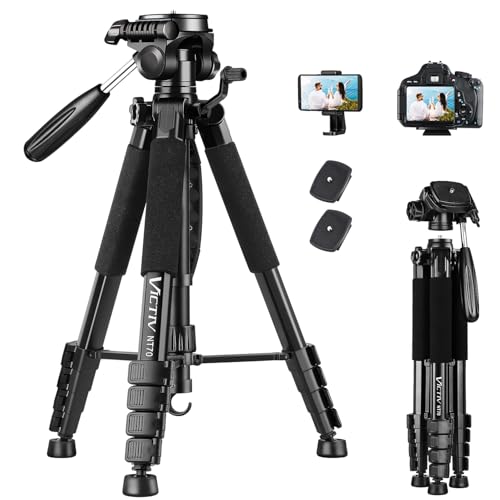
- Works with cameras and phones
- Three-way pan head with handle
- Includes phone holder and carrying bag
Best For: Everyday photography and content creation
Best Lightweight Travel Tripod
K&F Concept 64-Inch Aluminum Tripod

- Folds to 15.5 inches and weighs 2.53 pounds
- 360-degree ball head supports up to 17.6 pounds
- Reversible center column enables low-angle shots
Best For: Travel, landscapes, and flexible camera or smartphone shooting
Best All-in-One Creator Tripod
K&F Concept 75-Inch Aluminum Tripod

- Reaches 75 inches while weighing 2.6 pounds
- Includes phone-and-tablet holder and Bluetooth remote
- Three-way pan head and bubble level aid composition
Best For: Vlogging, livestreaming, mobile content, and travel photography
Most Versatile

- 75-inch height with 14.17-inch folded size
- Converts to monopod or selfie stick
- Remote, phone holder, and adjustable legs
Best For: Travel, outdoor photography, and content creation
Best All-Purpose Setup

- 3-way pan head for varied compositions
- Supports cameras, phones, and tablets
- Includes remote, quick-release plates, and bag
Best For: Mixed camera, phone, and tablet shooting
Highest Load Rating

- 78-inch height with a 22-pound stated limit
- Converts to monopod or walking stick
- Metal ball head with 360-degree panning
Best For: Heavier camera and outdoor observation equipment
Travel Pick – Lightweight 50-Inch Tripod
If portability is your priority, this camera tripod for photography offers a simple, lightweight setup for travel, hiking, and casual shooting. Its three-section lever-lock legs adjust from 16.1 to 50 inches, while the quick-release plate helps you move efficiently between shots.
Best For: Travel photographers using lightweight cameras and compact setups.
Pros:
- Weighs just 1.23 pounds and includes a zippered storage bag.
- Three-way head supports tilt, swivel, portrait, and landscape positioning.
- Built-in bubble level and quick-release plate simplify setup.
- Folds quickly and extends to 50 inches.
Cons:
- Not recommended for heavy, high-end DSLRs, long lenses, or large telescopes.
- Equipment weight should not exceed 4.4 pounds.
- It is not water resistant.
This is a practical entry-level choice when low weight and easy transport matter more than heavy-duty stability. Keep the payload within its stated limit for the best results.
High-Angle Choice – 90-Inch Overhead Tripod
For elevated and overhead compositions, this camera tripod for photography reaches an impressive 90 inches and supports horizontal positioning. Its flexible legs, gimbal-style head, and 360-degree rotation provide broad control for creative camera angles.
Best For: Photographers who need high viewpoints, overhead positioning, and panoramic control.
Pros:
- Extends to 90 inches while folding to about 21 inches.
- Supports up to 22 pounds with a 28mm ball head.
- Flexible legs tilt from 0 to 180 degrees and rotate 360 degrees.
- Detachable monopod adds versatility in confined spaces.
Cons:
- At about 4.4 pounds, it is heavier than compact travel tripods.
- Its 90-inch height may be more capability than casual photographers need.
- It is not water resistant.
This model stands out for photographers who regularly work from unusual angles or need extra height. The higher capacity and horizontal setup make it a more specialized option than a basic tripod.
Heavy-Duty Hybrid – 71-Inch Ball Head Tripod
This camera tripod for photography combines a sturdy aluminum build with a 360-degree ball head and a convertible monopod. It adjusts from 16 to 71 inches and includes an inverted center pole for low-angle and macro photography.
Best For: DSLR, mirrorless, action-camera, and content-creation setups that need higher payload capacity.
Pros:
- Supports up to 33 pounds vertically and 11 pounds when tilted.
- Converts from a tripod to a monopod for travel and hiking.
- 360-degree ball head supports horizontal and vertical shooting.
- Three accessory threads accommodate external arms, phones, or monitors.
Cons:
- Telephoto zoom lenses may require an additional tripod or lens mount ring.
- At 3.4 pounds, it is less lightweight than basic travel models.
- It is not water resistant.
With its substantial stated load capacity and accessory-friendly design, this is a strong fit for photographers building a more capable shooting setup. The monopod conversion and low-angle option add useful flexibility.
All-Around Value – 74-Inch Camera and Phone Tripod
Designed for mixed camera and phone use, this camera tripod for photography offers a 19- to 74-inch height range, a three-way pan head, and a universal phone holder. It also includes a quick-release plate, carrying bag, and weight hook for added shooting convenience.
Best For: Beginners, vloggers, and photographers switching between cameras, phones, and indoor or outdoor projects.
Pros:
- Works with cameras, phones, projectors, spotting scopes, and other compatible devices.
- Three-way pan head supports panoramic, vertical, and up-and-down movement.
- Adjusts from 19 to 74 inches and folds to about 20 inches.
- Includes phone holder, extra quick-release plate, handle, and carrying bag.
Cons:
- Its 9.5-pound weight limit is lower than the SmallRig and K&F models.
- At about 3.14 pounds, it is not the lightest travel option.
- It is not water resistant.
This tripod is a convenient general-purpose choice for users who want one stand for photography, phone shooting, video, and livestreaming. Its included accessories make it especially approachable for everyday content creation.
Best Lightweight Travel Tripod – K&F Concept 64-Inch Aluminum Tripod
If you need a camera tripod for photography that is easy to carry between locations, this K&F Concept model balances a 64.1-inch maximum height with a compact 15.5-inch folded size. Its aluminum construction, 360-degree ball head, and included phone holder make it a practical option for travel, landscapes, and mixed camera or smartphone use.
Best For: Travelers, landscape photographers, and creators who want a lightweight tripod with flexible camera angles.
Pros:
- Lightweight 2.53-pound design folds to 15.5 inches for transport.
- 360-degree ball head supports panoramic positioning and loads up to 17.6 pounds.
- Reversible center column and short column support low-angle and special photography.
- Quick flip leg locks allow fast setup and adjustment.
Cons:
- It is not water resistant.
- The four-section legs may require more adjustments than simpler designs.
Choose this model when portability matters without giving up a full-height setup. The included quick-release plate, phone holder, and carrying bag add useful flexibility for photography and smartphone shooting.
Best Heavy-Duty Height – Victiv 85-Inch Camera Tripod
For a camera tripod for photography that prioritizes reach and load capacity, the Victiv H85-Orange extends up to 80 inches as a tripod or 85 inches with its extra tube. Thick aluminum legs, a large ball head, and independently adjustable legs provide a stable platform for cameras, spotting scopes, and other compatible equipment.
Best For: Photographers and outdoor shooters who need exceptional height, high load capacity, or monopod versatility.
Pros:
- Supports equipment loads up to 35 pounds.
- Extends from 18.5 inches to 80 inches, or 85 inches with the extra tube.
- Converts to a monopod or walking-stick-style support from 31 to 85 inches.
- Reversible center column enables macro and low-angle photography.
Cons:
- At about 3.8 pounds, it is heavier than more compact travel tripods.
- Its folded size is approximately 18.5 inches, so it takes more packing space.
This is the stronger choice when stability, height, and equipment capacity are more important than minimum carry weight. The independent pan and ball locks also support horizontal, vertical, and overhead compositions.
Best All-in-One Creator Tripod – K&F Concept 75-Inch Aluminum Tripod
This K&F Concept model is a versatile camera tripod for photography, video, and phone-based content. It reaches 75 inches, folds to about 20 inches, and includes a phone-and-tablet holder plus Bluetooth remote, making it useful for travel photography, livestreaming, group photos, and hands-free recording.
Best For: Content creators, vloggers, and photographers who use cameras, phones, or tablets.
Pros:
- Lightweight 2.6-pound aluminum design folds to about 20 inches.
- Adjusts from 19 to 75 inches for varied shooting heights.
- Three-way pan head supports horizontal and vertical positioning with a bubble level.
- Includes a phone-and-tablet holder and Bluetooth remote for hands-free shooting.
Cons:
- Its stated weight limit is 8.8 pounds, lower than heavy-duty alternatives.
- It is not water resistant.
- The five-section legs require more extension points during setup.
Consider this tripod when one compact kit needs to cover photography, video, and mobile content. Its broad device compatibility and included remote make it especially convenient for solo creators and online meetings.
Most Versatile – XXZU 75" Camera Tripod
For photographers who want one compact setup for varied shooting situations, the XXZU is a flexible camera tripod for photography. It reaches 75 inches, supports landscape and portrait positioning, and can convert into a monopod or selfie stick for travel and content creation.
Best For: Travel photographers, outdoor shooters, vloggers, and creators who need multiple shooting configurations.
Pros:
- Converts into a monopod or selfie stick, with an inverted center column for low-angle macro work.
- Independent leg-angle and length adjustments help on stairs, rocky trails, and uneven terrain.
- Includes a phone holder, remote control, level indicators, accessory mount, and carrying bag.
- Folds to 14.17 inches and weighs 2.18 pounds for easier transport.
Cons:
- The stated maximum load varies by position: up to 17.64 pounds vertically but 6.61 pounds at a 45-degree tilt.
- The broad feature set may be more than needed for photographers seeking a basic tripod.
The XXZU stands out for its portability and shooting flexibility. Its low folded length, remote, phone compatibility, and terrain-friendly leg adjustments make it a practical all-purpose option, while the ball head and hanging hook add useful support for outdoor work.
Best All-Purpose Setup – ZIKZOK 75" Camera Tripod
The ZIKZOK is a practical camera tripod for photography when you want broad device compatibility and straightforward height adjustment. Its 3-way pan head supports vertical, horizontal, and overhead shots, while the included phone and tablet holder expands its usefulness beyond traditional cameras.
Best For: Photographers, vloggers, families, and travelers using cameras, phones, or tablets.
Pros:
- Adjusts from approximately 19.7 to 75 inches and folds to about 20 inches.
- 3-way pan head supports 360-degree rotation and multiple shooting orientations.
- Works with DSLRs, compact cameras, phones, iPads, camcorders, and spotting scopes.
- Includes quick-release plates, a wireless remote, travel bag, non-slip feet, and stability hook.
Cons:
- At roughly 2.91 to 3.2 pounds, it is heavier than the lightest travel tripod options listed here.
- The supplied notes list a three-month warranty.
Choose the ZIKZOK when versatility and familiar pan-head controls matter more than the smallest possible pack size. Its wide compatibility and accessory bundle make it suitable for mixed photo and video use at home, events, or on the road.
Highest Load Rating – Victiv 78" Camera Tripod
The Victiv is a tall, heavy-duty camera tripod for photography and observation equipment. It reaches 78 inches, supports up to 22 pounds according to the supplied specifications, and uses a larger metal ball head for panoramic movement and adjustable tilt.
Best For: Photographers and outdoor users carrying heavier cameras, spotting scopes, binoculars, or telescopes.
Pros:
- 22-pound stated weight limit and 26mm leg tubes provide a sturdier platform for compatible equipment.
- Transforms into a monopod or walking stick, with an inverted center pole for low-angle shots.
- Ball head supports 360-degree panning and +90/-70-degree tilt.
- Folds to 16.7 inches and includes a carrying case.
Cons:
- At 3.3 pounds, it is not the lightest option for extended travel.
- Magic arms for the threaded leg holes are not included.
- The supplied information states that it is not water resistant.
The Victiv is the strongest choice of the three when load capacity and equipment range are priorities. Its high maximum height, ball-head movement, monopod conversion, and accessory threads make it especially useful for outdoor photography and scope-based setups.
How We Picked the Best Camera Tripod for Photography
We focused on practical features that affect everyday shooting: maximum height, folded portability, aluminum construction, quick-release systems, ball-head flexibility, monopod conversion, phone compatibility, and included accessories. The selection covers entry-level travel tripods as well as taller and heavier-duty designs for larger cameras, phones, tablets, and overhead compositions.
Because specifications and real-world stability can vary by setup, match each tripod’s stated capacity and dimensions with your camera, lens, and accessories. A tripod that is suitable for a lightweight mirrorless camera may not provide the same steadiness with a long telephoto lens.
Quick Comparison
| Best For | Look For |
|---|---|
| Travel and casual photography | Lightweight aluminum legs, compact folded size, and a quick-release plate |
| Portraits and eye-level shooting | At least 60–70 inches of maximum height and a stable center column |
| Phone and hybrid use | Included phone holder, remote, or adaptable mounting hardware |
| Overhead or top-down work | A horizontal center column or dedicated overhead design |
| Video and heavier cameras | Stronger leg locks, a broad stance, and a head suited to smooth movement |
Key Buying Factors for a Camera Tripod for Photography
Height and Stability
A taller tripod helps you work at eye level and avoid bending, but maximum height alone is not a stability rating. Check the leg section count, locking mechanism, foot design, and center-column construction. For windy locations or long exposures, keep the center column low when possible.
Weight, Folded Size, and Materials
Aluminum tripods generally offer a useful balance of price, durability, and weight. A compact model is easier to carry, while a heavier frame can resist vibration better. Consider whether the tripod will fit your backpack, carry-on, or storage space before prioritizing height.
Head and Mount Compatibility
A ball head is versatile for still photography and quick reframing. A quick-release plate speeds up setup, but confirm that it locks securely and works with your camera or existing plate system. If you switch between a camera and phone, an included holder can be a worthwhile convenience.
Monopod and Overhead Features
Monopod conversion adds flexibility for events, sports, or crowded locations. Horizontal-column models are more specialized and useful for product photos, flat lays, digitizing documents, and top-down creative work, but they require careful balancing.
Who Should Buy Which Camera Tripod for Photography?
Choose a compact travel tripod if you mainly use a lightweight camera, photograph on trips, or value minimal bulk. Choose a tall 74- to 78-inch model for standing portraits, group photos, and flexible eye-level framing. Choose a heavy-duty option if you use a larger camera, phone-and-tablet accessories, or need extra resistance to movement. Choose an overhead tripod for product photography, crafts, cooking content, or other top-down compositions. For mixed camera and smartphone use, prioritize a secure phone holder and easy switching between mounts.