Camera sliders with vertical movement give filmmakers more than a simple left-to-right push. They can help create rising reveals, angled tracking shots, and repeatable motion for time-lapse or product videos.
We’ve selected 10 motorized models from NEEWER, iFootage, and GVM, ranging from compact phone-friendly sliders to longer carbon-fiber systems designed for heavier camera setups.
Best 10 Camera Sliders with Vertical Movement Picks for 2026
Best Compact Motorized Slider

- 45-degree tilt support
- App, video, and time-lapse modes
- 11-pound horizontal payload
Best For: Creators needing portable motorized movement with moderate tilt capability
Best Tabletop Option

- 255mm slide with 360-degree pan
- Up to eight app-programmed keyframes
- Supports vertical loads up to 1.1 pounds
Best For: Phone and lightweight camera tabletop videos
Best Long-Rail Value

- 47.2-inch motorized travel
- 45-degree tilt support
- 11-pound horizontal payload
Best For: Longer tracking shots, product videos, and time-lapses
Best Advanced Multi-Axis System

- 360-degree rotary axis and vertical tilts
- Up to eight programmable motion points
- DJI gimbal and AI tracking support
Best For: Advanced multi-axis tracking, macro, and time-lapse work
Best Long-Rail Option

- 120cm carbon-fiber rail with app control
- Supports vertical, horizontal, and 45° setups
- Six shooting modes and up to 20-pound recommendation
Best For: Long programmed camera moves and heavier setups
Best Compact Setup

- Lightweight 1.9-pound motorized slider
- Works with DJI Pocket, action cameras, and phones
- Seven-hour battery and eight programmable points
Best For: Portable motion shots with compact camera gear
Best Budget Dolly Style

- Quiet dual motors with non-slip wheels
- App control and five selectable speeds
- 360° rotation and 90° tilt via ball head
Best For: App-controlled dolly moves with moderate camera loads
Long-Run Motorized Pick
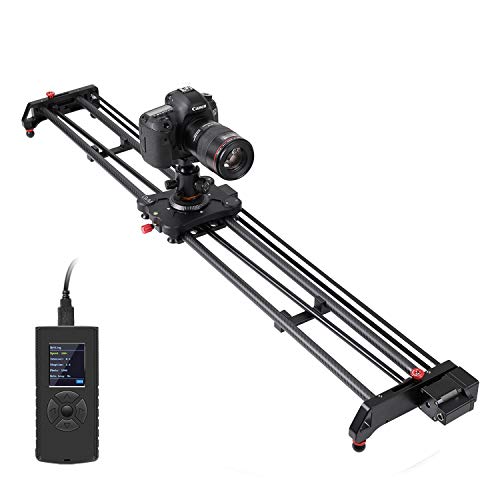
- 48-inch carbon-fiber rail
- Manual and motorized operation
- Includes battery, cables, remote, and bag
Best For: Long tracking, time-lapse, and panoramic camera moves
Portable Tilt-Capable Pick
NEEWER ER1-80 Motorized Slider

- Supports 45-degree tilted shooting
- App and manual control
- Includes 4400mAh NP-F750 battery
Best For: Outdoor video and time-lapse with angled camera movement
Precision Control Pick
GVM 48-Inch Carbon-Fiber Slider
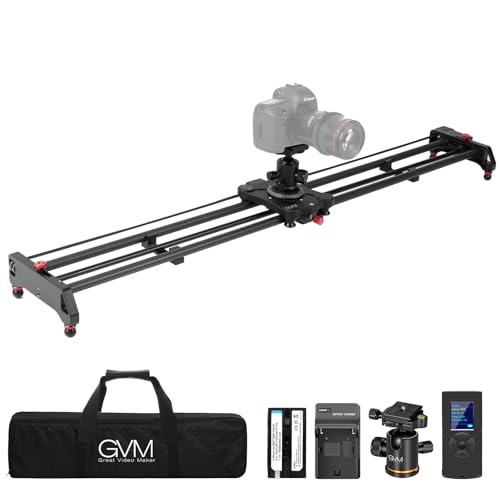
- Tracking, horizontal, and 120-degree modes
- Remote-adjustable motion parameters
- Supports up to 1,000 time-lapse photos
Best For: Repeatable professional video and time-lapse sequences
Best Compact Motorized Slider – NEEWER ER1 31.5-inch
For creators seeking camera sliders with vertical movement, the NEEWER ER1 offers motorized travel, app control, and support for 45-degree tilting. Its 31.5-inch carbon-fiber rail balances portability with useful camera capacity for product videos, time-lapses, and tracking shots.
Best For: Content creators who want a relatively compact motorized slider with horizontal, panoramic, and moderate tilt capabilities.
Pros:
- Supports up to 11 pounds horizontally and 5.5 pounds when tilted up to 45 degrees.
- App control, manual, video, and time-lapse modes provide flexible motion programming.
- Includes a 4400mAh NP-F750 battery and uses a quiet stepper motor.
- Carbon-fiber construction, roller bearings, and 1/4-inch and 3/8-inch mounting threads support stable setups.
Cons:
- The 2.4G remote and charger are not included.
- Minor shake may occur during macro photography.
- It is not water resistant.
The ER1 is a practical middle ground for controlled camera movement, especially when you need some vertical angle without moving to a larger cinema-focused system. Confirm that the included battery setup and separate charger requirements fit your workflow.
Best Tabletop Option – IFOOTAGE Shark Slider PICO
The IFOOTAGE Shark Slider PICO is a compact choice for camera sliders with vertical movement, combining 255mm of motorized travel with 360-degree pan rotation. It is designed around phones, action cameras, and lightweight tabletop production rather than full-size camera rigs.
Best For: Smartphone filmmakers, product-video creators, and solo shooters working on tabletop scenes or small-location setups.
Pros:
- Combines motorized sliding with 360-degree pan rotation for changing perspectives.
- Onboard controls handle A/B points, speed, and looping without requiring the app.
- The Moco app supports up to eight keyframes for complex moves, time-lapse, and stop motion.
- Weighs approximately 1.9 pounds, includes a phone holder and carrying case, and offers up to seven hours of horizontal battery operation.
Cons:
- Payload is limited to 2.4 pounds horizontally or 1.1 pounds vertically.
- Additional mounts and a PD 30W-or-higher charger are sold separately.
- Its 255mm travel is shorter than that of full-length camera sliders.
The PICO stands out when portability and easy tabletop operation matter more than long travel or heavy payloads. Its vertical capacity is modest, so check the combined weight of the camera, phone, and accessories before planning a tilted move.
Best Long-Rail Value – NEEWER ER1 47.2-inch
For longer compositions using camera sliders with vertical movement, this 47.2-inch NEEWER ER1 provides more travel than the compact version while retaining motorized operation and 45-degree tilt support. It is suited to extended tracking shots, product work, and time-lapse photography.
Best For: Videographers who want a longer motorized rail for smoother, more spacious camera moves with moderate tilt.
Pros:
- Offers 47.2 inches of travel for broader camera movements.
- Supports up to 11 pounds horizontally and 5.5 pounds at a 45-degree tilt.
- App control includes manual, video, and time-lapse shooting modes.
- The carbon-fiber rail uses four roller bearings and includes 1/4-inch and 3/8-inch tripod threads.
Cons:
- The 2.4G remote and charger are not included.
- Minor shake may occur for macro photography.
- Its longer rail may be less convenient to transport than the 31.5-inch model.
This version makes the most sense when framing flexibility and longer travel are priorities. It delivers useful tilt capacity without requiring a separate vertical-motion system, but you should plan for transport space and a compatible charger.
Best Advanced Multi-Axis System – IFOOTAGE Shark Nano II
The IFOOTAGE Shark Nano II is aimed at demanding productions that need camera sliders with vertical movement plus coordinated pan and gimbal motion. Its 360-degree rotary axis, touchscreen control, multi-point paths, and DJI gimbal integration make it the most feature-rich option in this group.
Best For: Professional and advanced creators programming complex tracking, panorama, time-lapse, macro, and vertical-tilt sequences.
Pros:
- Supports synchronized multi-axis movement with DJI gimbals through the included RS Adapter.
- Built-in IPS touchscreen and the Moco app allow up to eight customizable motion points.
- AI face and object tracking can help keep a selected subject centered.
- Offers five shooting modes, real-time stabilization algorithms, and a quiet brushless motor.
Cons:
- Its advanced controls and multi-axis features may be more than casual users need.
- The supplied notes do not specify the maximum payload or exact rail travel capacity.
- Direct USB-C operation requires a 60W PD 3.0 charger, while an optional battery grip is sold separately.
The Nano II is the strongest fit for intricate, repeatable camera moves rather than simple A-to-B slides. Its independent touchscreen and tracking features can reduce reliance on external controllers, but verify payload and mounting compatibility for your specific camera and gimbal.
Best Long-Rail Option – GVM 48-Inch Motorized Slider
If you need camera sliders with vertical movement, the GVM 48-inch motorized slider stands out for its long carbon-fiber rail and multiple mounting points. Its side and center 1/4-inch and 3/8-inch ports support horizontal, vertical, and 45-degree setups, while app control handles programmed motion.
Best For: Creators who want a long, motorized slider for tracking shots, panoramas, time-lapses, and angled or vertical setups.
Pros:
- Supports tracking, panoramic, time-lapse, video capture, and looping modes.
- Multiple mounting ports enable horizontal, vertical, and 45-degree shooting.
- App control, adjustable legs, six shutter cables, and a carry bag add flexibility.
- Carbon-fiber construction and a stated 20-pound maximum recommendation suit heavier camera setups.
Cons:
- At 4 kg and 120 cm, it is less portable than compact sliders.
- Battery life is listed at approximately two hours.
- It is not water resistant.
The GVM is the most versatile choice here for larger setups and true vertical movement, but its size and weight favor planned shoots over quick handheld travel.
Best Compact Setup – iFootage Shark Slider PICO
For creators seeking camera sliders with vertical movement in a highly portable package, the iFootage Shark Slider PICO is a compact motorized option. It weighs 1.9 pounds, offers 360-degree pan rotation, and integrates with DJI Pocket cameras, action cameras, and smartphones.
Best For: Mobile creators using compact cameras, phones, or DJI Pocket devices who want programmable motion and pan shots.
Pros:
- Supports Video, Time-Lapse, Stop Motion, Panorama, and Multi-Target modes.
- Up to eight programmable points can store position, timing, and angle parameters.
- Brushless motor is designed for quiet operation during recording.
- 5000mAh battery provides up to seven hours of operation, with 30W PD fast charging.
Cons:
- Its 2.4-pound payload is aimed at compact gear rather than full-size camera rigs.
- The 15.8-inch slider offers less travel than a long-rail system.
- Vertical operation is not specifically described in the supplied specifications.
The PICO is a strong travel-friendly choice when portability, quiet operation, and repeatable movements matter more than long travel or heavy payload capacity.
Best Budget Dolly Style – NEEWER DL400 Motorized Dolly
The NEEWER DL400 is a practical motorized dolly for creators comparing camera sliders with vertical movement and angled motion. Its non-slip wheels, app control, dual motors, and included NP-F750 battery support repeatable moves, while the ball head adds 360-degree rotation and 90-degree tilt.
Best For: DSLR and mirrorless users who want app-controlled dolly movement, quiet operation, and adjustable camera angles.
Pros:
- Dual motors operate below 30dB for quieter shooting.
- App supports Manual, Live Video, and Time-Lapse modes.
- Included NP-F750 battery provides up to five hours of runtime.
- Ball head offers 360-degree rotation and 90-degree tilt, with five speed settings.
Cons:
- Maximum load is 6.6 pounds.
- Time-lapse photography requires a separately purchased shutter cable.
- The supplied notes describe 30-degree left-right movement, not dedicated vertical rail travel.
The DL400 is best viewed as a flexible motorized dolly rather than a full vertical rail slider. Its tilt-capable ball head and app control make it useful for compact, angle-changing shots.
Long-Run Motorized Pick – GVM 48-Inch Motorized Slider
For camera sliders with vertical movement, the GVM GP-120QD offers a long 48-inch carbon-fiber rail with motorized or manual operation. Its adjustable feet support level horizontal setups, while the side knobs enable tracking and 120-degree panoramic movement.
Best For: Filmmakers who need a long slider for automated tracking, time-lapse, or panoramic shots.
Pros:
- 48-inch rail supports extended camera moves.
- Motorized controls allow adjustable speed, intervals, stop times, and automatic looping.
- Supports tracking, time-lapse, and 120-degree panoramic shooting.
- Includes a battery, charger, shutter cables, remote, extension cable, and carrying bag.
Cons:
- At 11.8 pounds, it is relatively heavy to transport.
- The rail is not water resistant.
- Its 48-inch folded length may require substantial storage space.
This is a feature-rich choice when reach and automated repeatability matter more than portability. Its adjustable feet and multiple tripod threads also make it practical for stable studio or field setups.
Portable Tilt-Capable Pick – NEEWER ER1-80 Motorized Slider
The NEEWER ER1-80 is a practical option for camera sliders with vertical movement, supporting horizontal loads up to 11 pounds and tilted shooting up to 45 degrees. App control, optional remote control, and a silent stepper motor add flexibility for video and time-lapse work.
Best For: Outdoor shooters who want a comparatively compact slider with 45-degree tilt capability.
Pros:
- Supports horizontal loads up to 11 pounds and tilted loads up to 5.5 pounds at 45 degrees.
- Offers app control, manual mode, video mode, and time-lapse mode.
- Silent stepper motor provides smooth, noiseless movement.
- Includes a 4400mAh NP-F750 battery and supports USB-C power input.
Cons:
- The 2.4G RT-08 remote control is not included.
- The battery charger is not included.
- It is 31.5 inches long, giving it less travel than the 48-inch alternatives.
Choose this model when tilt capability and lower transport demands are priorities. The 45-degree support is useful for angled movement, though heavier tilted camera setups need to stay within its 5.5-pound rating.
Precision Control Pick – GVM 48-Inch Carbon-Fiber Slider
For camera sliders with vertical movement and repeatable motion, this 48-inch GVM slider combines tracking, horizontal, and 120-degree panoramic modes with detailed remote adjustments. It can automate video or time-lapse movement between user-set start and end points.
Best For: Controlled production work requiring programmable motion, repeatable passes, and multiple shooting modes.
Pros:
- Supports tracking, horizontal, and 120-degree panoramic shooting.
- Remote control adjusts speed, dwell time, distance, pause time, shot count, and looping.
- Time-lapse mode supports up to 1,000 photos.
- Includes six shutter cables and an extension cable for broad camera compatibility.
Cons:
- At 5.42 kg, it is not especially lightweight.
- The 120-centimeter rail is less convenient for compact travel setups.
- It is not water resistant.
This model stands out when precise parameter control is more important than minimal setup size. Its broad shooting modes and included shutter cables make it a strong choice for planned, repeatable camera movement.
How We Picked the Best Camera Sliders with Vertical Movement
We compared the selected sliders by travel length, motorized control, camera compatibility, portability, motion features, and suitability for vertical or angled movement. We also considered practical extras such as app or remote control, battery capacity, time-lapse support, panoramic functions, and rotating axes.
Because product listings can describe vertical capability differently, check each model’s stated payload and mounting requirements before purchase. A slider may support tilted movement without being designed for a fully upright camera-and-lens setup.
Quick Comparison
| Best For | What to Prioritize |
|---|---|
| Travel and compact rigs | Short rails, low weight, and simple controls |
| DSLR or mirrorless video | Payload capacity, stable rails, and adjustable speed |
| Time-lapse production | Repeatable motion, interval controls, and long battery life |
| Large reveal shots | Longer 31.5-inch to 48-inch travel and reliable support |
| Multi-axis movement | Rotary-axis or pan-and-slide compatibility |
Key Buying Factors for Camera Sliders with Vertical Movement
Payload and Balance
Vertical movement places more demand on the motor and mounting system than a level slide. Add the camera body, lens, plate, accessories, and any pan or tilt head when estimating total weight. Leave a safety margin rather than choosing a slider that only meets the listed limit.
Rail Length and Portability
Long rails create more dramatic movement but take more room to transport and level. Short sliders are easier to use on a tabletop or compact set. If you frequently shoot products, interviews, or small locations, a shorter model may be more practical.
Control and Repeatability
App control can make it easier to set speed, direction, intervals, and repeatable moves. Remote controls may be preferable when you want straightforward operation without relying on a phone. For time-lapse work, verify the available interval and loop functions.
Power and Mounting
Battery capacity matters for long shoots, especially when the slider is operating under load. Look for compatible tripod mounting points and a stable base. For inclined or upright use, secure the slider at both ends whenever possible.
Who Should Buy Which Camera Sliders with Vertical Movement?
Choose a compact iFootage PICO or similar mini slider for phones, lightweight cameras, tabletop work, and travel. A mid-length NEEWER or iFootage Shark Nano II is a stronger fit for solo creators who need more travel without carrying a full-size rail.
For larger cameras, wide product scenes, and dramatic tracking shots, consider a 47.2-inch or 48-inch NEEWER or GVM slider. These longer systems suit studios and controlled locations best. If repeatable time-lapse or panoramic movement is your priority, focus on app control, rotary-axis support, battery capacity, and programmable motion rather than rail length alone.