The right camera slider can turn a basic tripod setup into a more polished production tool, adding smooth lateral movement, repeatable time-lapse motion, and controlled cinematic reveals.
These 10 options cover compact travel rigs, manual sliders, motorized rails, and advanced motion-control systems so you can match the slider to your camera, workflow, and budget.
Best 10 Camera Slider for Filmmaking Picks for 2026
Heavy-Duty Professional Pick
Proaim Flyking PRO 4ft Mitchell Slider

- 220-pound stated payload for heavy camera rigs
- 4-foot travel with 360° sweeping pan movement
- Mitchell mount and quick flip-lock control
Best For: Professional productions using large camera setups
Best App-Controlled Dolly
NEEWER DL400 Motorized Camera Slider

- Wireless app control for manual, video, and time-lapse modes
- Quiet dual motors rated below 30 dB
- Includes NP-F750 battery with up to 5 hours of runtime
Best For: Solo creators and compact camera setups
Advanced Gimbal Motion Pick
IFOOTAGE Shark Slider Nano II-860

- Five-axis integration with several DJI RS gimbals
- 24.9-inch travel and 11-pound horizontal payload
- Quiet motor with app control, keyframes, and AI tracking
Best For: Gimbal-equipped filmmakers needing programmable motion
Best Motorized Slider

- Programmable eight-point motion paths
- AI subject tracking and DJI gimbal support
- Quiet motor with five shooting modes
Best For: Automated cinematic moves, time-lapses, and product shoots
Best Manual Rail Slider
Zecti 24-Inch Carbon Fiber Slider

- Lightweight 654-gram travel-friendly design
- Adjustable legs and multiple mounting threads
- Supports horizontal, vertical, and diagonal use
Best For: Portable manual shots with small cameras and phones
Best Compact Dolly

- Creates straight or circular camera movement
- Includes ball head and rotatable phone clamp
- Pocket-sized 220-gram aluminum design
Best For: Tabletop videos, smartphones, and compact cameras
Feature-Rich Long-Rail Pick
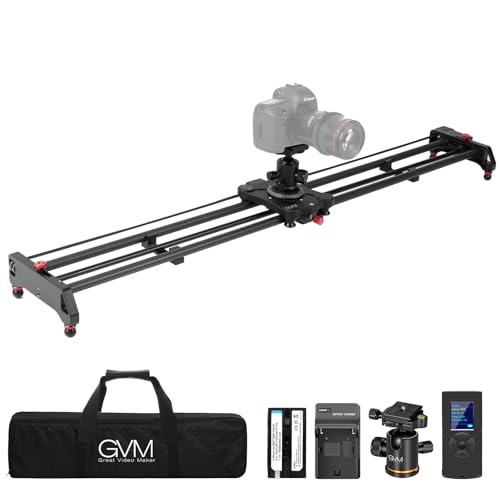
- 120cm carbon-fiber rail
- Remote programmable motion
- Tracking, panorama, and time-lapse modes
Best For: Filmmakers needing long, repeatable programmed camera moves
Compact 2-Axis Pick
IFOOTAGE PICO Pro Motorized Slider
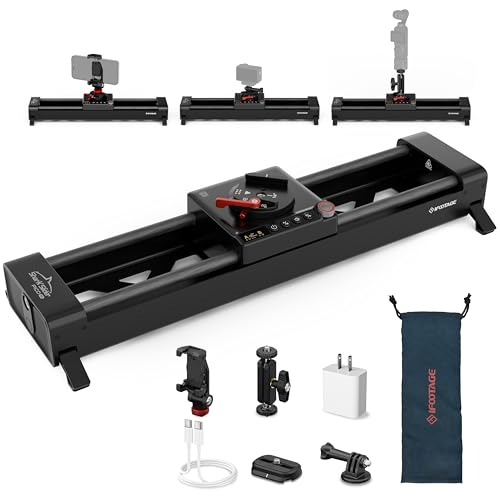
- Linear and 360° panoramic motion
- LCD and app control
- Supports up to 1.1kg
Best For: Portable product videos, interviews, and cinematic B-roll
Outdoor-Ready Value Pick
NEEWER ER1 47.2-Inch Motorized Slider

- 120cm carbon-fiber rail
- App control and quiet motor
- Includes 4400mAh NP-F750 battery
Best For: Mobile creators shooting product videos and time-lapses
Heavy-Duty Professional Pick – Proaim Flyking PRO 4ft Mitchell Slider
For productions using substantial camera rigs, the Proaim Flyking PRO is a camera slider for filmmaking built around stability and long travel. Its 4-foot rail, Mitchell compatibility, 360° sweeping pan movement, and 220-pound stated payload make it suited to demanding studio or location setups.
Best For: Professional filmmakers, rental houses, commercials, studio productions, and heavy camera configurations.
Pros:
- Supports up to 220 pounds, accommodating heavy rigs, fluid heads, and accessories.
- Provides 4 feet of travel for tracking, reveal, and controlled motion shots.
- Offers 360° sweeping panning movement and Mitchell-mount compatibility.
- Flip-lock controls help speed up setup adjustments.
Cons:
- At 34.5 pounds, it is considerably less portable than compact slider systems.
- Its Mitchell-oriented design may be more specialized than a standard camera-mount slider.
The Flyking PRO is an equipment-focused choice when payload capacity and professional support compatibility matter more than lightweight portability. It is particularly compelling for crews working with large cinema configurations.
Best App-Controlled Dolly – NEEWER DL400 Motorized Camera Slider
The NEEWER DL400 is a compact, motorized camera slider for filmmaking that emphasizes wireless control and quiet operation. Its app supports manual, live video, and time-lapse modes, while the included NP-F750 battery provides up to five hours of stated runtime.
Best For: Solo filmmakers, time-lapse work, product videos, and creators who want app-controlled motion.
Pros:
- App control enables wireless operation in manual, live video, and time-lapse modes.
- Dual motors are rated for quiet operation below 30 dB.
- Includes an NP-F750 battery with up to five hours of stated runtime.
- Offers five speeds plus 30° manual left-and-right movement.
Cons:
- The maximum load is 6.6 pounds, limiting compatibility with heavier rigs.
- A camera shutter cable is separately required for time-lapse photography.
- The supplied guidance cautions against starting at the fastest speed uphill.
Choose the DL400 when remote control, portability, and repeatable motorized movement are priorities. Its lighter payload makes it better suited to DSLR and mirrorless-style setups than cinema rigs.
Advanced Gimbal Motion Pick – IFOOTAGE Shark Slider Nano II-860
The IFOOTAGE Shark Slider Nano II-860 is a camera slider for filmmaking designed for coordinated motion control. With 24.9 inches of travel, five-axis gimbal integration, app-based path control, and a quiet PD60W brushless motor, it targets filmmakers seeking precise, programmable movement.
Best For: Gimbal-based filmmaking, professional tracking shots, interviews, vlogs, and mobile production teams.
Pros:
- Integrates with DJI RS2, RS2 Pro, RS3 Pro, RS4, and RS4 Pro gimbals.
- Provides 24.9 inches of travel across a 34-inch track.
- Supports up to 11 pounds horizontally and 5.5 pounds vertically.
- Offers near-silent operation, app controls, keyframes, and AI-powered tracking features.
Cons:
- Its 11-pound horizontal payload is not intended for very heavy cinema rigs.
- Gimbal integration is most useful for users already invested in compatible DJI systems.
- At 7.65 pounds, it is portable but not an ultra-light travel accessory.
The Nano II-860 stands out for filmmakers who want more than simple linear travel. Its gimbal compatibility and programmable controls make it a strong option for coordinated pan, tilt, roll, and slide movements.
Best Compact Circular Dolly – NEEWER DL100 Wireless Video Dolly
The NEEWER DL100 is a small motorized camera slider for filmmaking that uses adjustable wheels to create straight or circular movement. Wireless speed and direction control, a built-in rechargeable battery, and support for cameras, phones, and action cameras make it a flexible option for compact shooting kits.
Best For: Smartphone creators, action-camera users, tabletop videos, and lightweight DSLR or camcorder setups.
Pros:
- Adjustable wheel angles enable straight-line and circular routes.
- Remote control changes speed, direction, and pause from up to 19.7 feet away.
- Three speeds support motion at 1.4, 2.4, or 3.0 cm/s.
- Built-in 1,800mAh battery provides up to six hours of stated service time.
Cons:
- The 6.6-pound maximum load limits use with larger camera rigs.
- It is not water resistant according to the supplied specifications.
- Accessories such as camera and smartphone holders are not included.
The DL100 is a practical choice when you want creative dolly paths in a compact package. Its adjustable wheels are especially useful for circular product shots, while the modest payload favors phones, action cameras, and smaller camera bodies.
Best Motorized Slider – IFOOTAGE Shark Nano II
The IFOOTAGE Shark Nano II is a feature-rich camera slider for filmmaking when you need repeatable movement, automated tracking, and multi-axis control. Its 26-inch carbon-tube design combines an IPS touchscreen, app control, and several shooting modes for more advanced production work.
Best For: Filmmakers creating automated tracking shots, time-lapses, product videos, interviews, and macro footage.
Pros:
- Supports up to eight customizable motion points through the touchscreen or iFootage Moco app.
- Works with DJI gimbals through the included RS Adapter for synchronized multi-axis movement.
- Offers AI face and object tracking, stabilization algorithms, and a quiet brushless motor.
- Includes time-lapse, stop-motion, video, macro, and panorama modes with direct USB-C PD power support.
Cons:
- Its advanced motorized controls may be more than needed for simple manual sliding shots.
- Powering it directly requires a compatible 60W USB-C PD source; the optional battery grip is sold separately.
The Nano II is the most capable option here for automated and repeatable camera moves. Choose it when precise programming and tracking matter more than keeping the setup simple and fully manual.
Best Manual Rail Slider – Zecti 24-Inch Carbon Fiber Slider
The Zecti 24-inch slider is a practical manual camera slider for filmmaking, offering a portable carbon-fiber rail, adjustable legs, and multiple mounting points. Its compact 654-gram design is suited to travel and supports horizontal, vertical, diagonal, and sideways operation.
Best For: Travelers, photographers, and filmmakers who want a lightweight manual slider for small cameras, phones, and action cameras.
Pros:
- Four precision bearings and a double interior carbon-fiber rail are designed for smooth, quiet movement.
- Adjustable legs, non-skid feet, and a bubble level help with setup on different surfaces.
- Multiple 1/4-inch and 3/8-inch mounting holes support various camera and ball-head configurations.
- Includes a carrying bag and supports cameras, smartphones, action cameras, and compact camcorders up to 4.4 pounds.
Cons:
- It is a manual slider, so it does not provide motorized programming or automated tracking.
- The manufacturer notes that overtightened screws can cause noise or less-smooth movement.
- It is not water resistant.
The Zecti offers a straightforward balance of portability, mounting flexibility, and manual control. It is a sensible choice for lightweight setups, provided you adjust the hardware carefully for the smoothest movement.
Best Compact Dolly – NEEWER SD001 Camera Dolly
The NEEWER SD001 is a pocket-sized alternative to a traditional rail camera slider for filmmaking. Its four adjustable wheels can create straight-line or circular movement on floors, tables, or compatible slider surfaces, while the included ball head and phone clamp make it ready for compact shooting setups.
Best For: Tabletop filming, smartphone content, product shots, and compact mirrorless or action-camera setups.
Pros:
- Adjustable wheels support both linear movement and curved or circular panning paths.
- Soft rubber wheel rings are designed for smooth, quiet operation.
- The ball head rotates 360 degrees and tilts 90 degrees for flexible camera positioning.
- Compact aluminum-alloy construction weighs about 220 grams and includes a rotatable phone clamp with a cold shoe.
Cons:
- It is not suitable for telephoto lenses.
- Its tabletop dolly format offers less rail travel than a full-length slider.
- An adapter may be required for some action-camera setups.
The SD001 is best viewed as a compact tabletop dolly rather than a conventional long slider. Its small size and circular movement make it particularly useful for mobile creators and product-oriented shots.
Feature-Rich Long-Rail Pick – GVM 48-Inch Motorized Slider
If you need a versatile camera slider for filmmaking, the GVM 48-inch motorized model offers long travel, remote operation, and several programmed movement options. Its 120cm carbon-fiber rail supports horizontal, tracking, panoramic, video, and time-lapse workflows.
Best For: Filmmakers who want programmable camera movement and a full-length rail for tracking shots, time-lapses, and panoramic footage.
Pros:
- Offers tracking, horizontal, 120° panoramic, video, and time-lapse modes.
- Remote control adjusts speed, endpoints, dwell time, pauses, shot count, and looping.
- Includes multiple 1/4-inch and 3/8-inch mounting ports plus six shutter cables and an extension cable.
Cons:
- At 5.42kg, it is relatively heavy for portable setups.
- It is not water resistant.
The GVM stands out when control flexibility matters more than minimal carry weight. Its long rail and extensive remote settings make it a capable choice for repeatable cinematic moves and automated time-lapse work.
Compact 2-Axis Pick – IFOOTAGE PICO Pro Motorized Slider
The IFOOTAGE PICO Pro is a compact camera slider for filmmaking designed for controlled movement without the bulk of a full-size rail system. Its carbon-fiber rail combines linear travel with 360° panoramic rotation, while LCD and app controls simplify setup.
Best For: Content creators and filmmakers producing product videos, interviews, B-roll, time-lapses, and orbit-style shots with portable gear.
Pros:
- Combines linear sliding with 360° panoramic rotation for two-axis movement.
- Provides LCD screen and mobile-app control for repeatable motion settings.
- Supports up to 1.1kg and offers video, time-lapse, stop-motion, panorama, and multi-point target modes.
Cons:
- The 1.1kg maximum recommendation limits heavier camera builds.
- Its compact design may provide less travel than a traditional full-size slider.
Choose the PICO Pro when portability and motion complexity are priorities. The added panoramic axis is particularly useful for dynamic product sequences, controlled reveals, and more cinematic B-roll.
Outdoor-Ready Value Pick – NEEWER ER1 47.2-Inch Motorized Slider
For filmmakers seeking a long, practical camera slider for filmmaking, the NEEWER ER1 pairs a 120cm carbon-fiber rail with app control, a quiet motor, and an included 4400mAh NP-F750 battery. It supports automated video and time-lapse movement, plus several shooting angles.
Best For: Creators who want a relatively lightweight motorized slider for product videos, time-lapses, and outdoor camera movement.
Pros:
- Supports horizontal loads up to 11lb and 45° tilting loads up to 5.5lb.
- Offers app control, manual operation, video mode, and time-lapse settings.
- Includes a 4400mAh NP-F750 battery and uses a quiet stepper motor.
Cons:
- The 2.4G remote is not included.
- A charger is not included.
- The notes caution that minor shake may occur during macro photography.
The ER1 is a well-rounded option for users who want long travel and useful automation without the 5.42kg weight of the GVM model. Its battery-powered design and carbon-fiber construction also suit mobile and outdoor workflows.
How We Picked the Best Camera Slider for Filmmaking
We focused on the factors that most affect real-world shooting: load capacity, usable travel, movement smoothness, portability, setup requirements, control options, and compatibility with cameras, tripods, gimbals, and accessories. The selection includes both manual and motorized models because each suits a different production style.
We also considered whether a slider is practical for solo operators, studio crews, travel filmmakers, interviews, product videos, time-lapse work, and motion-control shots. A premium feature is only useful if it fits your equipment and shooting process.
Quick Comparison
| Slider type | Best for | Main advantage | Trade-off |
|---|---|---|---|
| Manual rail | Fast, simple camera moves | Low setup complexity | Less repeatable motion |
| Compact motorized | Travel and solo filmmaking | Portable automated movement | Lower payload or shorter travel |
| Long motorized slider | Studio and time-lapse work | Extended, programmable moves | More weight and setup time |
| Motion-control system | Advanced repeatable shots | Precise multi-axis control | Higher cost and learning curve |
Key Buying Factors for a Camera Slider for Filmmaking
Length and Travel
Slider length is not the same as usable travel. Short rails are easier to transport and work well for tabletop or tight interior shots, while 47- to 48-inch models provide more noticeable movement for interviews, establishing shots, and product sequences. Check your available floor or tripod space before choosing a long rail.
Payload and Stability
Calculate the combined weight of the camera, lens, cage, battery, monitor, and any mounted accessories. Choose a slider with comfortable capacity above that total, especially for fast movement or angled setups. A rigid rail and stable support points matter as much as the published load rating.
Manual or Motorized Operation
Manual sliders are quick to deploy and offer intuitive speed control. Motorized models are better for repeatable moves, time-lapse sequences, and unattended operation. App control can make programming easier, but it adds batteries, pairing, and setup considerations.
Compatibility and Mounting
Look for standard tripod threads, a suitable camera plate, and enough clearance for your camera body. If you use a gimbal, verify payload, mounting dimensions, and stated compatibility rather than assuming the slider will support the complete system.
Power, Noise, and Portability
For location work, battery capacity, charging options, packed size, and total weight can determine whether the slider is genuinely useful. For dialogue or quiet sets, consider motor noise and whether the slider supports smooth, low-speed operation.
Who Should Buy Which Camera Slider for Filmmaking?
- Travel filmmakers: Choose a compact carbon-fiber or short motorized slider that fits your case and can be supported quickly.
- Product and tabletop shooters: A shorter rail with precise speed control is usually easier to position around small subjects.
- Interview and commercial crews: A longer, stable slider provides more dramatic movement and better framing flexibility.
- Time-lapse creators: Prioritize programmable motor control, dependable battery life, and repeatable start-and-stop movement.
- Advanced motion-control users: Consider a multi-axis system if you need coordinated pan, tilt, or gimbal movement rather than simple linear travel.
- Budget-conscious beginners: Start with a manual slider if you mainly need occasional movement and want the simplest learning curve.
Before buying, match the slider’s actual payload, travel, support method, and control system to your camera package. The best Camera Slider for Filmmaking is the one you can transport, level, and operate confidently on the shoots you do most often.