Reliable wind measurements can make outdoor testing safer, faster, and more repeatable. The best anemometers for field work combine useful accuracy with a rugged design, readable display, and controls that are easy to use on location.
This roundup compares 10 handheld models across pocket-sized wind meters, HVAC-focused airflow tools, and multifunction devices with temperature, humidity, or pressure readings. Use the guide below to narrow your choice by measurement needs, working conditions, and portability.
Best 10 Anemometers for Field Work Picks for 2026
Rugged Field Classic
Kestrel 1000 Pocket Wind Meter

- Current, maximum, and average wind-speed readings
- Waterproof, floating, and military drop-tested
- Five-year warranty with replaceable impeller
Best For: Construction, HVAC, boating, and outdoor wind monitoring
Waterproof Thermo-Anemometer

- Measures air velocity and temperature
- Includes wind chill and selectable averaging
- Waterproof, floating, and six-foot drop-resistant
Best For: Portable HVAC and air-quality field testing
Versatile HVAC Wind Gauge
HoldPeak 866B Digital Anemometer

- Measures airflow, temperature, and wind chill
- Tracks maximum, minimum, and average readings
- Backlit display and tripod mount for field use
Best For: HVAC checks, CFM estimates, and outdoor wind monitoring
High-Resolution Compact Meter

- 0.01 resolution with 0.5-second sampling
- Six selectable wind-speed units and MAX mode
- Backlight, alarm, batteries, and protective housing included
Best For: Precision-oriented outdoor, HVAC, and CFM checks
Best Pocket Pick
TopTes TS-301 Digital Anemometer
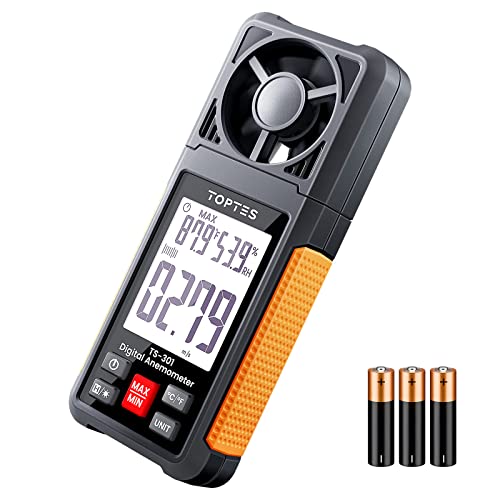
- Large backlit 2.26-inch display
- Six wind-speed measurement units
- Temperature and humidity readings
Best For: Portable outdoor and basic HVAC checks
Best HVAC Airflow Option
POROMETISTO Portable CFM Anemometer
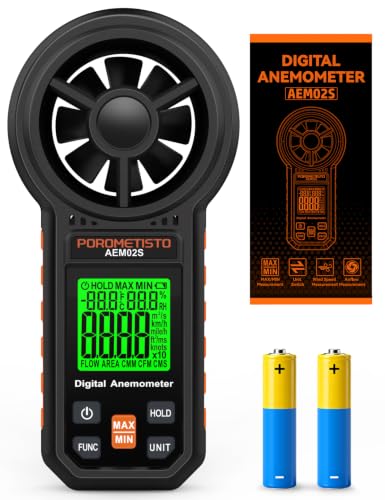
- Measures CFM, CMM, and CMS airflow
- Custom airflow-area setting and MAX/MIN tracking
- Three-color alarm with backlit display
Best For: HVAC airflow and indoor comfort checks
Best Weather-Data Tool
BTMETER BT-100WM Handheld Anemometer
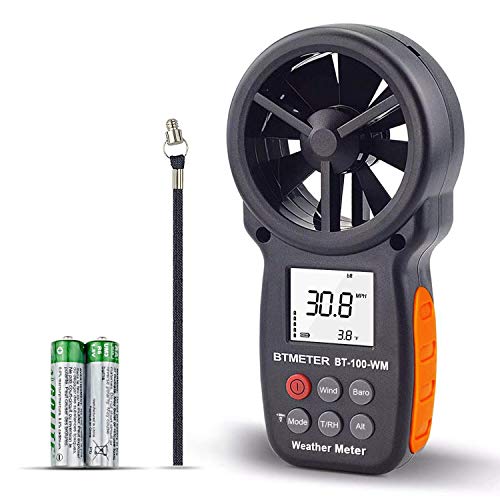
- Measures wind and multiple weather conditions
- Logs 16 groups of barometric data
- Includes altitude and tripod-mount features
Best For: Field weather observations and shooting or HVAC checks
Compact Field Meter
UNI-T UT363 Handheld Anemometer

- Measures wind speeds up to 30 m/s
- Backlit display with temperature and wind chill
- MAX/AVG, hold, and five speed units
Best For: Portable outdoor, HVAC, and equipment checks
All-in-One Readout
Mcbazel 3-in-1 Digital Anemometer

- Measures speed, temperature, and wind level
- Displays speed and temperature together
- Includes backlight and MAX/MIN/AVG functions
Best For: HVAC, sailing, fishing, and general field use
Wide-Use Wind Tester
Soonkoda 3-in-1 Handheld Anemometer

- Measures 0.06 to 30.0 m/s
- Displays speed and temperature simultaneously
- Includes hold, MAX/MIN/AVG, and backlight
Best For: Ventilation, industrial, and outdoor measurements
Rugged Field Classic – Kestrel 1000 Pocket Wind Meter
For anemometers for field work, the Kestrel 1000 stands out as a compact, rugged choice for straightforward wind-speed checks. Its replaceable impeller and large LCD display make it practical for outdoor and job-site use.
Best For: Construction, HVAC, sailing, aviation, and outdoor wind monitoring.
Pros:
- Displays current, maximum, and average wind speed in multiple units.
- Waterproof, floats, and is drop-tested to military standards.
- Includes a protective cover, lanyard, battery, and five-year warranty.
Cons:
- Uses a disposable CR2032 coin-cell battery.
- Focuses on wind speed rather than temperature or other environmental readings.
The Kestrel 1000 is a strong pick when durability, portability, and dependable wind-speed readings matter more than extra measurement modes.
Waterproof Thermo-Anemometer – Extech 45118 Mini Anemometer
The Extech 45118 is a compact option among anemometers for field work, combining air-velocity readings with temperature, wind chill, and averaging functions. Its floating, waterproof design suits mobile HVAC and air-quality checks.
Best For: HVAC technicians, air-quality checks, and portable airflow testing.
Pros:
- Measures 100–5,500 ft/min and temperature from 0–122°F.
- Offers wind chill and 5-, 10-, or 13-second averaging.
- Waterproof, floats, and withstands a six-foot drop.
Cons:
- Uses a CR2032 battery.
- Has a one-year warranty.
- The supplied notes do not specify a backlit display.
This Extech is well suited to technicians who want a small, protective instrument with useful temperature and averaging features alongside air-velocity measurements.
Versatile HVAC Wind Gauge – HoldPeak 866B Digital Anemometer
The HoldPeak 866B offers useful flexibility for anemometers for field work, measuring light airflow, temperature, wind chill, and changing gust conditions. Its backlit display, tripod mount, and carrying case add convenience at job sites and outdoor locations.
Best For: HVAC airflow checks, CFM estimates, sailing, drone preparation, and outdoor measurements.
Pros:
- Measures 0.67–67.1 mph with ±5% accuracy.
- Provides MAX, MIN, and AVG readings plus multiple speed units.
- Includes a backlight, wrist strap, protective case, and tripod mount.
Cons:
- The compatible tripod is not included.
- The backlight turns off after 15 seconds.
- Its one-year warranty is shorter than some rugged field meters.
The 866B is a practical all-rounder for users who need both HVAC airflow comparisons and outdoor wind tracking in a readable handheld format.
High-Resolution Compact Meter – POROMETISTO AEM01S Anemometer
The POROMETISTO AEM01S is a compact choice among anemometers for field work when fine resolution and fast sampling are priorities. It combines 0.01 resolution with selectable units, MAX recording, a backlight, and a three-color wind-speed alarm.
Best For: Outdoor sports, sailing, shooting, mountaineering, HVAC work, and basic CFM calculations.
Pros:
- Covers 0.70–30.00 m/s with 0.01 resolution and 0.5-second sampling.
- Supports six wind-speed units and displays the wind-speed scale.
- Includes two AAA batteries, automatic shutoff, and a protective fan housing.
Cons:
- Accuracy varies by range, reaching ±(2.0% + 0.5 m/s) from 1–30 m/s.
- Uses two AAA batteries rather than a rechargeable power system.
- Its one-year free replacement service is limited to product-quality issues.
Choose the AEM01S if detailed, quickly updated readings and simple field portability are more important than advanced environmental measurements.
Best Pocket Pick – TopTes TS-301 Digital Anemometer
For field work that calls for quick, portable wind checks, the TopTes TS-301 is a practical choice among anemometers for field work. Its large backlit display, six wind-speed units, and included carry pouch make it easy to use outdoors or during basic HVAC airflow checks.
Best For: Outdoor activities, portable weather checks, and straightforward HVAC or vent airflow measurements.
Pros:
- Large 2.26-inch backlit LCD is easy to read.
- Measures wind speed in six units, including m/s, mph, knots, and km/h.
- Also measures temperature and relative humidity.
- Lightweight, pocket-friendly design includes batteries and a storage pouch.
Cons:
- Temperature and humidity sensors may need at least 30 minutes to adjust to a new environment.
- Automatic shutdown occurs after 10 minutes of inactivity.
The TS-301 stands out for simple operation and field portability. Choose it when readable wind-speed measurements and basic environmental readings matter more than advanced logging or airflow alarms.
Best HVAC Airflow Option – POROMETISTO Portable CFM Anemometer
The POROMETISTO portable meter is a strong fit for field workers who need more than a basic wind-speed reading. Among anemometers for field work, it adds CFM, CMM, and CMS airflow measurements, custom area settings, and a three-color alarm for quicker HVAC and indoor-air assessments.
Best For: HVAC technicians, indoor comfort checks, and jobs requiring airflow calculations with temperature and humidity readings.
Pros:
- Supports wind-speed, CFM, CMM, and CMS airflow measurements.
- Eight-blade sensor is designed for full-directional sensing.
- Includes MAX/MIN tracking, data hold, unit switching, and a backlit display.
- Three-color alarm provides green, yellow, and red reading indicators.
Cons:
- Temperature and humidity ranges are intended primarily for indoor conditions.
- Wind-speed accuracy is listed as ±(2% + 1.6 ft/s).
- Uses two AAA batteries and has a 10-minute auto-off function.
With dedicated airflow modes and an adjustable measurement area, this model is more specialized than a basic handheld wind meter. It is particularly useful when field work involves ducts, vents, or documenting air movement rather than wind speed alone.
Best Weather-Data Tool – BTMETER BT-100WM Handheld Anemometer
The BTMETER BT-100WM is designed for field users who want wind readings alongside broader weather data. It is one of the more information-rich anemometers for field work, combining wind speed with humidity, dew point, wind chill, barometric pressure, and altitude measurements.
Best For: Shooting, hunting, sailing, drone activities, weather observations, and HVAC checks where environmental context is useful.
Pros:
- Measures wind speed, temperature, humidity, dew point, wind chill, pressure, and altitude.
- Offers current, average, maximum, and minimum wind readings in five units.
- Logs 16 groups of barometric-pressure data for comparison and analysis.
- Backlit display and tripod hole support field use and mounting.
Cons:
- Wind-speed accuracy is listed as ±5%.
- Its broader feature set may be more than needed for simple wind-speed checks.
- Automatic shutdown activates after 10 minutes without operation.
The BT-100WM is a sensible pick when wind is only one part of the field picture. Its data logging and altitude-related measurements add useful context, although users seeking only a quick wind reading may prefer a simpler meter.
Compact Field Meter – UNI-T UT363 Handheld Anemometer
For anyone comparing anemometers for field work, the UNI-T UT363 offers straightforward wind and temperature readings in a compact handheld design. It measures wind speeds up to 30 m/s, displays five selectable speed units, and adds Beaufort, wind-chill, MAX, and AVG information for quick on-site checks.
Best For: Outdoor activities, HVAC checks, vehicle air-conditioning maintenance, and other situations where portability and simple readings matter.
Pros:
- Measures wind speed up to 30 m/s with 0.1 m/s resolution.
- Displays wind speed and air temperature on a reader-friendly backlit LCD.
- Includes data hold, MAX/AVG readings, Beaufort scale, and wind-chill notification.
- Supports m/s, km/h, ft/min, knots, and mph.
Cons:
- Temperature range is limited to -10°C to 50°C (14°F to 122°F).
- Its mini size may be less suitable for users wanting a larger display or more advanced logging.
The UT363 is a practical choice when you need a compact field instrument with useful secondary readings rather than a specialized airflow measurement system.
All-in-One Readout – Mcbazel 3-in-1 Digital Anemometer
The Mcbazel 3-in-1 is a convenient option among anemometers for field work because it shows wind speed, temperature, and Beaufort wind level together. Its double-line backlit LCD, multiple units, and MAX/MIN/AVG functions make it useful for quick readings in changing indoor or outdoor conditions.
Best For: HVAC work, sailing, fishing, and general field measurements where simultaneous wind and temperature data is helpful.
Pros:
- Measures wind speed, wind temperature, and Beaufort wind level.
- Supports m/s, km/h, knots, ft/s, and mph.
- Shows wind speed and temperature simultaneously on a double-line LCD.
- Includes backlight, MAX/MIN/AVG, data hold, low-battery indicator, and auto power-off.
Cons:
- AAA batteries are required but not included.
- The supplied notes do not specify the wind-speed measuring range.
This model emphasizes readable, all-in-one field information and convenient monitoring features, making it a sensible general-purpose meter when a specified maximum range is not essential.
Wide-Use Wind Tester – Soonkoda 3-in-1 Handheld Anemometer
The Soonkoda 3-in-1 combines wind speed, wind temperature, and Beaufort level measurements in a handheld format. For anemometers for field work, its stated 0.06 to 30.0 m/s range, dual-line display, and selectable speed units provide useful coverage for outdoor, ventilation, and industrial checks.
Best For: Duct ventilation, HVAC-related work, industrial environments, sailing, surfing, flying, fishing, and other outdoor measurements.
Pros:
- Measures wind speed from 0.06 to 30.0 m/s.
- Measures wind speed, temperature, and Beaufort wind level.
- Displays wind speed and temperature simultaneously on a dual-line LCD.
- Offers MAX/MIN/AVG, data hold, backlight, auto power-off, and low-battery indication.
Cons:
- The supplied details list the item dimensions as 0.01 inches, which may be incomplete.
- The product notes do not specify a battery type or whether batteries are included.
With a clearly stated measuring range and broad application list, the Soonkoda is a versatile pick for users who need one compact meter for ventilation, industrial, and outdoor work.
How We Picked the Best Anemometers for Field Work
We focused on the features that matter when measurements happen away from a workbench: wind-speed range, stated resolution, measurement modes, display readability, portability, and resistance to moisture or rough handling. We also considered whether each meter adds useful readings such as temperature, humidity, wind chill, barometric pressure, airflow, or CFM.
Because specifications vary between models, treat accuracy claims and operating ranges as manufacturer-stated figures. For professional compliance work, confirm that the instrument’s calibration documentation and performance meet your organization’s requirements.
Quick Comparison
- Best for simple pocket measurements: Kestrel 1000.
- Best for wet outdoor conditions: Extech 45118.
- Best for HVAC and airflow checks: HoldPeak 866B or a POROMETISTO CFM model.
- Best for large-screen readability: TopTes TS-301.
- Best for added weather data: BTMETER BT-100WM or UNI-T UT363.
- Best for general recreational use: Mcbazel or Soonkoda multifunction meters.
Key Buying Factors for Anemometers for Field Work
Measurement Type and Range
Choose a wind-speed meter that covers the conditions you expect to encounter. Basic meters are suitable for spot checks, while HVAC work may require airflow calculations, CFM readings, or averaging functions. A higher displayed resolution can help reveal small changes, but it does not automatically guarantee greater accuracy.
Display and Controls
A backlit LCD is valuable in shaded areas, vehicles, and low-light conditions. Large digits reduce errors when you are holding the instrument at arm’s length. Max, average, hold, and unit-selection functions are particularly useful when readings fluctuate.
Durability and Portability
For field work, look for a protective case, compact dimensions, lanyard or wrist-strap options, and clear information about water resistance. A pocket meter is convenient for frequent checks, while a larger handheld design may be easier to read and operate with gloves.
Extra Sensors and Power
Temperature, humidity, wind chill, and barometric pressure can add context to a wind reading, but they may increase cost and battery demands. Check the battery type, auto-off behavior, and whether replacement batteries are easy to obtain before extended site visits.
Who Should Buy Which Anemometers for Field Work?
Choose the Kestrel 1000 or Extech 45118 if you want a focused, portable instrument for outdoor wind checks. HVAC technicians should prioritize models that provide airflow or CFM functions, such as the HoldPeak and POROMETISTO options. The TopTes TS-301 is a practical choice when screen size and backlighting matter.
If you want one device for broader weather observations, consider the BTMETER or UNI-T models with additional environmental readings. For occasional sailing, surfing, flying, fishing, or recreational testing, the Mcbazel and Soonkoda meters offer useful multifunction coverage without requiring a specialized setup.