Printing at home is easier to manage when your enclosure controls dust, odors, and airborne particles instead of letting them spread through the room. The right setup can also help stabilize temperature and make resin or filament printing more comfortable.
We selected 10 enclosure and filtration options for different printers, spaces, and budgets, with attention to filter type, ventilation, fit, access, and everyday usability.
Best 10 3d Printer Enclosures with Filter Picks for 2026
Large Resin Workspace
Dual-Printer Filtered Enclosure

- Fits a resin printer and curing machine
- Carbon filter, fans, and expandable pipes
- Clear window and dust-resistant enclosure
Best For: Large resin-printing setups needing enclosed ventilation
Advanced Air Filtration
HEPA H13 Printer Filter System

- Pre-filter, HEPA H13, and carbon stages
- Default connector for Bambu Lab P1S/X1C
- Quick-swap filters and compact design
Best For: Enclosed-printer users prioritizing particle and odor filtration
Resin Tent Solution
Adjustable Three-Layer Filter Enclosure

- UV-blocking window for resin printing
- Adjustable fan-speed ventilation
- Three-layer filter and fire-resistant fabric
Best For: Small LCD resin printers needing a filtered tent
High-Flow Add-On

- Up to 80.6 CFM adjustable airflow
- Magnetic filter and duct attachment
- Two-meter tube for outdoor venting
Best For: TOPCUBE enclosure owners needing powerful exhaust
Best Overall Filtration

- Pre-filter, H13 HEPA, and activated carbon stages
- Direct Bambu Lab P1S/X1C connection
- 60 m³/h fan with tool-free filter changes
Best For: Enclosed-printer users seeking dedicated particle and odor filtration
Best Resin Enclosure
Ventilated Resin Printer Cover

- Carbon filter sheet targets resin odors
- Six-sided cover with exhaust fan and duct
- Large viewing window for monitoring prints
Best For: Compatible resin printers needing containment and ventilation
Best External Setup

- Routes printer exhaust into an external filter box
- Three-stage HEPA and carbon filtration
- Includes duct, adapter, controller, and hardware
Best For: Bambu Lab P1P, P1S, and X1C users wanting beside-printer filtration
Best Ventilated Resin Tent
VEVOR Constant-Temperature Enclosure
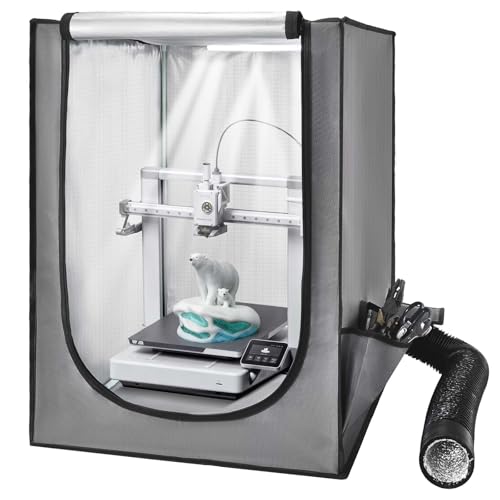
- Ventilation helps expel smoke and dust
- LED-lit transparent viewing window
- Sized for compact FDM and LCD resin printers
Best For: Small resin printers needing ventilation and temperature stability
Best Filtered Enclosure
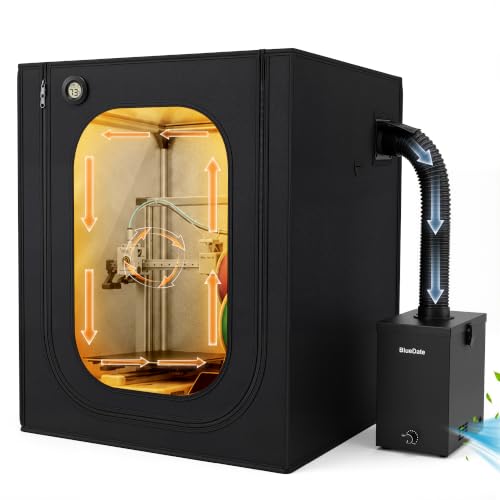
- Four-stage HEPA and activated-carbon filtration
- Adjustable fan speed with supplied smoke pipe
- Fits many listed FDM and resin models
Best For: Users prioritizing smoke, odor, and particulate filtration
Best Large Printer Tent

- Spacious design for larger listed printers
- LED window supports print monitoring
- Ventilation holes accept optional fan components
Best For: Large printers needing dust, noise, and temperature protection
Large Resin Workspace – Dual-Printer Filtered Enclosure
If you need 3D printer enclosures with filter capacity for a resin setup, this YOOPAI enclosure stands out for its generous interior. It can accommodate a resin printer and curing machine, while its carbon filter sheet, exhaust fans, and expandable pipes help manage odors and emissions.
Best For: Resin users who need room for two devices and want enclosed, filtered ventilation.
Pros:
- Large 30 x 19.7 x 28.3-inch interior can accommodate two resin-related machines.
- Built-in carbon filter sheet helps adsorb resin odors.
- Six-sided enclosure helps limit dust, splashes, and odor spread while the clear window allows monitoring.
- Insulated design may help maintain a more consistent printing temperature.
Cons:
- Its large footprint requires careful space planning and dimension checks.
- Carbon filtration slows airflow, so the enclosure may need extra time to vent before opening.
- Exhaust piping may be needed on both sides to increase airflow.
Choose this model when workspace and resin odor control matter more than portability. Measure both machines before ordering, and allow additional venting time when using the carbon filter.
Advanced Air Filtration – HEPA H13 Printer Filter System
For shoppers comparing 3D printer enclosures with filter systems, this compact unit takes a more targeted air-cleaning approach. Its three-stage setup combines a pre-filter, True HEPA H13 filtration, and activated carbon, with a default connector for Bambu Lab P1S and X1C printers.
Best For: Bambu Lab owners and makerspaces seeking compact HEPA-and-carbon filtration for enclosed printers.
Pros:
- Three-layer filtration targets debris, ultrafine particles, and odors or fumes.
- Designed for Bambu Lab P1S and X1C, with adapter options for other enclosed printers.
- Centrifugal fan provides airflow up to 60 m³/h while supporting negative pressure.
- Tool-free, quick-swap filter modules simplify maintenance.
Cons:
- Compatibility with other printer models may require an adapter or printed connector.
- This is a filtration system rather than a complete enclosure.
- Its 3.54-pound weight is greater than some basic fan-and-filter accessories.
This is the most filtration-focused option in the group, especially for users concerned about both particles and VOC-related odors. Confirm connector requirements for your printer before buying.
Resin Tent Solution – Adjustable Three-Layer Filter Enclosure
This multifunctional tent is a practical choice for shoppers seeking 3D printer enclosures with filter ventilation for smaller resin printers. It combines a UV-blocking viewing window, fire-resistant fabric, adjustable fan speed, and a three-layer filter system in a package designed for common LCD resin printers.
Best For: Owners of compact Anycubic, Elegoo, and Creality resin printers who want a filtered enclosure tent.
Pros:
- UV-blocking window protects resin prints while allowing progress monitoring.
- Adjustable 12V fan lets users control airflow for their setup.
- Three-layer filter helps address dust and harmful gases.
- Stainless-steel pipe and viewing window support a practical, durable tent design.
Cons:
- A plastic adapter must be printed to replace the steel fan bracket.
- Compatibility depends on the printer’s complete dimensions, so measuring is essential.
- The printer is not included, and the enclosure is not water resistant.
Consider this model if you want an affordable-style tent enclosure with adjustable ventilation for a smaller resin workflow. Check the included adapter requirements and measure your printer before ordering.
High-Flow Add-On – Magnetic Exhaust Filter Kit
If your enclosure already has an exhaust opening, this TOPCUBE kit offers a straightforward way to add powered venting. It pairs an adjustable fan with a magnetic carbon filter attachment and a retractable tube for directing odors, smoke, and dust outdoors.
Best For: Existing TOPCUBE enclosure owners who need strong, adjustable exhaust airflow.
Pros:
- Adjustable fan delivers airflow up to 80.6 CFM.
- Magnetic attachment makes the filter and duct quick to install or remove.
- Retractable exhaust tube extends up to 2 meters for flexible outdoor venting.
- Carbon sheet helps reduce fumes, fine particles, and unpleasant odors.
Cons:
- The 56.2 dB fan prioritizes airflow and does not include noise-reduction features.
- Installing the carbon filter reduces maximum airflow.
- It is not compatible with 3D printers directly and may require a DIY exhaust opening on some fabric enclosures.
This is best viewed as a ventilation upgrade rather than a complete enclosure or standalone printer filter. It makes the most sense when you already have a compatible enclosure and can route the duct outdoors.
Best Overall Filtration – Triple-Layer Printer Filter
For shoppers comparing 3d printer enclosures with filter, this dedicated filtration system is designed to connect to enclosed printers rather than simply circulate room air. Its pre-filter, H13 HEPA stage, and activated carbon bed target particles and odors from materials including ABS, ASA, and Nylon.
Best For: Bambu Lab owners and makers who want an external filter for enclosed-printer setups, especially when workspace is limited.
Pros:
- Three-stage filtration combines a pre-filter, H13 HEPA filter, and activated carbon.
- Supports Bambu Lab P1S and X1C directly, with broader compatibility through printable adapters.
- 60 m³/h centrifugal fan is designed to maintain negative pressure while printing.
- Tool-free filter-module replacement and a space-saving design simplify maintenance.
Cons:
- Some supported printers require a separately printed adapter.
- It works alongside room ventilation rather than replacing it.
This is the most filtration-focused option in the group. Its broad enclosed-printer compatibility, visible testing information, and replaceable three-stage design make it a practical choice for workshops, classrooms, and home offices.
Best Resin Enclosure – Ventilated Resin Printer Cover
Among 3d printer enclosures with filter, the YOOPAI combines a six-sided resin-printer cover with a carbon filter sheet, exhaust fans, and expandable ducting. The enclosure is intended to help manage resin odors while keeping the printer covered and easier to monitor.
Best For: Resin-printing users with compatible ELEGOO Photon, Saturn, Mars, or Halot-series machines that fit within the 28 × 18 × 17-inch enclosure.
Pros:
- Built-in carbon filter sheet is designed to adsorb resin odors.
- Exhaust fans and expandable pipes provide a way to route air away from the enclosure.
- Large transparent front window allows monitoring without opening the cover.
- Fully enclosed structure helps shield the printer from dust and resin splashes.
Cons:
- Compatibility depends on the printer fitting within the listed enclosure dimensions.
- It is designed around resin printers rather than general enclosed filament printers.
The YOOPAI is a cover-and-ventilation solution rather than a standalone external purifier. Its main advantages are enclosure containment, resin-odor management, and convenient visibility during a print.
Best External Setup – Bambu Exhaust Filter System
For buyers comparing 3d printer enclosures with filter, this external exhaust system routes air from a compatible Bambu Lab printer through a separate filter box. The pre-filter, H13 HEPA filter, and activated carbon stages provide a structured path for addressing airborne particles and odors without placing another device inside the enclosure.
Best For: Bambu Lab P1P, P1S, and X1C owners who prefer a beside-the-printer filtration box and a clearly visible duct connection.
Pros:
- Direct exhaust routing starts the filtration path at the printer outlet.
- Three-stage pre-filter, H13 HEPA, and carbon configuration separates filtration tasks.
- External placement preserves space inside the printer enclosure.
- Kit includes the controller, duct, printer adapter, mounting hardware, and screwdrivers.
Cons:
- Compatibility is specifically designed for Bambu Lab P1P, P1S, and X1C.
- Its external duct and controller require additional workspace beside the printer.
This kit suits users who want a contained, inspectable exhaust route and do not want to install a filter inside the printer enclosure. The included connection hardware also makes it a more complete setup than a filter box alone.
Best Ventilated Resin Tent – VEVOR Constant-Temperature Enclosure
For shoppers comparing 3d printer enclosures with filter, this VEVOR tent focuses on temperature stability, ventilation, and visibility for small FDM and LCD resin printers. Its enclosed Oxford-cloth design measures 21.65 x 25.59 x 29.53 inches and includes an LED-lit viewing window.
Best For: Small LCD resin printers and compact FDM setups that need a ventilated, dust-resistant enclosure.
Pros:
- Ventilation system helps expel smoke and dust after printing.
- Constant-temperature enclosure may help reduce warping, cracking, clogging, and jamming.
- Flame-retardant materials and a stable structure add protective features.
- Transparent window and built-in LED support print monitoring in low light.
Cons:
- It does not specify a HEPA or activated-carbon filter system.
- The listed dimensions may not fit larger printers; measuring beforehand is important.
This is a practical option when enclosure ventilation and resin-printer compatibility matter more than built-in filter media. Confirm your printer’s dimensions and ventilation needs before ordering.
Best Filtered Enclosure – BD-60A HEPA Smoke Purifier
Among 3d printer enclosures with filter, the BD-60A stands out for its integrated smoke-purification setup. It combines an enclosure with a four-stage filtration design using pre-filters, HEPA filtration, and activated carbon, plus adjustable fan speed and a supplied smoke pipe.
Best For: Users prioritizing particulate and odor control for compatible open-style FDM or resin printers.
Pros:
- Four-stage filtration is specified to capture particulate matter and odors, including particles as small as 0.3 microns.
- Includes an H13 HEPA filter, activated-carbon filter, and five pre-filters.
- Stepless speed control allows adjustment for airflow and noise preferences.
- Large 650 x 750 x 800 mm enclosure fits many listed printer models.
Cons:
- At 55 dB and 20 pounds, it is less lightweight and potentially less quiet than a simple fabric tent.
- Compatibility should be checked carefully because the listed model support is specific.
- Filters are consumable components that will require attention over time.
This is the strongest match in the group for buyers specifically seeking built-in filtration rather than enclosure-only ventilation. Its larger footprint and higher weight make it better suited to a dedicated workspace.
Best Large Printer Tent – VEVOR LED Enclosure
For larger machines, this VEVOR enclosure offers a spacious 27.56 x 29.53 x 35.43-inch tent with temperature retention, dust protection, and noise reduction. It has an LED-lit transparent window and ventilation openings for optional fan installations.
Best For: Larger Creality, ELEGOO, Anycubic, and similar printers that need an enclosed workspace.
Pros:
- Large interior supports listed models such as Ender 3 Max Neo, Ender 5 Plus, Neptune 4 Plus, and CR-10 variants.
- Enclosed structure helps reduce noise and keep dust out.
- Heat-resistant, flame-retardant materials provide added protective features.
- Transparent window and LED lighting make print monitoring easier.
Cons:
- Ventilation components are optional and not included.
- It does not include a specified HEPA or activated-carbon filter.
- The large footprint requires more workspace, and printer dimensions should still be verified.
This enclosure is a good fit when size, visibility, and basic environmental protection are the priorities. Buyers seeking active filtered exhaust will need to add compatible ventilation components separately.
How We Picked the Best 3d Printer Enclosures with Filters
We focused on the features that matter during regular printing: enclosure size, material quality, ventilation design, filter capability, printer compatibility, access to controls, and ease of installation. We also considered whether each option is better suited to resin printers, enclosed filament printers, or specific Bambu Lab models.
Because product listings often use “filter” broadly, check the included components carefully. A true HEPA filter paired with activated carbon offers more meaningful particle and odor control than a basic exhaust fan or charcoal sheet alone. An enclosure may also require an external duct, power source, or replacement filters.
Quick Comparison
| Best for | Prioritize | Watch for |
|---|---|---|
| Resin printing | Carbon filtration, sealed coverage, ventilation | Small openings and chemical odor leakage |
| Bambu Lab printers | Model-specific fit and compatible exhaust ports | Adapters, fan noise, and clearance |
| Large printers | Interior dimensions, sturdy frame, access panels | Loose fabric or restricted airflow |
| Budget setups | Basic enclosure plus replaceable filter | Limited filtration and weaker materials |
Key Buying Factors for 3d Printer Enclosures with Filters
Fit and Usable Space
Measure the printer, spool holder, cables, and any accessories before ordering. Leave room for ventilation and maintenance. A tight enclosure can restrict airflow or make it difficult to remove finished prints.
Filter Type and Airflow
HEPA filtration is intended to capture fine particles, while activated carbon helps reduce odors and some volatile compounds. Neither replaces room ventilation. Look for a fan strong enough to move air through the filter, but consider noise if the printer operates near a workspace or bedroom.
Temperature and Ventilation Control
Some enclosures retain useful heat for certain materials, while others primarily provide dust and odor protection. Adjustable fans, ducting options, and vents give you more control. Avoid sealing a printer so tightly that electronics or motors overheat.
Construction and Access
Oxford-cloth tents are lightweight and affordable; rigid systems usually provide more stable mounting and easier cleaning. Transparent windows, front doors, cable openings, LED lighting, and removable panels can make daily use substantially easier.
Who Should Buy Which 3d Printer Enclosures with Filter?
- Resin printer owners: Choose a covered enclosure with activated carbon, reliable exhaust, and enough space to handle bottles, tools, and cleanup supplies.
- Bambu Lab users: A model-specific filtration system is convenient, but verify the exact printer model and whether the package includes the required fittings.
- Large or multi-printer setups: Select the largest enclosure that fits your workspace, with a powerful fan and accessible filter replacements.
- Noise-sensitive users: Favor adjustable ventilation and quieter fan designs, then place the enclosure on a stable, vibration-resistant surface.
- First-time buyers: A complete enclosure-and-ventilation kit is usually easier than assembling a tent, fan, filter, and ducting separately.
Whichever option you choose, treat filtration as one layer of safety. Follow the printer and resin manufacturer’s guidance, replace filters on schedule, and provide appropriate room ventilation whenever possible.