Heavy camera bodies and telephoto lenses demand more than a basic support pole. The right monopod can reduce fatigue, improve framing, and add useful stability without the bulk of a full tripod.
We’ve compared 10 capable options, focusing on load support, construction, foot design, adjustment speed, portability, and video-friendly features.
Best 10 Camera Monopods for Heavy Cameras Picks for 2026
Best Overall
NEEWER TP71 Carbon Fiber Video Monopod

- 6 kg load capacity with carbon-fiber construction
- Fluid head and adjustable tripod base
- Compatible with DJI RS and 501PL quick-release systems
Best For: Hybrid photo and video shooters needing versatile heavy-camera support
Best Fluid-Head Value

- 13.2 lb capacity with 360° fluid panning
- Folding three-legged base with tabletop-tripod option
- Compact 28.4-inch folded length
Best For: Event and sports videographers who value fast fluid-head setup
Best Configurable Aluminum Pick
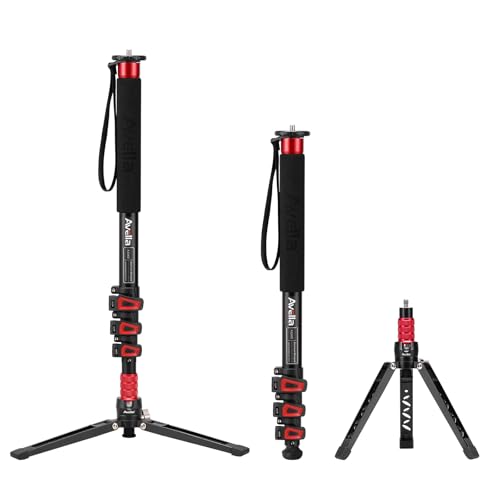
- 13.2 lb capacity in a 2.4 lb aluminum design
- Three configurations with removable tripod stand
- Reversible 1/4-inch and 3/8-inch mounting screw
Best For: Travel and outdoor shooters wanting flexible support configurations
Best High-Capacity Carbon Fiber

- 15 kg leg capacity and 5 kg ball-head capacity
- One-touch height adjustment for quick operation
- Carbon fiber folds to 68 cm and reaches 166.5 cm
Best For: Heavy camera rigs within the 5 kg head limit
Best for Easy Setup

- 17.6-pound vertical payload
- Three-use detachable-base design
- Pivoting feet and quick-release plate
Best For: Traveling photographers and videographers needing versatile support
Best Budget Pick
NEEWER T222 Extendable Monopod
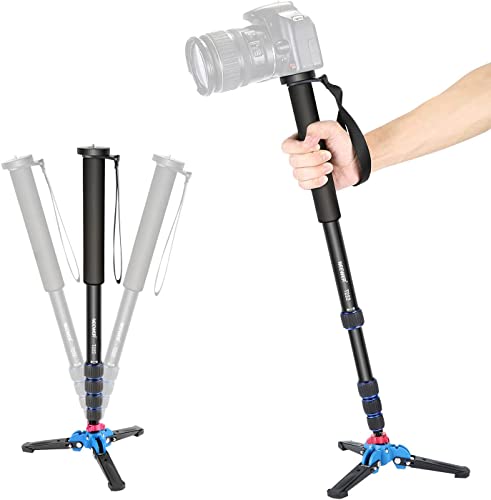
- 11-pound maximum load
- 66-inch height with five-section adjustment
- Lightweight detachable three-leg base
Best For: Moderate camera setups and value-focused buyers
Highest Load Capacity

- 44-pound maximum load
- Carbon-fiber construction with one-click adjustment
- Dual screw mount and detachable steel feet
Best For: Heavy professional rigs, scopes, and telescopes
Best Lightweight Pick

- Weighs only 9.44 ounces
- Supports up to 5 pounds
- Collapses to 16.75 inches
Best For: Traveling DSLR and mirrorless photographers
Best Carbon-Fiber Video Pick
COMAN M1ProV5 Carbon-Fiber Monopod

- Supports up to 22 pounds
- Includes a hydraulic fluid head
- One-click height adjustment
Best For: Heavy video rigs and wildlife shooting
Best Versatile Aluminum Pick
COMAN KX3232Q6 Fluid-Head Monopod

- Supports up to 22 pounds
- Works in three support modes
- Extends to 73.2 inches
Best For: Video creators needing flexible support configurations
Best Overall – NEEWER TP71 Carbon Fiber Video Monopod
For camera monopods for heavy cameras, the NEEWER TP71 combines a 6 kg load capacity with a removable, adjustable tripod base and a fluid video head. Its 182 cm maximum height, gimbal-friendly quick release, and carbon-fiber construction make it a versatile option for photography and video work.
Best For: Hybrid shooters who need a tall monopod with fluid movement, stable feet, and DJI RS or Manfrotto 501PL compatibility.
Pros:
- Supports up to 6 kg while remaining suited to on-location production.
- Adjustable base supports 360° rotation, 45° tilt, and landscape-to-portrait positioning.
- Fluid head offers 360° swivel, -70°/+90° tilt, and damping control.
- Quick-release system works with DJI RS2, RS3, RS3 Pro, and 501PL systems.
Cons:
- Its 72 cm folded length is less compact than shorter monopods.
- The feature-rich fluid-head design may be more than still photographers need.
The TP71 is a strong all-around pick when heavy-camera support, controlled video movement, and fast switching between support setups matter more than minimum packed size.
Best Fluid-Head Value – Cayer FP34 Video Monopod
The Cayer FP34 is a practical choice among camera monopods for heavy cameras, pairing a 13.2 lb capacity with a fluid head and folding three-legged base. Its aluminum construction, 71.2-inch height, and quick-operation flip locks suit sports, events, and travel shoots.
Best For: Videographers who want fluid panning, a supportive foot base, and a compact aluminum kit for fast-moving shoots.
Pros:
- Fluid head supports up to 13.2 lb with 360° panning and +90°/-50° tilt.
- Pivoting foot provides 360° swivel, 45° tilt, and a 90° drop notch.
- Removable feet can be used as a small tabletop tripod.
- Accepts the included QR plate or compatible RS2, RS3, and RS3 Pro plates.
Cons:
- At 4.2 lb, it is heavier than the carbon-fiber alternatives listed here.
- The maximum height is slightly shorter than the NEEWER TP71.
Choose the FP34 when a fluid video head and fast setup are priorities. It offers substantial capacity and useful base movement, though its aluminum build adds carrying weight.
Best Configurable Aluminum Pick – Avella A324D Camera Monopod
The Avella A324D gives shoppers considering camera monopods for heavy cameras several ways to work: use it with adjustable feet, as a portable monopod, or as a low-angle camera pod. Its 13.2 lb capacity, reversible mounting screw, and aluminum build support a broad range of DSLR and video-camera setups.
Best For: Outdoor photographers and videographers who want a flexible, travel-friendly monopod with multiple configurations.
Pros:
- Supports up to 13.2 lb despite weighing 2.4 lb.
- Removable tripod stand enables three shooting configurations.
- Pivoting base swivels 360° and tilts 90° for orientation changes.
- Reversible 1/4-inch to 3/8-inch screw fits many DSLR and camcorder setups.
Cons:
- Its 66.92-inch maximum height is shorter than several competing models.
- Aluminum construction is less weight-efficient than carbon fiber.
The A324D is a sensible value-oriented option for users who want heavy-camera capacity without committing to a dedicated fluid-head system. Its detachable base makes it particularly adaptable for outdoor work.
Best High-Capacity Carbon Fiber – SmallRig Ball Head Monopod
The SmallRig ball head monopod stands out among camera monopods for heavy cameras with legs rated to 15 kg and a head rated to 5 kg. Its carbon-fiber four-section leg, one-touch height adjustment, and 68 cm packed length offer a useful balance of capacity, portability, and fast operation.
Best For: Photographers and video creators carrying substantial camera rigs who need quick one-handed height adjustment and a compact carbon-fiber support.
Pros:
- Legs support up to 15 kg, while the ball head supports up to 5 kg.
- One-touch mechanism locks the monopod at any position.
- Carbon-fiber design reaches 166.5 cm and folds to 68 cm.
- Built-in bubble level and accessory thread support precise, expandable setups.
Cons:
- The ball head’s 5 kg limit is lower than the leg capacity.
- It does not include the adjustable tripod-foot system described for some competing models.
The SmallRig is compelling for heavy rigs that remain within the 5 kg head limit. Its one-touch adjustment and accessory-mount options favor fast, controlled setup, while the carbon-fiber build keeps the package manageable.
Best for Easy Setup – IFOOTAGE Cobra 3 A180T
For camera monopods for heavy cameras, the IFOOTAGE Cobra 3 A180T combines a sturdy aluminum build with a 17.6-pound vertical payload. Its adjustable feet, quick-release plate, and pivoting base make it a flexible choice for travel, video, and changing shooting angles.
Best For: Photographers and videographers who want a versatile, travel-friendly monopod with stable feet.
Pros:
- Supports up to 17.6 pounds while weighing about 2.7 pounds.
- Three-use design works as a fixed monopod, trekking pole, or low-angle tripod.
- Pivoting base allows 90-degree tilting and 360-degree swiveling.
- Includes a quick-release plate with 1/4-inch and 3/8-inch screws.
Cons:
- The listed payload applies to vertical use.
- Phone and GoPro adapters are not included.
- It is not water resistant.
The Cobra 3 is a strong all-purpose option when you need substantial camera support without carrying a full tripod. Its compact folded size and detachable base add useful flexibility for travel and location work.
Best Budget Pick – NEEWER T222 Extendable Monopod
The NEEWER T222 is a practical entry-level choice among camera monopods for heavy cameras, supporting up to 11 pounds with its aluminum-alloy construction. Its detachable three-leg base, five-section adjustment system, and compact folded length suit everyday shooting.
Best For: Budget-conscious photographers using moderately heavy DSLR or mirrorless camera setups.
Pros:
- Supports up to 11 pounds for optimal performance.
- Extends to 66 inches and folds to 20.5 inches.
- Detachable tripod base provides additional support and 15-degree tilt.
- Lightweight design weighs about 1.3 pounds.
Cons:
- The manufacturer notes that the monopod should be held when a camera is mounted.
- It has a lower load rating than the other options in this roundup.
- The 1/4-inch mounting plate may require a different setup for some accessories.
The T222 offers useful height adjustment and a supportive base at a relatively low carrying weight. It is best treated as assisted support rather than a hands-free stand for heavier camera rigs.
Highest Load Capacity – COMAN M1 Carbon Fiber Monopod
The COMAN M1 stands out among camera monopods for heavy cameras with a stated 44-pound load capacity. Its carbon-fiber construction, one-click height adjustment, detachable steel support feet, and dual screw options are designed for demanding camera, scope, and telescope setups.
Best For: Professional users carrying heavy camera rigs, camcorders, birding scopes, or telescopes.
Pros:
- High 44-pound maximum load rating.
- 3K carbon fiber keeps the monopod relatively light at about 3.16 pounds.
- One-click adjustment extends it to 62.8 inches.
- Top supports both 1/4-inch and 3/8-inch screws, with three accessory ports.
Cons:
- No head is included, so a compatible head may be needed.
- Its listed minimum height is 28 inches, limiting very low setups.
- The supplied details list the item weight inconsistently, so buyers should verify the current specification.
The M1 is the clear choice when payload capacity takes priority. Its compact folded length and carbon-fiber build make that capacity more manageable for travel, while the detachable base adds stability on location.
Best Lightweight Pick – Altura Photo 62-Inch Monopod
For photographers seeking camera monopods for heavy cameras without adding much carrying weight, the Altura Photo offers a compact aluminum design with a 5-pound capacity. It reaches 62 inches, collapses to 16.75 inches, and includes a carry pouch for travel.
Best For: DSLR and mirrorless users who prioritize portability for hikes, travel, and everyday photography.
Pros:
- Weighs just 9.44 ounces and collapses to 16.75 inches.
- Supports cameras and accessories weighing up to 5 pounds.
- Includes a soft foam grip, safety wrist strap, rubber foot, and retractable spike.
- Works with a universal 1/4-inch thread and includes a 3/8-inch adapter.
Cons:
- Its 5-pound capacity is lower than the other options in this roundup.
- It does not include a fluid head or tripod-style base.
The Altura is best viewed as a lightweight support stick rather than a full video monopod. It is a practical choice when packability matters more than maximum load capacity or advanced camera movement.
Best Carbon-Fiber Video Pick – COMAN M1ProV5 Carbon-Fiber Monopod
The COMAN M1ProV5 is a strong contender among camera monopods for heavy cameras, combining a 22-pound load rating with a carbon-fiber leg and integrated fluid head. Its one-click lifting system, support feet, and dual quick-release modules are designed for fast-paced video and wildlife work.
Best For: Videographers and wildlife shooters who need high capacity, fluid camera movement, and quick transitions between support modes.
Pros:
- Supports up to 22 pounds with a B-2 carbon-fiber tube.
- V5 hydraulic fluid head provides 360-degree panning and ±90-degree tilt.
- One-click height adjustment speeds setup and retraction.
- Includes support feet, a quick-release plate, and compatibility with DJI RS2/RS3/RS4 and Manfrotto 501 systems.
Cons:
- At 2.5 kg, it is substantially heavier than a basic travel monopod.
- Its folded length is about 30 inches, so it needs more storage space.
- It is not water resistant according to the supplied specifications.
The M1ProV5 offers the most specialized feature set here for demanding video setups. Its high capacity and fluid head suit heavier rigs, while the one-click mechanism helps when shooting conditions require frequent repositioning.
Best Versatile Aluminum Pick – COMAN KX3232Q6 Fluid-Head Monopod
For buyers comparing camera monopods for heavy cameras, the COMAN KX3232Q6 adds a 22-pound capacity to a flexible aluminum platform. Its removable tripod base, Q6 fluid head, and three usage modes make it useful for video, low-angle work, and stable stationary shots.
Best For: Video creators who want one support system for monopod, stand, and low-angle tripod configurations.
Pros:
- Supports up to 22 pounds while extending to 73.2 inches.
- Q6 fluid head supports 360-degree rotation and +90/-60-degree tilt.
- Offers fixed monopod, portable stand, and low-angle tripod modes.
- Quick-release plate and built-in hex keys simplify installation.
Cons:
- Its 3.9-pound weight is higher than lightweight travel monopods.
- The folded length is 26 inches, which may be less convenient for compact bags.
- It is not water resistant according to the supplied specifications.
The KX3232Q6 is a versatile choice when flexibility matters as much as load capacity. Its aluminum construction and removable base make it especially appealing for creators who switch between mobile support and low-angle or tabletop setups.
How We Picked the Best Camera Monopods for Heavy Cameras
We evaluated these monopods by looking at the features that matter most when supporting substantial camera and lens combinations. Key considerations included stated load capacity, carbon-fiber versus aluminum construction, maximum height, folded size, section count, locking mechanisms, and the stability provided by feet or detachable bases.
We also considered how each design suits real shooting situations. A monopod for fast-moving sports needs quick height adjustment, while wildlife photographers may prioritize low weight and rigidity. Video users can benefit from fluid heads, removable feet, and smoother movement controls.
Quick Comparison
| Feature | What to look for | Why it matters |
|---|---|---|
| Material | Carbon fiber or aluminum | Carbon fiber usually reduces weight; aluminum often costs less. |
| Support base | Feet, folding base, or removable stand | Adds balance and can improve hands-free stability. |
| Load rating | A rating above your total camera setup | Provides a safer margin for heavy lenses and accessories. |
| Head design | Ball head, fluid head, or standard mount | Determines how easily you can tilt, pan, and reframe. |
| Height and folded length | Comfortable working height and travel-friendly storage | Helps match the monopod to your height and transport needs. |
Key Buying Factors for Camera Monopods for Heavy Cameras
Load Capacity and Rigidity
Check the combined weight of your camera, lens, battery grip, flash, and other accessories. Choose a model with a comfortably higher capacity rather than relying on the maximum rating at the limit. A rigid monopod also helps reduce vibration and unwanted flex.
Feet and Base Stability
Integrated or detachable feet can make a major difference when you need the monopod to stand briefly on its own. They do not replace a tripod, and you should not leave an expensive setup unattended unless the manufacturer explicitly supports that use. Folding bases are particularly useful for video and event work.
Material, Locks, and Portability
Carbon fiber is often preferable for long hikes or all-day assignments because it keeps weight down. Aluminum models can offer strong performance at a lower price, though they may be heavier. Twist locks are compact, while lever locks can be faster to operate and easier to check visually.
Head Compatibility and Movement
Verify the mounting thread and quick-release system before buying. Photographers may prefer a ball head for flexible composition, while video shooters should consider a fluid head or a base designed for controlled pans and tilts.
Who Should Buy Which Camera Monopods for Heavy Cameras?
Choose a carbon-fiber model if you travel frequently, hike to shooting locations, or need to minimize fatigue. Choose aluminum if value and rugged everyday use matter more than the lowest possible weight.
Choose a model with feet or a folding base for sports, events, and video work where extra support and quick repositioning are useful. Choose a compact travel design if the monopod must fit in carry-on luggage or a small camera bag.
For the heaviest professional setups, prioritize a high stated capacity, thick lower sections, secure locks, and a stable base over maximum height alone. Whichever option you select, keep one hand on the camera whenever the monopod is standing and confirm that every lock is fully engaged before shooting.