Choosing among conductivity meters is easier when you match the instrument’s range, accuracy, and features to the water or solution you test. The right meter can simplify routine checks for dissolved ions, salinity, TDS, and temperature.
This roundup covers pocket testers, multiparameter instruments, benchtop meters, and classroom-friendly options, including models for quick field readings and more demanding laboratory workflows.
Best 10 Conductivity Meters Picks for 2026
Best Value Pocket Tester
Apera EC20 Conductivity Tester

- 0–20 mS/cm range with ±1% F.S. accuracy
- Auto calibration and temperature compensation
- Includes solutions, batteries, lanyard, and case
Best For: Routine portable conductivity testing
Most Versatile Professional Meter
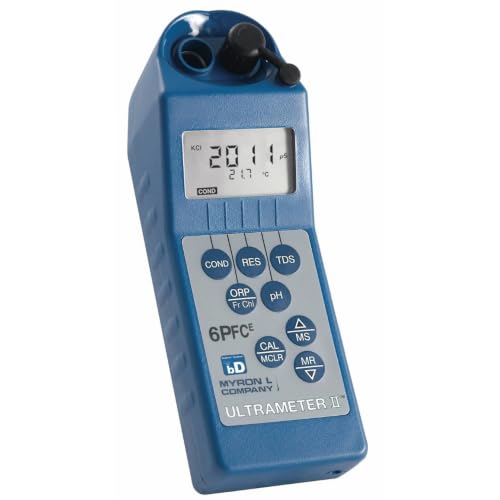
- Measures seven water-quality parameters
- Four-electrode conductivity technology
- Over 100 hours or 5,000 tests per battery life
Best For: Professional multiparameter water-quality monitoring
Best Multiparameter Pocket Kit

- Measures pH, EC, TDS, salinity, and temperature
- Replaceable multiparameter probe
- Includes calibration and storage accessories
Best For: Portable all-in-one water-quality testing
Best for Trend Tracking

- Five measurements with one electrode
- Nine selectable units of measure
- Stores 25 labeled readings with trend bargraph
Best For: Portable multiparameter checks and trend monitoring
Everyday EC Testing

- Measures EC and TDS with four selectable scales
- Automatic temperature compensation and 1 ppm resolution
- Water-resistant design with data hold and auto-off
Best For: Nutrient testing and routine water checks
Field-Ready Versatility
Extech EC210 Conductivity Meter

- Measures conductivity, TDS, and temperature
- Three ranges reach 100 mS/cm and 66,000 ppm
- Adjustable compensation with Min/Max and data hold
Best For: Portable testing across varied water samples
Benchtop Precision

- 0–200.0 mS/cm conductivity range with temperature measurement
- 1–4 point automatic calibration and self-diagnosis
- Stores 50 data groups and includes an electrode holder
Best For: Dedicated benchtop testing and repeat measurements
Best Classroom Conductivity Meter
United Scientific Electric Conductivity Tester

- Ten-level green LED display
- Dual probes test solids and liquids
- Battery and instructions included
Best For: Classroom demonstrations and basic lab testing
Best Portable Conductivity Meter

- Measures EC, TDS, salinity, and temperature
- Auto calibration and temperature compensation
- IP67 waterproof with replaceable probe
Best For: Portable water-quality and multiparameter testing
Best Multiparameter Conductivity Meter
Myron L 6PIIFCE Water-Testing Meter

- Measures conductivity, resistivity, and TDS
- Also tests pH, ORP/free chlorine, and temperature
- Includes autoranging and date-time stamping
Best For: Broad water-quality testing and recordkeeping
Best Value Pocket Tester – Apera EC20 Conductivity Tester
For straightforward conductivity measurements, the Apera EC20 is a practical choice among conductivity meters. Its BPB probe, automatic calibration, temperature compensation, and included carrying kit make it well suited to routine testing at home, in the field, or in other indoor applications.
Best For: Buyers who want a dedicated, portable conductivity tester with an included calibration kit.
Pros:
- Measures across a 0 to 20 mS/cm range with ±1% F.S. accuracy.
- Automatic calibration with buffer recognition and automatic temperature compensation.
- Includes calibration solutions, batteries, lanyard, and portable case.
- Offers up to 1,000 hours of continuous operation on AAA batteries.
Cons:
- It is designed primarily for conductivity rather than multiparameter testing.
- The listed response time is 8 seconds.
The EC20 emphasizes simple operation and long battery life in a compact waterproof design. Choose it when conductivity is your main measurement; users who also need pH, salinity, or TDS may prefer a multiparameter model.
Most Versatile Professional Meter – Myron L Ultrameter II 6PIIFCE
The Myron L Ultrameter II is a comprehensive option among conductivity meters for users who need more than a single water-quality reading. It combines four-electrode conductivity technology with seven measurement parameters and controls intended for quick, one-handed operation.
Best For: Water treatment, industrial, laboratory, and field users who need multiple water-quality measurements in one handheld device.
Pros:
- Measures pH, ORP, conductivity, TDS, resistivity, FCE, and temperature.
- Uses advanced four-electrode conductivity technology and microprocessor-controlled performance.
- Provides automatic temperature compensation and automatic range selection.
- Battery life is rated for more than 100 hours or 5,000 tests.
Cons:
- Its broader feature set and 1.43-pound weight may be more than casual users need.
- The supplied notes do not list included calibration accessories or a carrying case.
This is the strongest fit for demanding users who want one instrument to cover several water-quality parameters. Its adjustability and memory retention add convenience for repeated professional measurements, though a simpler pocket tester may be easier for occasional conductivity checks.
Best Multiparameter Pocket Kit – Apera PC60 5-in-1 Tester
The Apera PC60 is a convenient pick among conductivity meters when conductivity is only one part of the job. This waterproof pocket tester also measures pH, TDS, salinity, and temperature, while its replaceable probe and color-backlit display support repeat testing.
Best For: Users who want portable conductivity testing alongside pH, TDS, salinity, and temperature measurements.
Pros:
- Measures pH, conductivity, TDS, salinity, and temperature.
- Uses a replaceable multiparameter probe with easy installation.
- Offers a large display with three backlight colors and dual measurement display.
- Includes calibration solutions, bottles, storage solution, batteries, lanyard, and case.
Cons:
- Its broad measurement range may be unnecessary if you only need conductivity.
- The supplied notes do not specify a conductivity accuracy rating.
The PC60 balances portability with a useful set of water-quality functions and a complete starting kit. It is especially appealing for buyers who want one pocket instrument rather than separate pH and conductivity meters.
Best for Trend Tracking – Extech EC500 ExStik II
The Extech EC500 is a compact option among conductivity meters for users who also want pH and other water-quality readings. Its single electrode measures five parameters, while the analog bargraph and labeled memory readings make it useful for observing changes over time.
Best For: Portable testing where conductivity, pH, TDS, salinity, temperature, and basic reading storage are all useful.
Pros:
- Measures conductivity, TDS, salinity, pH, and temperature with one electrode.
- Supports nine units of measure, including µS/cm, mS/cm, ppm, and ppt.
- Analog bargraph helps indicate measurement trends.
- Stores up to 25 labeled readings.
Cons:
- Memory capacity is limited to 25 readings.
- The supplied notes do not list included calibration solutions or a carrying case.
- Its one-year warranty is shorter than the two-year instrument warranties noted for the Apera models.
The EC500 stands out for readable trend indication and basic data storage in a small waterproof body. It is a sensible choice for routine multiparameter checks, especially when multiple display units are helpful.
Everyday EC Testing – HM Digital COM-80 HydroTester
The HM Digital COM-80 is a practical choice for conductivity meters shoppers who need quick EC and TDS readings for water or nutrient testing. It measures across four selectable scales, offers 1 µS/ppm resolution, and includes automatic temperature compensation for more consistent results.
Best For: Nutrient testing and routine water checks where a compact, water-resistant handheld meter is useful.
Pros:
- Measures both electrical conductivity and total dissolved solids.
- Supports EC in µS and mS plus TDS in ppm and ppt.
- Includes automatic temperature compensation and a 0.5-second response time.
- Provides auto-off, data hold, and a low-battery indicator.
Cons:
- Its 0–5000 ppm TDS range may be limiting for some higher-concentration applications.
- Uses three LR44 batteries.
The COM-80 keeps operation simple while covering the core EC and TDS measurements most users need. Its compact design and water resistance make it a convenient handheld option for regular checks.
Field-Ready Versatility – Extech EC210 Conductivity Meter
The Extech EC210 is a versatile option among conductivity meters, combining conductivity, TDS, and temperature measurement in a compact handheld format. Its three conductivity and three TDS ranges, adjustable temperature compensation, and included soft case support varied water-testing tasks.
Best For: Portable field testing when adjustable compensation and broad measurement ranges are important.
Pros:
- Measures conductivity, TDS, and temperature.
- Offers conductivity ranges up to 100 mS/cm and TDS ranges up to 66,000 ppm.
- Allows temperature compensation adjustment from 0–5% per °C.
- Includes Min/Max, data hold, a 1-meter cable, 9V battery, and soft case.
Cons:
- Requires a 9V battery rather than smaller button cells.
- Its carbon electrode is connected by a cable, which may be less convenient for users who prefer an integrated probe.
With adjustable settings and higher measurement ranges than many basic handheld meters, the EC210 is suited to varied samples. The cable-mounted cell and carrying case also make it practical for testing away from a bench.
Benchtop Precision – Apera EC700 Benchtop Meter
The Apera Instruments EC700 is a benchtop choice for conductivity meters buyers who want a wider measurement range and guided calibration. It measures conductivity and temperature simultaneously, reaches 200.0 mS/cm, and stores up to 50 groups of data.
Best For: Benchtop conductivity and temperature testing where calibration guidance, data storage, and a stable setup matter.
Pros:
- Measures conductivity across a 0–200.0 mS/cm range along with temperature.
- Includes 1–4 point automatic calibration with a calibration guide and self-diagnosis.
- Uses advanced digital processing for quick, stable readings.
- Features a detachable electrode holder, calibration solutions, and IP54 spill- and dust-proof protection.
Cons:
- At 2.2 pounds, it is less portable than compact handheld meters.
- Its benchtop form is better suited to a dedicated workspace than on-the-go testing.
The EC700 is the most workspace-oriented option in this group, emphasizing calibration support, stability, and record keeping. Its broad range and included holder make it a strong fit for repeat testing at a bench.
Best Classroom Conductivity Meter – United Scientific Electric Conductivity Tester
If you need a straightforward conductivity meter for demonstrations or basic lab checks, this United Scientific tester emphasizes quick, qualitative results rather than numerical readings. Its ten-level green LED display provides an immediate visual indication when testing liquids, salts, acids, reagents, or conductive solids.
Best For: Classrooms, introductory chemistry experiments, and labs needing a compact tester that works with both solids and liquids.
Pros:
- Ten-level LED display makes conductivity differences easy to see.
- Dual brass probes can test immersed liquids and solids.
- Includes a 12V battery and operating instructions for out-of-box use.
- Compact 14 cm design fits conveniently in a lab drawer or field kit.
Cons:
- Provides qualitative LED readings rather than a detailed numerical measurement.
- Its listed measurement type is ohmmeter, so it may be less suitable for advanced conductivity documentation.
This is a practical pick when simplicity and immediate visual feedback matter most. It is especially well suited to teaching environments, while users needing EC, TDS, salinity, or temperature data should consider a more advanced meter.
Best Portable Conductivity Meter – Apera EC60 Pocket Tester Kit
The Apera EC60 is a versatile conductivity meter for users who want portable testing with automatic calibration and temperature compensation. It measures conductivity, TDS, salinity, and temperature, while its replaceable platinum black probe and IP67 waterproof housing support repeated field or laboratory use.
Best For: Water-quality checks, fieldwork, and users who need EC, TDS, salinity, and temperature readings in one handheld instrument.
Pros:
- Measures conductivity, TDS, salinity, and temperature with one-tap mode switching.
- Automatic one- to three-point calibration and automatic temperature compensation simplify setup.
- Replaceable probe helps extend the meter’s useful life.
- Complete kit includes calibration solutions, bottles, batteries, lanyard, and carrying case.
Cons:
- The advanced features and calibration process may be more than casual users need.
- Operation depends on four AAA batteries.
With ±1% F.S. accuracy, a backlit dual-display screen, stable-reading indication, and IP67 waterproofing, the EC60 is the most broadly capable option here. Its replaceable probe and included accessories make it a strong choice for regular testing.
Best Multiparameter Conductivity Meter – Myron L 6PIIFCE Water-Testing Meter
Myron L 6PIIFCE Conductivity, Resistivity, TDS, pH, ORP/Free Chlorine, Temperature Meter
Check Price On AmazonThe Myron L 6PIIFCE is designed for buyers seeking more than a basic conductivity meter. Along with conductivity, it covers resistivity, TDS, pH, ORP/free chlorine, and temperature, and adds practical functions such as autoranging, adjustable temperature compensation, ratio adjustment, and date-and-time stamping.
Best For: Users who need a broad set of water-testing measurements and recordkeeping features in one handheld meter.
Pros:
- Combines conductivity, resistivity, TDS, pH, ORP/free chlorine, and temperature testing.
- Autoranging simplifies measurement across changing conditions.
- Adjustable temperature compensation supports more flexible testing.
- Date-and-time stamping helps organize measurement records.
Cons:
- The supplied notes do not specify accuracy, measurement ranges, waterproof rating, or included accessories.
- Its broad feature set may be unnecessary for users who only need conductivity readings.
This is the specialist-oriented choice in the group. Choose it when multiple water-quality parameters and timestamped results are more important than a simple, single-purpose conductivity check.
How We Picked These Conductivity Meters
We selected instruments across several common use cases rather than treating every meter as interchangeable. The lineup includes compact EC and TDS testers for quick checks, multiparameter meters for broader water-quality measurements, and benchtop equipment for repeatable laboratory or process testing. We also considered stated accuracy, measurement range, temperature compensation, calibration options, waterproofing, display usability, and whether the meter is designed for field or stationary use.
Before buying, verify the manufacturer’s specifications for the exact model and confirm that its included probe, calibration solution, and accessories fit your workflow.
Quick Comparison
| Best For | Look For | Typical Format |
|---|---|---|
| Fast field checks | Waterproof housing, automatic temperature compensation, replaceable probe | Pocket tester |
| Hydroponics and aquariums | EC, TDS, salinity, and temperature readings | Multiparameter pocket meter |
| Laboratory or process work | Wider range, multiple calibration points, stable benchtop design | Benchtop meter |
| Basic classroom testing | Simple controls, readable display, low operating complexity | Entry-level tester |
Key Buying Factors for Conductivity Meters
Range and Resolution
Choose a range that covers your expected sample concentrations without forcing the meter to operate at its limits. Low-conductivity water may require greater sensitivity, while nutrient solutions, brines, and industrial samples benefit from a higher maximum range. Resolution tells you how finely readings are displayed, but it should not be confused with overall accuracy.
Accuracy and Calibration
For routine monitoring, a stated accuracy around 1% can be suitable, while regulated or process-critical work may require tighter control and documented calibration. Automatic calibration can save time, but you still need the correct standard solutions and a consistent cleaning procedure. Follow the manufacturer’s schedule and recalibrate when readings drift.
Temperature Compensation and Probe Design
Conductivity changes with temperature, so automatic temperature compensation is valuable when samples are not tested at a controlled temperature. Check whether compensation is fixed or adjustable for your application. Probe durability, replaceability, cable length, and ease of rinsing also affect long-term ownership.
Extra Measurements and Durability
A dedicated EC meter may be simpler and faster, while a multiparameter model can replace several instruments. TDS, salinity, pH, ORP, and temperature functions are useful only if you will use them. For field work, prioritize waterproofing, battery life, readable controls, and a protective case.
Who Should Buy Which Conductivity Meters?
Buy a compact pocket tester if you need quick readings in gardens, tanks, hydroponic systems, or the field. Choose a multiparameter pocket meter when one device must track EC alongside TDS, salinity, pH, or temperature. A benchtop model is the better choice for laboratories, educational facilities, and quality-control stations where stability, range, and repeatable calibration matter more than portability. For occasional demonstrations or basic instruction, a straightforward classroom or entry-level meter can provide the essential reading without unnecessary complexity.