The best portable anemometers make it easy to measure wind speed and airflow without carrying bulky equipment. The 10 models in this roundup cover simple handheld meters, Bluetooth-connected options, HVAC-focused tools, and units with temperature or airflow calculations.
Use this guide to compare measurement range, display design, portability, app support, and professional features so you can choose an anemometer suited to your work or outdoor activity.
Best 10 Portable Anemometers Picks for 2026
Best All-Around Pick
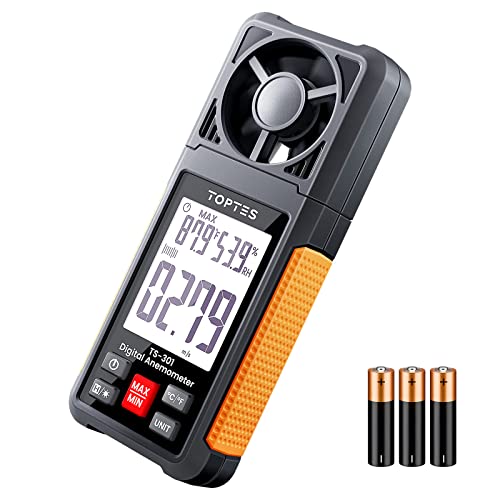
- Large 2.26-inch backlit display
- Six wind-speed measurement units
- Temperature and humidity readings
Best For: Outdoor use and basic HVAC checks
Best Connected Option

- Bluetooth app data logging
- Export readings to Excel or TXT
- Tripod mount for continuous testing
Best For: Recorded HVAC and outdoor measurements
Best Ultra-Light Pick

- Only 53 grams with battery and lanyard
- Measures 0.1–30 m/s
- One-hand controls with MAX and AVG modes
Best For: Pocket carry and outdoor field readings
Best for HVAC Checks

- Sensitive eight-blade impeller
- MAX, MIN, and AVG readings
- Tripod-ready with carrying case
Best For: Vent, grille, and exhaust airflow comparisons
Best Smart HVAC Pick
testo 405i Wireless Anemometer

- Measures velocity, temperature, and in-duct airflow
- 15-inch telescopic shaft reaches confined spaces
- Bluetooth app supports graphs and custom reports
Best For: Professional HVAC inspections and duct measurements
Best Value 3-in-1
Mcbazel Handheld Digital Anemometer

- Measures wind speed, temperature, and Beaufort level
- Offers five wind-speed unit options
- Backlit display includes MAX, MIN, AVG, and hold
Best For: General HVAC, sailing, fishing, and outdoor readings
Best Ultra-Compact Option
BTMETER BT-816B Wind Speed Meter

- Weighs just 53 grams for easy portability
- Adds temperature and real-time wind-chill readings
- Backlit LCD includes current, max, and average modes
Best For: Outdoor activities and quick HVAC or wind checks
Versatile 3-in-1 Pick

- Measures wind speed, temperature, and wind level
- 0.06–30.0 m/s range with five speed units
- Backlit double-line display with data hold
Best For: HVAC, ventilation, and outdoor wind checks
Compact Airflow Monitor

- 0–100 mph wind-speed range
- Measures temperature and wind chill
- Includes 9V battery and backlit LCD
Best For: HVAC ducts and portable outdoor measurements
Mountable HVAC Specialist

- Measures speed, temperature, and wind chill
- Tripod thread enables hands-free readings
- Includes case, neck strap, and AAA batteries
Best For: HVAC, duct airflow, and continuous measurements
Best All-Around Pick – TopTes TS-301
The TopTes TS-301 is a practical choice for shoppers comparing portable anemometers for outdoor activities and basic airflow checks. Its large backlit display, six wind-speed units, and added temperature and humidity readings make it versatile without being difficult to operate.
Best For: Outdoor enthusiasts, HVAC spot checks, and anyone who wants an easy-to-read handheld meter.
Pros:
- Large 2.26-inch backlit LCD is easy to read.
- Measures wind speed in six units, including mph, knots, and m/s.
- Also measures temperature and relative humidity.
- Includes three AAA batteries, a storage pouch, and a three-year warranty.
Cons:
- Temperature and humidity sensors may need at least 30 minutes to adjust to a new environment.
- Auto shutoff occurs after 10 minutes of inactivity.
Choose this model if display readability and broad everyday functionality matter more than app connectivity. Its 135-gram body and included pouch also make it convenient to carry on hikes, boat trips, or recreational outings.
Best Connected Option – BTMETER BT-100APP
The BTMETER BT-100APP stands out among portable anemometers for buyers who want wireless data logging. Along with wind speed and temperature readings, it connects to an iPhone, iPad, Android phone, or tablet through an app for logging and exporting measurements.
Best For: HVAC technicians, weather tracking, sailing, and users who want recorded measurements or tripod-based testing.
Pros:
- Bluetooth app supports data logging and export to Excel or TXT.
- Measures wind speed in five units and displays temperature, wind chill, and battery power.
- Supports data hold, MAX/MIN/AVG readings, and adjustable power-off settings.
- Built-in 1/4-inch metal mounting hole enables tripod use.
Cons:
- App-based features may be unnecessary for simple spot checks.
- Its listed wind-speed accuracy is ±5% of readings.
This is the strongest fit in the group for documenting airflow or wind conditions over time. The 0.67–67.1 mph range and sensitivity to low airflow also suit duct, vent, and CFM-related checks.
Best Ultra-Light Pick – AP-816B Handheld Anemometer
For shoppers prioritizing portability, this AP-816B is one of the lightest portable anemometers in the roundup. It weighs just 53 grams with its battery and lanyard, yet measures wind from 0.1 m/s up to 30 m/s and includes temperature, wind-chill, MAX, and AVG functions.
Best For: Hiking, sailing, fishing, golf, and field work where minimal weight and one-hand operation are important.
Pros:
- Ultra-light 53-gram design slips easily into a pocket.
- Detects gentle airflow from 0.1 m/s and measures up to about 67 mph.
- One-hand, glove-friendly controls with current, MAX, and AVG modes.
- Five-second backlight and automatic wind-chill display add convenience outdoors.
Cons:
- Uses a CR2032 battery rather than the more commonly available AAA format.
- The backlight remains on for only five seconds after button activation.
This model makes the most sense when carrying comfort is a deciding factor. Its low power consumption, lanyard, and pre-installed battery make it ready for quick readings during outdoor activities or light HVAC checks.
Best for HVAC Checks – HoldPeak 866B
The HoldPeak 866B is a practical choice among portable anemometers for checking vents, grilles, and exhaust fans. Its eight-blade impeller responds to light airflow, while MAX, MIN, and AVG readings help compare changing conditions during HVAC or outdoor measurements.
Best For: Home and professional HVAC airflow checks, vent comparisons, and hands-free tripod measurements.
Pros:
- Measures 0.67–67.1 mph with stated ±5% accuracy.
- Supports mph, m/s, km/h, ft/min, and knots.
- Backlit display, non-slip grips, and wrist strap improve field usability.
- Includes a 1/4-inch tripod mount, carrying case, lanyard, and screwdriver.
Cons:
- Tripod is not included.
- At 200 grams, it is heavier than the ultra-light option in this roundup.
- Its warranty is one year.
Pick the 866B if your main goal is comparing airflow at different HVAC locations or tracking gusts and averages outdoors. The carrying case and mounting option make it well suited to organized job-site use.
Best Smart HVAC Pick – testo 405i Wireless Anemometer
For HVAC professionals who need more than basic wind readings, the testo 405i is one of the most capable portable anemometers in this roundup. Its hot-wire sensor measures air velocity, temperature, and in-duct airflow, while the telescopic shaft and Bluetooth connectivity make difficult inspections easier.
Best For: HVAC inspections, air-conditioning servicing, and readings in ducts, vents, or other confined spaces.
Pros:
- Measures air velocity, temperature, and in-duct airflow, with volume-flow calculations when duct dimensions are entered.
- Extendable hinged shaft reaches up to 15 inches for hard-to-access ducts and vents.
- Bluetooth 4.0 and the Smart Probe App support remote readings, graphs, data storage, and custom reports.
- Compact 0.23 kg design is practical for carrying between service calls.
Cons:
- Smartphone or tablet use is required for the Bluetooth app features.
- Response time is listed as 5 seconds, so it may not be ideal when instant readings are needed.
- Its specialized HVAC features may be more than casual outdoor users need.
The testo 405i stands out when duct access, documentation, and connected measurements matter. It is a strong choice for professional HVAC work, though simpler users may prefer a basic handheld meter.
Best Value 3-in-1 – Mcbazel Handheld Digital Anemometer
The Mcbazel 3-in-1 is a straightforward option for shoppers wanting portable anemometers with useful everyday measurement modes. It displays wind speed, temperature, and Beaufort level, with multiple units and a backlit screen for flexible indoor or outdoor use.
Best For: HVAC checks, sailing, fishing, and general wind monitoring where simple controls and multiple readouts are useful.
Pros:
- Measures wind speed, wind temperature, and Beaufort scale level in one device.
- Supports m/s, km/h, knots, ft/s, and mph speed units.
- MAX, MIN, AVG, and data-hold functions make readings easier to compare.
- Double-line LCD, backlight, low-battery indicator, and auto power-off add convenience.
Cons:
- AAA batteries are required but are not included.
- It does not offer the Bluetooth connectivity or app reporting found on more advanced meters.
- The supplied notes do not specify a measurement accuracy rating.
With its broad unit selection and clear double-line display, the Mcbazel is a practical general-purpose meter. It is best suited to routine readings rather than connected professional reporting.
Best Ultra-Compact Option – BTMETER BT-816B Wind Speed Meter
If pocketability is the priority, the BTMETER BT-816B is among the most convenient portable anemometers here. This 53-gram handheld meter measures wind speed and temperature, adds real-time wind chill, and uses a backlit LCD that is easier to read in low-light conditions.
Best For: Outdoor activities, quick HVAC checks, sailing, climbing, and anyone who wants a small meter with wind-chill data.
Pros:
- Very compact and lightweight at 53 grams, with one-handed operation.
- Measures wind speeds from 0.3 to 30 m/s and includes temperature and wind-chill readings.
- Provides current, maximum, and average modes with several selectable speed units.
- Backlit LCD, low-battery indicator, lanyard, and one-year warranty support convenient use.
Cons:
- Its stated wind-speed accuracy is ±5% of the reading.
- The small display and compact controls may be less convenient for extended professional use.
- Its wind-speed range is narrower than what some specialized measurement tasks may require.
The BT-816B is a sensible grab-and-go choice when size, weight, and wind-chill information matter. It offers useful modes for outdoor and basic equipment checks without the bulk of a larger instrument.
Versatile 3-in-1 Pick – Soonkoda Handheld Anemometer
For shoppers comparing portable anemometers, the Soonkoda stands out as a straightforward 3-in-1 tool that measures wind speed, wind temperature, and wind level. Its 0.06–30.0 m/s range and double-line display make it suitable for outdoor checks and airflow-related work.
Best For: HVAC, ventilation, sailing, surfing, flying, fishing, and general outdoor wind monitoring.
Pros:
- Measures wind speed, temperature, and Beaufort wind level.
- Supports m/s, km/h, knots, ft/s, and mph.
- Includes max, minimum, average, data hold, backlight, and low-battery functions.
- Displays wind speed and temperature simultaneously.
Cons:
- Its stated wind-speed range ends at 30.0 m/s.
- The supplied notes do not specify included batteries or a carrying case.
The Soonkoda is a practical choice when you want several basic readings in one compact handheld instrument, especially if Beaufort-scale information is useful for outdoor activities.
Compact Airflow Monitor – BINTA Digital Anemometer
The BINTA is one of the more compact portable anemometers for users who need airflow, temperature, and wind-chill readings in a pocket-sized format. Its four-blade sensor covers up to 100 mph and is designed for faint airflow checks inside HVAC ducts.
Best For: HVAC inspection, duct airflow checks, drone flying, sailing, golf, hiking, and other portable measurements.
Pros:
- Measures wind speed from 0 to 100 mph with a stated ±3% reading tolerance.
- Displays wind speed, ambient temperature, and wind chill.
- Offers five speed units, max/min/average readings, and data hold.
- Includes a 9V battery and user manual.
Cons:
- Temperature measurement is limited to 0°C–45°C.
- It uses a matched 9V battery rather than the AAA batteries included with some alternatives.
Choose the BINTA if broad speed coverage and airflow sensitivity matter more than advanced mounting options. Its backlit display and flexible power controls also help during indoor or low-light checks.
Mountable HVAC Specialist – BTMETER BT-100 Anemometer
The BTMETER BT-100 is a strong option among portable anemometers for HVAC and ductwork tasks, combining wind speed, wind temperature, wind chill, and a tripod mount. Its included case and batteries make it ready for field use.
Best For: HVAC installation, duct airflow and CFM checks, drone or RC use, shooting, sailing, and other field applications.
Pros:
- Measures wind speed from 0.67 to 67.1 mph with stated ±2% accuracy.
- Includes wind temperature and wind-chill readings across multiple units.
- Metal tripod thread supports hands-free continuous measurements.
- Comes with a carry bag, neck strap, manual, and two AAA batteries.
Cons:
- The listed wind-speed range is narrower than the BINTA’s 0–100 mph range.
- Its temperature range begins at -10°C rather than covering colder conditions.
The BT-100 is especially appealing for users who need repeatable positioning or CFM-related airflow work. The tripod mount, case, and included batteries add practical value for field measurements.
How We Picked These Portable Anemometers
We selected these meters based on the features that matter most in real-world wind and airflow testing: measurement range, stated accuracy, display readability, portability, battery convenience, and useful functions such as maximum or average readings, temperature measurement, CFM calculations, and Bluetooth connectivity.
The lineup includes basic wind-speed meters for recreation and household checks, as well as more specialized tools for HVAC diagnostics. Because specifications and included accessories can vary, verify the manufacturer’s current details before purchasing.
Quick Comparison
| Best For | What to Look For |
|---|---|
| Outdoor sports and casual use | Lightweight design, clear screen, and a broad wind-speed range |
| HVAC and ventilation work | Airflow calculations, temperature readings, and a probe or telescopic shaft |
| Remote monitoring | Bluetooth connectivity, app support, and data-recording features |
| Low-light environments | Backlit display and simple controls |
| Frequent field use | Protective case, replaceable batteries, and durable construction |
Key Buying Factors for Portable Anemometers
Measurement Range and Accuracy
Choose a range that comfortably exceeds the wind speeds you expect to measure. For HVAC testing, accuracy at low airflow can be more important than maximum speed. Check whether the stated accuracy applies across the entire range and whether the meter measures wind speed in the units you prefer.
Airflow, Temperature, and CFM Functions
A basic anemometer reports air velocity, while advanced models may calculate volumetric airflow in CFM or measure temperature. CFM functions are useful for registers, fans, and ducts, but they require accurate entry of the vent or duct area. Temperature readings add convenience but do not replace a dedicated thermometer for demanding work.
Display, Controls, and Portability
A large backlit LCD is easier to read outdoors, in attics, or near mechanical equipment. Compact, lightweight meters are convenient for sailing, flying drones, fishing, and sports. If you will use the meter inside ducts or hard-to-reach vents, consider a model with a probe or extendable shaft.
Connectivity and Power
Bluetooth models can make it easier to record, review, or share readings from a phone, but they add setup requirements and depend on app compatibility. For occasional use, a straightforward battery-powered meter may be faster. Look for auto shutoff, a low-battery indicator, and accessible replacement batteries.
Who Should Buy Which Portable Anemometers?
Choose a simple handheld meter if you mainly need quick wind readings for outdoor activities, drone flying, shooting, or general checks. Choose an HVAC-oriented model if you need CFM calculations, temperature readings, or a probe for registers and ducts. Choose a Bluetooth anemometer if documenting measurements or monitoring readings from a phone is important. Choose the lightest model for travel and sports, and prioritize a backlit screen if you regularly work in changing light.