The best sound level meters for measurement make it easier to identify excessive noise, verify workplace or classroom conditions, and troubleshoot sound problems at home or on the job.
We selected 10 practical options ranging from simple handheld decibel readers to meters with weighting controls, alarms, maximum readings, and data-logging capabilities.
Best 10 Sound Level Meters for Measurement Picks for 2026
Best All-Around Pick

- 30–130 dB range with ±1.5 dB accuracy
- A/C weighting and MAX/MIN tracking
- Backlit display, case, and batteries included
Best For: Everyday home, office, workshop, and factory noise checks
Best Traditional Meter
Extech 407730 Digital Sound Level Meter

- 40–130 dB measurement range
- 0.1 dB resolution with 2 dB accuracy
- Analog bar graph and MAX/MIN functions
Best For: Structured sound checks with visual level trends
Best for Flexible Sound Analysis
Goldeep SL750A Sound Level Meter

- 30–130 dB range with ±1.5 dB accuracy
- FAST/SLOW response and MAX/MIN tracking
- dB and SONE units with A/C weighting
Best For: Environmental, workplace, music, and perceived-loudness checks
Best Budget-Friendly Basic Meter
VLIKE VL6708 Digital Sound Level Meter
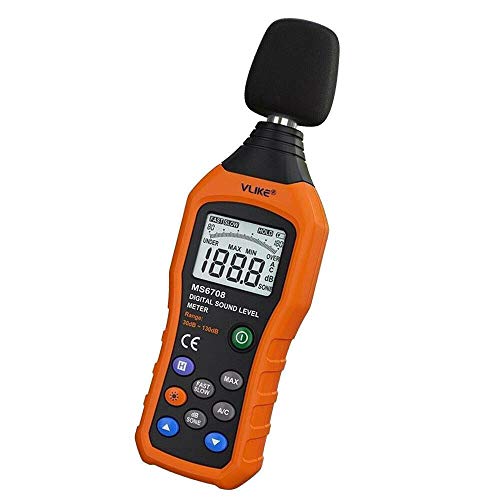
- 30–130 dB range with A/C modes
- Backlit display and MAX locking
- Compact anti-drop casing with auto range
Best For: Simple portable checks around homes, offices, schools, and workplaces
Portable Everyday Pick
Tadeto Digital Sound Level Meter
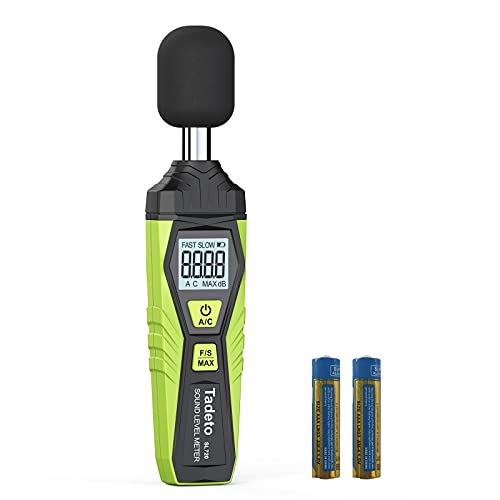
- 30–130 dB range with ±2.0 dB accuracy
- A/C weighting and fast/slow response modes
- Backlit display with 0.1 dB resolution
Best For: Portable environmental and workplace noise checks
Data-Logging Choice
DANOPLUS Rechargeable Decibel Meter

- Stores up to 43,000 readings for PC review
- ±1.5 dB accuracy across 30–130 dB
- Color alarms, A/C weighting, and USB charging
Best For: Extended monitoring and exportable noise records
Large-Display Option
SW-525A Wall-Hanging Sound Level Meter

- 30–130 dB measurement range
- Large red LCD readout
- Automatic, wall-hanging design
Best For: Stationary monitoring with an easy-to-see display
Best Overall
RISEPRO HT-80A Sound Level Meter

- 30–130 dB range with ±1.5 dB accuracy
- FAST response, A-weighting, and MAX/MIN readings
- Backlight, hold function, pouch, and gift box
Best For: General-purpose home, workplace, and environmental noise checks
Best for Continuous Monitoring
Portable Calibrated Decibel Meter

- 30–130 dBA range with ±1.5 dB accuracy
- Disable auto-off for continuous measurements
- Large LCD, alarm, MAX/MIN, and 0.1 dB resolution
Best For: Portable complaints, job-site, and noise-pollution monitoring
Best for Flexible Testing
S8607 Digital Sound Level Meter

- 30–130 dB range with 0.1 dB resolution
- FAST/SLOW modes and A-weighted measurement
- MAX/MIN, hold, backlight, and over/under alerts
Best For: Classroom, home, office, traffic, and workplace measurements
Best All-Around Pick – TopTes TS-501B
For shoppers comparing sound level meters for measurement, the TopTes TS-501B offers a practical combination of readable controls, broad 30–130 dB coverage, and useful peak-value tracking. Its backlit 2.25-inch screen and portable, nonslip design make it convenient for routine checks around the home, office, workshop, or factory.
Best For: Everyday noise monitoring when you want A/C weighting, MAX/MIN readings, and an easy-to-read display.
Pros:
- Measures 30–130 dB with stated ±1.5 dB accuracy and 30–8,000 Hz frequency coverage.
- A- and C-weighting modes support different environmental and higher-intensity sound checks.
- Backlight, data hold, MAX/MIN readings, carry case, and included AAA batteries improve usability.
Cons:
- It uses three AAA batteries rather than a rechargeable power system.
- The supplied notes do not indicate that it can generate measurement reports directly.
The TS-501B is a well-rounded choice for home noise investigations and general sound checks. Factory calibration and the included case add convenience for users who want a ready-to-use handheld meter.
Best Traditional Meter – Extech 407730 Digital Sound Level Meter
The Extech 407730 is a straightforward option among sound level meters for measurement, with a 40–130 dB range, A/C weighting, and a digital readout supported by a fast-responding analog bar graph. Its MAX/MIN and Max Hold functions are useful when sound levels change over time.
Best For: Users who prefer a conventional digital meter with an analog trend display and dependable recording features.
Pros:
- Measures 40–130 dB with 0.1 dB resolution and stated 2 dB accuracy.
- A/C weighting accommodates different sound-measurement situations.
- Analog bar graph, MAX/MIN recording, Max Hold, windscreen, and auto power-off are included.
Cons:
- Its 40 dB minimum is narrower than meters that begin at 30 dB.
- The supplied notes list four AAA batteries but do not specify that they are rechargeable.
The Extech stands out for its bar-graph feedback and fine 0.1 dB display resolution. It is a sensible fit for users who value familiar controls and time-based maximum or minimum observations over extra display features.
Best for Flexible Sound Analysis – Goldeep SL750A Sound Level Meter
For sound level meters for measurement that offer more ways to interpret readings, the Goldeep SL750A combines 30–130 dB testing with A/C weighting, FAST/SLOW response, and dB or SONE units. That mix makes it useful for both environmental checks and situations where perceived loudness matters.
Best For: Buyers who want response-speed controls and SONE readings alongside standard decibel measurements.
Pros:
- Measures 30–130 dB with stated ±1.5 dB accuracy and a 31.5 Hz–8 kHz response.
- FAST and SLOW modes suit changing or relatively steady sound levels.
- Offers dB/SONE units, A/C weighting, MAX/MIN tracking, data hold, and a windbreak ball.
Cons:
- Only two AAA batteries are included, so replacements may be needed sooner.
- The supplied notes do not mention a carry case or factory calibration.
The SL750A is especially versatile for users moving between traffic, workplace, classroom, machinery, music, and audio checks. Its SONE mode and selectable response speeds give it a broader feature set than a basic real-time meter.
Best Budget-Friendly Basic Meter – VLIKE VL6708 Digital Sound Level Meter
The VLIKE VL6708 is a compact choice for shoppers seeking sound level meters for measurement without a complicated interface. It provides real-time 30–130 dB readings, A/C modes, a backlight, and a protective anti-drop casing for general checks around homes, offices, schools, roads, and workplaces.
Best For: Basic portable noise monitoring where a simple display, broad range, and low-power design are priorities.
Pros:
- Provides a 30–130 dB measuring range with selectable A/C modes.
- Backlight supports reading data in darker conditions, with automatic backlight shutoff.
- Compact casing includes an anti-drop design, auto range, MAX locking, and power-saving circuitry.
Cons:
- Batteries are not included, and the meter requires four AAA batteries.
- The device cannot keep or generate a report directly, according to the supplied notes.
- The notes do not provide a stated accuracy figure.
The VL6708 focuses on simple, immediate readings rather than documentation or advanced analysis. It is a practical handheld option for checking whether everyday environments are unusually loud.
Portable Everyday Pick – Tadeto Digital Sound Level Meter
For straightforward sound level meters for measurement, the Tadeto offers a practical mix of portability, readable results, and flexible settings. Its 30–130 dB range, ±2.0 dB accuracy, A/C weighting, and fast or slow response modes suit routine noise checks around homes, offices, factories, vehicles, and construction areas.
Best For: Portable environmental and workplace noise checks where simple real-time readings are the priority.
Pros:
- Measures from 30 to 130 dB with stated ±2.0 dB accuracy.
- A and C weighting support ambient-noise and higher-intensity machine-noise measurements.
- Fast and slow response settings accommodate general readings and changing noise levels.
- Backlit 4-digit LCD offers 0.1 dB resolution and clearer viewing in dark places.
Cons:
- Does not list data logging or PC export features.
- Uses replaceable batteries rather than the rechargeable design listed for some alternatives.
The Tadeto is a sensible choice when you want a lightweight meter for on-the-spot readings. Its weighting and response controls add useful flexibility without making the basic measurement process complicated.
Data-Logging Choice – DANOPLUS Rechargeable Decibel Meter
Among sound level meters for measurement, the DANOPLUS stands out for recording and reviewing readings rather than only displaying them live. It measures 30–130 dB with stated ±1.5 dB accuracy, stores up to 43,000 data points, and connects to a Windows PC for export, analysis, and printing.
Best For: Users who need extended noise monitoring, exported records, or visual alarm feedback.
Pros:
- Stores up to 43,000 readings and supports Excel export through a PC connection.
- Stated ±1.5 dB accuracy across a 30–130 dB measurement range.
- Offers A/C weighting, adjustable fast/slow response, and DC output.
- Three-color alarm indicators provide configurable low, medium, and high noise alerts.
Cons:
- PC connectivity and data-export features are compatible with Windows 7, 10, and 11, not broadly specified for other systems.
- Its added logging, alarm, and analysis functions may be more than needed for occasional spot checks.
This is the strongest fit of the three for documenting noise over time. The rechargeable design, large data capacity, color screen, and computer workflow make it better suited to recurring measurement projects than basic handheld-only meters.
Large-Display Option – SW-525A Wall-Hanging Sound Level Meter
The SW-525A is a simple option for sound level meters for measurement when a large, visible readout matters most. Its 30–130 dB range, red LCD display, automatic operation, and wall-hanging design make it suited to a fixed monitoring location rather than highly portable field work.
Best For: Wall-mounted or stationary noise monitoring where an easy-to-see display is useful.
Pros:
- Measures sound levels across a 30–130 dB range.
- Large red LCD display is designed for visibility.
- Automatic operation supports a straightforward monitoring setup.
Cons:
- Supplied notes do not specify accuracy, frequency weighting, or response-time settings.
- Wall-hanging construction and 0.6 kg weight make it less convenient for portable measurements.
- Supplied information does not mention data logging or PC export.
The SW-525A is best considered a basic display-focused meter. Choose it when you want a fixed, readable indication of sound level and do not need the documented controls or logging functions offered by the other models.
Best Overall – RISEPRO HT-80A Sound Level Meter
For shoppers comparing sound level meters for measurement, the RISEPRO HT-80A is a practical general-purpose option with a 30–130 dB range, ±1.5 dB accuracy, and both MAX/MIN and hold functions. Its backlight and included carrying pouch also make it convenient for checks in different environments.
Best For: Home, workplace, family, industrial, and general environmental noise checks.
Pros:
- Measures 30–130 dB with stated ±1.5 dB accuracy.
- Offers FAST 125 ms response and A-weighted frequency measurement.
- Includes data hold, MAX/MIN readings, backlight, and auto power-off.
- Comes with a black carrying pouch and gift box.
Cons:
- Its frequency range is specified as 31.5 Hz to 4 kHz.
- Uses a plastic housing and is a compact handheld device.
The HT-80A stands out as a balanced choice when you want useful monitoring features without a complicated interface. The included accessories add convenience for routine portable measurements.
Best for Continuous Monitoring – Portable Calibrated Decibel Meter
If you need sound level meters for measurement that can keep recording without an automatic shutdown, this calibrated handheld model is worth considering. It covers 30–130 dBA, displays readings to 0.1 dB, and combines a large LCD with alarm, MAX/MIN, and hold functions.
Best For: Neighbor-noise complaints, job-site checks, and noise-pollution monitoring.
Pros:
- Factory-calibrated with a 30–130 dBA range and ±1.5 dB accuracy.
- 0.1 dB resolution and a large LCD display support easy reading.
- Automatic shutoff can be disabled for continuous measurement.
- Includes AAA batteries, a wind-proof sponge ball, and user manual.
Cons:
- The supplied details conflict on battery quantity: the bullets say three AAA batteries, while the specifications list two required batteries.
- The notes specify A-weighted measurement rather than multiple weighting options.
This model is especially useful when monitoring duration matters. Its compact one-hand design and included wind-proof cover make it a convenient ready-to-use choice for portable noise checks.
Best for Flexible Testing – S8607 Digital Sound Level Meter
The S8607 is a straightforward choice among sound level meters for measurement when you want selectable response speeds and clear status indicators. It measures 30–130 dB with 0.1 dB resolution, supports A-weighting, and records MAX/MIN values for checks in classrooms, homes, streets, and workplaces.
Best For: Classroom, residential, office, traffic, factory, and workshop sound-level checks.
Pros:
- 30–130 dB measuring range with stated ±1.5 dB accuracy.
- FAST and SLOW response modes accommodate different testing situations.
- Provides MAX/MIN measurement, result hold, and over/under indicators.
- Backlight, low-battery indicator, and automatic shutdown improve usability.
Cons:
- Automatic shutdown occurs three minutes after stopping.
- MAX readings use a stated 0.5-second sampling rate and may have up to ±5% maximum error.
The S8607 offers a useful feature set for routine environmental measurements, particularly where FAST/SLOW selection and held readings are helpful. Its display alerts also make readings easier to interpret during basic checks.
How We Picked the Best Sound Level Meters for Measurement
We focused on meters that cover common measurement needs without overlooking usability. The shortlist includes models with useful sound ranges, readable displays, portable designs, and practical controls such as A/C weighting, data hold, maximum or minimum readings, and backlighting. We also considered whether each meter suits occasional checks, repeated monitoring, or more organized recordkeeping.
Because specifications and included accessories can vary, confirm the current product listing before buying. A basic decibel reader may be enough for household troubleshooting, while professional work may call for a better-documented instrument and more advanced logging features.
Quick Comparison
| Best For | Features to Look For | Typical Shortlist Fit |
|---|---|---|
| Home and occasional checks | 30–130 dB range, backlit display, data hold | Basic handheld meters |
| Workshops and job sites | A/C weighting, MAX/MIN readings, clear controls | Portable SPL testers |
| Longer-term monitoring | Data logging, export, rechargeable battery | Data-logger models |
| Wall or fixed placement | Large screen, alarm, visible readings | Wall-hanging or large-display meters |
Key Buying Factors for Sound Level Meters
Measurement Range and Resolution
A 30–130 dB range covers many everyday situations, from quiet rooms to loud machinery and traffic. Check the meter’s resolution and stated accuracy as well as its maximum range. A wider range is useful only if the instrument remains appropriate for the sounds you need to measure.
Weighting Options
A-weighting is commonly used to approximate human hearing and is useful for general noise checks. C-weighting captures more low-frequency sound and can help when evaluating louder audio, machinery, or bass-heavy environments. If your measurements have a specific compliance purpose, verify which weighting standard is required.
Display, Controls, and Power
Backlighting helps in dim rooms, while a large or high-contrast display is valuable when reading measurements from a distance. Data hold and MAX/MIN functions simplify quick checks. Consider battery type, automatic shutoff, charging options, and whether the meter can be operated easily with one hand.
Logging and Documentation
For recurring inspections, a data logger can be more useful than a meter that only shows a live reading. Look for storage capacity, export support, recording intervals, and clear software or file compatibility. These features matter when you need to compare locations or create a record over time.
Who Should Buy Which Sound Level Meters for Measurement?
Choose a straightforward handheld meter if you need to check appliances, rooms, classrooms, neighbors’ noise, or general workplace conditions. Prioritize A/C weighting and MAX/MIN functions for workshop, audio, and machinery checks. Select a data-logging model when measurements must be reviewed later or shared with others. A large-screen or alarm-equipped unit is better for fixed observation in classrooms, offices, production areas, or other spaces where people need to see changing noise levels quickly.
For regulated inspections, legal disputes, or formal occupational-health decisions, treat consumer meters as screening tools unless their accuracy, calibration, and standards compliance meet your required method.