Choosing among benchtop pH meters is easier when you match the instrument to your sample type, accuracy needs, calibration workflow, and documentation requirements. The right meter can improve repeatability while reducing maintenance and measurement errors.
This roundup compares 10 selected models, including general-purpose laboratory meters and specialized options for micro-volume samples, dirty liquids, wastewater, strong acids, and HF-containing solutions.
Best 10 Benchtop Ph Meters Picks for 2026
Routine Lab Pick

- ±0.01 pH accuracy
- 1–3 point auto-recognized calibration
- Temperature compensation and endpoint lock
Best For: Routine lab measurements with guided calibration
Data-Ready Choice
Apera AI521 PH800 Benchtop pH Meter

- 500-group GLP data storage
- USB output for data transfer
- Auto calibration recognizes five standards
Best For: Research and quality-control recordkeeping
Compact Footprint Pick

- Footprint claimed over 40% smaller
- Includes probe stand
- 110/220 VAC operation
Best For: Space-conscious benchtop setups
Simple Storage Pick

- 0.01 pH accuracy
- Built-in measurement storage
- Includes electrode holder
Best For: Simple routine liquid testing with saved readings
Micro-Volume Specialist

- Measures samples as small as 15 microliters
- Automatic calibration with electrode diagnostics
- Includes calibration solutions and dual-electrode holder
Best For: Micro-volume water and biological samples
Custom-Buffer Option

- Supports user-defined non-standard buffers
- Provides pH, mV, and temperature readings
- Features 0.01 pH resolution and a 5.9-inch display
Best For: Specialized lab and industrial calibration workflows
Data-Logging Workhorse

- Includes refillable glass electrode and temperature probe
- Stores 200 data sets with USB output
- Guided TFT display and electrode-slope diagnostics
Best For: General water testing with data logging
Best Overall
LOHAND LH-T710 Benchtop pH Meter

- -2 to 16 pH range with 0.01 resolution
- Stores up to 1,000 measurement records
- Multipoint calibration and BNC compatibility
Best For: Versatile laboratory and water-quality testing
Best for Dirty Samples
Apera PH700-WW Wastewater pH Meter

- Electrode designed for wastewater and slurries
- Self-diagnosis with electrode condition display
- Includes calibration solutions and electrode holder
Best For: Wastewater, suspensions, emulsions, and slurries
Best for Strong Acids
Apera PH700-HF Acid-Solution pH Meter
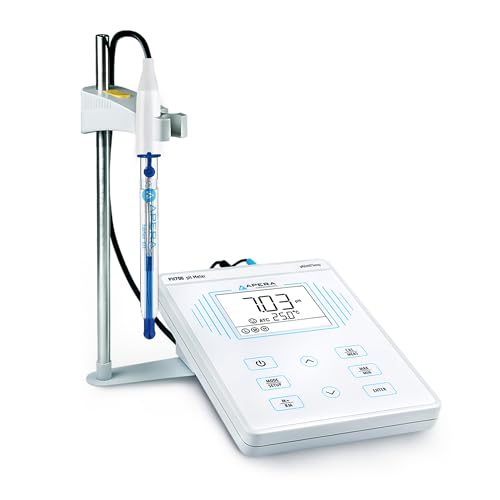
- Specialized electrode for strong acids and HF samples
- Supports 0–2 pH and HF up to 2,000 ppm
- Automatic calibration and electrode diagnostics
Best For: Compatible strong-acid and HF-containing solutions
Routine Lab Pick – Bante 210 Benchtop pH Meter
The Bante 210 is a practical choice among benchtop pH meters for routine laboratory measurements. It combines a backlit display, automatic buffer recognition, temperature compensation, and endpoint locking in a compact 8.2-by-8-by-2.9-inch body.
Best For: Routine lab users who want guided calibration and electrode diagnostics.
Pros:
- Measures with stated ±0.01 pH accuracy.
- Supports one- to three-point calibration with automatic buffer recognition.
- Provides automatic temperature compensation and auto-read endpoint locking.
- Displays electrode slope for basic electrode diagnosis.
Cons:
- Its feature set is focused on routine measurements rather than advanced data management.
- The supplied notes do not specify data storage or USB connectivity.
Choose the Bante 210 if straightforward calibration and measurement stability matter more than extensive recordkeeping features.
Data-Ready Choice – Apera AI521 PH800 Benchtop pH Meter
The Apera AI521 stands out among benchtop pH meters for users who need measurement records as well as accuracy. Its kit includes a pH/temperature combination electrode, GLP data management for 500 groups, USB output, and a large backlit display.
Best For: Scientific research and quality-control workflows that require stored, transferable readings.
Pros:
- Provides stated 0.01 pH accuracy.
- Offers one- to three-point automatic calibration with recognition of five pH standards.
- Stores up to 500 groups of data and supports USB output.
- Displays electrode slope to help monitor electrode health.
Cons:
- At 5.5 pounds, it is heavier than the lighter benchtop option in this roundup.
- The included 201T-F combination electrode is specified for regular water solutions, not every sample type.
The AI521 is the stronger fit when GLP-oriented records and USB data transfer are central to your testing process.
Compact Footprint Pick – Oakton pH 700 Benchtop Meter
Oakton WD-35419-12 Instruments Series pH 700 Benchtop Meter with Probe Stand, 110/220 VAC
Check Price On AmazonThe Oakton WD-35419-12 is a compact option among benchtop pH meters, with a footprint described as more than 40% smaller than other benchtop meters. It includes a probe stand and supports 110/220 VAC operation.
Best For: Benches where conserving workspace is a priority.
Pros:
- Compact footprint is stated to be over 40% smaller than other benchtop meters.
- Includes a probe stand for hands-free positioning.
- Supports both 110 VAC and 220 VAC power.
Cons:
- The supplied notes do not state pH accuracy, calibration features, or data-management functions.
- Listed product dimensions are larger than the stated compact package footprint, so available workspace should be checked carefully.
The Oakton makes the most sense when a probe stand and flexible voltage support are useful, but buyers should confirm performance specifications for their application.
Simple Storage Pick – Digital Lab Benchtop pH Meter
This digital lab meter is a straightforward option among benchtop pH meters, pairing 0.01 pH accuracy with a high-definition LCD, one-key operation, data storage, and an included electrode holder. Its electrode is specified for solution temperatures from 5 to 60°C.
Best For: Routine liquid testing when simple controls and saved readings are useful.
Pros:
- Offers stated 0.01 pH accuracy.
- Stores readings through a dedicated store/extract button.
- Displays multiple values on a clear, non-reflective LCD.
- Includes an electrode holder for hands-free testing.
Cons:
- The electrode’s stated temperature range is limited to 5–60°C.
- The supplied notes do not specify calibration points, automatic temperature compensation, or connectivity.
This meter is worth considering for uncomplicated bench testing, especially where basic data storage and an included holder are more important than advanced workflow features.
Micro-Volume Specialist – Apera PH700-MS
Among benchtop pH meters, the Apera PH700-MS stands out for samples where volume is limited. Its LabSen 241-3SP electrode is designed for measurements as small as 15 microliters, including water solutions, biological samples, and protein-containing solutions.
Best For: Micro-volume water, biological, and protein-containing samples.
Pros:
- Measures micro-volume samples as small as 15 microliters.
- Supports one- to three-point automatic calibration with self-diagnosis and electrode-condition display.
- Stores 50 data sets and includes pH 4, 7, and 10 calibration solutions.
- Includes a holder for up to two electrodes and offers Max/Min reading mode.
Cons:
- Its specialized micro-volume electrode may be more than needed for routine, larger-volume samples.
- Data storage is limited to 50 sets.
The PH700-MS is a focused choice for labs that cannot spare much sample. Its micro-volume capability and electrode-health information are especially useful when working with biological or protein-containing solutions.
Custom-Buffer Option – Benchtop pH Meter PHS-3E
This benchtop pH meter is built for users who need flexibility beyond standard calibration routines. It offers 0.01 pH resolution, configurable two-point calibration for non-standard buffers, temperature compensation, and simultaneous pH, mV, and temperature readings.
Best For: Labs, industrial settings, and educational work involving custom buffers or specialized sample matrices.
Pros:
- Measures pH across a 0.00–16.00 range with 0.01 pH resolution and ±0.01 pH basic error.
- Supports user-defined buffer values as well as automatic recognition of pH 4.00, 6.86, and 9.18 buffers.
- Offers automatic or manual temperature compensation and simultaneous pH, mV, and temperature measurement.
- Uses a large 5.9-inch color touchscreen for viewing readings and navigating settings.
Cons:
- Temperature compensation is specified for 0.0–60.0°C, while the temperature measurement range extends to 80.0°C.
- The feature set may be unnecessary for users who only use standard buffers and basic pH readings.
The PHS-3E is a practical match for specialized workflows. Its custom-calibration support gives it an advantage when standard buffer presets do not fit the application, while the large display simplifies routine monitoring.
Data-Logging Workhorse – Apera PH910
Apera Instruments PH910 Benchtop Lab pH Meter Kit with LabSen 211 Refillable Glass pH Electrode
Check Price On AmazonThe Apera PH910 is one of the more versatile benchtop pH meters for general water-solution testing. It pairs a refillable LabSen 211 glass electrode with a separate temperature probe, a guided TFT display, and built-in data logging with USB output.
Best For: General water-solution testing where guided operation and data export are useful.
Pros:
- Includes a refillable LabSen 211 glass pH electrode and separate temperature probe.
- Large TFT HD screen provides multi-language prompts and graphic tutorials.
- Stores 200 data sets and supports USB data output through its manual or automatic data logger.
- Provides one- to three-point calibration with self-diagnosis and displays electrode slope after calibration.
Cons:
- Its supplied electrode and temperature probe are oriented toward general water solutions rather than micro-volume testing.
- The larger package dimensions may require more bench or storage space.
Choose the PH910 when record keeping and straightforward operation matter as much as the measurement itself. The guided interface and 200-set logger make it well suited to repeated water-solution testing and later data review.
Best Overall – LOHAND LH-T710 Benchtop pH Meter
For buyers comparing benchtop pH meters for varied laboratory and water-quality work, the LOHAND LH-T710 offers a broad testing range, automatic calibration, and useful recordkeeping features. It measures from -2 to 16 pH with 0.01 pH resolution and supports automatic or manual temperature compensation.
Best For: Laboratories, wastewater monitoring, aquaculture, hydroponics, food and beverage testing, and other users who need flexible measurement modes and substantial onboard data storage.
Pros:
- Wide -2 to 16 pH range with ±0.03 pH accuracy and 0.01 resolution.
- Supports multipoint automatic calibration and temperature compensation.
- Stores up to 1,000 records and includes calibration, alarm, and electrode-slope alerts.
- Standard BNC electrode compatibility helps simplify future probe replacement.
Cons:
- The extensive functions may be more than casual users need.
- Its IP54 rating protects against dust and splashing, but it is not waterproof.
The LH-T710 is a strong all-around choice when documentation, broad sample compatibility, and operational flexibility matter. Its multiple measurement modes and large memory make it especially practical for recurring testing and compliance records.
Best for Dirty Samples – Apera PH700-WW Wastewater pH Meter
Among benchtop pH meters designed for difficult samples, the Apera PH700-WW is purpose-built for wastewater, suspensions, emulsions, and slurries. Its included Swiss LabSen 333 electrode uses an open junction and long-life reference system to address dirty-liquid testing.
Best For: Wastewater analysis and laboratories measuring suspensions, emulsions, slurries, or other samples that can challenge a standard pH electrode.
Pros:
- Includes an electrode engineered for dirty liquids and suspended samples.
- Offers one- to three-point automatic calibration with self-diagnosis.
- Displays electrode condition and supports Max/Min reading mode.
- Includes an electrode holder, premixed pH 4/7/10 calibration solutions, and IP54 protection.
Cons:
- Stores 50 data sets, considerably fewer than some higher-capacity meters.
- The specialized electrode is optimized for dirty samples rather than general-purpose use.
The PH700-WW is a focused option for users whose main challenge is obtaining dependable readings from contaminated or viscous liquids. Its diagnostic features and included accessories make it convenient for routine wastewater workflows.
Best for Strong Acids – Apera PH700-HF Acid-Solution pH Meter
For specialized chemical testing, the Apera PH700-HF stands apart from general-purpose benchtop pH meters by including a Swiss LabSen 833 electrode designed for strong acidic solutions and samples containing HF acid up to 2,000 ppm. It is intended for measurements from 0 to 2 pH and includes automatic calibration and electrode diagnostics.
Best For: Laboratories working with strong acidic solutions or HF-containing samples within the specified concentration and pH limits.
Pros:
- Includes a specialized HF membrane electrode for compatible HF-containing solutions.
- Designed for strong acids from 0 to 2 pH and HF concentrations up to 2,000 ppm.
- Provides one- to three-point automatic calibration, self-diagnosis, and electrode condition display.
- Includes Max/Min reading mode, calibration solutions, and an electrode holder.
Cons:
- Its specialized 0–2 pH range is less suitable for general water testing.
- Data storage is limited to 50 sets.
- HF and strong-acid work requires appropriate laboratory safety procedures.
The PH700-HF is best evaluated as a purpose-built acid-testing system rather than a universal pH meter. If your samples fall within its stated pH and HF limits, its dedicated electrode can be a more appropriate fit than a standard probe.
How We Picked These Benchtop Ph Meters
We selected these meters by comparing the features that matter most in laboratory and routine analytical work: stated pH accuracy, calibration options, temperature compensation, electrode compatibility, sample specialization, data handling, and included accessories. The list includes straightforward meters for everyday measurements alongside models designed for demanding or unusual samples.
Because specifications and included components can vary by listing, verify the current package contents, electrode type, power requirements, warranty, and replacement-probe availability before ordering.
Quick Comparison
- Routine measurements: The Bante 210, Oakton pH 700, and general digital bench meter are practical starting points for common laboratory liquids.
- Documentation and connectivity: The Apera AI521 PH800 emphasizes GLP data management and USB output, while the PH910 is positioned as a more advanced laboratory kit.
- Small-volume or biological samples: The Apera PH700-MS is designed for micro-volume samples above 15 microliters.
- Dirty or difficult samples: The PH700-WW targets wastewater, suspensions, emulsions, and slurries.
- Special chemistry: The PH700-HF is intended for strong acidic solutions and solutions containing hydrofluoric acid; use the correct safety procedures and electrode.
Key Buying Factors for Benchtop Ph Meters
Accuracy, Resolution, and Calibration
A stated accuracy of 0.01 pH is common in this selection, but practical performance also depends on calibration quality, electrode condition, temperature stability, and sample handling. Look for two- or three-point calibration when testing across a broad pH range, and confirm whether the meter supports standard or custom buffers.
Electrode and Sample Compatibility
The electrode is often more important than the display unit. Micro-volume, dirty, slurry, strong-acid, and HF applications require purpose-built probes and suitable materials. Do not substitute a general-purpose electrode for a specialized one without confirming chemical compatibility.
Temperature Compensation and Workflow
Automatic or manual temperature compensation can improve consistency, particularly when samples vary in temperature. A probe stand, stable benchtop design, readable display, and simple calibration controls are valuable for frequent testing.
Data Management and Power
If results must be traceable, prioritize GLP records, data storage, USB output, or other connectivity. Also check whether the instrument uses the correct voltage, especially when comparing 110/220 VAC laboratory models with region-specific equipment.
Who Should Buy Which Benchtop Ph Meters?
Choose a basic general-purpose meter for occasional or routine liquid testing where straightforward operation matters most. Select a model with GLP records or USB connectivity for regulated, research, or quality-control workflows. Choose the micro-volume model when sample quantity is limited, and choose the wastewater-focused option for suspended or contaminated samples.
For strong acids or HF-containing solutions, use the dedicated specialized meter and electrode only after reviewing the manufacturer’s chemical-compatibility guidance and your laboratory’s safety procedures. If your work spans unusual buffers or a wide pH range, a meter supporting custom calibration and flexible temperature compensation may provide the best long-term value.