The best chemistry sets for classrooms make abstract concepts easier to see, measure, and discuss. A balanced collection can support lessons on atoms, bonding, molecular structure, measurement, and basic laboratory technique.
These 10 classroom-friendly options include reusable plastic labware, glass equipment, molecular model kits, and chemistry-themed display materials for different ages, budgets, and teaching styles.
Best 10 Chemistry Sets for Classrooms Picks for 2026
Advanced 3D Modeling Pick
LINKTOR 444-Piece Molecular Model Kit

- 444 pieces for organic and inorganic models
- Ball-and-stick and space-filling formats
- Useful for geometry and stereochemistry lessons
Best For: Middle school through advanced chemistry modeling
Versatile Measurement Set
Teenitor Plastic Beakers and Cylinders

- Ten pieces in varied capacities
- Durable plastic with raised scales
- Stable hexagonal cylinder bases
Best For: General classroom liquid measurement
Organic Chemistry Builder

- Hands-on organic structure building
- Reusable atoms and bonds
- Includes guide, remover tool, and stencil
Best For: Organic chemistry and STEM modeling lessons
Early Learner Measurement Pick
hand2mind Starter Science Cylinders

- Five sizes from 10 mL to 250 mL
- Colorful bases support stability
- Nesting design saves storage space
Best For: Preschool and elementary measurement activities
Visual Molecular Learning
444-Piece Organic Chemistry Model Kit

- 136 atoms, 158 bonds, and 150 fullerene parts
- Builds ball-and-stick and space-filling models
- Portable Snap-Lock design with guide and tool
Best For: Older students studying molecular structures and organic chemistry
Junior Lab Exploration
33-Piece Plastic Science Experiments Set

- Includes beakers, test tubes, rack, droppers, and pipettes
- Adds goggles, gloves, funnel, flask, and tools
- Plastic components are colorful and easy to clean
Best For: Introductory classroom activities and guided science exploration
Classroom Structure Builder
452-Piece Chemistry Molecular Model Kit

- 452 pieces for organic and inorganic structures
- Includes electronic-cloud and C60 components
- Supports ball-and-stick, VSEPR, and reaction models
Best For: Collaborative chemistry, biology, and physics modeling lessons
Hands-On Starter
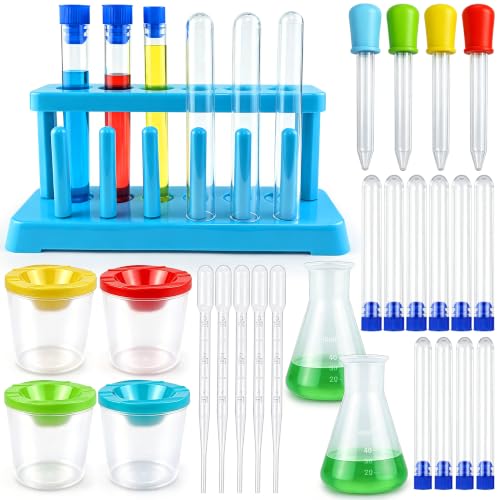
- Includes tubes, droppers, flasks, pipettes, and a rack
- Lightweight plastic tools for simple experiments
- Works for classroom, homeschool, or family learning
Best For: Introductory classroom science activities and exploratory learning
Visual Learning Accent
45-Piece Science Bulletin Board Cutouts

- Includes 45 pieces in 15 science-themed designs
- Comes with 100 glue dots for display setup
- Laminated paper is tear-resistant and waterproof
Best For: Brightening science classrooms, labs, and educational displays
Full Glassware Collection
Frienda 37-Piece Glass Lab Kit

- Combines beakers, flasks, cylinders, tubes, and droppers
- Uses clear borosilicate glass with a plastic rack
- Covers measuring capacities from 10 ml to 1000 ml
Best For: Supervised school labs, demonstrations, and science fairs
Advanced 3D Modeling Pick – LINKTOR 444-Piece Molecular Model Kit
For classrooms seeking chemistry sets for classrooms that make molecular structure tangible, this LINKTOR kit offers a large, reusable collection for building organic and inorganic models. Its ball-and-stick and space-filling approaches support lessons in molecular geometry, bond angles, and stereochemistry.
Best For: Middle school through advanced chemistry instruction, including teacher demonstrations and student modeling activities.
Pros:
- 444 pieces include atoms, bonds, and Fullerene components.
- Supports both ball-and-stick and space-filling molecular models.
- 3D construction helps students examine structures, bonds, and angles from multiple directions.
- Color-coded atoms and a disconnecting tool simplify assembly and reuse.
Cons:
- The extensive piece count may be more than introductory learners need.
- The listing’s age details are inconsistent, so instructors should confirm suitability for their class.
This is the strongest choice here for broad, hands-on molecular modeling. It is especially useful when a classroom needs one substantial kit that can support foundational through advanced concepts.
Versatile Measurement Set – Teenitor Plastic Beakers and Cylinders
For practical chemistry sets for classrooms, this Teenitor collection supplies multiple reusable beakers and graduated cylinders for measuring and transferring liquids. The plastic construction is acid- and alkali-resistant, while the range of sizes supports varied classroom activities.
Best For: General classroom liquid-measurement exercises, demonstrations, and science activities where reusable plastic equipment is preferred.
Pros:
- Includes five graduated cylinders from 10 mL to 250 mL and five beakers from 50 mL to 1,000 mL.
- Raised, double-sided scales are designed for clear, durable reading.
- Hexagonal cylinder bases improve stability during measurement.
- Food-grade plastic is reusable and resistant to many acids, bases, and common solvents.
Cons:
- Plastic equipment may not provide the same feel or heat tolerance as laboratory glassware.
- The set focuses on measuring and containing liquids rather than molecular modeling or specialized experiments.
This is a practical equipment bundle for classrooms building a basic liquid-handling station. Its varied capacities make it more flexible than a single-size measuring set.
Organic Chemistry Builder – 239-Piece Molecular Model Kit
This 239-piece model kit is a focused option among chemistry sets for classrooms, giving students a hands-on way to build and inspect organic structures. Physical atoms and bonds can make flat textbook diagrams easier to interpret during lessons or independent practice.
Best For: Organic chemistry students, STEM classrooms, and repeated structure-building practice.
Pros:
- Turns two-dimensional diagrams into physical 3D models.
- Reusable pieces support building, adjusting, and rebuilding structures.
- Includes atoms, bonds, a bond remover tool, instructional guide, and bonus molecule stencil.
- Designed for straightforward assembly and repeated study use.
Cons:
- It is primarily presented as an organic chemistry model kit rather than a complete lab-equipment set.
- The manufacturer recommends it for ages 15 and up, limiting its fit for younger classrooms.
Choose this kit when the teaching goal is visualizing atoms, bonds, and molecular arrangements rather than conducting liquid experiments. Its included guide and stencil add useful structure to introductory modeling activities.
Early Learner Measurement Pick – hand2mind Starter Science Cylinders
For younger learners, these hand2mind cylinders offer an approachable entry point to chemistry sets for classrooms. The five clear plastic cylinders are sized for basic pouring and measuring, with colorful bases and removable collars that support stability and storage.
Best For: Preschool and elementary science centers, sensory exploration, and introductory measurement activities.
Pros:
- Includes five cylinders measuring 10, 25, 50, 100, and 250 mL.
- Easy-to-read marks and sliding collars help children measure liquid levels.
- Colorful bases provide stability on flat surfaces.
- Removable bases allow the cylinders to nest for storage.
Cons:
- This is an introductory measuring set, not a full chemistry apparatus collection.
- Its educational focus is early exploration rather than advanced molecular or laboratory instruction.
This set is a good classroom starter when the priority is safe-feeling, accessible measurement practice for children. The included Getting Started Guide can help teachers organize first activities.
Visual Molecular Learning – 444-Piece Organic Chemistry Model Kit
For classrooms covering molecular structures, this 444-piece kit turns abstract chemistry into hands-on 3D models. It supports lessons from Grade 7 through graduate-level study, with components for organic chemistry, biochemistry, and molecular biology.
Best For: Students and teachers who need a reusable visual aid for building organic molecules, polymers, and fullerene structures.
Pros:
- Includes 136 atoms, 158 bonds, and 150 fullerene parts for exploring varied structures.
- Supports both ball-and-stick and space-filling models.
- Snap-Lock design is portable for use at home, in the classroom, or in a lab.
- Includes a bond remover tool and instructional guide.
Cons:
- Its recommended age range and subject depth may make it more suitable for older students than young beginners.
- The set focuses on molecular modeling rather than hands-on reaction experiments.
Choose this kit when spatial understanding is the priority. Its broad component mix and fullerene pieces make it a strong classroom model-building resource, though teachers seeking wet-lab activities will need separate equipment.
Junior Lab Exploration – 33-Piece Plastic Science Experiments Set
This 33-piece plastic lab set gives classrooms a practical starting point for introductory science activities. The colorful, easy-to-clean equipment lets students observe changes while practicing basic measuring, transferring, and handling skills.
Best For: Junior learners, classroom demonstrations, and guided home activities that introduce lab tools and exploratory science.
Pros:
- Includes beakers, test tubes, a rack, droppers, pipettes, a conical flask, and other accessories.
- Plastic construction is designed for easy cleaning.
- Includes goggles and gloves for a more complete activity setup.
- Supports curiosity-driven experiments and exploratory skills.
Cons:
- The supplied notes do not list specific experiment instructions or materials.
- Plastic equipment may be less appropriate for advanced laboratory work than specialized labware.
- The manufacturer-recommended age is listed as 16 years and up despite its junior-focused positioning.
This is a flexible starter kit for chemistry sets for classrooms when the goal is tool familiarity and observation. Plan activities around the included equipment and provide appropriate adult supervision and experiment guidance.
Classroom Structure Builder – 452-Piece Chemistry Molecular Model Kit
For teachers comparing chemistry sets for classrooms, this 452-piece model kit covers organic and inorganic structure building in one reusable package. Its colored atoms, bonds, electronic-cloud pieces, and C60 components support visual lessons across chemistry, biology, and physics.
Best For: Students and teachers building common molecules, ball-and-stick models, VSEPR models, and reaction models together.
Pros:
- Includes 99 chemical atoms, 178 bonds, 24 electronic-cloud pieces, and 150 C60 pieces.
- Supports organic and inorganic molecule models as well as VSEPR structures.
- Brightly colored plastic pieces are designed to be durable and easy to assemble.
- Suitable for collaborative classroom, home, teaching, and research-related use.
Cons:
- The large number of pieces may require organized storage between lessons.
- The supplied notes do not specify an instructional guide or detailed experiment manual.
- It is a modeling aid rather than a kit for conducting chemical reactions.
This set stands out when a class needs broad coverage of molecular representation rather than a single chemistry topic. The electronic-cloud and C60 pieces add versatility, while the plastic construction keeps it suitable for repeated model-building activities.
Hands-On Starter – 26-Piece Plastic Lab Kit
For classrooms seeking chemistry sets for classrooms that are lightweight and easy to organize, this 26-piece plastic lab kit provides basic tools for observation, measuring, transferring, and simple experiments. It is designed for exploratory learning and includes test tubes, droppers, flasks, pipettes, and washing cups.
Best For: Classroom or home activities for young learners exploring introductory science concepts.
Pros:
- Includes test tubes, a rack, droppers, flasks, pipettes, and pen-washing cups.
- Plastic construction keeps the tools lightweight and reusable.
- Supports practical, curiosity-driven experiments and independent learning.
- Suitable for classroom activities, homeschooling, and family science time.
Cons:
- Plastic tools are intended for basic educational use rather than advanced laboratory work.
- The compact 7-by-5-by-2-inch size may limit larger experiments.
- The manufacturer lists a recommended age of 16 years and up, despite the junior-focused positioning.
This is a practical choice when durability, portability, and a broad selection of introductory accessories matter more than professional-grade materials. Teachers should pair it with age-appropriate supervision and activities.
Visual Learning Accent – 45-Piece Science Bulletin Board Cutouts
These science-themed cutouts offer a low-cost way to support chemistry sets for classrooms by creating a more engaging lab or science learning environment. The set includes 45 laminated paper pieces in 15 designs, plus glue dots for bulletin boards, walls, doors, and other displays.
Best For: Teachers decorating science classrooms, labs, homeschool spaces, or educational displays.
Pros:
- Provides 45 pieces across 15 science-themed designs.
- Includes 100 glue dots for convenient mounting.
- Laminated, tear-resistant, and waterproof paper supports repeated use.
- Can also be used for DIY decorations, handmade embellishments, or mini banners.
Cons:
- This is classroom decor rather than an experiment kit or labware set.
- The pieces are single-sided printed paper cutouts.
- Glue dots may not suit every wall or display surface.
Choose this set when the goal is to make a chemistry or science area more visually inviting. It complements hands-on chemistry sets but does not replace measuring, mixing, or observation equipment.
Full Glassware Collection – Frienda 37-Piece Glass Lab Kit
For classrooms needing chemistry sets for classrooms with a wider range of measuring and handling tools, this 37-piece Frienda kit combines clear borosilicate glassware with a blue plastic rack. It includes beakers, flasks, graduated cylinders, test tubes, droppers, stirring rods, and other core accessories for school labs, demonstrations, and science fairs.
Best For: Middle school through college demonstrations, supervised classroom labs, home projects, and science fair displays.
Pros:
- Offers seven essential tool types in one coordinated 37-piece collection.
- Borosilicate glass provides clear visibility for measuring and observing contents.
- Graduated cylinders range from 10 ml to 100 ml, while beakers range from 50 ml to 1000 ml.
- Includes a three-tier test tube rack and two test tube sizes for organization.
Cons:
- Glass construction is heavier and more breakable than plastic alternatives.
- The set weighs 5.5 pounds, which may make classroom storage and transport less convenient.
- It is better suited to supervised lab use than unsupervised activities.
This kit is the strongest fit for instructors who want varied capacities and transparent glassware in one purchase. Its broad selection supports more realistic demonstrations, but classrooms should plan for careful handling and secure storage.
How We Picked the Best Chemistry Sets for Classrooms
We focused on usefulness in real classroom settings rather than treating every kit as a complete laboratory. The selection covers core teaching needs: modeling molecular structures, practicing volume measurement, organizing demonstrations, and giving students tangible materials to handle. We also considered piece count, range of included sizes, material choice, storage value, and whether a set is better suited to individual learners, small groups, or whole-class instruction.
Plastic sets generally offer lower breakage risk and easier distribution, while glass kits can provide a more authentic laboratory experience when used with appropriate supervision. Molecular model kits were included because they help students visualize three-dimensional structures that are difficult to represent on a flat worksheet.
Quick Comparison
- Best for molecular modeling: The 239-, 444-, and 452-piece atom-and-bond kits provide broad structure-building capability.
- Best for measuring practice: Graduated cylinder sets with several capacities support lessons on volume, accuracy, and unit conversion.
- Best for basic stations: Plastic beaker, test tube, and flask assortments are practical for introductory activities and demonstrations.
- Best for visual classroom support: Chemistry cutouts can reinforce vocabulary and decorate science boards without adding lab-management demands.
- Best for advanced demonstrations: Glassware sets offer a more realistic lab setup but require stronger handling procedures.
Key Buying Factors for Chemistry Sets for Classrooms
Student Age and Lesson Goals
Choose molecular modeling sets for bonding, formulas, and organic or inorganic structure lessons. Select graduated cylinders and beakers when students need practice with measurement, comparison, or procedural work. For younger learners, durable plastic and simple components are usually the most practical starting point.
Plastic Versus Glass
Plastic is lightweight, inexpensive, and less concerning if dropped. Glass is more resistant to some forms of wear and may feel more authentic, but it can break and should be reserved for classrooms with clear safety routines and close supervision.
Set Size and Group Coverage
A high piece count does not automatically mean better classroom value. Check whether the pieces create multiple usable student stations or mostly add duplicate connectors and accessories. For group work, several smaller matching sets may be easier to manage than one large kit.
Storage and Replacement
Look for kits that can be sorted and stored after each lesson. Separate containers or labeled bags help prevent missing connectors, test tubes, and model parts. Before buying, confirm the listed quantities and consider how easily consumable or breakable pieces can be replaced.
Who Should Buy Which Chemistry Sets for Classrooms?
Teachers introducing atomic structure and bonding should prioritize a molecular model kit with enough atoms and connectors for pairs or small groups. Instructors teaching measurement should choose graduated cylinders in multiple capacities, ideally paired with beakers. For general science stations, plastic labware sets provide flexible, low-risk equipment for demonstrations and observation activities.
Schools seeking a more realistic laboratory presentation may prefer the glass kit, provided storage, safety equipment, and supervision are already in place. Finally, bulletin-board cutouts are best for classrooms that need visual reinforcement rather than hands-on equipment. In many cases, the strongest setup combines one molecular modeling kit, one durable plastic labware set, and a measurement-focused cylinder set.