The best barometers for field work do more than display air pressure. They help hikers, surveyors, foresters, anglers, and outdoor professionals monitor elevation, weather trends, wind, and temperature while away from a full weather station.
We compared handheld weather meters, multifunction altimeters, analog barometers, and wireless systems for portability, measurement range, durability, and practical outdoor use. The right choice depends on whether you need basic pressure trends, accurate altitude readings, or a broader set of field measurements.
Best 10 Barometers for Field Work Picks for 2026
Best Handheld Weather Meter
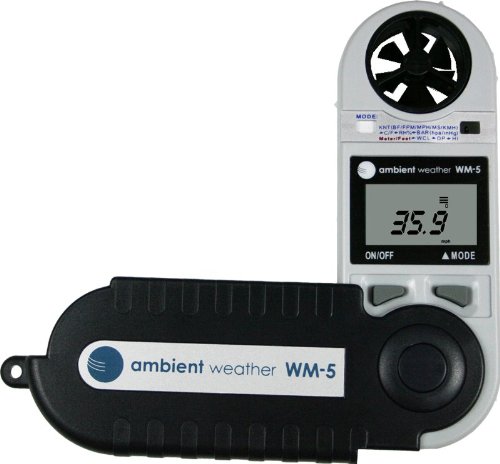
- Handheld barometer with altitude and weather readings
- Water resistant and floats
- Includes cases, lanyard, and two-year warranty
Best For: Portable outdoor weather measurements
Best Multitool Barometer

- Combines barometer, altimeter, compass, and thermometer
- Altitude range reaches 29,500 feet
- Includes a five-second electronic backlight
Best For: Hiking and climbing navigation
Best Field Monitoring Station

- Tracks pressure, rain, wind, temperature, and humidity
- Large 8.5-inch color display
- Wireless range up to 328 feet
Best For: Stationary environmental monitoring and research
Best Forestry Slope Tool
Waterproof Handheld Clinometer

- Measures slope, tree height, and building height
- Waterproof and shockproof aluminum body
- Includes lanyard and storage bag
Best For: Forestry, trail, and height measurements
Fishing Pressure Tracker
Camco TRAC Outdoors Fishing Barometer

- Adjustable local-pressure calibration
- Color-coded fishing-condition dial
- Compact housing with braided lanyard
Best For: Anglers needing a simple portable pressure reference
Multifunction Weather Meter
BTMETER BT-100WM Handheld Anemometer
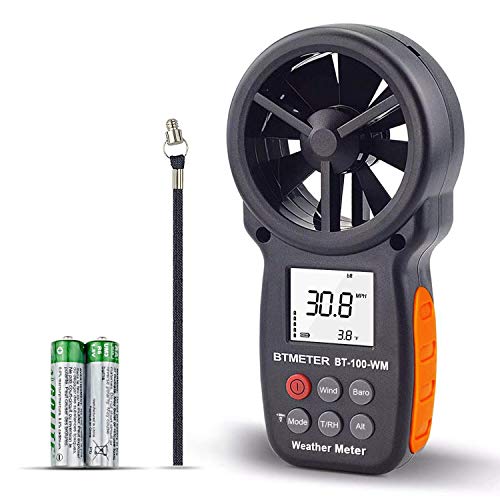
- Measures pressure plus wind and weather data
- Logs 16 groups of pressure readings
- Backlit LCD with tripod mounting hole
Best For: Field users needing portable environmental measurements
Battery-Free Altitude Gauge

- Battery-free analog pressure operation
- Reads altitude up to 15,000 feet
- Rugged ABS case with lanyard
Best For: Hikers and campers building an analog field kit
Most Versatile
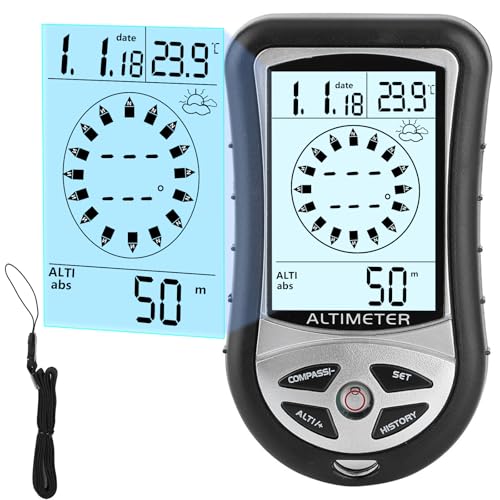
- 300–1100 mbar range with 0.1 mbar resolution
- Altimeter measures from -2300 to 29,500 feet
- Compass, thermometer, forecast, clock, calendar, and backlight
Best For: Hiking, camping, and mountaineering with one compact tool
Best for Wind Monitoring
HoldPeak 866B-WM Weather Meter
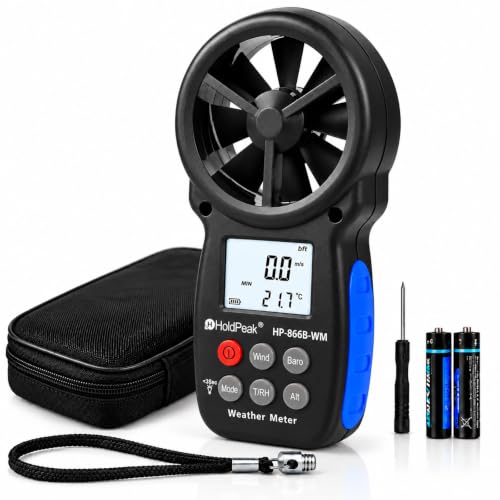
- Measures wind, temperature, humidity, dew point, altitude, and pressure
- Stores 16 sets of barometric pressure data
- Includes tripod mount, hand strap, backlight, and unit switching
Best For: Wind-sensitive fieldwork, HVAC checks, boating, and drone flying
Best for Low-Light Use

- Altimeter reaches 29,500 feet or 9,000 meters
- Adds compass, thermometer, timer, weather, and barometer functions
- Bright LED backlight and included lanyard support field use
Best For: Outdoor navigation and monitoring in variable light
Best Handheld Weather Meter – Ambient Weather WM-5
For barometers for field work, the Ambient Weather WM-5 is a compact weather meter that combines barometric pressure and altitude readings with practical wind and temperature data. Its pocket-knife-style design, water resistance, floating construction, and included carrying accessories make it suited to mobile outdoor use.
Best For: Hikers, field researchers, gardeners, and outdoor users who want a handheld weather meter with barometric pressure and wind measurements.
Pros:
- Measures barometric pressure, altitude, wind speed, temperature, humidity, dewpoint, heat index, and windchill.
- Compact ergonomic design includes a soft case, belt case, neck lanyard, and replacement impeller.
- Water resistant, floats, and includes a two-year factory warranty.
Cons:
- Battery powered, with the recommended CR2032 battery noted as possibly included.
- Its small handheld format may be less suitable for continuous site monitoring than a fixed weather station.
The WM-5 is a versatile choice when portability matters more than a large display or permanent installation. It offers a broad set of field measurements in a protective, easy-to-carry design.
Best Multitool Barometer – Digital 8-in-1 Altimeter
Among barometers for field work, this digital 8-in-1 instrument adds an electronic compass, altimeter, thermometer, time display, and weather updates in one compact tool. Its broad altitude range and backlit display are useful for hiking, climbing, and navigation.
Best For: Hikers, climbers, and campers who want barometric pressure, altitude, direction, and temperature readings in a single handheld device.
Pros:
- Combines an altimeter, barometer, electronic compass, thermometer, time, and weather functions.
- Measures altitude from -2,300 to 29,500 feet with approximately 3.3-foot resolution.
- Barometer covers 300 to 1,100 mbar, while the thermometer reads 14°F to 140°F.
Cons:
- The supplied notes do not specify battery life, water resistance, or warranty coverage.
- Its multifunction design may require more setup and mode switching than a dedicated barometer.
This device is a practical all-in-one option for users who need more than pressure readings. It is especially appealing when navigation and elevation tracking are part of the field task.
Best Field Monitoring Station – Wireless Weather Station
For stationary barometers for field work, this wireless weather station provides a broader environmental monitoring setup than a handheld instrument. Its outdoor sensor tracks barometric pressure alongside wind, rainfall, temperature, humidity, dew point, and related weather data, with transmission up to 328 feet.
Best For: Environmental monitoring, weather observation, research, and educational installations that need ongoing indoor and outdoor data.
Pros:
- Tracks barometric pressure, rainfall, wind speed and direction, temperature, humidity, dew point, moon phase, and UV index.
- Large 8.5-inch color LCD displays real-time readings and weather forecasts.
- Wireless outdoor sensor reaches up to 328 feet and includes mounting hardware and a two-year warranty.
Cons:
- It is a mounted station rather than a portable field instrument.
- Requires installation of the outdoor sensor and a display setup.
- The product is specified as having no Wi-Fi connectivity.
This station is the strongest fit when the goal is continuous site observation rather than grab-and-go measurements. Its dedicated rain gauge, anemometer, and wireless sensor support more comprehensive monitoring.
Best Forestry Slope Tool – Waterproof Handheld Clinometer
Although it is not a barometer, this handheld clinometer is a useful companion for field work involving slopes, tree heights, and building measurements. Its sighting design provides quick angle readings, while the small aluminum-alloy body is built for portable outdoor use.
Best For: Forestry, trail assessment, backpacking, hiking, tree-height measurement, and building-height checks.
Pros:
- Measures height and slope with a deflection-angle lens for straightforward readings.
- Provides height readings in inches and millimeters.
- Waterproof, shockproof aluminum-alloy construction includes a lanyard and nylon storage bag.
Cons:
- It measures slope and height rather than barometric pressure or weather conditions.
- The supplied notes do not specify measurement accuracy or a detailed warranty.
This is best considered a specialized field-measurement tool rather than one of the barometers for field work. Pair it with a handheld weather meter when your work requires both terrain measurements and atmospheric data.
Fishing Pressure Tracker – Camco TRAC Outdoors Fishing Barometer
For anglers looking at barometers for field work, the Camco TRAC Outdoors Fishing Barometer offers a simple, portable way to monitor local pressure changes. Its adjustable indicator and color-coded dial are designed to help interpret conditions while fishing.
Best For: Anglers who want a straightforward, battery-free-style pressure reference for fishing trips and outdoor use.
Pros:
- Calibrates to local barometric pressure.
- Adjustable pressure-change indicator includes a reference marker.
- Color-coded dial identifies great, good, or poor fishing conditions.
- Sure-grip plastic housing and braided lanyard support portability.
Cons:
- Designed specifically around fishing conditions rather than broad weather-field measurements.
- Plastic construction may offer less ruggedness than heavier-duty instruments.
This is a focused choice for anglers who value quick visual interpretation over a multifunction weather meter. The compact 4-ounce design and lanyard make it convenient to carry or hang at camp.
Multifunction Weather Meter – BTMETER BT-100WM Handheld Anemometer
Among barometers for field work, the BTMETER BT-100WM stands out for combining barometric pressure with wind, temperature, humidity, dew point, wind chill, and altitude readings. Its handheld format, backlit LCD, and data logging make it useful when field decisions depend on more than pressure alone.
Best For: Shooters, sailors, outdoor users, and technicians who need portable environmental readings and recorded pressure data.
Pros:
- Measures barometric pressure, altitude, wind speed, temperature, humidity, dew point, and wind chill.
- Logs 16 groups of barometric pressure data for comparison and analysis.
- Offers current, minimum, maximum, and average wind-speed readings.
- Backlit display, multiple units, tripod hole, and automatic shutoff improve field usability.
Cons:
- Requires a battery, unlike analog field instruments.
- Its many functions may be more than needed for users seeking pressure readings only.
- Wind-speed accuracy is specified at +/- 5%.
The BT-100WM is the most versatile option in this group for data-oriented field work. Choose it when tracking several environmental variables matters more than having the simplest possible instrument.
Battery-Free Altitude Gauge – Sun Company Altimeter 203
For hikers and campers comparing barometers for field work, the Sun Company Altimeter 203 provides an analog, battery-free way to track altitude and surrounding pressure. Its adjustable dial helps compensate for changing pressure systems, while the included lanyard keeps it accessible on the move.
Best For: Hikers, backpackers, campers, and drivers who prefer a compact analog altimeter with a weather-trend indicator.
Pros:
- Battery-free operation uses surrounding barometric pressure.
- Reads altitude from 0 to 15,000 feet.
- Adjustable dial accounts for high- or low-pressure systems.
- Rugged ABS case, lanyard, and included instructions support portable use.
Cons:
- Analog readings require manual adjustment and interpretation.
- Plastic construction may not suit users seeking a metal instrument.
- It does not provide the multifunction measurements available from a digital weather meter.
The Altimeter 203 is a practical low-maintenance pick for users who want altitude and pressure information without batteries. It is especially appealing for analog gear kits and straightforward outdoor navigation support.
Most Versatile – 8-in-1 Handheld Barometer
For shoppers comparing barometers for field work, this handheld unit combines pressure tracking with altitude, compass, temperature, time, calendar, and weather-forecast functions. Its broad altitude range and compact lanyard design make it practical for hiking, camping, and mountaineering.
Best For: Outdoor users who want one lightweight instrument for navigation, elevation checks, and basic weather monitoring.
Pros:
- Measures barometric pressure from 300 to 1100 mbar with 0.1 mbar resolution.
- Altimeter covers -2300 to 29,500 feet with 3.3-foot resolution.
- Includes an 8-direction digital compass, thermometer, weather icons, clock, calendar, and backlight.
- Lanyard makes the plastic handheld unit easy to carry.
Cons:
- The plastic construction may be less suitable for users seeking a ruggedized professional instrument.
- Its weather feature provides a 12–24-hour forecast rather than a detailed meteorological report.
This is a strong all-purpose choice when field work involves more than pressure readings. Choose it for its broad feature set and altitude capability, especially when portability matters.
Best for Wind Monitoring – HoldPeak 866B-WM Weather Meter
Among barometers for field work, the HoldPeak 866B-WM stands out when pressure readings need to be considered alongside wind and humidity conditions. It is a handheld weather meter with data logging, altitude correction, a tripod mount, and multiple wind-speed units.
Best For: Field tasks involving wind measurement, environmental checks, boating, drone flying, HVAC work, or other applications where airflow matters.
Pros:
- Measures wind speed, temperature, humidity, dew point, altitude, barometric pressure, and wind chill.
- Records 16 sets of barometric pressure data and allows manual pressure correction for altitude measurements.
- Supports multiple wind-speed units and displays maximum, minimum, and average wind speed.
- Tripod hole, hand strap, backlight, battery indicator, and auto-off add field convenience.
Cons:
- At 6.5 by 3.55 by 1.5 inches and 200 grams, it is less pocket-friendly than simpler handheld barometers.
- Its feature set is centered on wind and environmental measurement rather than compass navigation.
This is the better fit when field work requires actionable wind data as well as barometric pressure. Its logging and manual correction features are especially useful for repeat measurements and comparative readings.
Best for Low-Light Use – 8-in-1 Altimeter Barometer
This 8-in-1 unit is a practical option for shoppers seeking barometers for field work with clear readings in changing light. It combines barometric pressure, altitude, compass, thermometer, weather forecasting, timer, and a bright LED backlight in a portable lanyard-equipped design.
Best For: Hikers, campers, and mountaineers who need a compact multi-function instrument for daytime or nighttime outdoor use.
Pros:
- Measures altitude up to 29,500 feet or 9,000 meters and includes a digital compass.
- Combines barometer, thermometer, weather forecast, timer, and other outdoor functions.
- Bright LED backlight helps illuminate the LCD display in low-light conditions.
- Portable design includes a lanyard for carrying on trails or in a pack.
Cons:
- The plastic construction may not satisfy buyers looking for a heavy-duty field instrument.
- The notes do not specify a separate barometric data-logging function.
This model is a sensible choice for general outdoor field use where readability and portability are priorities. Its broad feature set reduces the need to carry separate basic instruments, while the backlight supports use after dark.
How We Picked the Best Barometers for Field Work
We evaluated these products according to the needs of people working or traveling outdoors. Key considerations included barometric-pressure measurement, altitude functionality, weather-trend indicators, portability, display readability, power requirements, and resistance to demanding conditions. We also considered whether each device offers useful secondary measurements such as wind speed, temperature, humidity, compass direction, or slope.
Because field conditions vary widely, the list includes compact handheld instruments, battery-free analog options, multifunction digital devices, and a wireless weather station. Product specifications can vary by model and seller, so verify the stated measurement range, accuracy, water resistance, and included accessories before purchasing.
Quick Comparison
| Best For | Recommended Type | Why It Matters |
|---|---|---|
| Hiking and backpacking | Compact digital altimeter-barometer | Combines elevation, pressure, compass, and temperature readings. |
| Weather observation | Handheld weather meter or station | Provides pressure trends and may add wind, rain, or humidity data. |
| Forestry and slope work | Clinometer with altimeter functions | Helps estimate slope, height, and terrain angles. |
| Fishing and boating | Analog pressure barometer | Offers an easy-to-read pressure-change reference without complex controls. |
| Emergency or low-maintenance use | Battery-free altimeter-barometer | Works without charging or replacing batteries. |
Key Buying Factors for Barometers for Field Work
Pressure and Altitude Performance
Barometric pressure changes with elevation, so an altimeter must be calibrated to a known reference before use. Look for an adjustable altimeter, clear pressure units, and a range appropriate for your expected terrain. A pressure-trend feature is especially useful for spotting developing weather changes, but it should supplement—not replace—an official forecast.
Portability and Durability
For hiking or field surveys, choose a lightweight device with a lanyard, protective case, sealed controls, or water resistance. Large buttons and a backlit display are valuable when wearing gloves or working in low light. Analog models can be simple and dependable, while digital meters usually provide more measurements in a smaller package.
Power and Usability
Check whether the instrument uses replaceable batteries, rechargeable power, or no battery at all. Also consider calibration procedures, display readability, memory functions, and whether the device can show measurements in the units you use. Extra features are worthwhile only if they will be used regularly.
Who Should Buy Which Barometers for Field Work?
Choose a multifunction digital altimeter if you backpack, climb, or need compass, thermometer, timer, and pressure readings in one compact tool. Choose a handheld weather meter if wind speed, humidity, dew point, or temperature are as important as pressure. Choose a clinometer-style instrument for forestry, construction, trail assessment, or slope measurements. Choose an analog or battery-free barometer when simple pressure trends, low maintenance, and immediate readability matter most. Finally, a wireless weather station is better for a base camp, workshop, or property where you want continuous local readings rather than a pocket-sized instrument.