The right vise can make delicate jewelry work more stable, precise, and comfortable. Whether you need to hold rings, small components, or hand tools, a compact bench vise should provide secure grip without damaging finished surfaces.
We compare 10 bench vises for jewelers, including ball vises, multi-angle models, tabletop clamps, and portable options. Use the guide below to match jaw design, rotation, mounting style, and size to your workspace and projects.
Best 10 Bench Vises for Jewelers Picks for 2026
Best Compact Engraving Block

- Self-centering jaws for precision work
- Adjustable 360-degree rotational resistance
- Includes 17 attachments
Best For: Stone setting, engraving, and microscope work
Best Portable Precision Vise
- 360-degree swivel and multi-angle adjustment
- Protective gripping surfaces for small parts
- Includes sockets and bench pins
Best For: Jewelry, watch, and lightweight tabletop work
Best Complete Jewelry Kit

- 71-piece kit with ring-making accessories
- Self-centering jaws for jewelry pieces
- Smooth rotation with adjustable braking
Best For: Ring fabrication and comprehensive jewelry benches
Best Multi-Angle Workbench Vise

- 360-degree articulating positioning
- Eight locking positions for forceful work
- 5-inch jaws with swappable pads
Best For: Mixed workshop repairs and multi-angle clamping
Best Versatile Pick

- Dual 2.5-inch serrated and 1.5-inch smooth jaws
- 360-degree swivel base and head
- Clamp-on or bolt-down installation
Best For: Jewelers needing a versatile vise for jewelry and general workshop tasks
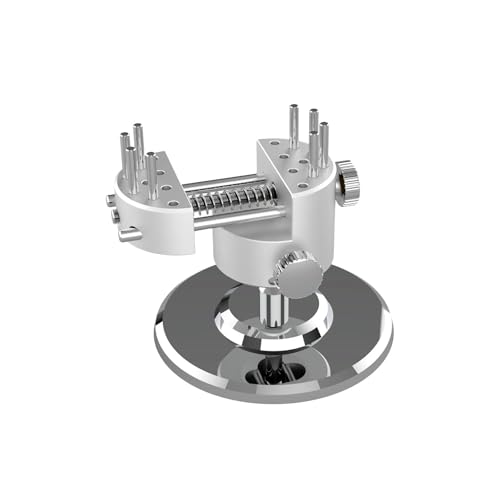
Best for Delicate Detail Work

- 360-degree rotation with 90-degree tilt
- 14 silicone-covered rods for irregular parts
- Detachable tabletop and handheld design
Best For: Jewelry repair and fine-detail work with small or delicate parts
Best Lightweight Swivel Vise
Fasmov 3-Inch Universal Table Vise

- 360-degree adjustable positioning
- Removable rubber jaws for protected clamping
- Lightweight 1.9-pound cast-aluminum body
Best For: Portable jewelry, soldering, and small-part bench work
Best Precision Pick
KojinTora Mini Rotating Tabletop Vise

- Multi-angle positioning for close-up work
- 14 adjustable rods for irregular parts
- Compact aluminum-alloy tabletop design
Best For: Jewelry making, watch repair, and small-part crafts
Best Heavy-Duty Option
3-Inch Cast-Iron Swivel Bench Vise

- Cast-iron body for workshop stability
- 360-degree swivel base
- 3.2-inch jaws and clamp-on installation
Best For: Mixed jewelry and general workshop tasks
Best Compact Value

- Lightweight aluminum construction
- Up to 2.1-inch opening range
- Includes support columns and clamping blocks
Best For: Portable jewelry, watch repair, and carving work
Best Compact Engraving Block – 3-Inch Ball Vise
For jewelers comparing bench vises for jewelers, this 3-inch ball vise is designed around precise stone setting, engraving, and microscope work. Its self-centering jaws, low profile, and adjustable rotational brake provide stable positioning without taking up the space of a larger vise.
Best For: Jewelers and engravers who need a compact, maneuverable vise for stone setting, small engravings, and detailed microscope work.
Pros:
- Self-centering jaw system helps hold small workpieces securely.
- 360-degree rotation with adjustable resistance, from free movement to locked positioning.
- Double ball bearings are designed for smooth rotation without looseness or wear.
- Includes 17 attachments in a full standard block set.
Cons:
- The 3-inch ball and 53 mm maximum opening may limit larger projects.
- At 2.28 kg, it is less portable than a lightweight tabletop vise.
This is a focused choice for precision jewelry work rather than general-purpose clamping. The low-profile stainless steel construction and included attachments make it particularly useful when controlled positioning matters more than maximum jaw capacity.
Best Portable Precision Vise – 2.5-Inch Swivel Vise
2.5 Inch Mini Vise with 360 Degree Swivel Base Aluminum Alloy Tabletop Vise for Jewelry Watch & DIY
Check Price On AmazonThis compact aluminum-alloy vise is a practical option for shoppers seeking bench vises for jewelers that can handle small parts while offering flexible positioning. Its swivel base, adjustable angles, protective gripping surfaces, and included bench pins suit jewelry, watch, and DIY tasks.
Best For: Jewelers, watchmakers, and DIY users who want a lightweight tabletop vise for small parts and multi-angle work.
Pros:
- 360-degree rotation plus 45- to 90-degree front-and-rear angle adjustment.
- Protective rubber-particle gripping surfaces help reduce damage to clamped objects.
- Includes 18 fixed sockets and eight bench pins for different holding setups.
- Lightweight 350 g aluminum and stainless steel construction is easy to move.
Cons:
- The 35 mm clamp-block opening is intended for smaller workpieces.
- Its lightweight design may provide less mass and stability than a heavy ball vise.
This vise favors flexibility and portability over the heavy, locked-in feel of a traditional engraving block. It is well suited to small jewelry and watch components when quick angle changes and protected clamping are priorities.
Best Complete Jewelry Kit – 4-Inch Ball Vise Set
Among bench vises for jewelers, this 4-inch ball vise stands out as a broad ring-making and precision-work package. It combines a self-centering stainless steel vise with 39 ring-focused accessories, making it useful for stone setting, engraving, polishing, and ring fabrication.
Best For: Jewelers who want one comprehensive kit for ring work, stone setting, engraving, and related bench tasks.
Pros:
- 71-piece package includes the original 32 precision tools plus 39 ring-making accessories.
- Self-centering jaws and a 3-inch maximum opening support rings, pendants, and bracelets.
- Adjustable rotational brake and double ball bearings provide controlled, smooth positioning.
- Low-profile design is suited to microscope work, and the rubber base helps reduce slipping.
Cons:
- At 9.23 pounds, it is substantially heavier than compact tabletop vises.
- The large accessory set may be more than needed for users focused only on basic clamping.
This is the most workshop-oriented option in the group. Its size, weight, and extensive ring accessories favor a dedicated jewelry bench, especially for users who want to avoid purchasing ring holders, blanks, and pin bases separately.
Best Multi-Angle Workbench Vise – IQ Articulating Bench Vice
For buyers considering bench vises for jewelers alongside broader workshop tasks, the IQ Vise offers a large, articulating setup rather than a specialized engraving block. Its ball-and-socket design, locking positions, interchangeable jaw pads, and workbench mounting support filing, sawing, drilling, and repairs.
Best For: Users who need a versatile bench vise for jewelry-related repairs as well as metalwork, woodworking, gunsmithing, or general hobby work.
Pros:
- 360-degree articulating ball-and-socket system positions work at multiple angles.
- Quick Cam lever and eight locking positions are designed to hold work under force.
- 5-inch parallel jaws accept interchangeable Flex-Fit pads and optional specialty jaws.
- Four integrated ports support compatible lights, magnifiers, and phone holders.
Cons:
- It is a 10-pound, workbench-mounted vise and less compact than jewelry-specific ball vises.
- Additional jaws and IQ Connect accessories are sold separately.
- The supplied notes do not identify jewelry-specific attachments such as ring holders or engraving tools.
This is the better fit for a mixed-use workshop than a dedicated jewelry engraving bench. Its larger jaws and force-oriented construction provide versatility, while the articulating mechanism helps when repairs require frequent changes in viewing or working angle.
Best Versatile Pick – WORKPRO Dual-Jaw Table Vise
For jewelers who also work with tubing, hardware, or general DIY projects, the WORKPRO is one of the more versatile bench vises for jewelers. Its two jaw types and rotating design make it adaptable, while the clamp-on setup helps conserve bench space.
Best For: Jewelers and hobbyists who need a portable vise for both delicate and general-purpose work.
Pros:
- Includes 2.5-inch serrated jaws and 1.5-inch smooth jaws for different workpieces.
- 360-degree swivel base and head allow flexible positioning.
- Can be clamped to or bolted onto a workbench.
- Ductile-iron body and hardened carbon-steel jaws provide up to 660 pounds of clamping force.
Cons:
- At 7.7 pounds, it is less convenient to carry than miniature hobby vises.
- Bolts for bolt-down installation are not included.
- The serrated jaws may require care around delicate jewelry surfaces.
This WORKPRO is a strong choice when versatility matters more than ultra-fine scale. Jewelers should use the smooth jaws for more delicate parts and reserve the serrated jaws for sturdier materials.
Best for Delicate Detail Work – TGDGAMER Mini Tabletop Vise
The TGDGAMER is purpose-built for small, precise tasks, making it a compelling option among bench vises for jewelers. Its compact footprint, adjustable positioning, and silicone-covered rod system are suited to holding tiny or irregular parts during jewelry repair and finishing work.
Best For: Jewelry repair, soldering, polishing, and other fine-detail projects involving small or delicate components.
Pros:
- Detachable design switches between tabletop and handheld use.
- 360-degree rotation and 90-degree tilt support precise positioning.
- Fourteen silicone-covered steel rods accommodate tiny, irregular, and delicate parts.
- Compact size and lightweight design make it easy to store or transport.
Cons:
- Its 0.98-inch clamping range limits it to small workpieces.
- It is not intended for heavy-duty clamping tasks.
- Small components and rods may take more setup time than a conventional jaw vise.
For jewelry makers prioritizing control over maximum force, this mini vise offers the most specialized setup of the three. The adjustable rods and protective silicone coverings are especially useful when a standard jaw profile does not fit the piece.
Best Lightweight Swivel Vise – Fasmov 3-Inch Universal Table Vise
The Fasmov combines a lightweight cast-aluminum body with a 360-degree adjustable design, giving jewelers a practical way to reposition small workpieces. Removable rubber jaw covers can help protect surfaces, while the cross-pattern jaw faces can grip wires and rods when needed.
Best For: Jewelry making, electronics soldering, model work, and other small-part tasks where portability and angle adjustment are important.
Pros:
- 360-degree rotation supports positioning workpieces at different angles.
- Rubber jaw covers help provide firm, non-scratch clamping.
- Removable rubber covers reveal a cross pattern for wire and rod work.
- Lightweight 1.9-pound aluminum construction is easy to move between work areas.
Cons:
- The 2-inch jaw opening may not suit larger pieces.
- Its lightweight construction is better suited to small work than heavy-duty jobs.
- Removing the rubber covers may expose the workpiece to harder jaw surfaces.
The Fasmov is a useful middle ground for jewelers who want more jaw capacity than a mini precision vise without moving up to a heavier bench model. Its removable jaw protection also gives it flexibility for both delicate parts and wire-based work.
Best Precision Pick – KojinTora Mini Rotating Tabletop Vise
For jewelers comparing bench vises for jewelers, this compact aluminum-alloy vise is designed for close-up work where flexible positioning matters. Its detachable clamp, adjustable silicone-covered rods, and multi-angle movement make it useful for holding small or irregular parts on a limited work surface.
Best For: Jewelry making, watch repair, model work, and detailed craft projects involving small or irregular components.
Pros:
- 360-degree rotation, 90-degree vertical positioning, and 45-degree left/right tilt support varied working angles.
- Fourteen adjustable steel rods help adapt the hold to different small part shapes.
- Compact folded dimensions and anti-slip pads suit smaller workbenches.
- Detachable clamp structure supports flexible setup and access.
Cons:
- The 0.79- to 1.06-inch clamping range is intended for small components rather than larger workpieces.
- Its lightweight, compact format is more specialized than a general-purpose heavy bench vise.
This is a strong choice when precision access and positioning are more important than maximum clamping capacity. The adjustable rod system is particularly helpful for irregular jewelry or repair parts.
Best Heavy-Duty Option – 3-Inch Cast-Iron Swivel Bench Vise
Among bench vises for jewelers, this cast-iron clamp-on model suits users who also need a more general workshop vise for filing, drilling, sawing, or metalworking. Its 3.2-inch jaws, 2.5-inch maximum opening, and 360-degree swivel base provide broader capacity than miniature precision vises.
Best For: General workshop tasks, light-duty metalworking, drilling, woodworking, and jewelry work that benefits from a larger clamp-on vise.
Pros:
- Cast-iron construction is designed to provide reliable clamping force and stability.
- 360-degree swivel base allows the work angle to be adjusted.
- Clamp-on base accommodates desktops, workbenches, and countertops up to 3.2 inches.
- Built-in anvil adds a useful surface for applicable workshop tasks.
Cons:
- Its 3.8-pound, general-purpose design may be less convenient for highly delicate, close-up jewelry work.
- The larger jaws and wider opening are more capacity than some small jewelry components require.
This vise is the better fit for a bench setup that serves multiple purposes. Choose it when jewelry work shares space with drilling, filing, woodworking, or other light workshop jobs.
Best Compact Value – Mini Flat Parallel Table Vise
This portable aluminum mini vise is a practical option for bench vises for jewelers when space and easy handling are priorities. Its 0- to 2.1-inch opening, support columns, and multi-purpose clamping blocks are suited to small round, square, and irregular objects.
Best For: Watch repair, jewelry, sculpture, carving, and other compact precision tasks requiring portable part holding.
Pros:
- Lightweight aluminum construction keeps the vise portable while providing a durable body.
- Accommodates round, square, and irregular objects with a 0- to 2.1-inch opening range.
- Includes four support columns, two multi-purpose clamping blocks, and four fixed screws.
- Compact 4.1-by-2.3-by-1.3-inch size saves workbench space.
Cons:
- The mini format is intended for small parts and is not suited to large or heavy workpieces.
- Its handheld, lightweight design may provide less overall mass than a full-size bench vise.
This model makes sense for jewelers who need a simple, space-saving holder for small components. Its included accessories broaden the ways it can support detailed repair and craft work.
How We Picked the Best Bench Vises for Jewelers
We focused on the features that matter most for jewelry making and other fine-detail tasks: compact footprints, stable mounting, useful jaw movement, smooth positioning, and the ability to access a workpiece from multiple angles. The selection includes dedicated ball vises and jewelry kits as well as general-purpose mini bench vises that can suit hobby benches.
Because jewelry work varies widely, we also considered flexibility. A vise with 360-degree rotation or multi-angle adjustment can reduce repositioning, while interchangeable or protective jaws may help prevent marks on softer metals. Product descriptions and listed specifications were compared for size, construction, included accessories, and mounting approach.
Quick Comparison
| Vise type | Best for | What to look for |
|---|---|---|
| Ball vise | Engraving, stone setting, and ring work | Stable base, smooth rotation, secure locking |
| Mini swivel vise | General jewelry and hobby tasks | Jaw alignment, compact size, clamp or bolt mounting |
| Multi-angle vise | Frequent changes in working position | Reliable articulation and strong locking joints |
| Dual-jaw or universal vise | Mixed small-part projects | Jaw versatility, opening range, and surface protection |
Key Buying Factors for Bench Vises for Jewelers
Jaw Design and Protection
Fine jewelry requires control without unwanted impressions. Look for parallel jaws, replaceable jaw covers, smooth contact surfaces, or a design that accepts padding. A broad jaw may hold larger components, while narrow jaws can improve access around rings and small assemblies.
Rotation and Positioning
Swivel and ball mechanisms let you bring the work to a comfortable angle instead of twisting your hands. Confirm that the adjustment can be locked firmly; excessive play is frustrating during filing, sawing, drilling, or engraving.
Mounting and Stability
Clamp-on models are convenient for temporary setups and small desks, while bolt-down vises generally offer greater rigidity. Check the required edge thickness, clamp clearance, base dimensions, and available bench space before ordering.
Size, Capacity, and Materials
A 2.5- or 3-inch mini vise is often easier to position for jewelry than a larger workshop vise. Aluminum models are lightweight and portable, whereas steel or heavier constructions may resist movement during demanding work. Match capacity to your largest regular project rather than choosing by jaw width alone.
Who Should Buy Which Bench Vises for Jewelers?
Choose a ball vise or jewelry kit if engraving, ring making, or stone-setting access is your priority. A multi-angle articulating model suits makers who constantly change orientation. A compact swivel or clamp-on vise is a practical choice for beginners, apartment workshops, and portable setups. For broader DIY use, a dual-jaw or universal tabletop vise offers more flexibility, especially when jewelry is only one part of your project list.