USB duplicators can copy data to multiple flash drives at once without a computer, making them useful for IT teams, educators, event organizers, and businesses distributing identical media.
This roundup compares 10 standalone USB duplicators by port count, speed, erase features, compatibility, and ease of use so you can choose the right capacity for your workflow.
Best 10 USB Duplicators Picks for 2026
Best Compact Professional Pick

- Standalone copying and erasing
- Sector-by-sector and file-copy modes
- LCD monitoring and verification
Best For: Small-scale IT duplication and USB sanitizing
Best High-Volume Pick

- Copies to 15 drives at once
- Standalone, computer-free operation
- Synchronous and asynchronous modes
Best For: Business-scale USB distribution
Best Portable Pick
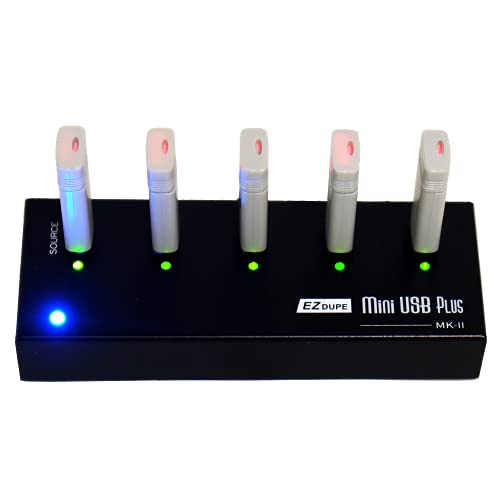
- Compact four-target design
- Up to 2.5 GB/min listed speed
- Asynchronous copying and flexible power
Best For: Mobile and small-batch duplication
Best Mid-Range Capacity Pick

- Copies to seven drives simultaneously
- Bit-by-bit duplication
- Synchronous and asynchronous modes
Best For: Small-business and departmental batches
Best for Easy Setup

- Duplicates to seven USB drives
- Includes cloning, erasing, and verification modes
- Standalone LCD-controlled operation
Best For: IT technicians handling moderate USB duplication and sanitization
Best for High-Volume Production

- Copies to up to 31 USB drives
- Standalone operation needs no computer
- Supports synchronous and asynchronous modes
Best For: Large-batch business and production duplication
Best Touchscreen Pick
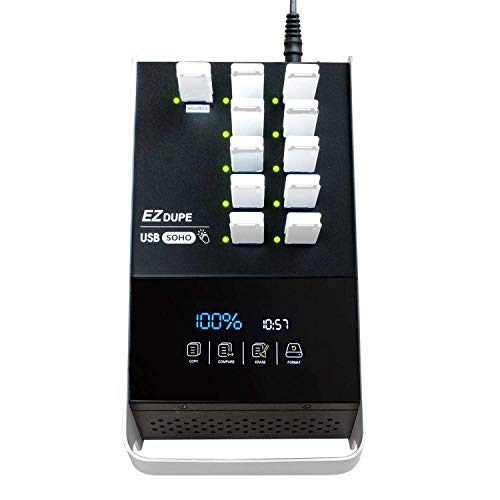
- Touchscreen controls simplify everyday tasks
- Supports USB 2.0, 3.0, and 3.1 media
- Includes copy, compare, format, and erase
Best For: Accessible small-office and recurring USB workflows
Best Compact USB Duplicator

- Standalone 1-to-2 copying
- Quick or bit-for-bit cloning
- Built-in testing and erase tools
Best For: Portable small-batch USB duplication
Best High-Capacity USB Duplicator
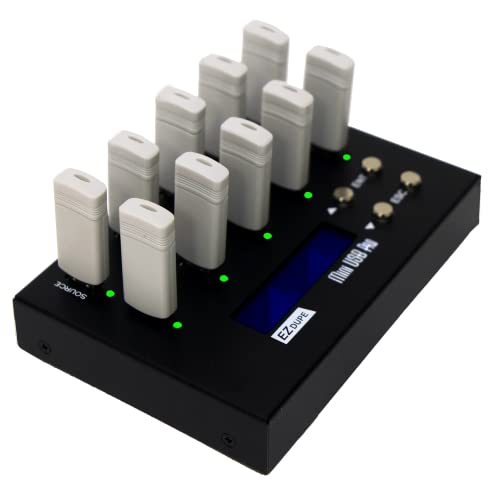
- Duplicates up to nine drives
- Supports USB 1.0 through 3.0
- Includes two erase functions
Best For: Larger USB distribution batches
Best USB Duplicator for IT Workflows

- Copies to five USB drives
- Includes overwrite erase modes
- Adds scanning and copy verification
Best For: IT duplication and drive sanitization
Best Compact Professional Pick – StarTech 1:2 USB Duplicator
For technicians and IT professionals who need versatile USB duplicators, the StarTech USBDUP12 combines two-port copying with drive-erasing functions in a standalone unit. It supports system-and-file or sector-by-sector duplication, plus multiple erase modes.
Best For: Small-scale IT work, boot-drive preparation, USB sanitizing, and teams that need copy-and-compare verification.
Pros:
- Copies or erases USB 1.1, 2.0, and 3.0 flash media without a computer
- Supports sector-by-sector copying and FAT, NTFS, and Linux file systems
- Offers quick erase, single-pass, and three-pass overwrite modes
- LCD menu, activity LEDs, bad-sector scanning, and copy verification
Cons:
- Only duplicates to two target drives at a time
- Asynchronous copying requires source content under 64 MB
- External USB storage may need its own power source
The StarTech is a practical choice when erasing and verification matter as much as duplication. Its modest 1.5 GB/min copy rate is balanced by broad format support and a useful display-driven interface.
Best High-Volume Pick – Systor 1:15 USB Duplicator
For higher-volume production, this Systor is one of the more capable USB duplicators in the group, with one source and up to 15 target drives. It works without a computer and supports both synchronous and asynchronous copying.
Best For: Businesses, labs, and deployment workflows that need to create many identical USB drives at once.
Pros:
- Copies to up to 15 USB drives simultaneously
- Standalone operation requires no computer or software
- Bit-by-bit copy mode supports exact duplication
- Copy speed is listed at up to 2 GB per minute and remains consistent as the load increases
Cons:
- Uses a USB 2.0 interface
- Larger desktop-style design is less portable than mini models
- Supplied notes do not list dedicated erase modes or display features
The SYS-USBD-15 is the clear capacity choice here. Its 15-target design can reduce repeated copy cycles, making it better suited to organized production or business distribution than occasional personal use.
Best Portable Pick – EZ Dupe 1:4 Mini USB Plus
The EZ Dupe Mini USB Plus MK II is a compact option for shoppers comparing portable USB duplicators. It copies to four target drives, supports USB 1.0 through 3.0 media, and can run from a power bank or USB power source.
Best For: Mobile technicians, small teams, and users who want asynchronous copying in a lightweight standalone unit.
Pros:
- Compact 1-to-4 design supports four simultaneous target drives
- Updated version is rated up to 2.5 GB/min or 45 MB/s
- Asynchronous mode lets finished drives be replaced without waiting for a full batch
- Supports media above 2 TB and USB 1.0, 2.0, and 3.0 flash drives
Cons:
- Maximum speed depends on the connected drives
- External USB hard drives require their own power source
- Supplied notes do not list dedicated erase or sanitizing modes
This EZ Dupe model balances portability and productivity. It is more flexible than a basic one-at-a-time copier, while its four-port limit keeps it better suited to small batches than large-scale duplication.
Best Mid-Range Capacity Pick – Systor 1:7 USB Duplicator
The Systor SYS-USBD-7 offers a middle ground for USB duplicators, copying one source to seven targets without requiring a computer or software. It supports synchronous and asynchronous modes and includes bit-by-bit copying.
Best For: Small businesses, IT departments, and users who need more throughput than a two- or four-port duplicator.
Pros:
- Duplicates to seven USB drives simultaneously
- Standalone design simplifies repeat copying tasks
- Supports bit-by-bit duplication for direct source replication
- Hot-swappable operation and both synchronous and asynchronous modes
Cons:
- Listed transfer speed is up to 2 GB per minute or 33 MB/s
- Uses a USB 1.1 interface specification
- Supplied notes do not detail dedicated erase modes or an LCD display
The SYS-USBD-7 is a sensible capacity step up for recurring small-batch work. It provides seven target bays without the footprint and scale of the 15-drive model, though its listed interface and speed are oriented toward practical rather than high-performance use.
Best for Easy Setup – StarTech 1:7 USB Duplicator
For technicians who need versatile usb duplicators without connecting a computer, the StarTech 1:7 model combines drive cloning, erasing, verification, and error scanning in a compact standalone unit. It supports USB 2.0 and 3.0 media and offers both file-based and sector-by-sector copying.
Best For: IT professionals managing boot drives, data distribution, and secure USB sanitization in smaller batches.
Pros:
- Copies to up to seven USB drives simultaneously.
- Supports file, whole-drive, quick-erase, single-pass, and three-pass overwrite modes.
- LCD controls, activity/error LEDs, and Copy & Compare verification add useful oversight.
- Asynchronous copying can keep work moving for source content under 128 MB.
Cons:
- Its seven-port capacity is smaller than high-volume duplicators.
- Asynchronous mode is limited to source content under 128 MB.
- Some external USB devices may need their own power source.
The StarTech is a strong choice when flexibility matters as much as duplication speed. Its erasure controls and verification features make it particularly practical for mixed IT workflows.
Best for High-Volume Production – Systor 1:31 USB Duplicator
The Systor SYS-USBD-31 is built for high-volume USB duplication, with 31 target ports and a standalone design that requires no computer or software. Its stated transfer rate reaches up to 2GB per minute, while synchronous and asynchronous modes support different production workflows.
Best For: Businesses and production environments that need to create many identical USB drives in a single batch.
Pros:
- Handles up to 31 USB drives at once.
- Operates independently without a computer or software.
- Performs bit-by-bit copying for direct duplication.
- Supports both synchronous and asynchronous copy modes.
Cons:
- The supplied notes describe copying and duplication but do not list dedicated erase or verification functions.
- Its USB 1.1 interface specification may be less appealing for users prioritizing newer connectivity standards.
- The large port count may be unnecessary for occasional or low-volume tasks.
Choose the Systor when throughput and batch size are the main priorities. Its 31-drive capacity is the standout advantage for organizations producing large runs of identical USB media.
Best Touchscreen Pick – EZ Dupe SOHO Touch 1:10
The EZ Dupe SOHO Touch is one of the more approachable usb duplicators for daily use, pairing a touchscreen interface with copy, compare, format, and erase functions. It supports USB 2.0, 3.0, and 3.1 flash media and is rated for duplication speeds up to 35MB per second.
Best For: Small offices, creators, and operators who want guided touchscreen control for recurring USB copying and cleanup tasks.
Pros:
- Touchscreen menu simplifies copy, compare, format, and erase operations.
- Supports USB 2.0, 3.0, and 3.1 thumb drives.
- Handles all file formats, file sizes, and drive capacities according to the supplied notes.
- Includes Smart Copy, strict comparison, and one-touch erase features.
Cons:
- Its 10-drive capacity is smaller than large production-focused systems.
- The listed duplication speed is lower than the Systor’s stated 2GB-per-minute rate.
- It carries a one-year manufacturer warranty.
The SOHO Touch is a practical middle ground for users who value ease of operation and broader everyday controls. Its touchscreen and compare function make routine duplication less intimidating while retaining useful erase and formatting tools.
Best Compact USB Duplicator – BestDuplicator UB300
The BestDuplicator UB300 is a practical choice among usb duplicators when you need to copy one flash drive to two targets without using a computer. Its standalone controls, verification tools, and portable design suit small-batch deployments and field work.
Best For: IT technicians, schools, businesses, and users who need portable 1-to-2 USB duplication.
Pros:
- Copies to two USB drives simultaneously without a computer.
- Offers Quick Copy and bit-for-bit Whole Media Copy modes.
- Includes capacity checks, device information, speed testing, and erase functions.
- Supports USB 1.1 and 2.0 media, plus other cards with a compatible reader.
Cons:
- Has only two target ports.
- Designed around USB 1.1 and USB 2.0 media rather than newer USB standards.
- A card reader is required for SD, microSD, CF, and other memory cards.
The UB300 is a straightforward, space-saving option for users who value independent operation and drive-testing features over high-volume duplication.
Best High-Capacity USB Duplicator – EZ Dupe MiniUSB Pro
The EZ Dupe MiniUSB Pro stands out among usb duplicators for copying one source to as many as nine USB devices at once. It also supports whole-media cloning, essential-file copying, and drive erasure, making it useful for larger distribution jobs.
Best For: Teams and businesses that need simultaneous duplication of up to nine USB drives.
Pros:
- Copies to up to nine USB flash drives simultaneously.
- Supports Quick Copy and sector-by-sector Whole Media Copy.
- Works with USB 1.0, 2.0, and 3.0 flash media and USB devices.
- Can support external USB-powered hard drives up to 2TB when they have their own power source.
Cons:
- External hard drives require their own power source.
- Its 35MB-per-second copy speed may be less suitable when maximum throughput is the priority.
- The larger nine-target capacity may be unnecessary for occasional home use.
With nine target ports and built-in erase functions, the MiniUSB Pro is a strong fit for repeated media distribution where batch size matters.
Best USB Duplicator for IT Workflows – StarTech 1:5 USB Duplicator
The StarTech 1:5 is a versatile option among usb duplicators, combining five-target copying with drive erasure, error scanning, and copy verification. Its support for common file systems and asynchronous mode makes it useful for preparing multiple USB drives in technical environments.
Best For: IT professionals and technicians who need five-drive duplication, sanitization, and verification features.
Pros:
- Duplicates one source to five USB drives without a computer.
- Supports system-and-file copying and sector-by-sector whole-drive cloning.
- Provides quick erase, single-pass, and three-pass overwrite options.
- Includes error scanning, Copy & Compare verification, an LCD menu, and upgradeable firmware.
Cons:
- External USB devices may require their own power source.
- Asynchronous Copy mode is intended for source content under 64MB.
- The feature set may be more than needed for simple occasional duplication.
The StarTech model is a well-rounded choice when duplication is only part of the job and drive checking, sanitization, and verification are equally important.
How We Picked the Best USB Duplicators
We focused on standalone units that copy or erase USB flash media without requiring a host computer. The selection includes compact 1:2 and 1:4 models, midrange systems with seven to ten target ports, and high-capacity duplicators designed for larger production runs.
We also considered advertised transfer speed, source-to-target capacity, USB-generation compatibility, display and menu controls, portability, and whether the unit supports drive sanitizing. Port counts describe the number of target drives; a 1:2 model, for example, copies one source to two destinations simultaneously.
Quick Comparison
| Best For | Recommended Capacity | Features to Prioritize |
|---|---|---|
| Occasional home or office use | 1:2 or 1:4 | Compact design, simple controls, broad media support |
| Small business distribution | 1:5 to 1:10 | Parallel copying, LCD or touchscreen menus, erase modes |
| IT departments and installers | 1:7 to 1:15 | Consistent throughput, verification, sanitizing tools |
| High-volume duplication | 1:31 | Maximum target count, reliable cooling, efficient workflow |
Key Buying Factors for USB Duplicators
Port Count and Throughput
Choose enough target ports to finish a normal batch in one cycle, but do not assume more ports always means faster output. A unit rated at 2GB per minute may still be limited by the slowest flash drive, source media, or file mix. For occasional jobs, a smaller duplicator can be more economical and easier to store.
Copy Modes and Verification
Look for options such as whole-media copying, file-system-aware copying, comparison or verification, and capacity checking. Verification is valuable when distributing installation media, training materials, or business-critical files because it helps identify failed target drives before delivery.
Erasing and Sanitizing
If drives are reused, choose a model with erase or sanitize functions. Check the available erase modes and confirm they match your organization’s data-handling requirements. Basic formatting is not equivalent to every formal data-destruction standard.
Compatibility and Controls
Confirm support for the USB drive types and capacities you use, including USB 2.0 and USB 3.x devices where applicable. LCD screens are generally sufficient for straightforward jobs, while touchscreen menus may make multi-step operations easier for frequent users.
Who Should Buy Which USB Duplicators?
Choose a compact 1:2 or 1:4 duplicator for occasional copying, travel, classrooms, or small offices. A 1:5, 1:7, or 1:9 model suits recurring business batches without taking up as much space as a high-capacity tower. For IT teams, service providers, and organizations preparing many identical drives, a 1:10, 1:15, or 1:31 system can reduce handling time substantially.
Before buying, estimate your largest routine batch, verify the supported media formats, and decide whether sanitizing is essential. The best USB duplicator is usually the one that completes your normal workload in one pass without paying for unused ports or features.