Adding a second or third display can make a laptop far more useful for work, study, content creation, and travel. Laptop screen extenders provide extra workspace without requiring a permanent desktop monitor setup.
We selected 10 portable models in multiple sizes and configurations, including lightweight dual-screen designs, triple-screen extenders, and options with USB-C or HDMI connectivity. Use the guide below to match screen capacity, laptop fit, and portability to your daily workflow.
Best 10 Laptop Screen Extenders Picks for 2026
Best All-Around Value
KEFEYA 14-inch FHD Laptop Screen Extender

- 14-inch 1080p IPS display
- 180-degree rotation and portrait mode
- USB-C and HDMI connectivity
Best For: Flexible work, travel, and multitasking
Best for Flexible Setups
Wixzet 15.6-inch Detachable Laptop Screen Extender

- 11+ configurations for dual or triple screens
- 15.6-inch 1080p IPS display with HDR
- Detachable screens and included carrying case
Best For: Customizable mobile workstations
Best for Vertical Workspace
16-inch 1200p Ultra-Slim Triple Monitor

- Dual 16-inch 1920×1200 IPS displays
- 16:10 aspect ratio adds vertical space
- Slim aluminum design with two-cable setup
Best For: Documents, coding, spreadsheets, and mobile offices
Best Triple-Screen Travel Pick
Blackview DCM6 Triple Laptop Screen Extender

- Triple-screen 14.1-inch 1080p setup
- Lightweight 2-pound portable design
- Broad compatibility and multiple connection methods
Best For: Traveling professionals who need a portable three-screen workspace
Best Lightweight Dual-Screen Pick
Ultra-Portable 14.2-inch Laptop Extender

- Only 1.87 pounds and 0.27 inches thin
- 1080p IPS display with adjustable viewing angle
- USB-C or HDMI/USB-A setup with no driver required
Best For: Travelers and remote workers wanting a lightweight second screen
Best Standalone Triple-Screen Pick
15.6-inch P7 Laptop Screen Extender
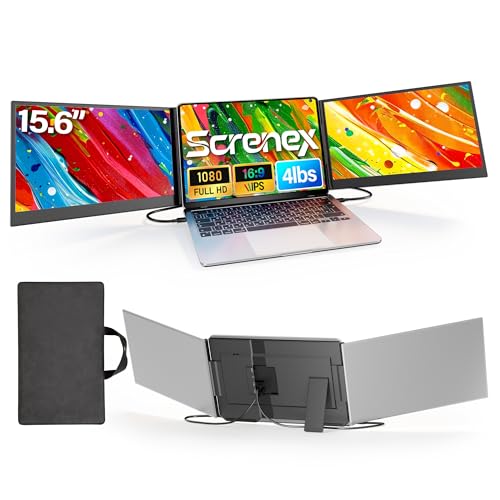
- Two 15.6-inch 1080p IPS side screens
- Free-standing design avoids clamping to the laptop
- Includes cables, power adapter, and carry bag
Best For: Multitaskers who prioritize large screens and laptop protection
Best Cable-Saving Pick
15.6-inch Triple-Screen Extender
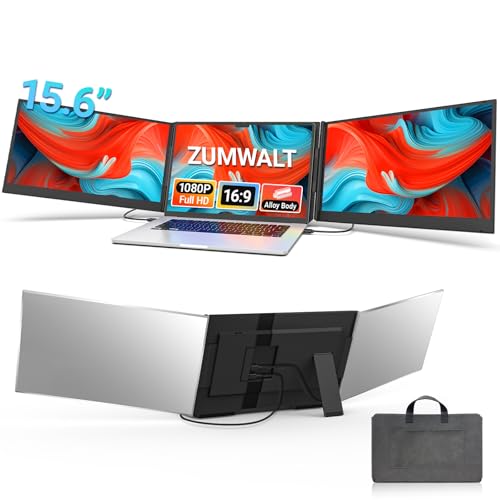
- Two 1080p displays for an expansive workspace
- Streamlined USB-C connection on supported laptops
- Aluminum body and carrying bag for travel
Best For: Professionals who want larger screens with less cable clutter
Best One-Cable Setup
15.6-inch Portable Triple Monitor

- Single Type-C connection on supported laptops
- Matte 1080p IPS display with wide viewing angle
- Ultra-thin design includes cables and carrying bag
Best For: Traveling workers who prioritize compactness and simplified connections
Best Lightweight Option
14-inch FHD Triple-Screen Extender

- Dual 1080p IPS displays with 100% sRGB coverage
- 3.37-pound body for easier travel
- 90-degree adjustable built-in stand
Best For: Students and travelers who need a lighter mobile workstation
Best All-Around Value – KEFEYA 14-inch FHD Laptop Screen Extender
The KEFEYA is a practical choice among laptop screen extenders for users who want a portable second display without installing drivers. Its 14-inch Full HD IPS panel, flexible viewing modes, and broad device compatibility suit work, travel, presentations, and casual entertainment.
Best For: Remote workers, business users, programmers, stock traders, and travelers who need a versatile second screen.
Pros:
- 14-inch 1920×1080 IPS display with 60Hz refresh rate and 300-nit brightness
- Supports mirror, extended, landscape, and portrait modes with 180-degree rotation
- Includes USB-C, USB-C-to-USB-A, and HDMI cables for flexible connections
- Compatible with Windows, macOS, Chrome, Linux, Android, Switch, PS4, Xbox, and more
Cons:
- HDMI connections require an additional USB-A-to-USB-C cable for power
- At 1.04 kg, it is not the lightest option for frequent travel
Choose the KEFEYA if you want a straightforward, widely compatible laptop screen extender with useful orientation options and solid Full HD image quality.
Best for Flexible Setups – Wixzet 15.6-inch Detachable Laptop Screen Extender
The Wixzet stands out among laptop screen extenders because its detachable screens can be used in triple-screen, dual-screen, or standalone configurations. With multiple folding and rotation options, it is designed for users who want a customizable workstation at home, in the office, or on the road.
Best For: Remote professionals, designers, programmers, and travelers who want detachable screens and multiple workspace layouts.
Pros:
- Supports more than 11 configurations, including triple-screen and standalone use
- 15.6-inch 1080p IPS displays with HDR, 120% sRGB, and 300-nit brightness
- Each detachable screen weighs 1.5 pounds and includes a carrying case
- 235-degree folding and 90-degree rotation provide broad positioning flexibility
Cons:
- Each screen’s weight contributes to a listed total item weight of 5 pounds
- Two USB-C ports are needed for the simplest two-cable setup
- HDMI use requires a separate USB-A-to-USB-C power connection
The Wixzet is a strong pick when configuration flexibility matters more than minimum weight. Its detachable design makes it more adaptable than a fixed laptop screen extender.
Best Dual-Screen Productivity Pick – KYY 15.6-inch Triple Screen Extender
The KYY is a laptop screen extender built around two additional 15.6-inch displays, creating a spacious triple-screen workstation. Its aluminum construction, adjustable stand, and screen rotation make it especially useful for office-based multitasking and collaborative viewing.
Best For: Stock traders, financial analysts, designers, and professionals who need two large auxiliary displays.
Pros:
- Two 15.6-inch Full HD IPS screens with 178-degree viewing angles
- One USB-C-to-USB-C cable can provide a simpler connection when supported
- Built-in stand adjusts up to 90 degrees, while screens rotate from 0 to 360 degrees
- Aluminum alloy exterior includes blue-light filtering and flicker-free features
Cons:
- Drivers must be downloaded before use
- Not compatible with PS5, Xbox Series X, and other gaming consoles
- Its dual-screen design is larger and less compact than a single portable monitor
The KYY makes sense for users who value screen area and positioning control. Confirm driver and USB-C compatibility before buying, particularly if you need a quick plug-and-play setup.
Best for Vertical Workspace – 16-inch 1200p Ultra-Slim Triple Monitor
This 16-inch model is a laptop screen extender for users who want more vertical workspace than standard 1080p panels provide. Its 1920×1200 resolution, 16:10 aspect ratio, slim aluminum construction, and two-cable setup are aimed at productivity-focused travel and mobile offices.
Best For: Professionals, students, coders, traders, and content creators who benefit from extra document and webpage height.
Pros:
- Dual 16-inch IPS screens provide 1920×1200 resolution and a 16:10 workspace
- 350-nit brightness and 100% color gamut support clear, vibrant visuals
- Two USB-C cables enable a driver-free triple-screen setup when the laptop has two full-featured USB-C ports
- 6.5mm-thick screens use a lightweight aluminum alloy frame
Cons:
- The simplest setup requires two full-featured USB-C ports on the laptop
- Glossy screens may be less suitable for bright environments than matte panels
- The listed item weight is 4.6 pounds
Pick this extender if vertical screen space is a priority. Its 16:10 panels are particularly useful for documents, spreadsheets, coding, and webpages, while the slim frame helps with portability.
Best Triple-Screen Travel Pick – Blackview DCM6 Triple Laptop Screen Extender
For shoppers comparing laptop screen extenders, the Blackview DCM6 stands out as a lightweight triple-screen setup with a 14.1-inch 1080p display, broad operating-system compatibility, and several connection options. Its integrated design is intended for 13- to 17-inch laptops and packs into the included protective case.
Best For: Frequent travelers and mobile professionals who want three-screen multitasking without carrying a heavier setup.
Pros:
- Triple-screen operation with mirror, extended, landscape, and portrait modes.
- Lightweight 2-pound, 0.17-inch-thin design with a protective case.
- 14.1-inch 1080p IPS display with 300 nits brightness and 100% sRGB coverage.
- Supports Windows, Mac, ChromeOS, Android, Linux, and compatible USB-C devices.
Cons:
- Some connection setups require multiple cables and, depending on the laptop, external power.
- Compatibility depends on having suitable full-function USB-C, HDMI, or adapter connections.
Choose the DCM6 if portability and a full triple-screen workspace matter more than the simplest cable arrangement. Its TÜV SÜD-certified blue-light filtering and 24-month warranty add useful reassurance for extended use.
Best Lightweight Dual-Screen Pick – Ultra-Portable 14.2-inch Laptop Extender
This laptop screen extender is a practical dual-display choice for users who want a quick, lightweight workstation. Its 14.2-inch 1080p IPS screen supports extended, mirrored, and portrait modes, while included USB-C, HDMI, and USB-A cables accommodate laptops with different connection options.
Best For: Remote workers, students, programmers, and frequent travelers seeking a light second screen for 14- to 17.3-inch laptops.
Pros:
- Weighs 1.87 pounds and measures 0.27 inches thin for easier travel.
- 1080p IPS display with 300 nits brightness and a 0-226-degree adjustable viewing angle.
- No-driver setup through USB-C, or HDMI plus USB-A when full-function USB-C is unavailable.
- Compatible with Windows, macOS, ChromeOS, Linux, and Android.
Cons:
- Provides a dual-monitor setup rather than the triple-screen arrangement offered by some extenders.
- Non-USB-C connections require more than one cable.
The main appeal is balance: this model keeps weight low while preserving a useful 1080p display and flexible positioning. It is a strong fit when portability and straightforward setup are higher priorities than maximum screen count.
Best Standalone Triple-Screen Pick – 15.6-inch P7 Laptop Screen Extender
Among laptop screen extenders, the P7 is designed for users who prefer a free-standing triple-monitor setup rather than panels hanging from the laptop display. It uses two 15.6-inch 1080p IPS screens, a widened non-slip stand, and a carry case for creating a larger workspace at home, in an office, or while traveling.
Best For: Multitaskers who want larger side screens and a standalone design that avoids clamping onto the laptop display.
Pros:
- Two 15.6-inch 1080p IPS panels provide a spacious triple-screen workspace.
- Free-standing design helps avoid screen scratches and hinge stress.
- Supports mirror, extended, and portrait modes across Windows, Mac, Android, and Chrome OS.
- Includes connection cables, power adapter, quick guide, and carrying handbag.
Cons:
- At 3.9 pounds, it is heavier than the other listed options.
- Laptops without suitable full-function USB-C ports may require an H5-T cable, HDMI, USB-A power, and driver installation.
- Its 15.6-inch panels create a larger setup that may be less convenient in tight spaces.
The P7 makes the most sense when screen size and laptop protection outweigh minimum carry weight. Two USB-C cables can provide plug-and-play operation on compatible laptops, but shoppers should verify ports carefully—especially MacBook users.
Best Cable-Saving Pick – 15.6-inch Triple-Screen Extender
This 15.6-inch laptop screen extender is designed for users who want a cleaner triple-screen setup with fewer cables. Its two 1080p displays support extend, mirror, and portrait modes, while the aluminum shell and included carrying bag make it practical for mobile work.
Best For: Professionals who need a spacious triple-screen workspace for multitasking at home, in the office, or while traveling.
Pros:
- Uses two USB-C cables for full functionality when the laptop supports it, helping reduce cable clutter.
- Dual 15.6-inch 1080p displays offer a large, 178-degree viewing area.
- Lightweight aluminum construction, leather carry bag, and no top clip help portability and laptop-hinge comfort.
- Supports Windows, Mac, Chrome, Android, and Switch devices, with alternate cabling available for some systems.
Cons:
- M1/M2/M3 MacBooks and laptops without full-featured USB-C may require an H5-T cable, HDMI, USB-A, external power, and driver installation.
- At about 4 pounds, it is portable but heavier than the smaller 14-inch option.
This is a strong choice among laptop screen extenders if you prioritize larger displays and a streamlined connection setup. Confirm your laptop’s port support before ordering.
Best One-Cable Setup – 15.6-inch Portable Triple Monitor
This laptop screen extender focuses on simplified installation: laptops with one full-featured Type-C port can connect both screens with a single cable after the driver is installed. The 15.6-inch matte 1080p display is built for multitasking, presentations, and mobile work.
Best For: Remote workers and travelers who value a thin triple-screen setup and convenient single-port connectivity.
Pros:
- One full-featured Type-C cable can connect both screens after driver installation.
- 15.6-inch 1080p IPS display has a matte finish and 178-degree viewing angle.
- Approximately 4 mm thick per screen and includes a carrying bag for portability.
- Supports Windows, Mac, Chrome, Android, Linux, Dex, and Switch devices.
Cons:
- Driver installation is required before use.
- If the laptop cannot provide enough power, an additional power supply may be needed.
- Compatibility and setup should be checked carefully, particularly across different operating systems and devices.
Choose this model when one-cable convenience matters more than a completely driver-free setup. Its thin design and broad stated compatibility make it well suited to portable workstations.
Best Lightweight Option – 14-inch FHD Triple-Screen Extender
This 14-inch laptop screen extender balances portability with image quality. Its dual 1080p IPS displays provide 300 nits brightness, 100% sRGB coverage, and adjustable picture settings, while the built-in stand adjusts up to 90 degrees for flexible positioning.
Best For: Students, digital nomads, and business travelers who want a lighter triple-screen setup that fits easily into a backpack.
Pros:
- Dual 1080p IPS screens offer 300 nits brightness, 100% sRGB coverage, and a 178-degree viewing angle.
- Supports extend, mirror, portrait, and presentation modes.
- Lightweight 3.37-pound design with an approximately 0.3-inch slim body.
- Built-in telescopic stand adjusts up to 90 degrees for flexible viewing.
Cons:
- Laptops without full-featured USB-C and M1/M2/M3 MacBooks may require an H5-T cable, HDMI, USB-A, external power, and driver installation.
- The 14-inch screens provide less display area than the 15.6-inch alternatives.
This is the most travel-friendly choice of the three, especially if weight and bag space are priorities. Its color coverage and adjustable stand also make it appealing for extended work sessions.
How We Picked the Best Laptop Screen Extenders
We focused on the features that matter most when adding portable displays to a laptop: screen size, resolution, panel type, laptop compatibility, connection options, weight, thickness, and overall ease of setup. The selection includes 14-inch, 15.6-inch, and 16-inch models, so shoppers can compare portability with viewing area.
We also considered whether each design provides one additional screen or a triple-screen arrangement, since the best choice depends on your workload and how often you travel. USB-C and HDMI support were treated as important practical considerations because laptop ports and power requirements vary widely.
Quick Comparison
| Best For | Recommended Configuration | What to Prioritize |
|---|---|---|
| Frequent travelers | Lightweight 14-inch extender | Low weight, slim construction, protective storage |
| Office multitasking | 15.6-inch dual-screen model | Full HD resolution, stable mounting, broad compatibility |
| Maximum workspace | Triple-screen extender | Hinge range, power delivery, laptop support |
| Creative and spreadsheet work | 15.6-inch or 16-inch model | Larger viewing area and sharp IPS panels |
Key Buying Factors for Laptop Screen Extenders
Laptop Fit and Mounting
Check the stated laptop-size range before buying. An extender must sit securely behind or beside the display without blocking the keyboard, ports, webcam, or ventilation. Detachable designs can offer more flexibility, particularly when the laptop lid or hinge layout is unusual.
Ports, Cables, and Power
USB-C is convenient, but not every USB-C port supports video output. Some laptops require HDMI for the picture and USB for power, while triple-screen models may need multiple connections or additional power. Confirm your laptop’s port capabilities and inspect the included cable requirements.
Resolution and Panel Quality
Full HD 1080p is usually sufficient for documents, email, coding, and general multitasking. IPS panels generally provide better viewing angles and more consistent color than basic alternatives. A 1200p display can provide additional vertical workspace, which is useful for long documents and spreadsheets.
Weight, Thickness, and Durability
Portable displays add noticeable weight to a laptop bag. If you commute or work from cafés, compare the listed weight and thickness carefully. A slightly heavier extender may be worthwhile for a larger screen, stronger hinges, or a sturdier frame.
Who Should Buy Which Laptop Screen Extenders?
Choose a lightweight 14-inch model if portability is your priority and you mainly need one extra display. A 15.6-inch extender is a balanced option for everyday office work, especially when you want more comfortable text and window sizing. Triple-screen models are best for users who regularly compare documents, monitor dashboards, code, edit media, or manage multiple applications at once.
Before ordering, measure your laptop, count its available ports, and decide whether you need a detachable setup. The right laptop screen extender should expand your workspace without making your computer difficult to carry or connect.