Sharp astrophotography depends on repeatable focus, especially when temperature changes, long exposures, and narrow depth of field make tiny adjustments visible in every frame.
We compare 10 options spanning motorized focus upgrades, manual precision focusers, guide-scope accessories, and complete imaging telescopes with astrophotography-focused optical designs.
Best 10 Telescope Focusers for Astrophotography Picks for 2026
Best Motorized Upgrade
Celestron Focus Motor for SCT and EdgeHD

- Computer-controlled, hands-free focusing
- Backlash compensation and indexed positions
- Mount or USB power options
Best For: Compatible Celestron SCT, EdgeHD, and RASA-style optical tubes
Best Temperature-Aware Option
Akozon Automatic Telescope Focuser

- Onboard temperature sensor
- Automatic or hand-controller focusing
- Supports drivers and third-party software
Best For: Astrophotography setups needing environmental focus adaptation
Best Complete Imaging Package
SVBONY SV503 80ED with Field Flattener

- 2-inch dual-speed 1:10 focuser
- Included 0.8x reducer and field flattener
- Portable 2.5 kg ED refractor OTA
Best For: Deep-sky imaging with a ready-to-use 80ED optical system
Best Guide-Scope Focuser
Astromania 1.25-inch Double Helical Focuser

- Fixed orientation prevents camera rotation
- 0.05 mm precision and 10 mm travel
- All-metal guide-scope construction
Best For: Manual focusing of guide scopes and finder scopes
Best Integrated Focuser

- Dual-speed 1:10 focuser for fine adjustments
- 90mm travel suits imaging accessories
- 360° rotator simplifies camera alignment
Best For: Astrophotographers wanting a complete ED refractor with imaging-friendly focusing controls
Best Upgrade Focuser
16-Bearing Astrophotography Focuser

- 16-bearing travel design for stable movement
- Two-speed controls with oversized hand wheels
- 360° rotation supports composition changes
Best For: Astrophotographers upgrading a compatible telescope with a manual focuser
Best Compact APO Focuser
- 2.5-inch dual-speed 1:10 focuser
- 87mm back focus for camera setup planning
- Designed to reduce full-frame vignetting
Best For: Deep-sky imagers wanting a compact APO OTA with camera-friendly focusing
Wide-Field Precision Pick
SV555 APO Astrophotography Telescope

- Petzval triplet design for flat-field imaging
- Full-frame compatible with 44mm coverage
- EAF-ready precision focusing support
Best For: Full-frame wide-field astrophotography and portable imaging
Large-Aperture Fine-Focus Pick
SV550 122mm Triplet APO Telescope

- 122mm aperture for increased light gathering
- 2.5-inch dual-speed 1:10 focuser
- FPL-51 triplet APO optical design
Best For: Deep-sky imaging and observation with precise manual focusing
Portable Flat-Field Pick

- Quadruplet self-flattened optical design
- Lightweight 71mm aperture refractor
- 360-degree rotatable focus assembly
Best For: Portable deep-sky imaging and mixed photo/visual use
Best Motorized Upgrade – Celestron Focus Motor for SCT and EdgeHD
For owners seeking telescope focusers for astrophotography, the Celestron Focus Motor adds electronic, hands-free focusing to compatible Schmidt-Cassegrain, EdgeHD, and Rowe-Ackermann Schmidt Astrograph optical tubes. Computer control, indexed positions, multiple speeds, and backlash compensation make it suited to repeatable imaging workflows.
Best For: Celestron SCT and EdgeHD users who want remote or computer-controlled focusing.
Pros:
- Supports computer control and compatible Celestron computerized mount hand controllers.
- Offers multiple speed rates, automatic goto indexed focuser positions, and backlash compensation.
- Can draw power from a compatible mount or directly from a computer over USB.
- Includes Windows Focuser Utility software and a two-year US warranty.
Cons:
- Compatibility is limited to listed Celestron optical tubes.
- It is an electronic motor upgrade rather than a complete standalone telescope focuser.
This is a strong choice when remote operation and repeatable focus adjustments matter more than universal compatibility. Confirm that your optical tube appears on Celestron’s compatibility list before buying.
Best Temperature-Aware Option – Akozon Automatic Telescope Focuser
The Akozon automatic focuser is a flexible option for shoppers comparing telescope focusers for astrophotography. Its onboard temperature sensor can work with software to adapt focus as conditions change, while supported drivers and third-party software enable integration with a range of devices.
Best For: Astrophotographers wanting automated focusing with temperature-based environmental adaptation.
Pros:
- Built-in temperature sensor supports software-assisted focus adjustments as conditions change.
- Offers one-click automatic focusing and manual control through the hand controller.
- Designed for plug-and-play use across various telescope setups.
- Compatible with drivers and third-party software.
Cons:
- The supplied details do not identify specific telescope mounting hardware or optical-tube compatibility.
- Software and driver compatibility should be confirmed for your imaging system before purchase.
Its temperature-sensing feature makes it appealing for imaging sessions where focus can shift with environmental changes. Because the notes do not specify mounting standards, verify mechanical fit and software support first.
Best Complete Imaging Package – SVBONY SV503 80ED with Field Flattener
Although it is a complete refractor rather than a standalone motor focuser, the SVBONY SV503 80ED addresses key focusing needs for telescope focusers for astrophotography with its 2-inch dual-speed focuser and 1:10 micro-adjustment. The included 0.8x field flattener is designed to produce sharper edge-to-edge images and a faster imaging system.
Best For: Deep-sky imagers wanting a portable 80mm ED telescope with precise manual focusing and a field flattener.
Pros:
- 2-inch dual-speed focuser provides 1:10 micro-adjustment for precise manual focus.
- Included 0.8x reducer/field flattener supports faster imaging and a wider field.
- Designed for clear, edge-to-edge imaging with large sensors.
- Lightweight 2.5 kg OTA helps reduce mount load.
Cons:
- Focus is manual, not electronic or computer controlled.
- This is an optical-tube and field-flattener package, not a focuser-only upgrade.
For buyers building an imaging system from the ground up, this package combines a fine-adjustment focuser with optics and flattening accessories in one setup. It is less suitable if you only need to motorize an existing telescope.
Best Guide-Scope Focuser – Astromania 1.25-inch Double Helical Focuser
The Astromania double helical focuser is a compact manual choice among telescope focusers for astrophotography, especially for guide scopes and finder scopes. Its fixed orientation prevents a mounted camera or eyepiece from rotating, while 0.05 mm precision and 10 mm of travel support repeatable adjustments.
Best For: Guide scopes, finder scopes, and telephoto-lens setups using 1.25-inch accessories.
Pros:
- Fixed orientation keeps the guide star’s field of view stable while focusing.
- Provides 0.05 mm accuracy with a 10 mm focusing stroke.
- All-metal construction is intended to minimize flexure and thermal expansion.
- Supports autoguider cameras, eyepieces, and 1.25-inch accessories.
Cons:
- Manual operation provides no computer or motor control.
- Compatibility depends on the required M42x0.75 or included adapter interfaces.
- The 1.25-inch format is primarily suited to guide and finder scopes.
This is a practical add-on when stable, fine manual focus is the priority in a guiding train. Check thread dimensions and available backfocus before ordering, particularly when adapting it to an existing rack-and-pinion focuser.
Best Integrated Focuser – SV503 102mm ED Refractor
For photographers comparing telescope focusers for astrophotography, the SVBONY SV503 102mm ED refractor offers a capable built-in focusing setup rather than requiring an immediate focuser upgrade. Its dual-speed 1:10 focuser, 90mm of travel, and 360-degree field rotator are useful when adding imaging accessories and fine-tuning camera composition.
Best For: Astrophotographers who want a larger-aperture ED refractor with integrated fine focusing and camera-rotation controls.
Pros:
- Dual-speed 1:10 focuser supports precise critical-focus adjustments.
- 90mm of focus travel accommodates accessories such as filter wheels and field flatteners.
- 360-degree field rotator helps align a camera without rotating the optical tube.
- 102mm aperture, f/7 optics, and S-FPL51 ED glass support bright, detailed images with reduced color fringing.
Cons:
- Manual focus means electronic focusing is not built in.
- This is a complete 102mm refractor rather than a standalone replacement focuser.
- A finderscope is not included according to the listed details.
The SV503 is a strong choice when you need both an imaging-ready refractor and a versatile focusing assembly. Its long travel and rotator are particularly practical for a camera train, while the ED optics broaden its use for visual observing.
Best Upgrade Focuser – 16-Bearing Astrophotography Focuser
Telescope Focuser 16-Bearing Travel with Convex Adapter Ring for Astrophotography
Check Price On AmazonThis TeSeek focuser is a focused upgrade option for photographers evaluating telescope focusers for astrophotography. Its 16-bearing travel design, two-speed controls, large adjustment wheels, and 360-degree rotation prioritize smooth manual focusing and composition adjustments in a camera setup.
Best For: Users seeking a standalone manual focuser with rotation, fine adjustment, and an emphasis on precise interface locking.
Pros:
- 16-bearing travel design and high interface precision support stable adjustment.
- Two-speed components provide coarse and fine manual focusing.
- Large 38mm coarse and 28mm fine wheels are easier to turn accurately.
- 360-degree rotation helps with photographic composition and visual inspection.
Cons:
- Compatibility with a specific telescope is not provided in the listed details.
- It is manual and does not include an electronic focusing motor.
- The product listing identifies a convex adapter ring, so buyers should verify the required interface before ordering.
Choose this model when you are upgrading an existing optical tube and want substantial hand wheels plus rotational adjustment. The missing telescope-compatibility information makes measuring the mounting interface an important pre-purchase step.
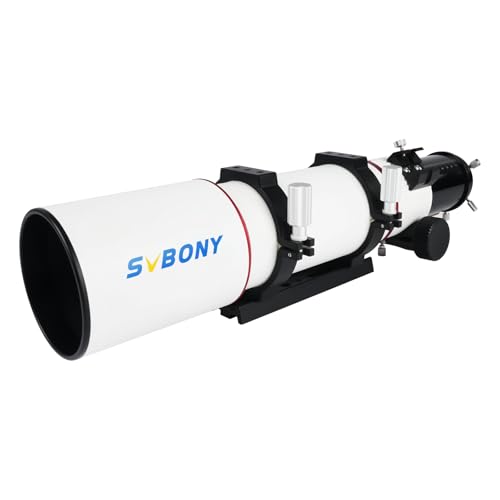
Best Compact APO Focuser – SV550 80mm Triplet Refractor
For a compact imaging setup, the SVBONY SV550 combines an 80mm triplet APO optical tube with a 2.5-inch dual-speed 1:10 toothed focuser. Among telescope focusers for astrophotography, its 87mm back-focus distance and reduced-vignetting design are especially relevant to photographers using full-frame cameras.
Best For: Deep-sky imagers who want a portable 80mm apochromatic refractor with a dual-speed focuser and camera-oriented back focus.
Pros:
- 2.5-inch dual-speed 1:10 focuser enables controlled manual focusing.
- 87mm back-focus distance supports camera setup planning.
- Focuser design helps reduce vignetting with full-frame cameras.
- Air-spaced triplet APO optics with S-FPL51 ED glass are designed to reduce chromatic aberration.
Cons:
- Manual focus does not include an electronic focusing drive.
- Its 80mm aperture gathers less light than the 102mm SV503.
- The product is an OTA, so a mount and other imaging accessories are needed separately.
The SV550 is a sensible fit for photographers prioritizing compact size, color control, and full-frame compatibility. Its dual-speed toothed focuser and stated back focus make it easier to plan a camera train, although the manual operation may encourage a separate motor upgrade later.
Wide-Field Precision Pick – SV555 APO Astrophotography Telescope
For photographers comparing telescope focusers for astrophotography, the SVBONY SV555 combines a Petzval triplet optical design with an upgraded precision focus system. Its fine-adjustment focuser, full-frame compatibility, and pre-installed EAF adapter support make it suited to wide-field camera work.
Best For: Full-frame deep-sky imaging, travel setups, and photographers who want EAF-ready focusing support.
Pros:
- Petzval triplet design is intended to reduce coma and chromatic aberration while supporting a flatter field.
- Enhanced focus travel and smooth fine adjustment help with accurate framing.
- Supports 44mm full-frame sensors and includes a 2-inch filter holder.
- Includes an EAF mount kit compatible with ZWO EAF Gen1.
Cons:
- Manual focus operation means electronic focusing hardware is not included.
- The supplied specifications list no eyepiece or finderscope.
The SV555 is a strong option when imaging flexibility and compact field use matter more than visual observing accessories. Its integrated EAF support gives astrophotographers a practical upgrade path.
Large-Aperture Fine-Focus Pick – SV550 122mm Triplet APO Telescope
The SVBONY SV550 is a substantial refractor for astrophotographers who need more light-gathering capability and precise manual focusing. Its 2.5-inch dual-speed toothed focuser provides separate fast and fine focusing controls, while the triplet APO design is intended to improve color correction.
Best For: Deep-sky imaging and observation where a 122mm aperture and fine manual focus control are priorities.
Pros:
- 122mm aperture gathers more light for detailed views of deep-sky targets.
- FPL-51 triplet APO optics are designed to reduce chromatic aberration.
- Dual-speed 2.5-inch focuser offers a 1:10 ratio for precise adjustments.
- Long 87mm focus travel and a 300mm dovetail help with setup and balance.
Cons:
- At approximately 6.44kg, it is less portable than smaller refractors.
- It uses manual focus, so automated focusing requires additional equipment.
The SV550 favors aperture and focusing control over compactness. Its dual-speed focuser is particularly useful for dialing in sharp focus during demanding deep-sky sessions.
Portable Flat-Field Pick – Askar 71F ED Refractor OTA
The Askar 71F is a lightweight flat-field refractor for photographers who want a manageable setup for deep-sky imaging. Its 71mm aperture, 493.9mm focal length, and rotatable focus design support composition changes, while the included 230mm Vixen dovetail plate helps simplify mounting.
Best For: Portable astrophotography, visual observation, and users who value a compact self-flattened optical system.
Pros:
- Quadruplet air-spaced APO design provides a self-flattened imaging configuration.
- Approximately 2.5kg for the OTA makes it practical to carry and use in the field.
- Focus assembly rotates 360 degrees to help with photographic composition.
- Includes a 230mm Vixen dovetail plate and supports camera and smartphone use.
Cons:
- The 71mm aperture gathers less light than the larger SV550.
- Manual/mechanical focusing does not include electronic focusing automation.
- The supplied specification lists an altazimuth mount rather than a dedicated tracking mount.
The Askar 71F is a sensible choice for portability and straightforward flat-field imaging. Its rotating focus design adds practical flexibility when switching between framing and visual observation.
How We Picked the Best Telescope Focusers for Astrophotography
We evaluated these products for focusing control, compatibility, imaging practicality, mechanical precision, and the type of astrophotography setup they support. Because the list includes both standalone focusers and telescope systems with integrated imaging features, we considered whether each option solves a genuine focusing need rather than comparing them as identical accessories.
Priority went to products that can deliver fine, repeatable adjustments, support stable camera or guide-scope connections, and fit common observing workflows. Motorized models were assessed for hands-free operation and automation potential, while manual focusers were judged on travel, rigidity, and adjustment sensitivity.
Quick Comparison
| Best For | Look For | Typical Advantage |
|---|---|---|
| Remote or automated imaging | Motor compatibility and controller support | Repeatable focus changes without touching the telescope |
| Fine manual focusing | Helical or multi-bearing construction | Precise adjustment with a simple setup |
| Guide scopes | 1.25-inch fit and secure locking | Accurate guide-camera positioning |
| Wide-field deep-sky imaging | Flat-field optics and rigid camera connection | Sharper stars toward the edges of the frame |
| Large refractor systems | Load capacity and focuser stability | Better support for heavier cameras and accessories |
Key Buying Factors for Telescope Focusers for Astrophotography
Compatibility
Check the telescope design before buying. A dedicated SCT or EdgeHD motor is not interchangeable with a refractor focuser, while a guide-scope focuser may use a smaller 1.25-inch interface. Confirm mounting points, drawtube size, adapter requirements, and whether your camera reaches the correct back focus.
Precision and Repeatability
Astrophotography benefits from small, controlled movements. Fine-pitch helical mechanisms and multi-bearing systems can make manual focusing easier, but motorized focusers are preferable when you need repeatable autofocus routines or want to avoid vibration from touching the telescope.
Load Capacity and Rigidity
A focuser must support the camera, filter wheel, adapters, and sometimes an off-axis guider without sagging. A rigid connection is particularly important with long focal lengths, where even slight tilt or flexure can soften stars or create uneven corners.
Optical Design and Field Coverage
If you are choosing a complete telescope rather than an accessory, consider aperture, focal ratio, field flattening, and the camera sensor size. Flat-field and apochromatic designs can reduce edge distortion and chromatic aberration, but they may require specific reducers, flatteners, or back-focus spacing.
Who Should Buy Which Telescope Focusers for Astrophotography?
Choose a motorized SCT-compatible focuser if you already own a compatible Schmidt-Cassegrain or EdgeHD telescope and want remote focusing. Pick a compact manual or helical focuser for a guide scope, portable rig, or visual setup where simplicity matters. A multi-bearing travel focuser is a better fit when you need stronger support for imaging accessories and more controlled manual travel.
If you are building a complete deep-sky imaging rig, the listed ED, triplet APO, and flat-field telescope systems may be more useful than a replacement focuser alone. They are suited to buyers who want optical performance and astrophotography compatibility in one package. Before ordering, verify camera back focus, mounting hardware, required adapters, and the focuser’s supported payload.