Long-exposure astrophotography demands more than accurate polar alignment. A capable guide scope or off-axis guider helps your mount correct tracking errors so stars stay round and fine detail remains sharp.
This roundup compares 10 options, from compact mini guide scopes to larger 50mm and 60mm models, plus an off-axis guider and compatible guide-camera hardware. The right choice depends on your imaging telescope, camera, mount, and targets.
Best 10 Telescope Guide Scopes for Long Exposures Picks for 2026
Lightweight APO Guide Scope

- 50mm f/4.8 APO doublet with ED glass
- Includes finder stalk and Vixen-style rail
- Built-in T-threads for optional astrograph use
Best For: Compact astrophotography and flexible mounting
Precision Off-Axis Guiding
Celestron Deluxe Off-Axis Guider

- Guides through the main telescope
- Large 12.5mm prism and 48mm clear aperture
- Includes DSLR and astronomy-camera adapters
Best For: SCT and EdgeHD long-exposure imaging
Multi-Use Helical Guide Scope
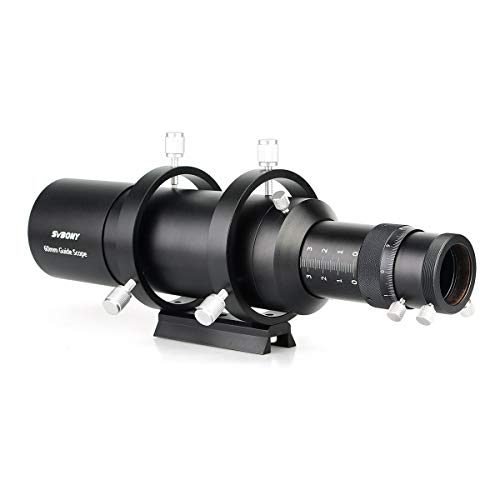
- Helical focuser preserves device orientation
- Up to 35mm of additional back-travel
- Can double as a finder with an optional eyepiece
Best For: Flexible guiding and finder-scope setups
Compact Color Guide Camera

- 1.23MP color CMOS sensor with small pixels
- USB 2.0 and ST4 guiding interfaces
- Supports PHD2, NINA, MDL, and SKY-X
Best For: Adding autoguiding to a compatible guide scope
Bright-Image Finder
9x50 Right-Angle Correct-Image Scope

- Bright 50mm objective for locating targets
- Upright image with crosshair reticle
- Compatible Synta-style dovetail base
Best For: Beginners needing comfortable visual target acquisition
Compact Autoguiding Option
SV165 40mm F4 Mini Guide Scope

- Designed for OTAs up to 700mm focal length
- Supports 1.25-inch and M42 camera interfaces
- Front focuser and adjustable six-point guide ring
Best For: Compact guided imaging setups with compatible cameras
Precision Focusing Choice

- 60mm aperture with 240mm focal length
- Fine helical focusing with compression ring
- Includes rings and Synta-style dovetail bar
Best For: Longer-focal-length astrophotography and precise manual focusing
Best with Extra Features
SV208 8x50 Illuminated Finderscope

- 50mm objective with a 7.3° field of view
- Correct-image prism for intuitive viewing
- Illuminated glass reticle for dark skies
Best For: Visual target acquisition and illuminated finding
Precision Guiding Pick
Alstar 60mm Compact Deluxe Guidescope

- 60mm aperture with 240mm focal length
- 48mm helical focusing range with micro-focus
- T-thread and Synta-style mounting compatibility
Best For: Astrophotography setups needing precise manual focus
Lightweight Wide-Field Option
Astromania 30mm F4 Mini Guidescope

- Compact 30mm F4 optics for a broad field
- T2 adapter supports guide cameras and some DSLRs
- 90° diagonal enables comfortable visual finding
Best For: Portable rigs needing lightweight guiding and finding
Lightweight APO Guide Scope – Sky-Watcher EvoGuide 50DX
The Sky-Watcher EvoGuide 50DX is a lightweight 50mm apochromatic doublet designed for telescope guide scopes for long exposures. Its 242mm focal length, ED glass, helical focuser, and included mounting hardware make it a practical choice for astrophotographers who want a compact, adaptable setup.
Best For: Astrophotographers seeking a lightweight guide scope that can also support visual observing or optional astrograph use.
Pros:
- 50mm f/4.8 APO doublet uses matched ED glass.
- Includes a finder stalk and Vixen-style mounting rail.
- Built-in T-threads support optional astrograph adaptation.
- Compact 242mm focal length and 1.25-inch helical focuser.
Cons:
- The astrograph adapter is optional and not included.
- Manual focusing requires hands-on adjustment.
The EvoGuide 50DX stands out when low weight, flexible mounting, and dual-purpose use matter. Its included mounting options simplify installation, while the APO optics and helical focuser make it a well-rounded guide-scope platform.
Precision Off-Axis Guiding – Celestron Deluxe Off-Axis Guider
The Celestron Deluxe Off-Axis Guider is an alternative to telescope guide scopes for long exposures, using a prism to guide through the main telescope instead of a separate guide tube. Its large prism, helical focuser, and 48mm clear aperture are aimed at accurate guiding with DSLR and astronomy-camera setups.
Best For: Schmidt-Cassegrain and EdgeHD users who want off-axis guiding without adding a separate guide scope.
Pros:
- Off-axis design can improve guiding accuracy over a separate guide scope.
- 12.5mm multi-coated prism has aluminized backing for strong illumination.
- 48mm clear aperture supports full-frame cameras without vignetting.
- Includes adapters for DSLR, Nightscape CCD, M42, and M48 connections.
Cons:
- Requires careful manual focusing of the helical focuser.
- Its compatibility is especially oriented toward SCT and EdgeHD systems.
For demanding long-exposure work, the Deluxe Off-Axis Guider avoids differential flexure associated with a separate guide scope by using the imaging telescope’s optical path. It is a specialized choice, but the large prism and included adapters add useful system flexibility.
Multi-Use Helical Guide Scope – SVBONY SV106 60mm Guide Scope
The SVBONY SV106 combines a 60mm-class guide scope design with a built-in helical focuser, making it a versatile option among telescope guide scopes for long exposures. The focuser preserves device orientation while focusing, and the scope can also work as a straight-through finder with an optional 1.25-inch eyepiece.
Best For: Astrophotographers who want a guide scope that can double as a finder and accommodate different camera or eyepiece setups.
Pros:
- Helical focuser provides 8mm of precise travel without rotating the field.
- Telescoping drawtube adds up to 35mm of back-travel.
- Male T-threads support threaded guide-camera attachment.
- Can function as a finder with an optional 1.25-inch eyepiece.
Cons:
- An eyepiece is required for finder-scope use.
- Manual focusing may require adjustment for each camera setup.
- Specifications identify the objective as 50mm despite the 60mm product designation.
The SV106 is appealing for users who value versatility and focusing control. Its non-rotating helical mechanism and extra drawtube travel can simplify camera positioning, while the finder-scope capability gives the hardware a second role.
Compact Color Guide Camera – SVBONY SV905C Guide Camera
The SVBONY SV905C is a compact guide camera rather than a standalone optical tube, but it can complete a setup built around telescope guide scopes for long exposures. Its 1.23MP color CMOS sensor, small pixels, USB 2.0 connection, and ST4 port are designed for autoguiding and compatibility with several guiding platforms.
Best For: Users needing a compact 1.25-inch color guide camera for compatible guide scopes and autoguiding software.
Pros:
- 1/3-inch 1280×960 CMOS sensor with 3.75-micron pixels.
- High peak QE and low read noise support faint guide stars.
- USB 2.0 output and ST4 guide-star interface.
- Compatible with PHD2, MDL, NINA, SKY-X, and other software.
Cons:
- Not compatible with ASI AIR.
- It is a guide camera, so a separate guide scope or OAG is required.
- Driver software must be downloaded separately.
The SV905C is a practical add-on for a compatible guiding system, especially when a small 1.25-inch camera body and ST4 connectivity are useful. Confirm software and hardware compatibility before buying, particularly if your setup relies on ASI AIR.
Bright-Image Finder – 9×50 Right-Angle Correct-Image Scope
For telescope guide scopes for long exposures, the Astromania 9×50 is primarily a visual finder rather than a dedicated autoguiding scope. Its bright 50mm objective, upright correct-image view, and crosshair reticle make it useful for locating and centering targets before an imaging session.
Best For: Beginners and visual observers who want a comfortable right-angle finder for target acquisition and alignment.
Pros:
- 9×50 optics provide a bright view for locating brighter deep-sky objects.
- Fully multi-coated optics produce an upright, non-reversed image with contrast.
- Crosshair reticle, adjustable alignment, and a rotating focus ring support accurate setup.
- Synta-style dovetail base fits many Sky-Watcher, Vixen, Orion, and GSO finder shoes.
Cons:
- Designed as a finder scope, so the supplied notes do not identify it as an autoguiding scope.
- Manual alignment and focusing require initial setup before imaging.
The stable rubber focus ring and 90-degree viewing angle are helpful during long observing sessions, but astrophotographers seeking active guiding should choose a purpose-built guide scope and camera combination.
Compact Autoguiding Option – SV165 40mm F4 Mini Guide Scope
Among telescope guide scopes for long exposures, the SVBONY SV165 is a compact option for pairing with an autoguiding camera. It is intended for telescopes with focal lengths within 700mm and provides a front focuser, camera interfaces, and adjustable guide-ring support for astrophotography setups.
Best For: Compact deep-sky imaging rigs using compatible 1.25-inch or M42-threaded guide cameras on telescopes up to 700mm focal length.
Pros:
- 40mm fully multi-coated achromatic optics are designed for clear guide-star views.
- 1.25-inch and M42 interfaces support cameras including SV305 Pro, Orion, ZWO, and QHY models.
- Front focuser with a scale helps repeat focus, while the locking ring helps hold focus in use.
- Six-point guide rings allow adjustment of the scope’s alignment with the main telescope.
Cons:
- Recommended for telescope focal lengths within 700mm, limiting use on longer systems.
- If a paired eyepiece cannot focus, the tube length may need to be reduced by removing the red locking ring.
Its short, lightweight design and camera compatibility make it a practical starting point for guided long exposures, provided your telescope and camera match the stated focal-length and interface requirements.
Precision Focusing Choice – 60mm Multi-Use Guide Scope
For telescope guide scopes for long exposures, the Astromania 60mm model offers a larger aperture and a helical focuser aimed at precise autoguiding setup. Its 240mm focal length is specified for astrophotography telescopes up to 1500mm, while the included rings and dovetail bar simplify mounting.
Best For: Astrophotographers who want a versatile 60mm finder and guide scope with fine manual focusing for longer-focal-length imaging systems.
Pros:
- 60mm fully multi-coated objective provides a bright field for finding guide stars.
- 240mm focal length is designed for astrophotography telescopes up to 1500mm focal length.
- Helical focuser offers fine adjustments, a 45mm total focusing range, and a brass compression ring.
- Includes heavy-duty rings, a Synta-style dovetail plate, and T-thread camera attachment.
Cons:
- The larger 60mm assembly, rings, and mounting bar add more equipment and weight than a mini guide scope.
- Manual focusing and alignment require hands-on setup.
This is the most versatile choice of the three for users who want both visual-finder utility and a dedicated guiding platform, especially when precise focus and compatibility with longer imaging telescopes matter.
Best with Extra Features – SV208 8×50 Illuminated Finderscope
For telescope guide scopes for long exposures, the SVBONY SV208 is primarily a finder rather than a dedicated autoguider. Its 50mm, fully multi-coated objective provides a bright, wide 7.3-degree view for locating targets, while the illuminated crosshair can help under very dark skies.
Best For: Visual target acquisition and users who want an illuminated, corrected-image finder with a large field of view.
Pros:
- 50mm objective and 7.3-degree field of view provide a bright, spacious view.
- Correct-image roof prism delivers right-side-up, left-to-right-correct views.
- Dark-field LED illumination makes the glass reticle easier to see in dark conditions.
- Focus and parallax adjustments help align the target and reticle precisely.
Cons:
- It is listed as a finder scope, not a dedicated guide scope for autoguiding.
- Battery-powered illumination adds another component to manage.
- Manual focusing and a 632g weight may be more than needed for a lightweight setup.
The SV208 is a strong choice when easy, accurate target finding matters more than connecting a guide camera. For long-exposure guiding, verify camera compatibility and treat it as a finder unless your setup specifically supports its use as an optical guide scope.
Precision Guiding Pick – Alstar 60mm Compact Deluxe Guidescope
Among telescope guide scopes for long exposures, the Alstar 60mm model is the most purpose-built option here. Its 240mm focal length, fully multi-coated optics, T-thread compatibility, and fine helical focusing are designed to support guide cameras while also working as a finder.
Best For: Astrophotographers seeking a versatile 60mm guide scope with precise manual focusing and broad camera compatibility.
Pros:
- 60mm aperture and 240mm focal length gather light for reliable guide-star viewing.
- 48mm focusing range includes 10mm of micro-focusing adjustment.
- Helical focuser is designed to avoid image rotation during focus changes.
- Includes T-thread compatibility, pipe clamps, and a Synta-style dovetail plate.
Cons:
- At approximately 2 pounds, it may add noticeable weight to a portable rig.
- Manual focusing requires more setup than a simpler fixed-focus mini guider.
- The listed 1.04-degree field of view is narrower than the mini guide scope in this roundup.
The Alstar offers the most adjustment and mounting flexibility of these three products. Its heavier all-metal construction can suit a more substantial astrophotography setup, especially when precise focus and direct guide-camera attachment are priorities.
Lightweight Wide-Field Option – Astromania 30mm F4 Mini Guidescope
For telescope guide scopes for long exposures, the Astromania 30mm mini guide scope emphasizes compactness and a wide field. Its 30mm fully multi-coated achromatic optics, F4 design, T2 adapter, and Synta-style base support both autoguiding and quick visual target acquisition.
Best For: Lightweight astrophotography rigs and users who want one compact scope for guiding and right-angle visual finding.
Pros:
- Compact 30mm F4 design offers a wide field for fast target acquisition.
- Supports autoguider cameras and some T-thread-equipped DSLR accessories through the T2 adapter.
- Includes a 1.25-inch 90-degree diagonal for comfortable visual observing.
- Synta-style dovetail base fits finder bases from several common telescope brands.
Cons:
- The 30mm aperture collects less light than the Alstar’s 60mm system.
- Its 140mm focal length may provide less image scale for guiding than a longer guide scope.
- Compatibility still depends on the specific guide camera and mounting arrangement.
The Astromania is the practical low-weight choice for portable rigs where a broad field and easy installation matter. Its dual-purpose design is convenient, but users seeking maximum guide-star image scale may prefer the longer 240mm Alstar.
How We Picked These Telescope Guide Scopes for Long Exposures
We focused on products that can support autoguiding for deep-sky imaging, while also including practical accessories and alternatives represented in this selection. We considered aperture, focal length, optical design, focusing hardware, mounting convenience, compatibility, and likely suitability for different imaging rigs.
A guide scope is not judged by aperture alone. A stable mounting arrangement, accurate focus, and a guide camera that can detect enough stars are equally important. Off-axis guiding can be especially useful when flexure between the imaging and guide systems would otherwise limit exposure length.
Quick Comparison
| Type | Best For | Main Advantage | Watch For |
|---|---|---|---|
| 30–40mm mini guide scope | Portable and small imaging rigs | Low weight and simple mounting | Less light-gathering ability and shorter focal length |
| 50mm guide scope | General deep-sky astrophotography | Balanced sensitivity and portability | Needs a rigid guide-scope bracket |
| 60mm guide scope | Longer focal-length imaging systems | More resolving power and star availability | Greater size, weight, and balance demands |
| Off-axis guider | Flexure-sensitive long exposures | Guides through the imaging telescope’s optical path | More demanding spacing and setup |
Key Buying Factors for Telescope Guide Scopes for Long Exposures
Guide-Scope Focal Length and Aperture
Match the guide scope to the imaging telescope and guide camera rather than choosing the largest model automatically. A short focal-length guide scope can work well with many wide-field systems, while a longer focal length may provide more precise star measurements for narrower fields. A larger aperture can improve star detection, but it also adds weight.
Mounting Rigidity and Flexure
Any movement between the guide scope and imaging telescope can create elongated stars even when guiding software reports good corrections. Prefer a solid bracket, secure rings, and minimal play. Avoid relying on a lightweight finder shoe for a heavy guide assembly.
Focusing and Optical Quality
Helical focusers can make fine adjustments easier, while a dependable locking mechanism helps preserve focus during a session. Refractor optics and adequate baffling can improve star shapes and contrast, but the guide camera and software still determine how easily stars are detected.
Camera and Connection Compatibility
Check the guide scope’s interface, backfocus, thread standards, and included adapters. A monochrome guide camera is often sensitive for guiding, while a compact CMOS camera may be useful if it matches the scope’s focal plane and your software ecosystem.
Who Should Buy Which Telescope Guide Scopes for Long Exposures?
Choose a 30mm or 40mm mini guide scope for a lightweight travel mount, small refractor, or portable imaging setup. A 50mm model is the most versatile starting point for many beginner and intermediate deep-sky rigs. Consider a 60mm option when your imaging telescope has a longer focal length or when finding guide stars is a recurring problem.
Choose an off-axis guider when minimizing differential flexure matters more than having the simplest setup, particularly with longer focal-length telescopes or demanding exposure sequences. Before buying, confirm that your guide camera can reach focus and that the guider leaves enough backfocus for the imaging camera.