Small businesses often need a faster, more repeatable way to deploy drives, migrate systems, or preserve working copies. A standalone duplicator can handle many of these jobs without tying up a technician’s computer.
This roundup compares 10 options ranging from compact dual-bay docks to multi-drive SATA, IDE, and NVMe systems. The right choice depends on your drive formats, duplication volume, speed requirements, and whether erasing or analysis features matter.
Best 10 Hard Drive Duplicators for Small Businesses Picks for 2026
Best for Multi-Drive IT Workflows

- Clones one source to up to three targets
- Supports SATA and IDE drives
- Includes secure erase and docking modes
Best For: Small-business IT teams with recurring deployment and erasure work
Best for Fast Two-Drive Cloning
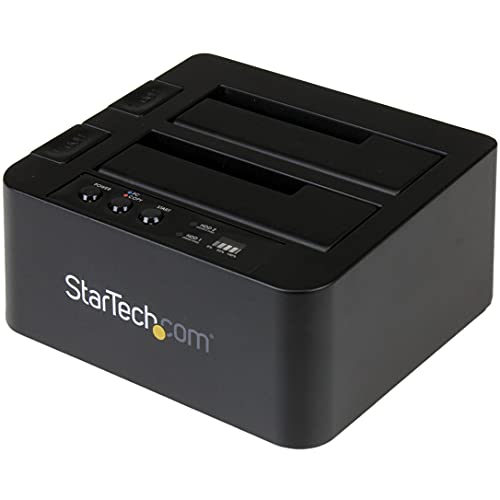
- Clones SATA drives without a computer
- Rated up to 28 GB/min
- Supports 4Kn, TRIM, and SATA III
Best For: Small teams cloning one SATA drive at a time
Best Budget-Friendly Dock
SABRENT Dual-Bay HDD/SSD Cloner

- Supports 2.5- and 3.5-inch SATA drives
- Provides offline cloning and USB 3.0 access
- Supports drives up to 10TB
Best For: Small offices needing occasional SATA cloning and drive access
Best for Documented Production Work

- Copies to three drives at up to 36GB/min per channel
- Offers extensive copy and erase modes
- Includes logging, labeling, adapters, and protective case
Best For: Teams needing repeatable, documented duplication projects
Best Compact SATA Cloner

- Offline cloning without a computer
- Supports 2.5-inch and 3.5-inch SATA drives
- Also works as a two-drive USB-C dock
Best For: Small offices handling routine SATA drive migrations
Best Dedicated Duplicator

- Standalone copying and erasing
- Handles 2.5-inch and 3.5-inch SATA drives
- Up to 90MBps duplication speed
Best For: IT teams needing cloning and drive sanitization
Best Versatile Three-Bay Cloner

- Clones NVMe and SATA drives offline
- Three independent tool-free bays
- USB 3.2 Gen 2 with USB-C and USB-A cable
Best For: Mixed-storage IT and repair workflows
Best Value Offline Cloner

- Offline cloning without a computer or drivers
- Works with 2.5-inch and 3.5-inch SATA drives
- UASP and USB 3.0 support for faster transfers
Best For: Small offices needing an affordable, tool-free drive dock
Best Hub-Integrated Option

- Offline cloning with four-stage progress indicators
- Three USB 3.0 hub ports expand connectivity
- Supports 2.5-inch and 3.5-inch SATA drives
Best For: Workstations needing cloning and additional USB ports
Best Drive Protection

- Fixed bezels help stabilize and protect inserted drives
- Offline cloning requires no computer
- Supports up to two 2.5-inch or 3.5-inch SATA drives
Best For: Teams that frequently swap bare drives
Best for Multi-Drive IT Workflows – 4-Bay 1:3 HDD/SSD Duplicator
For small businesses that need more than occasional cloning, this StarTech.com four-bay unit combines standalone duplication, drive erasing, and docking in one workstation. It supports 2.5- and 3.5-inch SATA drives, includes IDE adapters, and can clone one source to up to three targets without relying on an operating system.
Best For: IT teams handling recurring drive deployment, recovery, backup, or secure-erasure tasks.
Pros:
- Duplicates one source drive to up to three targets in standalone operation.
- Supports SATA and IDE drives in both 2.5- and 3.5-inch formats.
- Offers Quick Erase and Secure Erase, including NIST SP 800-88 Rev. 1 Purge support.
- Also works as a USB or eSATA drive dock with an LCD menu and status LEDs.
Cons:
- Target disks must be equal to or larger than the source disk.
- The four-bay design may be more equipment than a business needing only occasional two-drive cloning.
Its broad drive compatibility and erasure functions make it a flexible choice among hard drive duplicators for small businesses, particularly where IT work includes both deployment and decommissioning.
Best for Fast Two-Drive Cloning – Dual-Bay SATA Duplicator Dock
This StarTech dual-bay dock is a practical option for small businesses that need straightforward, standalone cloning without connecting a computer. It handles 2.5- and 3.5-inch SATA HDDs and SSDs, supports 4Kn and TRIM, and can also provide USB access to mounted drives.
Best For: Small IT departments and repair benches that regularly clone one SATA drive to another.
Pros:
- Copies drives sector by sector at speeds up to 28 GB/min.
- Works with 2.5- and 3.5-inch SATA drives of any capacity listed by the manufacturer.
- Supports 4Kn, TRIM, SATA III, and backward compatibility with SATA I and II.
- Tool-less, tray-less design includes drive doors, eject buttons, and USB 3.2 Gen 2 connectivity.
Cons:
- Cloning is limited to one source and one target at a time.
- IDE support requires a separately sold adapter.
- The target drive must be equal to or larger than the source.
With fast stated transfer performance and a simple no-PC cloning workflow, this is a focused choice for businesses that primarily work with SATA drives and do not need multi-target duplication.
Best Budget-Friendly Dock – SABRENT Dual-Bay HDD/SSD Cloner
The SABRENT EC-HD2B offers a simple way for small businesses to clone and access standard SATA drives. Its dual-bay design supports 2.5- and 3.5-inch HDDs and SSDs, works without drivers, and connects to a computer over USB 3.0 when the dock is being used as a drive reader.
Best For: Small offices seeking a basic dual-bay SATA dock for occasional cloning and drive access.
Pros:
- Supports offline cloning without a computer.
- Accepts standard 2.5- and 3.5-inch SATA HDDs and SSDs.
- Supports hard drives up to 10TB according to the supplied product notes.
- Provides USB 3.0 transfer speeds up to 5Gbps and requires no drivers.
Cons:
- Offline cloning is rated at up to 60Mbps, which is slower than its USB 3.0 interface rating.
- It has two bays, so it cannot duplicate to multiple targets simultaneously.
- The supplied notes do not specify secure-erasure functions.
This is a sensible entry-level pick among hard drive duplicators for small businesses when the priority is uncomplicated SATA cloning and docking rather than advanced erasure or multi-drive production work.
Best for Documented Production Work – HD Pal Pro 1:3 Duplicator Kit
The EZ Dupe HD Pal Pro is built for businesses that need repeatable duplication with detailed control and transport protection. It can copy one 2.5- or 3.5-inch HDD or SSD to three targets at up to 36GB/min per channel, supports SATA and IDE/PATA connections, and includes logging and labeling features for project records.
Best For: Production, repair, or media teams that need documented drive-copying workflows and broad interface support.
Pros:
- Duplicates to three drives with independent bandwidth design for multi-target work.
- Includes four copy modes and eight erase modes, including Secure and Enhanced Erase.
- Supports HPA/DCO duplication and removal, plus source write blocking through USB access.
- Includes downloadable log files, label printing, IDE adapters, and a rugged protective case.
Cons:
- Its specialized features may be unnecessary for businesses performing only occasional cloning.
- The product has a one-year manufacturer warranty.
- It is a standalone unit and is not intended to connect to other devices as a conventional dock.
Among hard drive duplicators for small businesses, this kit stands out when chain-of-custody records, source protection, legacy IDE support, and repeatable multi-drive projects matter as much as copying speed.
Best Compact SATA Cloner – Sabrent Dual-Bay USB-C Dock
For small businesses seeking hard drive duplicators for small businesses, the Sabrent EC-CH2B is a straightforward dual-bay option for cloning SATA drives without a computer. It supports bare 2.5-inch and 3.5-inch SATA HDDs and SSDs, while also functioning as a two-drive USB-C dock.
Best For: Small offices and technicians that need occasional offline cloning and convenient access to two SATA drives.
Pros:
- Offline 1-to-1 cloning requires no computer or software.
- Accepts both 2.5-inch and 3.5-inch SATA HDDs and SSDs.
- Both bays can be read and written simultaneously over USB.
- Tool-free, hot-swappable design with drive activity LEDs.
Cons:
- Supports SATA drives only; it does not support IDE/PATA, M.2, or NVMe drives.
- The target drive must be the same size as or larger than the source.
- The included cable is USB-C to USB-C, so a USB-C computer port or separate adapter cable may be needed.
The EC-CH2B is a practical choice when a business primarily uses SATA storage and wants a compact cloner that doubles as a basic two-drive workstation dock. Its offline cloning speed is limited to up to 60MBps, but its simple controls and broad SATA form-factor support keep setup uncomplicated.
Best Dedicated Duplicator – Systor 1:1 HDD/SSD Duplicator
The Systor SYS101HS-DP is a dedicated standalone choice for organizations comparing hard drive duplicators for small businesses. It copies or sanitizes 2.5-inch and 3.5-inch SATA HDDs and SSDs without requiring a computer, and its stated speed remains up to 90MBps even when multiple drives are loaded.
Best For: Businesses and IT teams that need standalone SATA duplication plus drive-erasing functions.
Pros:
- Operates independently without a computer or software.
- Supports both 2.5-inch and 3.5-inch SATA HDDs and SSDs without an adapter.
- Copies systems and files or entire hard drives.
- Includes drive-erasing functionality compliant with DoD 5220.22-M sanitization.
Cons:
- Compatibility is limited to SATA HDDs and SSDs.
- The listed digital storage capacity is 3TB.
- Its dedicated duplicator design is less suited to users seeking USB docking connectivity.
With a metal enclosure, hot-swappable operation, and business-oriented support that includes a three-year labor warranty, one-year parts warranty, and lifetime technical support, the Systor is aimed at repeatable office or service-desk workflows. It is especially useful when sanitizing retired SATA drives matters as much as cloning them.
Best Versatile Three-Bay Cloner – ICY BOX M.2 and SATA Dock
For businesses managing mixed storage formats, the ICY BOX three-bay station is one of the more flexible hard drive duplicators for small businesses. It provides one-touch offline cloning across M.2 PCIe NVMe, 2.5-inch SATA, and 3.5-inch SATA drives, while also serving as a USB 3.2 Gen 2 reader and dock.
Best For: IT professionals and repair environments working with both NVMe and SATA storage.
Pros:
- Supports offline cloning without software installation or a computer setup.
- Handles NVMe-to-NVMe and SATA-to-NVMe cloning, along with other listed drive combinations.
- Three independent bays allow multiple drives to be connected at once.
- Includes both USB-C and USB-A connection options through the dual-purpose cable.
Cons:
- The enclosure is plastic rather than metal.
- USB 3.2 Gen 2’s up-to-10Gbps rating does not guarantee that drive media will reach that speed.
- Its broader feature set may be unnecessary for businesses using SATA drives exclusively.
The ICY BOX stands out when a small business needs one tool for several current storage types instead of a SATA-only duplicator. Its three-bay layout and 24-month warranty add practical value for mixed-device workflows, while Windows and macOS compatibility supports offices with varied systems.
Best Value Offline Cloner – WAVLINK Dual-Bay SATA Dock
For small businesses comparing hard drive duplicators for small businesses, this WAVLINK dual-bay dock offers a straightforward way to clone or access two 2.5-inch or 3.5-inch SATA drives. Its offline cloning mode works without a computer, while UASP support can improve transfer performance over standard USB 3.0.
Best For: Small offices that need an affordable, tool-free dock for occasional drive cloning, backups, and file transfers.
Pros:
- Supports both 2.5-inch and 3.5-inch SATA HDDs and SSDs.
- Offline cloning requires no computer or drivers, provided the target drive is at least as large as the source.
- UASP support offers transfer speeds up to 6Gbps, according to the supplied specifications.
- Includes USB 3.0 and USB-C connectivity, hot-swapping, and automatic sleep after 30 minutes.
Cons:
- Offline cloning is one-way from the source disk to the target disk.
- It is not compatible with M1- or M2-based Macs.
- The listed 16TB capacity applies to each bay, so capacity requirements should be checked before purchase.
This WAVLINK is a practical choice when a small business needs simple disk access and occasional offline duplication without investing in a dedicated multi-drive copier. Confirm operating-system and drive-capacity compatibility before ordering.
Best Hub-Integrated Option – MAIWO Dual-Bay Drive Cloner
Among hard drive duplicators for small businesses, the MAIWO stands out by combining offline disk cloning with three USB 3.0 hub ports. It accepts 2.5-inch and 3.5-inch SATA drives, provides clone-progress indicators, and supports up to 24TB per bay according to the product notes.
Best For: Small-business workstations that need drive duplication plus extra USB connectivity for storage devices or peripherals.
Pros:
- Supports 2.5-inch and 3.5-inch SATA HDDs and SSDs in two bays.
- Offline cloning works without a computer, with LED indicators for 25%, 50%, 75%, and 100% progress.
- Three USB 3.0 Type-A hub ports add convenient peripheral and flash-drive connectivity.
- Includes a 12V/3A power adapter and offers up to 5Gbps USB 3.0 bandwidth.
Cons:
- The supplied details list an inconsistent total capacity, so verify the current product specifications before relying on the stated limit.
- Offline cloning requires the target drive to accommodate the source data.
- The enclosure is ABS plastic rather than metal.
The MAIWO is especially useful where desk space and USB ports are limited. Its progress LEDs and integrated hub make routine cloning and storage tasks easier to monitor, though buyers should confirm the capacity specification for their planned drives.
Best Drive Protection – WAVLINK Fixed-Bezel Dock
This WAVLINK dual-bay dock is a strong option for small businesses seeking hard drive duplicators for small businesses with added drive stability. Its fixed-bezel design helps hold the drives in place, while offline cloning, UASP, and broad operating-system compatibility support routine backups and migrations.
Best For: Small teams that regularly handle bare drives and want a stable, tool-free setup for cloning and data transfers.
Pros:
- Supports 2.5-inch and 3.5-inch SATA I, II, and III HDDs and SSDs.
- Offline cloning works without a computer and starts by holding the Clone button for about five seconds.
- UASP and USB 3.0 support provide transfer rates up to 5Gbps, with backward compatibility for USB 2.0 and 1.1.
- Fixed bezels help provide drive stability and protection during use.
Cons:
- The target drive must be at least as large as the source for offline cloning.
- The listed warranty description is limited to the SATA interface, so coverage details should be reviewed.
- Its enclosure is plastic rather than metal.
With its protective bezel design and simple offline-copy workflow, this model suits businesses that frequently swap bare SATA drives. It is a practical backup and migration tool, provided the drive-size and interface requirements match your setup.
How We Picked the Best Hard Drive Duplicators for Small Businesses
We focused on practical requirements for small-business IT work: standalone cloning, supported drive types, simultaneous source-to-target capacity, rated transfer speed, connection standards, and ease of handling 2.5-inch and 3.5-inch drives. The selection includes simple one-to-one docks, multi-bay duplicators, and more specialized systems for SATA, IDE/PATA, and M.2 NVMe media.
Published speed figures are useful for comparison but are not guarantees. Actual performance depends on the source drive, target drive, data amount, interface, and whether the duplicator performs a sector-by-sector copy. Always verify current specifications and included accessories before purchasing.
Quick Comparison
| Best For | Look For | Shortlist Direction |
|---|---|---|
| Occasional drive cloning | Simple offline operation and dual bays | SABRENT, WAVLINK, or MAIWO dual-bay docks |
| Multiple target drives | 1:3 duplication and higher throughput | StarTech.com or EZ Dupe multi-bay models |
| Mixed legacy media | IDE/PATA and SATA support | EZ Dupe HD Pal Pro |
| NVMe and SATA workflows | M.2 support plus USB-C connectivity | ICY BOX triple-bay system |
| Drive sanitation | Standalone erasing functions | StarTech.com or Systor eraser-capable models |
Key Buying Factors for Hard Drive Duplicators for Small Businesses
Drive Compatibility
Confirm whether your technicians use 2.5-inch SATA SSDs, 3.5-inch hard drives, M.2 NVMe modules, or older IDE/PATA devices. A SATA dock cannot replace an NVMe or legacy-drive solution without the correct bays or adapters.
Copy Ratio and Speed
A 1:1 unit is adequate for occasional migrations, while a 1:3 duplicator can save considerable labor when preparing several identical systems. Treat maximum gigabytes-per-minute claims as best-case figures, particularly when cloning nearly full or slower hard drives.
Standalone Controls and Erasing
Offline cloning keeps the process independent of an operating system and reduces workstation setup. If your business retires or repurposes drives, look for verified erase modes, status indicators, and a process that makes it clear when a drive has been wiped.
Connectivity and Physical Design
USB 3.0 is widely compatible, while USB-C and 10Gbps-class interfaces may improve transfers with suitable host hardware. Check power requirements, bay spacing, protective covers, fixed bezels, and whether the unit will remain stable during repeated use.
Who Should Buy Which Hard Drive Duplicators for Small Businesses?
Choose a basic dual-bay SABRENT, WAVLINK, or MAIWO dock if you primarily clone one drive to another and also want convenient computer-connected storage access. These models suit small offices with occasional upgrades and straightforward SATA media.
Choose a StarTech.com or EZ Dupe multi-bay unit when technicians regularly prepare several drives at once. The StarTech options are especially relevant when erasing or repeatable deployment workflows are part of the job, while the EZ Dupe model is a stronger fit for teams that still encounter IDE/PATA hardware.
Select the ICY BOX NVMe/SATA model if your inventory includes newer M.2 SSDs alongside conventional drives. A Systor one-to-one duplicator makes more sense for focused cloning and erasing rather than high-volume parallel production. Before ordering, map your current drive inventory and expected workload; that usually matters more than choosing the highest advertised transfer rate.