Physics becomes easier to understand when children can test ideas with their own hands. The best experiment sets turn concepts such as force, motion, magnetism, electricity, and light into manageable STEM activities.
This roundup compares 10 physics experiment sets for elementary students, with options for different ages, interests, supervision levels, and learning goals.
Best 10 Physics Experiment Sets for Elementary Students Picks for 2026
Best for Hands-On Motion Learning

- Build six working physics models
- Covers inertia, friction, and circular motion
- Includes theory, experiments, quiz, and 3D app
Best For: Older elementary students who enjoy structured construction projects
Best for Magnetism Basics
Junior Magnetism Experiment Set

- Includes 14 magnetism experiment pieces
- Features magnets, compass, cars, and iron filings box
- Uses common household items for added activities
Best For: Beginners ages 8 and up learning about magnetism
Best for Simple Machines

- Build 26 models and exercises
- Covers all six classic simple machines
- Includes a force-measuring spring scale
Best For: Ages 8 and up learning mechanics through building and measurement
Best for Younger Builders

- Build a catapult, trebuchet, and windmill
- Includes eight STEM challenges
- Designed for ages 5 to 10 with 56 pieces
Best For: Younger elementary learners exploring force, motion, and engineering
Best All-Around Electricity Kit
EUDAX Electricity & Magnetism Lab
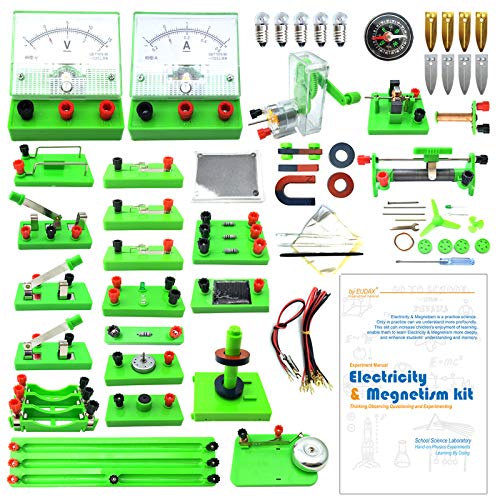
- 79 components with color manual
- Covers circuits and magnetism
- Batteries required, not included
Best For: Older elementary students exploring electricity and magnetism
Best for Forces and Motion
T&K Forces, Motion & Energy Set

- Includes 20 hands-on experiments
- Covers Newton’s laws and motion
- NGSS-aligned lesson plan included
Best For: Ages 8–14 studying mechanics and energy
Best Portable Circuit Starter
Mysterystone Electricity & Magnetism Kit

- More than 50 DIY experiments
- Includes LED and magnetic-switch projects
- Portable case with organized storage
Best For: Older students exploring circuits and electromagnetism
Light Path Explorer
Optical Physics Experiment Set

- Covers reflection, refraction, lenses, mirrors, and prisms
- Includes adjustable three-way light source and manual
- Recommended for ages 14 and up; batteries not included
Best For: Older students and supervised optics demonstrations
Circuit Builder Lab

- Includes seven electricity experiment modules
- Designed for ages 8–15 with step-by-step instructions
- Reusable integrated design; two AA batteries not included
Best For: Beginner circuit learning at home or in class
Magnetism Workshop
EUDAX Electricity and Magnetism Kit

- Covers circuits, electromagnets, generators, LEDs, and more
- Includes 27 pieces, full-color manual, and storage box
- Recommended for ages 14–17; batteries not included
Best For: Advanced students and supervised electricity-magnetism labs
Best for Hands-On Motion Learning – Physics Laws Building Kit
For families looking for physics experiment sets for elementary students ages 9 and up, this Engino kit combines model building with lessons on inertia, friction, and circular motion. Children can build six working models, follow theory and experiment instructions, and reinforce learning with a quiz.
Best For: Older elementary students who enjoy construction projects and want a structured introduction to motion-related physics.
Pros:
- Includes six working models, such as a rocket launcher, crash test rig, and sharpening wheel.
- Provides theory, experiments, fun facts, and a four-page quiz.
- Includes an interactive 3D app for virtual building.
- Supports construction, critical thinking, and other STEM skills.
Cons:
- Recommended for ages 9 and up, so it may be advanced for younger elementary students.
- Focuses specifically on inertia, friction, and circular motion rather than a broad range of physics topics.
This is a strong choice when you want a build-focused kit with accompanying explanations and assessment. Its age range and motion-centered subject matter make it especially suitable for students ready for more detailed physics concepts.
Best for Magnetism Basics – Junior Magnetism Experiment Set
This junior magnetism set is a practical option among physics experiment sets for elementary students ages 8 and up. It includes magnets, a compass, magnetic cars, and an iron filings box so children can investigate attraction, magnetic fields, and introductory earth magnetism using familiar household tools.
Best For: Beginners exploring magnetism at home or in a classroom with open-ended experiments.
Pros:
- Includes 14 magnetism-related pieces and accessories.
- Offers several magnet types, magnetic cars, a compass, and an iron filings box.
- Encourages observation, questioning, and creative investigation.
- Can be supplemented with common items such as pens, rulers, and paper.
Cons:
- Requires additional household tools for some experiments.
- Provides a focused magnetism experience rather than a broad physics curriculum.
Choose this set if your student is curious about magnets and benefits from simple, hands-on exploration. Its compact selection of materials makes it easy to use for introductory activities, though families seeking guided construction projects may prefer another kit.
Best for Simple Machines – Simple Machines Physics Set
For ages 8 and up, this set stands out among physics experiment sets for elementary students by combining model building with force measurement. Children work through 26 exercises involving gears and the six classic simple machines while using the included spring scale to observe how machines affect force.
Best For: Students who learn best by building models and measuring how levers, pulleys, gears, and other machines work.
Pros:
- Covers wheels and axles, levers, pulleys, inclined planes, screws, and wedges.
- Includes 26 model-building exercises.
- Spring scale lets students measure force direction and magnitude.
- Comes with a 32-page illustrated manual and requires no batteries.
Cons:
- Its focus is primarily simple machines and related mechanics.
- Building 26 models may require more time and adult support than a quick experiment set.
This is a particularly useful pick for connecting physics to familiar objects such as seesaws, wheelbarrows, and flagpoles. The spring scale adds a measurement component, making the kit more analytical than a model-only construction set.
Best for Younger Builders – Motioneering STEM Machines
Designed for children ages 5 to 10, this Motioneering set is a beginner-friendly choice among physics experiment sets for elementary students. Kids build, test, and adjust a catapult, trebuchet, and windmill while completing eight STEM challenges focused on force, motion, and engineering.
Best For: Younger elementary learners, homeschool settings, and classrooms seeking an accessible introduction to motion-based STEM.
Pros:
- Includes 56 building pieces and an activity guide.
- Offers three machine designs: a catapult, trebuchet, and windmill.
- Provides eight STEM challenges for guided exploration.
- Supports building, testing, tweaking, and independent design.
Cons:
- Recommended age range is 5 to 10, so older students may want more advanced physics content.
- Focuses on three machine designs rather than a wide selection of experiment topics.
This kit is a good starting point for children who are new to engineering-style activities. Its short list of designs and challenge-based format keeps the focus on experimenting with motion without requiring batteries or complicated equipment.
Best All-Around Electricity Kit – EUDAX Electricity & Magnetism Lab
For shoppers comparing physics experiment sets for elementary students, the EUDAX kit offers a broad introduction to electricity and magnetism through guided, hands-on projects. Its color manual and 79 included items support activities such as series and parallel circuits, fruit batteries, electromagnets, and a hand-crank generator.
Best For: Older children and classroom learners who want a wide electricity-and-magnetism project set with organized storage.
Pros:
- Includes 56 electricity items, 21 magnetism items, repair tools, and a color manual.
- Supports projects involving circuits, Ohm’s law, electromagnets, electric bells, and generators.
- Comes in a storage bag and is recommended for ages 8–18.
Cons:
- Requires three AA batteries, which are not included.
- The listed projects and recommended age range may suit older elementary students better than beginners.
This is a substantial choice for families or educators seeking one kit that covers both basic electronics and magnetism. The large component count adds flexibility, though younger children may need close adult guidance.
Best for Forces and Motion – T&K Forces, Motion & Energy Set
Among physics experiment sets for elementary students, this T&K set focuses on foundational mechanics rather than circuits. Its 20 hands-on experiments and model builds introduce acceleration, velocity, mass, gravity, friction, impact, inertia, work, and Newton’s laws in a visual, practical format.
Best For: Ages 8–14 and learners who want a structured introduction to motion, forces, and energy.
Pros:
- Includes 20 experiments covering a wide range of physics fundamentals.
- Uses model building and real-time experiments to make concepts concrete.
- Includes a ready-to-use lesson plan aligned with NGSS standards.
Cons:
- Its focus is mechanics, so it does not provide the electricity and magnetism activities found in the other kits.
- The supplied component list is relatively focused, including a spring scale, building parts, and rubber bands.
This is a strong curriculum-friendly option when the goal is to teach how objects move and interact. The lesson plan can make it especially useful for home educators and classrooms looking for a coherent sequence of activities.
Best Portable Circuit Starter – Mysterystone Electricity & Magnetism Kit
For families seeking physics experiment sets for elementary students, the Mysterystone kit provides a project-focused introduction to circuits, electricity, and magnetism. It includes more than 50 experiments, a clearly illustrated manual, and specialized activities such as a light-control LED, magnetic switch, and Joule’s first law module.
Best For: Students who enjoy electronics projects and need a portable, organized kit for guided exploration.
Pros:
- Offers more than 50 DIY experiments with 55 total items.
- Covers circuit boards, electromagnets, magnetic switches, LEDs, and Joule’s first law.
- Includes an illustrated manual and a solid storage case with dedicated spaces.
Cons:
- The manufacturer recommends it for ages 13–18, making it less suitable for younger elementary students.
- The supplied notes do not specify whether batteries are included.
This kit stands out for its combination of experiment variety and portable storage. Because the recommended age starts at 13, younger learners may need substantial adult supervision despite the approachable, hands-on format.
Light Path Explorer – Optical Physics Experiment Set
For shoppers comparing physics experiment sets for elementary students, this optical kit offers a hands-on introduction to reflection and refraction. It includes acrylic lenses, a prism, mirrors, a light source, and an English color-page manual, though its listed manufacturer recommendation is ages 14 and up.
Best For: Older students, teacher demonstrations, and supervised home or classroom optics activities.
Pros:
- Supports experiments with refraction, reflection, lenses, mirrors, and prisms.
- Includes multiple optical components and a three-way adjustable linear light source.
- Compact set with a color box and English manual for organized use.
Cons:
- Recommended for ages 14 and up, so it may be too advanced for younger elementary students.
- Requires two AAA batteries, which are not included.
This is a focused choice for teaching physical optics through demonstrations rather than a broad, general-purpose science kit. Adult guidance is especially appropriate for younger learners.
Circuit Builder Lab – 7-in-1 Electricity STEM Kit
This 7-in-1 electricity kit is one of the more accessible physics experiment sets for elementary students, with a stated age range of 8–15 years. Children can build circuits, test conductivity, explore homemade batteries, try fiber-optic lighting, and investigate manual power generation using a guided manual.
Best For: Ages 8–15, beginner circuit practice at home, and classroom STEM activities.
Pros:
- Offers seven experiment modules, including series and parallel circuits.
- Provides clear, hands-on demonstrations of conductivity and energy conversion.
- Integrated components are designed for firm connections, repeated use, and storage in the included box.
- Full-color, step-by-step instructions support independent learning.
Cons:
- Two AA batteries are required but not included.
- Its focus is primarily electricity, so it has less coverage of other physics topics.
For younger learners, the visible results and guided assembly make this a practical starting point. It is particularly useful when the goal is to build confidence with basic circuits and scientific testing.
Magnetism Workshop – EUDAX Electricity and Magnetism Kit
Although listed for ages 14–17 and grades 7–11, this EUDAX kit may appeal to advanced learners comparing physics experiment sets for elementary students. It combines basic electricity and magnetism projects with switches, wires, bulbs, LEDs, and a full-color manual for building models such as circuits, an electromagnet, a hand-crank generator, and a wind-powered car.
Best For: Older students, junior and senior high school labs, and supervised learners ready for expanded electricity and magnetism projects.
Pros:
- Combines electricity and magnetism in one 27-piece experiment kit.
- Supports projects including series and parallel circuits, electromagnets, generators, and LEDs.
- Includes a full-color manual and transparent storage box.
- Ready to use out of the box apart from the required batteries.
Cons:
- Its recommended age of 14–17 makes it less suitable for typical elementary students.
- Two AA batteries are required but not included.
This is the most advanced option of the three, with broader project coverage but a higher expected skill level. Choose it for older students or teacher-led activities rather than unsupervised elementary use.
How We Picked These Physics Experiment Sets for Elementary Students
We focused on kits that support active learning rather than passive demonstration. The selection covers core elementary physics topics, including forces, motion, friction, simple machines, magnetism, circuits, optics, and energy. We also considered the likely age range, project variety, clarity of the learning path, and whether the kit can support repeated experiments instead of a single activity.
Because these sets vary considerably, check the stated age recommendation and contents before buying. Some circuit, optics, and electromagnetism kits are better suited to older children or require close adult guidance.
Quick Comparison
| Best For | Look For | Good Match |
|---|---|---|
| Motion and forces | Ramps, wheels, friction, inertia, or energy activities | Motioneering, Forces, Motion & Energy, or Physics Laws sets |
| Simple machines | Hands-on mechanisms such as levers, pulleys, and gears | Simple Machines sets |
| Magnetism | Magnets, magnetic materials, and field investigations | Junior Magnetism sets |
| Electricity | Reusable wires, switches, lamps, motors, or circuit boards | Electric Circuit and Discovery Circuit kits |
| Light and optics | Prisms, lenses, mirrors, and a controlled light source | Optical Experiment sets |
Key Buying Factors
Age, Safety, and Supervision
Choose a kit that matches the child’s reading, dexterity, and reasoning skills. Elementary learners may need help interpreting instructions, assembling circuits, or handling small components. Avoid treating a higher age rating as a sign of better quality; it may simply indicate more complex projects.
Learning Focus and Project Variety
Decide whether the goal is broad STEM exploration or deeper practice in one topic. A multi-topic kit offers variety, while a focused magnetism, circuit, or optics set may provide a clearer progression. Look for enough experiments to encourage testing, changing one variable, and recording results.
Included Materials and Repeat Use
Review the parts list carefully. Batteries, consumable materials, tools, and household items may not be included. Reusable components such as magnets, lenses, wires, switches, wheels, and circuit boards make a set more useful for future investigations.
Instructions and Storage
Clear diagrams and short explanations matter, especially for independent learners. A labeled tray, case, or storage bag can prevent lost pieces and make setup faster. For classroom use, prioritize durable components and projects that can be reset easily.
Who Should Buy Which Physics Experiment Sets for Elementary Students?
For younger beginners, choose a visually guided set centered on motion, simple machines, or basic magnetism. These topics are accessible and usually offer immediate, observable results. For children interested in building, a forces, motion, or engineering-focused kit may provide more satisfying challenges.
For learners ready to explore electronics, choose a circuit kit with clearly identified connections, switches, and low-voltage components. Electricity and magnetism sets can be rewarding but are often better with adult supervision. For children fascinated by rainbows, reflections, and lenses, an optics kit is the most targeted choice.
Teachers and homeschool families may prefer a kit with varied activities, reusable parts, and enough structure to support discussion or written observations. Ultimately, the best choice is the set that matches the child’s current skills while leaving room for questions, safe experimentation, and repeat use.