The best USB-C RAID enclosures make it easier to combine multiple SATA hard drives or SSDs into a faster, larger, or more redundant external storage system. They are useful for desktop backups, media libraries, creative projects, and expanding a computer without installing internal drives.
This roundup compares 10 USB-C RAID enclosures across two-, four-, and five-bay designs, including diskless models with different RAID modes, cooling systems, drive compatibility, and connection speeds. Use the guide below to match capacity, redundancy, performance, and convenience to your setup.
Best 10 USB C Raid Enclosures Picks for 2026
Best High-Capacity Pick
Yottamaster PS500RC3 5-Bay RAID Enclosure

- Up to 110TB across five SATA drives
- Supports RAID 0/1/3/5/10, JBOD, and Clone
- Aluminum enclosure with intelligent cooling fan
Best For: Large media libraries, backups, and multi-drive workflows
Best Performance Pick
OWC Mercury Elite Pro Quad USB-C RAID Enclosure
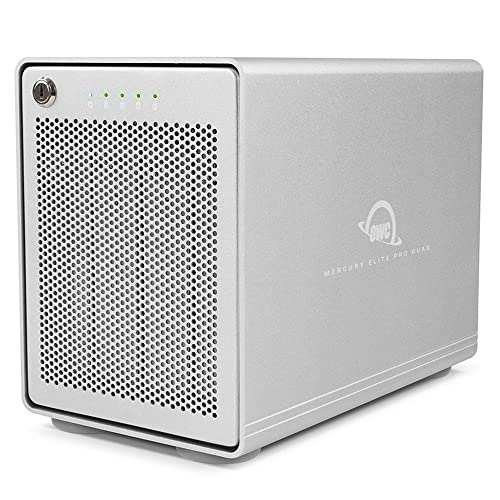
- Four bays for 2.5-inch and 3.5-inch SATA drives
- USB 3.2 10Gbps interface with up to 947MB/s listed performance
- Includes SoftRAID for RAID creation and monitoring
Best For: Four-drive Mac or Windows workflows
Best 3.5-Inch Workstation Pick

- Supports up to four 3.5-inch SATA drives
- Offers eight listed storage and RAID modes
- Includes two switch-controlled cooling fans
Best For: Desktop HDD arrays, workstations, and business storage
Best Compact Two-Bay Pick
TerraMaster D2-320 USB RAID Enclosure

- Two-bay hardware RAID with RAID 0, 1, JBOD, and Single
- USB 3.2 Gen 2 Type-C supports up to 10Gbps
- Tool-free trays and temperature-controlled fan
Best For: Simple local backups, mirrored storage, and two-drive DAS setups
Flexible Four-Bay Storage
CENMATE 4-Bay USB-C RAID Enclosure

- Four bays support up to 80TB total
- Eight RAID and storage modes
- USB-A/C 3.0, eSATA, and cooling fan
Best For: Four-drive desktop storage with broad RAID flexibility
High-Capacity Five-Bay Pick
UGREEN 5-Bay USB-C DAS Enclosure

- Five bays support up to 160TB total
- Eight RAID and storage modes
- Smart cooling with automatic fan adjustment
Best For: Large desktop DAS setups needing five drives
Fast Two-Bay Option
MAIWO Dual-Bay 10Gbps USB-C RAID Enclosure

- 10Gbps USB-C 3.1 Gen 2 interface
- RAID 0, RAID 1, LARGE, and NORMAL modes
- Compact aluminum case with cooling fan
Best For: Compact two-drive storage with faster USB-C connectivity
Best High-Capacity DAS

- Five 3.5-inch bays and up to 100TB capacity
- 10Gbps USB-C with independent drive access
- Tray-less design with temperature-controlled cooling
Best For: High-capacity JBOD storage, not hardware RAID
Best Budget Four-Bay Reader

- Four bays support 2.5- and 3.5-inch SATA drives
- USB-A/C 3.0 and eSATA connectivity
- Up to 80TB with aluminum cooling design
Best For: Simple multi-drive storage without RAID
Best Compact RAID Option

- Four modes: RAID 0, RAID 1, Normal, and JBOD
- Two-drive support up to 40TB total
- Tool-free design with USB-A/C 3.0 connectivity
Best For: Compact two-drive RAID or JBOD storage
Best High-Capacity Pick – Yottamaster PS500RC3 5-Bay RAID Enclosure
For users comparing USB C RAID enclosures for large media libraries or backups, the Yottamaster PS500RC3 offers five SATA bays and support for up to 110TB total capacity. Its broad RAID selection, removable trays, and USB-C connectivity make it a flexible direct-attached storage option for Windows, Mac, and Linux systems.
Best For: Photographers, video editors, and businesses needing high-capacity multi-drive storage.
Pros:
- Supports up to five 2.5-inch or 3.5-inch SATA HDDs or SSDs, with up to 110TB total capacity.
- Offers RAID 0/1/3/5/10, JBOD, and Clone modes, with hardware or software RAID options.
- Aluminum housing and an intelligent 80mm fan help with heat dissipation and quieter operation.
- Includes removable trays and USB 3.1 Type-C connectivity with up to 5Gbps transfer rates.
Cons:
- Drive power consumption must remain within the stated 78W limit for normal five-drive operation.
- New drives may need to be formatted and partitioned before use.
- USB transfer speeds are limited to up to 5Gbps rather than 10Gbps.
The PS500RC3 is a strong choice when capacity and RAID flexibility matter more than maximum USB bandwidth. Check drive power requirements and plan your RAID configuration before filling all five bays.
Best Performance Pick – OWC Mercury Elite Pro Quad USB-C RAID Enclosure
The OWC Mercury Elite Pro Quad is a performance-focused option among USB C RAID enclosures, pairing four universal drive bays with a 10Gbps USB-C interface. It includes SoftRAID software for creating and monitoring RAID sets and works with USB-C or Thunderbolt 3-equipped Mac and Windows computers.
Best For: Mac and Windows users who want four-drive RAID management and faster USB connectivity.
Pros:
- Four bays accept both 2.5-inch and 3.5-inch SATA drives.
- USB 3.2 connectivity provides up to 10Gbps bandwidth, with listed performance up to 947MB/s.
- SoftRAID supports creating, monitoring, and managing advanced RAID sets.
- Supports RAID 0/1/4/5/10 and JBOD configurations.
Cons:
- The enclosure is diskless, so drives must be purchased separately.
- It is substantially heavier than smaller desktop enclosures.
- The supplied details list a one-year OWC limited warranty and also show no warranty in the warranty field, so coverage should be confirmed before purchase.
This model stands out for its 10Gbps interface and software-based RAID control. It is a practical fit for users who need four bays and detailed RAID management rather than a simple plug-and-play enclosure.
Best 3.5-Inch Workstation Pick – MAIWO 4-Bay RAID Enclosure
If you are comparing USB C RAID enclosures for desktop hard drives, the MAIWO four-bay model focuses on 3.5-inch SATA storage, flexible RAID modes, and active cooling. It supports up to 96TB using four 24TB drives and includes both USB-A-to-USB-C and USB-C-to-USB-C cables.
Best For: Professionals, businesses, and power users building a four-drive 3.5-inch storage system.
Pros:
- Supports Normal, RAID 0, 3, 5, 1/10, Clone, and Large/JBOD modes.
- Accommodates up to four 3.5-inch SATA drives, with capacity up to 96TB.
- USB 3.1 A/C connectivity supports transfer rates up to 5Gbps.
- Two switch-controlled cooling fans help manage drive temperatures.
Cons:
- It is designed for 3.5-inch SATA HDDs rather than a mix of 2.5-inch and 3.5-inch drives.
- The fans are controlled by an on/off switch rather than automatic temperature adjustment.
- Its maximum listed USB speed is 5Gbps.
The MAIWO is a sensible choice for a traditional desktop HDD array where capacity and RAID variety are priorities. Its manually controlled fans give you direct cooling control, though users seeking automatic fan adjustment may prefer another enclosure.
Best Compact Two-Bay Pick – TerraMaster D2-320 USB RAID Enclosure
The TerraMaster D2-320 is a compact two-bay choice for shoppers seeking USB C RAID enclosures without the complexity of a larger array. It supports 2.5-inch and 3.5-inch SATA drives, hardware RAID 0, RAID 1, JBOD, and Single modes, and connects over USB 3.2 Gen 2 at up to 10Gbps.
Best For: Users who need a straightforward two-drive DAS for mirrored backups or faster striped storage.
Pros:
- USB 3.2 Gen 2 Type-C supports up to 10Gbps transmission.
- Hardware RAID supports RAID 0, RAID 1, JBOD, and Single modes.
- Accepts two 2.5-inch or 3.5-inch SATA HDDs or 2.5-inch SATA SSDs, up to 44TB total.
- Tool-free trays and an intelligent temperature-controlled fan simplify installation and cooling.
Cons:
- Two bays provide less expansion capacity than four- or five-bay alternatives.
- The enclosure is diskless, so storage drives are not included.
- It is a DAS, not a NAS, and does not provide network-based storage access.
The D2-320 is well suited to a simple local RAID setup, especially RAID 1 for mirrored data or RAID 0 for higher performance. Its two-bay design keeps the system more manageable, but it is not intended for large expandable arrays.
Flexible Four-Bay Storage – CENMATE 4-Bay USB-C RAID Enclosure
For shoppers comparing USB C RAID enclosures, the CENMATE offers four drive bays, USB-A/C 3.0 connectivity, and multiple RAID configurations in an aluminum enclosure. It supports 2.5- and 3.5-inch SATA HDDs or SSDs and up to 80TB total capacity, though its RAID setup requires careful attention before switching modes.
Best For: Users who need four-bay external storage and broad RAID-mode flexibility for Windows, Mac, or Linux systems.
Pros:
- Supports four 2.5- or 3.5-inch SATA drives and up to 80TB total.
- Offers RAID 0/1/3/5/10, CLONE, LARGE, and NORMAL modes.
- Includes USB-A/C 3.0 and eSATA connectivity, plus a cooling fan and aluminum construction.
- Includes a 12V power adapter and supports Windows, Mac, and Linux.
Cons:
- Hot-swapping is not supported.
- Fan noise is rated around 40–50 decibels.
- eSATA access to multiple bays requires a computer port with RAID functionality; changing RAID modes can cause data loss.
The CENMATE is a capacity-focused option for buyers who want four bays and extensive RAID choices at USB 3.0 speeds. Its manual mode-switching process and noise level make it better suited to deliberate desktop storage setups than quiet, frequently reconfigured workspaces.
High-Capacity Five-Bay Pick – UGREEN 5-Bay USB-C DAS Enclosure
The UGREEN 5-Bay USB-C DAS is a strong candidate among USB C RAID enclosures when maximum drive count and capacity matter. It accepts five 2.5- or 3.5-inch SATA drives, supports up to 160TB total, and provides 5Gbps USB-C connectivity for Windows, macOS, Linux, and compatible NAS devices.
Best For: Users building a high-capacity desktop DAS with automatic cooling and several RAID or independent-drive options.
Pros:
- Provides five bays and supports up to 32TB per drive or 160TB total.
- Includes PM, RAID 0/1/3/5/10, Large, and Clone modes.
- Uses S.M.A.R.T. temperatures to adjust fan speed automatically; drives and fan can sleep during inactivity in PM mode.
- Offers five drive-status LEDs, a 12V/8A power adapter, and a two-year manufacturer warranty.
Cons:
- Its USB-C interface is limited to 5Gbps.
- The drives cannot be added to or managed as part of a NAS storage pool.
- Changing RAID modes requires reformatting, so data must be backed up first.
With the most bays and highest stated capacity in this group, the UGREEN is well suited to expandable desktop storage. Its smart cooling and clear drive indicators add convenience, while the DAS design means it should not be mistaken for a network storage enclosure.
Fast Two-Bay Option – MAIWO Dual-Bay 10Gbps USB-C RAID Enclosure
For buyers prioritizing transfer speed and a smaller footprint, the MAIWO is a compact choice among USB C RAID enclosures. Its dual-bay aluminum case supports 2.5- and 3.5-inch SATA drives, offers USB 3.1 Gen 2 at up to 10Gbps, and provides RAID 0, RAID 1, LARGE, and NORMAL modes.
Best For: Users who need a compact two-drive enclosure for fast transfers, mirroring, or combined storage.
Pros:
- USB-C 3.1 Gen 2 supports up to 10Gbps and UASP acceleration.
- Supports RAID 0, RAID 1, LARGE/JBOD, and NORMAL/PM modes.
- Compact aluminum enclosure includes a two-speed cooling fan and ventilation holes.
- Includes both USB-C-to-C and USB-C-to-A cables and supports up to 48TB total.
Cons:
- Two drive bays offer less expansion than four- or five-bay alternatives.
- 2.5-inch drives require an additional 2.5-to-3.5-inch mounting bracket.
- Actual hard-drive speeds may be limited to 6Gbps under UASP, despite the 10Gbps interface.
The MAIWO stands out when a two-drive setup and faster USB-C interface are more important than maximum bay count. RAID 1 provides a straightforward mirrored configuration, while its compact design and included cables make it practical for desktop, laptop, or tablet use.
Best High-Capacity DAS – SABRENT 5-Bay USB-C Enclosure
For shoppers comparing usb c raid enclosures, the SABRENT DS-SC5B is worth separating from true RAID products: it is a five-bay USB-C direct-attached storage enclosure with JBOD-style individual drive access, not hardware RAID or NAS storage. It supports five 3.5-inch SATA HDDs or SSDs and connects at up to 10Gbps.
Best For: Users who need five independently accessible 3.5-inch drives, tray-less hot-swapping, and a high-capacity USB-C DAS setup.
Pros:
- Five 3.5-inch SATA bays with up to 100TB total capacity.
- Dedicated controller for each bay helps provide stable, independent drive connections.
- 10Gbps USB-C connectivity, with USB 3.0 and 2.0 backward compatibility.
- PWM-controlled 120mm fan, per-bay power switches, activity LEDs, and tool-free drive insertion.
Cons:
- Does not provide RAID; drives mount individually in JBOD style.
- Drives are not included.
- Its five-bay 3.5-inch design is relatively large and heavy.
The DS-SC5B is a strong choice when capacity, independent drive access, and USB-C speed matter more than built-in RAID. Buyers specifically seeking mirrored or striped storage should look elsewhere or configure RAID through their computer.
Best Budget Four-Bay Reader – CENMATE 4-Bay SATA Enclosure
This CENMATE is a practical option for shoppers browsing usb c raid enclosures who need multiple-drive access without RAID. Its four bays accept 2.5- or 3.5-inch SATA HDDs and SSDs, while USB-A, USB-C, and eSATA connections provide flexible compatibility.
Best For: Personal or business users who want an affordable four-drive enclosure with up to 80TB capacity and USB 3.0 connectivity.
Pros:
- Supports four 2.5- or 3.5-inch SATA drives, up to 80TB total.
- Includes USB-A/C 3.0 and eSATA cables for broad connection options.
- Aluminum construction and an integrated fan help manage heat.
- Works with Windows, Mac, and Linux systems.
Cons:
- This model is explicitly not RAID or NAS.
- Hot-swapping is not supported.
- The fan may produce approximately 40–50dB of noise.
The four-bay CENMATE keeps the feature set straightforward and adds useful eSATA flexibility. However, eSATA multi-bay access depends on the computer port supporting RAID functionality; otherwise, only one bay may be accessible through eSATA.
Best Compact RAID Option – CENMATE 2-Bay RAID Enclosure
For buyers specifically seeking usb c raid enclosures, this two-bay CENMATE provides four selectable modes: RAID 0, RAID 1, Normal, and JBOD. It accepts 2.5- or 3.5-inch SATA HDDs and SSDs and connects through USB 3.0 with either USB-A or USB-C host compatibility.
Best For: Users who want a compact two-drive enclosure with basic RAID 0 or RAID 1 options alongside normal and JBOD operation.
Pros:
- Offers RAID 0, RAID 1, Normal, and JBOD modes.
- Supports two 2.5- or 3.5-inch drives, up to 40TB total.
- Tool-free drive installation with aluminum construction and an integrated fan.
- Compatible with Windows, Mac, and Linux systems.
Cons:
- USB 3.0 limits the listed transfer rate to 5Gbps.
- Fan noise is rated around 40–50dB.
- Changing or resetting a RAID array may cause data loss, and Mac OS does not support the RAID software.
This CENMATE is the most direct fit for buyers who need actual enclosure-level RAID in a compact form. RAID configuration requires care, and the included instructions note that the Reset button must be held for five seconds after resetting the array.
How We Picked the Best USB C Raid Enclosures
We focused on the features that have the greatest effect on everyday storage use: bay count, supported drive sizes, RAID options, USB-C speed, cooling, installation, and overall flexibility. The selection includes compact two-bay enclosures for simpler mirrored storage, as well as four- and five-bay models for larger arrays and more expansion room.
Because these are generally diskless enclosures, the drives you install will determine much of the final capacity and performance. We also considered whether each model supports both 2.5-inch and 3.5-inch SATA drives, includes USB-A or eSATA compatibility, and offers practical features such as tool-free installation or active cooling.
Quick Comparison
| Best For | Recommended Design | What to Prioritize |
|---|---|---|
| Simple mirrored backup | Two-bay enclosure | RAID 1, quiet cooling, easy setup |
| Growing home storage | Four-bay enclosure | Multiple RAID modes, drive flexibility |
| Large media libraries | Five-bay enclosure | High capacity, sustained cooling, RAID options |
| Fast desktop transfers | USB-C 10Gbps model | Computer port support and quality cables |
| Mixed computers and accessories | USB-A/C or eSATA model | Broad host compatibility |
Key Buying Factors for USB-C RAID Enclosures
Bay Count and Drive Compatibility
More bays provide greater capacity and more RAID configurations, but they also require more desk space and power. Confirm whether the enclosure accepts both 2.5-inch and 3.5-inch SATA drives if you plan to mix SSDs and hard drives.
RAID Modes and Data Protection
RAID 0 can improve capacity and throughput but offers no drive failure protection. RAID 1 mirrors data across two drives, making it a strong choice for important files. RAID 5 and other multi-drive modes can balance capacity, speed, and redundancy, though they require more drives and may involve more complicated recovery.
USB-C Speed and Compatibility
A USB-C connector does not automatically mean high transfer speeds. Check whether the enclosure supports USB 3.0, USB 3.1, or USB 3.2 at up to 10Gbps, and verify that your computer supports the same standard. USB-C-to-USB-A compatibility can be useful with older systems.
Cooling, Noise, and Installation
Multiple mechanical drives produce heat during long transfers, so a fan can improve reliability. Look for accessible drive bays, tool-free mounting when available, and a cooling design that suits your noise tolerance and workspace.
Who Should Buy Which USB C Raid Enclosures?
Choose a two-bay enclosure if you want a straightforward backup or mirrored file system with minimal setup. A four-bay model is better for home offices, photographers, and video editors who need more capacity and multiple RAID choices. Pick a five-bay enclosure for large media collections, server-style storage expansion, or a system designed to grow over time.
For frequent large file transfers, prioritize a 10Gbps USB-C connection and fast source drives. For mixed-device households, select a model with both USB-A and USB-C support. Finally, remember that RAID is not a complete backup: keep a separate copy of irreplaceable files on another device or in secure cloud storage.