Choosing the right 3D scanner can make cosplay patterning faster, more accurate, and easier to repeat. The best options capture body measurements, props, armor, and costume details with enough precision for dependable digital templates.
This roundup compares 10 scanners across accuracy, scanning speed, portability, tracking, software support, and practical features such as color capture and wireless operation.
Best 10 3d Scanners for Cosplay Patterning Picks for 2026
Portable Precision Pick
Creality Pika Dual-Mode 3D Scanner

- 0.03mm accuracy for detailed props
- NIR mode supports full-body scans
- Wireless, battery-powered, and marker-free
Best For: Cosplayers scanning bodies and detailed costume parts
Beginner-Friendly Value
3DMakerpro Fox Medium-Format Scanner

- 0.07mm accuracy for hobby projects
- Markerless AI tracking helps recover scans
- JMStudio includes editing and optimization
Best For: Beginners scanning medium-sized cosplay props
Outdoor Workflow Choice
Creality Pika Blue-Laser and NIR Scanner

- 0.03mm precision for detailed parts
- NIR mode supports body scanning
- Touchscreen and Wi-Fi 6 aid mobile use
Best For: Mobile cosplayers scanning bodies and props
Steady Scanning Starter
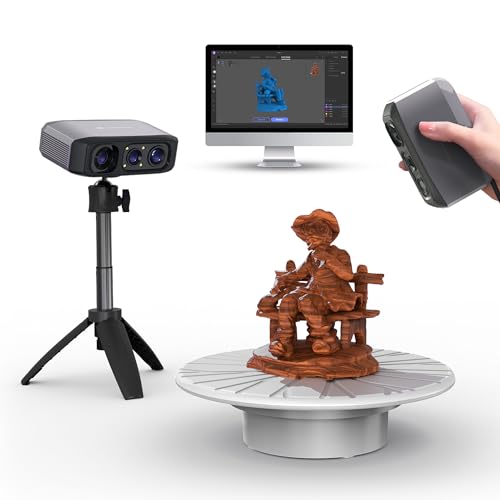
- 0.05mm precision for costume parts
- Anti-shake support helps handheld use
- Marker-free with AI repair tools
Best For: Beginners prioritizing stable handheld scanning
Precision Pick

- Up to 0.03 mm single-frame accuracy
- Five modes for varied surfaces and sizes
- AI segmentation helps clean Windows scans
Best For: Detailed props, armor parts, and large cosplay forms
Versatile Color Choice

- 0.05 mm accuracy and 30 fps scanning
- Scans dark and metallic surfaces without spray
- 24-bit color with broad export support
Best For: Color-rich costume details, props, and mixed-size scans
Portable Patterning Tool

- 190g design with Wi-Fi 6 scanning
- Up to 0.05 mm accuracy and 0.03 mm precision
- Includes calibration and scanning accessories
Best For: Portable scanning of props and costume components
Portable Detail Specialist

- Blue-laser detail capture up to 90 fps
- Infrared mode supports larger and black objects
- Wireless scanning with up to 3 hours of battery life
Best For: Portable cosplay prop and costume-part scanning
Precision Powerhouse

- Up to 0.02 mm accuracy in stated conditions
- 60 fps capture with up to 660,000 points per second
- Supports color scanning and difficult surfaces without powder
Best For: High-precision cosplay patterning and large-form scanning
Wireless Workflow Bundle

- Includes Scan Bridge for wireless scanning
- 0.02 mm stated accuracy and 60 fps capture
- Full-color mapping and marker-based alignment
Best For: Wireless multi-scan cosplay patterning workflows
Portable Precision Pick – Creality Pika Dual-Mode 3D Scanner
For shoppers comparing 3d scanners for cosplay patterning, the Creality Pika stands out as a compact option that can handle both fine prop details and full-body scanning. Its blue-laser and NIR modes, marker-free operation, color capture, and portable design support workflows ranging from costume fitting to scanning helmets, armor, and small accessories.
Best For: Cosplayers who want one lightweight scanner for body measurements, costume components, and detailed props.
Pros:
- 0.03mm accuracy and 0.1mm resolution suit detailed props and small parts.
- NIR structured light supports full-body scans with 24-bit color capture.
- AI body completion, retexturing, and hole filling can simplify model cleanup.
- Wireless PC mode, dual batteries, and outdoor scanning support improve portability.
Cons:
- The feature-rich design may be more than beginners need for occasional scans.
- The highest listed 110 FPS speed applies in blue-laser mode with a USB 3.0 computer.
The Pika is the most versatile choice here for cosplay patterning, especially when you need both body-scale scans and high-detail prop capture. Its cross-platform exports and included accessories add convenience for a mixed scanning and 3D-printing workflow.
Beginner-Friendly Value – 3DMakerpro Fox Medium-Format Scanner
The 3DMakerpro Fox is an approachable entry-level option for 3d scanners for cosplay patterning. Its medium-format design, markerless AI visual tracking, and integrated JMStudio software make it suited to hobbyists who want to turn real objects into usable models without managing a complicated scanning workflow.
Best For: Beginners and hobbyist cosplayers scanning medium-sized props, masks, and costume components.
Pros:
- 0.07mm accuracy and 0.10mm resolution provide useful detail for 3D printing and modeling.
- Markerless AI tracking can relock onto an object if handheld movement interrupts a scan.
- JMStudio combines scanning, editing, and optimization in one software environment.
- Designed as an accessible medium-format scanner for beginners and hobbyists.
Cons:
- The supplied notes do not specify body-scanning capability, wireless operation, or scan speed.
- Its medium-format focus may be less convenient for very small details or full-body capture.
Fox makes sense when ease of use matters more than an extensive feature list. It offers a practical starting point for cosplay prop modeling, while the markerless tracking and bundled software can reduce the learning curve.
Outdoor Workflow Choice – Creality Pika Blue-Laser and NIR Scanner
For 3d scanners for cosplay patterning that need to move between studio and convention or outdoor settings, this Creality Pika combines portability with dual-light scanning. It can capture fine details on props, scan bodies with NIR, and export printable models in common formats across Windows, macOS, Android, and iOS.
Best For: Mobile cosplayers who need body scanning, detailed prop capture, and reliable use beyond a fixed workstation.
Pros:
- Blue-laser mode reaches 0.03mm precision for intricate costume parts and models.
- NIR mode supports body scanning, while 24-bit capture records color.
- AI retexturing, hole filling, and body completion help refine scan output.
- Built-in touchscreen, Wi-Fi 6, removable IR filter, and cross-platform support suit mobile workflows.
Cons:
- Scan speeds vary by connection and mode; the listed 110 FPS requires a USB 3.0 computer in laser mode.
- The supplied notes do not specify battery capacity or included accessories.
This Pika is a strong fit for creators who value flexibility and portability. Its mode selection covers both wearable-scale scanning and high-detail prop work, while the AI tools can reduce post-processing effort.
Steady Scanning Starter – 3DMakerpro Moose Lite Premium
The 3DMakerpro Moose Lite Premium is a beginner-oriented handheld option among 3d scanners for cosplay patterning. Its AI visual tracking, optical anti-shake module, marker-free operation, and resume-style rescanning feature are designed to make handheld capture less intimidating for creators working on costume parts and props.
Best For: New users who prioritize stable handheld scanning and a simpler path to repairing interrupted scans.
Pros:
- 0.05mm precision supports detailed cosplay components and 3D-printing projects.
- Optical anti-shake assistance helps compensate for unsteady handheld movement.
- AI visual tracking and automated model repair can simplify the scanning process.
- Marker-free technology and lifetime OTA software updates add convenience.
Cons:
- The listed scanning speed is 10 FPS, slower than the Creality Pika options.
- The supplied notes do not specify full-body scanning, color capture, or outdoor performance.
- At 3.65 pounds in package weight, it may be less travel-friendly than the pocket-sized Pika.
Moose Lite Premium is appealing when ease of handling is the main concern. Its anti-shake and recovery features can help beginners produce usable scans, though shoppers seeking body scanning or maximum portability should compare its capabilities carefully.
Precision Pick – Revopoint POP 4
For demanding 3d scanners for cosplay patterning projects, the Revopoint POP 4 stands out with high stated accuracy, multiple scanning modes, and support for objects ranging from small parts to large forms. Its AI segmentation can also help create cleaner scans on Windows.
Best For: Cosplayers who need detailed scans of props, armor components, or full-size forms and want flexible capture modes.
Pros:
- Single-frame accuracy is rated up to 0.03 mm, with Full-Field Structured Light accuracy up to 0.08 mm.
- Five scanning modes cover fine structured-light work, rapid capture, reflective or dark objects, and narrow grooves.
- AI segmentation can identify the subject, track it, and filter background noise on Windows.
- Supports scan volumes from 10 × 10 × 10 mm up to 2 × 2 × 2 m.
Cons:
- AI segmentation is limited to Windows.
- The outdoor filter and 5500mAh battery grip are sold separately.
- Its broad feature set may require more setup than a simpler scanner.
The POP 4 is the most capability-focused option here for intricate cosplay patterning, especially when reflective materials, dark surfaces, or varied object sizes are part of the workflow.
Versatile Color Choice – Creality Otter Lite Basic
The Creality Otter Lite Basic is a practical choice among 3d scanners for cosplay patterning when you want color references, broad object-size coverage, and a relatively straightforward handheld workflow. It can scan dark and metallic surfaces without spray according to the supplied specifications.
Best For: Cosplayers scanning costume details, painted props, figurines, and larger forms across Windows, macOS, iOS, or Android.
Pros:
- Provides stated accuracy up to 0.05 mm and scanning speeds up to 30 frames per second.
- Quad-camera design supports objects from 0.8 inches to 78 inches.
- Can scan black and metallic surfaces directly without powder or spray.
- Captures 24-bit full-color textures and exports to formats including OBJ, STL, 3MF, GLTF, and FBX.
Cons:
- Outdoor scanning is specified for up to 30,000 lux, less than some alternatives in brighter conditions.
- The optional Scan Bridge handle is sold separately.
- Its 0.05 mm accuracy rating is not as fine as the POP 4’s stated single-frame figure.
With wide platform support, full-color capture, and no-spray scanning for difficult surfaces, the Otter Lite Basic is a flexible fit for makers who want to move between costume pieces, props, and reference objects.
Portable Patterning Tool – Revopoint INSPIRE 2
The Revopoint INSPIRE 2 suits makers seeking portable 3d scanners for cosplay patterning, with a 190g body, wireless scanning, and two scanning modules for different surfaces and object sizes. Its included tripod, markers, turntable, calibration board, and outdoor filters support a ready-to-use setup.
Best For: Cosplayers who value portability, wireless operation, and detailed scans of props or costume components.
Pros:
- Offers accuracy up to 0.05 mm and precision up to 0.03 mm, with a high-precision calibration board included.
- Infrared structured light and 11-line laser scanning help handle varied materials, including reflective or dark surfaces.
- Built-in Wi-Fi 6 supports mobile scanning and PC-to-mobile interactive streaming.
- Includes useful accessories such as a tripod, mini turntable, markers, calibration board, and outdoor filters.
Cons:
- Outdoor scanning is specified for up to 20,000 lux.
- Some listed computer workflows require 16GB RAM and a capable processor or GPU.
- Revo Design is paid separately and supports Windows only.
The INSPIRE 2 is a strong middle ground for cosplay work: lighter and more travel-friendly than a studio-oriented setup while still offering useful surface handling, color capture, and calibration tools.
Portable Detail Specialist – EINSTAR 2 Wireless 3D Scanner
For cosplay makers comparing 3d scanners for cosplay patterning, the EINSTAR 2 is a flexible option for capturing small costume parts, props, and larger forms. Its blue-laser and infrared modes support detailed scans, wireless operation, and challenging materials without requiring spray.
Best For: Cosplayers who want a portable scanner for props, costume components, and larger objects.
Pros:
- Blue-laser mode captures high-resolution detail and supports scanning up to 90 fps.
- Infrared mode is designed for larger objects, black surfaces, and outdoor scanning.
- Wireless use offers up to 3 hours of scanning from the swappable built-in battery.
- Can scan black and reflective objects directly, with no spray required.
Cons:
- The scanner weighs 5.72 pounds, which may feel substantial during extended handheld sessions.
- Wi-Fi interference may require switching to a cable connection.
The EINSTAR 2 stands out when portability and material flexibility matter. Its two scanning modes give cosplay patterning workflows room to handle both intricate parts and larger forms, while EXStar Hub provides tools for processing and optimizing scans.
Precision Powerhouse – Creality CR-Scan Raptor Pro
Among 3d scanners for cosplay patterning, the Creality CR-Scan Raptor Pro is suited to makers who prioritize fine measurement accuracy and fast capture. Its blue-laser and NIR modes cover objects from 5 mm to 4 m, making it useful for detailed props as well as body or costume-form scanning.
Best For: Advanced cosplay workflows needing high precision, fast scanning, and broad object-size coverage.
Pros:
- Offers accuracy up to 0.02 mm under the stated conditions.
- Captures at up to 60 fps and 660,000 points per second.
- Scans black, metallic, and some transparent glass surfaces without powder.
- Supports full-color capture and compatibility with software such as Rhino, ZBrush, and Maya.
Cons:
- The recommended computer setup includes 32 GB of RAM and an 8 GB VRAM GPU for Windows.
- At 9.06 pounds, it is heavier than a compact handheld scanner.
This Raptor Pro is the strongest fit for demanding patterning and reverse-engineering tasks where accuracy and scan speed are central. Its extensive system requirements and heavier body make it better suited to a prepared workstation than a lightweight beginner setup.
Wireless Workflow Bundle – Raptor Pro with Scan Bridge
This Raptor Pro bundle is a practical choice for 3d scanners for cosplay patterning when wireless convenience is a priority. It combines the scanner with a Scan Bridge, while retaining high-speed capture, fine stated accuracy, full-color mapping, and marker-based alignment for stitching multiple scans.
Best For: Cosplayers who want a ready-to-use wireless scanning bundle for detailed parts and medium-sized forms.
Pros:
- Includes the Raptor Pro scanner, Scan Bridge, calibration board, and quick-start guide.
- Provides stated accuracy of 0.02 mm and scanning speeds up to 60 fps.
- Captures objects from 5 mm to 2,000 mm with full-color texture mapping.
- Marker-based alignment helps combine multiple scans.
Cons:
- The listed scanning range is smaller than the 4,000 mm range of the other Raptor Pro listing.
- The package weighs 12.17 pounds, making it less convenient for frequent travel.
- Wireless functionality depends on the included Scan Bridge accessory.
Choose this bundle if the included wireless hardware and alignment workflow are more valuable than the broadest possible scan range. It offers a focused set of features for turning detailed cosplay scans into usable digital references and patterns.
How We Picked the Best 3d Scanners for Cosplay Patterning
We evaluated these scanners for the tasks cosplay makers actually perform: capturing body proportions, scanning helmets and armor, digitizing props, and creating reference meshes for pattern development. Key considerations included stated accuracy, scanning speed, supported object sizes, tracking performance, portability, connectivity, and software compatibility.
Specs such as blue-laser or infrared scanning can indicate how a device handles detail, but real-world results also depend on lighting, surface finish, scan distance, calibration, and post-processing. A scanner that is technically precise may still be a poor fit if it is difficult to track or requires a powerful computer.
Quick Comparison
| Best For | What to Prioritize | Useful Features |
|---|---|---|
| Body and garment patterning | Fast tracking and comfortable handheld use | Body completion, high frame rate, wireless operation |
| Armor and helmets | Reliable geometry capture and medium-format coverage | Structured light, blue laser, texture or color capture |
| Small costume details | Fine accuracy and stable alignment | Laser modes, high-resolution capture, markers |
| Outdoor or large-object scanning | Strong tracking in changing conditions | Infrared support, portable workflow, larger scan range |
Key Buying Factors for 3d Scanners for Cosplay Patterning
Accuracy and Detail
For fitted armor, masks, and small components, prioritize a scanner with a low stated accuracy figure and a mode designed for detailed surfaces. Do not treat the headline specification as a guaranteed finished-pattern tolerance; scanning technique and mesh cleanup remain important.
Tracking and Scan Speed
Higher frame rates help when scanning a person or large costume piece because they reduce pauses and alignment failures. AI-assisted completion can help fill gaps, but it should be checked carefully around edges, folds, and complex shapes.
Object Size and Surface Finish
Confirm that the scanner supports the size of your intended subjects. Dark, glossy, transparent, or reflective materials can be challenging. Matte spray, removable markers, or scanning accessories may improve results, while no-spray systems are more convenient for delicate props and worn clothing.
Software, Devices, and Workflow
Check compatibility with Windows, macOS, Android, or iOS before buying. Also consider export formats, alignment tools, hole filling, texture support, and whether the included software fits your CAD, Blender, slicing, or pattern-making workflow.
Portability and Setup
A compact wireless scanner is useful for conventions, fittings, and scanning subjects away from a workbench. Wired models may offer a steadier connection and simpler power management. Budget for a suitable computer, lighting, calibration tools, and storage.
Who Should Buy Which 3d Scanners for Cosplay Patterning?
Choose an entry-level medium-format scanner if you mainly digitize helmets, armor panels, and props and want a straightforward starting point. Choose a body-focused portable model if you need to capture people, clothing forms, or full costume proportions quickly.
Choose a higher-precision blue-laser scanner for intricate armor details, small props, and parts where clean edges matter. Choose a wireless or outdoor-capable model if portability, large subjects, or flexible scanning locations are priorities. For frequent professional work, favor the scanner with the strongest combination of tracking, accuracy, software support, and repeatable workflow rather than choosing solely by the lowest advertised measurement.