City skies can still deliver great astronomy nights if you choose the right telescope. The best models for urban use emphasize contrast, stable mounts, and practical magnification instead of raw power alone.
Below, you’ll find 10 picks suited to beginners and budget-minded stargazers who want easier setup, better moon and planet views, and more rewarding sessions under light-polluted skies.
Best 10 Telescopes for City Stargazing Picks for 2026
Travel-Friendly Starter Scope
Gskyer 70mm Refractor with Phone Adapter

- 70mm aperture with fully coated optics
- Includes 2 eyepieces, 3x Barlow, and finder scope
- Phone adapter, wireless remote, and carry bag included
Best For: Beginners and families wanting a portable moon-viewing scope
Classic Moon-and-Planet Pick

- 70mm achromatic refractor with fully coated optics
- Simple alt-azimuth mount and red-dot finder
- Includes 20mm, 10mm, and star diagonal accessories
Best For: Beginners wanting easy moon, planet, and daytime viewing
High-Aperture Budget Upgrade

- 90mm aperture with 600mm focal length
- 24x–180x range from eyepieces and 3x Barlow
- Carry case, tripod, and phone adapter included
Best For: Beginners wanting more aperture in a portable package
Best Deep-Sky Beginner Choice

- 130mm Newtonian reflector gathers more light
- Equatorial mount with slow-motion controls
- Includes 20mm, 10mm, and StarPointer finder
Best For: Beginners ready for brighter deep-sky observing
City-Friendly Starter Refractor

- 90mm aperture with fully multi-coated optics
- Includes 10mm/25mm eyepieces, 3x Barlow, and phone adapter
- Quick assembly and carry bag help with grab-and-go use
Best For: Beginners wanting an easy refractor for Moon views and casual city stargazing
Smartphone-Guided Deep-Sky Pick
Celestron StarSense Explorer LT 114AZ
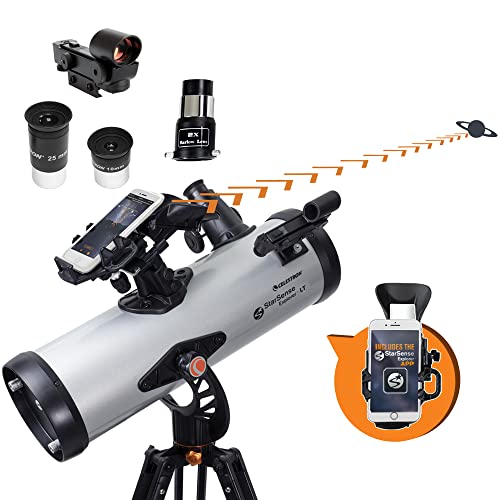
- Smartphone app uses sky recognition to guide you to targets
- 114mm Newtonian reflector for Moon, planets, and bright deep-sky sights
- Manual mount includes slow-motion adjustment for easier aiming
Best For: Observers who want app-assisted target finding in light-polluted skies
Portable All-Purpose Refractor

- 90mm fully coated optics with 800mm focal length
- Includes 2 eyepieces, 3x Barlow, phone adapter, and carry bag
- Quick setup and lightweight build suit travel and family use
Best For: Families and beginners wanting a portable refractor for casual observing
Budget Starter Pick

- 90mm aperture helps with brighter Moon and planet views.
- Includes three eyepieces, a 3x Barlow, and phone adapter.
- Adjustable tripod and guide make setup beginner-friendly.
Best For: Beginners wanting an easy Moon-and-planet telescope for city use.
Travel-Friendly Moon Viewer
HUGERSTAR 90mm 800mm Refractor

- 90mm aperture and multi-coated optics support brighter views.
- Includes moon filter, phone adapter, and carrying bag.
- Quick, tool-free assembly suits first-time users.
Best For: City stargazers who want portability and comfortable Moon viewing.
Best All-Rounder
Hawkko 90mm 900mm Refractor Kit

- 90mm aperture and FMC optics aim for brighter, sharper views.
- Includes eyepieces, Barlow lens, finder scope, and phone adapter.
- AZ mount and carry bag make it practical for casual use.
Best For: Beginners seeking a balanced, accessory-rich city viewing telescope.
Travel-Friendly Starter Scope – Gskyer 70mm Refractor with Phone Adapter
For city stargazing, this Gskyer telescope is a practical entry-level choice if you want a lightweight refractor that’s easy to carry and simple to set up. Its 70mm aperture and 400mm focal length are aimed at bright targets like the Moon and stars, while the included finder scope, phone adapter, and wireless remote make it easier to line up views and capture what you see.
Best For: Beginners and families who want a portable telescope for moon viewing and casual urban observing.
Pros:
- 70mm aperture with fully coated optics for bright, straightforward views.
- Includes two eyepieces, a 3x Barlow lens, and a 5×24 finder scope.
- Phone adapter and wireless remote add easy smartphone viewing and snapshots.
- Adjustable tripod and carry bag make it easy to store and travel with.
Cons:
- Best suited to bright celestial targets rather than faint deep-sky objects.
- Manual alt-azimuth design keeps it simple but not fully hands-free.
If you’re looking for one of the more portable telescopes for city stargazing, this model is built around convenience and beginner-friendly use rather than advanced performance. It’s a sensible pick when you want an easy way to get started without a lot of setup.
Classic Moon-and-Planet Pick – Celestron AstroMaster 70AZ
The Celestron AstroMaster 70AZ is a dependable option for city stargazing if you want a straightforward refractor for the Moon, planets, and other bright objects. Its fully coated 70mm achromatic optics, red-dot finderscope, and simple alt-azimuth mount make it easy to point and use from a backyard, patio, or other light-polluted setting.
Best For: Beginners who want a simple, reputable telescope for moon, planet, and daytime viewing.
Pros:
- 70mm fully coated achromatic optics for crisp views of bright targets.
- Alt-azimuth mount with panhandle makes manual aiming simple.
- Includes 20mm and 10mm eyepieces plus a StarPointer red dot finderscope.
- Works for both night sky observing and terrestrial daytime viewing.
Cons:
- Smaller aperture limits what you’ll see on faint deep-sky objects.
- Manual setup and mount control may feel basic to more advanced users.
As telescopes for city stargazing go, this one emphasizes ease of use and reliable optics over power. It’s a strong starter choice when your goal is to learn the sky and enjoy clean, bright views without extra complexity.
High-Aperture Budget Upgrade – WOSPORTS 90mm Refractor Scope
This 90mm telescope is a strong city stargazing pick if you want more light-gathering ability than a basic starter scope. With a 90mm aperture, 600mm focal length, fully coated glass, and magnification options from 24x to 180x, it’s built for clearer lunar detail, easier object location, and flexible viewing from the backyard or balcony.
Best For: Beginners who want a portable, higher-aperture telescope for the Moon, birds, and casual sky watching.
Pros:
- 90mm aperture and fully coated optics help produce crisp, high-contrast views.
- Includes 25mm and 10mm eyepieces plus a 3x Barlow lens for 24x–180x magnification.
- 3×24 finder scope and 45° diagonal help make viewing more comfortable.
- Carry case, adjustable tripod, and phone adapter improve portability and sharing.
Cons:
- Still a manual alt-azimuth setup, so tracking requires hand adjustment.
- Designed for beginners, so advanced deep-sky observing will be limited.
For telescopes for city stargazing, this model stands out as a practical step up in aperture without becoming bulky. It balances portability, simple setup, and useful accessories in a way that fits casual observers well.
Best Deep-Sky Beginner Choice – Celestron AstroMaster 130EQ
If you’re looking for telescopes for city stargazing with a stronger reach into the night sky, the Celestron AstroMaster 130EQ is the most capable option in this group. Its 130mm Newtonian reflector gathers significantly more light than smaller beginner scopes, and the equatorial mount with slow-motion controls can make it easier to keep planets and brighter deep-sky targets centered.
Best For: Beginners ready to move beyond a starter scope and try brighter deep-sky observing from home.
Pros:
- Large 130mm optics provide stronger light-gathering for celestial objects.
- Equatorial mount with slow-motion controls supports smoother tracking.
- Includes 20mm and 10mm eyepieces plus a StarPointer red-dot finderscope.
- Quick setup and adjustable tripod make it approachable for new users.
Cons:
- Heavier and larger than the smaller refractors in this roundup.
- Equatorial mounts can take more practice than simple alt-azimuth mounts.
This is the most ambitious pick here for users who want a real step up in capability without leaving beginner territory. If your city sky routine includes planets and brighter deep-sky targets, it offers the strongest optical headroom.
City-Friendly Starter Refractor – MEEZAA 90mm 800mm Telescope
For telescopes for city stargazing, this MEEZAA refractor is built around a 90mm aperture and 800mm focal length, which helps it pull in more light for the Moon and brighter night-sky targets. The included 10mm and 25mm eyepieces plus 3x Barlow lens give you a flexible range for beginner observing, while the phone adapter and carry bag make it easy to set up, pack away, and share what you see.
Best For: Beginners who want an affordable, easy-to-assemble refractor for lunar viewing, casual backyard observing, and occasional city stargazing.
Pros:
- 90mm aperture and fully multi-coated optics are designed to improve brightness and clarity.
- Includes two eyepieces, a 3x Barlow lens, phone adapter, and carry bag.
- Adjustable stainless steel tripod adds flexibility for different viewing positions.
- Manual setup is reported as quick, with many users assembling it in about 10 minutes.
Cons:
- Manual altazimuth mount means you’ll be doing all the tracking by hand.
- Best suited to simpler viewing targets rather than advanced deep-sky observing.
- Tripod height range is useful, but not as rigid as heavier-duty mounts.
This is a practical starter telescope if you want a straightforward way to explore the night sky from a bright urban area. It focuses on ease of use and basic optical reach, which makes it a sensible pick for learning the sky before moving to more advanced gear.
Smartphone-Guided Deep-Sky Pick – Celestron StarSense Explorer LT 114AZ
If you’re shopping for telescopes for city stargazing and want help finding targets fast, the Celestron StarSense Explorer LT 114AZ stands out for its smartphone-guided sky tour. The app uses sky recognition to point you toward curated objects based on your time and location, and the 114mm Newtonian reflector is described as capable of sharp views of the Moon, planets, and brighter deep-sky favorites.
Best For: Users who want app-guided navigation to quickly find planets and brighter deep-sky objects from urban skies.
Pros:
- StarSense Explorer app uses smartphone sky recognition to help locate targets.
- Curated nightly list is tailored to your time and location.
- 114mm reflector with coated mirrors is aimed at bright, vivid views.
- Manual mount includes slow-motion adjustment for smoother aiming.
Cons:
- Requires a smartphone to get the main guided-navigation experience.
- Manual tracking still requires hands-on adjustments.
- Heavier and larger than a basic beginner refractor setup.
This model is a strong fit if you want less guessing and more observing from the city. The app-guided workflow can make it easier to spend your time looking through the eyepiece instead of searching the sky, which is especially helpful for beginners.
Portable All-Purpose Refractor – Dianfan 90mm 800mm Telescope
For telescopes for city stargazing, the Dianfan 90mm refractor offers the same practical 800mm focal length and large aperture approach, but with a strong emphasis on portability and quick setup. It comes with two eyepieces, a 3x Barlow lens, a phone adapter, a phone holder, a carry bag, and a stainless steel tripod, making it a flexible choice for simple observing sessions, travel, and mixed daytime use.
Best For: Beginners and families who want a lightweight, travel-friendly telescope for Moon viewing, casual stargazing, and versatile outdoor use.
Pros:
- 90mm fully coated objective lens is designed to gather more light for brighter views.
- 32x–240x magnification gives you a broad range for beginner astronomy.
- Quick setup design is reported to be ready in about 15 minutes.
- Includes tripod, carry bag, phone adapter, and phone holder for convenience.
Cons:
- Manual focus and manual altazimuth mount require hands-on operation.
- Best for simpler targets rather than demanding deep-sky work.
- Lightweight portability is useful, but not the same as a heavier observatory-style mount.
This is a sensible all-round option if you want a beginner telescope that can move easily between the balcony, yard, and travel days. Its bundle of accessories and quick setup make it especially practical for casual stargazers who value convenience as much as optics.
Budget Starter Pick – HETEKAN 90mm 900mm Refractor
For telescopes for city stargazing, this HETEKAN refractor leans into brighter targets like the Moon and planets rather than deep-sky objects. The 90mm aperture and 900mm focal length give it a solid light-gathering advantage for backyard or balcony viewing, while the included eyepieces, Barlow lens, and phone adapter make it easy to start observing right away.
Best For: Beginners who want an affordable, easy-to-set-up telescope for Moon and planet viewing from home.
Pros:
- 90mm aperture offers strong light gathering for brighter lunar and planetary views.
- Includes 25mm, 10mm, and 6mm eyepieces plus a 3x Barlow lens for flexible magnification.
- Phone adapter, finder scope, and carrying bag make setup and sharing observations simpler.
- Adjustable alt-azimuth tripod supports 360-degree horizontal and 180-degree vertical movement.
Cons:
- Manual focus and alt-azimuth mount are better for simple viewing than precision tracking.
- High magnification claims are less useful in city conditions than the lower-power views.
- Designed mainly for beginner astronomy, not advanced deep-sky observing.
Overall, this is a straightforward beginner telescope with enough aperture and accessories to make city stargazing practical. It is best viewed as a Moon-and-planets option that keeps setup and operation uncomplicated.
Travel-Friendly Moon Viewer – HUGERSTAR 90mm 800mm Refractor
This HUGERSTAR model fits well among telescopes for city stargazing because it focuses on bright, easy-to-find targets and comes with practical accessories. Its 90mm aperture, fully multi-coated optics, and included moon filter should help produce clearer lunar views from light-polluted locations, while the carrying bag and quick assembly make it easy to move and store.
Best For: City observers who want a portable beginner telescope with a moon filter and smartphone-friendly extras.
Pros:
- 90mm aperture and 800mm focal length are suited to bright, detailed views of the Moon and stars.
- Fully multi-coated lenses improve light transmission for clearer images.
- Includes a moon filter, phone adapter, carrying bag, and accessory tray.
- Tool-free assembly is described as quick and beginner-friendly.
Cons:
- Lower focal length than some alternatives, so it is less geared toward maximum reach.
- Alt-azimuth mount is simple, but not as refined for tracking as more advanced mounts.
- Best results will still favor brighter celestial targets in city skies.
As a package, this telescope emphasizes convenience and lunar viewing over complexity. That makes it a sensible choice if you want an easy portable setup for casual city-night observing.
Best All-Rounder – Hawkko 90mm 900mm Refractor Kit
For telescopes for city stargazing, this Hawkko refractor is a balanced pick with a 90mm aperture, 900mm focal length, and fully multi-layer coating aimed at brighter, sharper views. It keeps the setup practical with an AZ mount, smartphone adapter, and complete accessory kit, so beginners can get started without hunting for extras.
Best For: Beginners who want a well-rounded telescope kit for backyard or city viewing with easy phone capture.
Pros:
- 90mm aperture and FMC optics are designed for brighter, clearer images.
- 900mm focal length supports higher-power viewing of the Moon and distant targets.
- Includes two eyepieces, a 3x Barlow lens, finder scope, and zenith mirror.
- Smartphone adapter and carry bag add convenience for travel and sharing.
Cons:
- Manual alt-azimuth style operation is simple, but not built for automated tracking.
- Higher magnification can be harder to use effectively in light-polluted city skies.
- Best suited to casual observing rather than advanced astronomy.
Overall, this Hawkko kit is the most rounded option here for someone who wants a capable beginner telescope with useful accessories. It should be especially appealing if you want a dependable city-friendly starter setup that can also travel well.
How We Picked the Best Telescopes for City Stargazing
For Telescopes for City Stargazing, we prioritized aperture, optical quality, mount stability, ease of alignment, and portability. In bright urban conditions, a well-balanced telescope often outperforms a larger but shaky setup. We also favored models that are beginner-friendly and practical for quick sessions from a balcony, driveway, or rooftop.
Quick Comparison
Most of the options in this roundup fall into two categories: compact refractors that are easy to use and transport, and beginner reflectors that can provide more light gathering for the price. If you want the simplest path to the Moon and bright planets, a refractor is often the easier choice. If you want to stretch toward dimmer objects, a reflector with a sturdier mount may be the better fit.
Key Buying Factors for Telescopes for City Stargazing
Aperture Matters, but Not Alone
Larger aperture helps collect more light, which is useful in light-polluted areas. Still, city observers should also weigh mount quality and optical contrast. A stable 70mm to 90mm refractor can be more satisfying than a bigger telescope that shakes or is difficult to focus.
Choose the Right Focal Length
Shorter focal lengths can be convenient and portable, while longer focal lengths may help with higher-magnification viewing of the Moon and planets. For Telescopes for City Stargazing, the best choice is usually one that supports useful low-to-mid power views without becoming hard to manage.
Prioritize Mount Stability
A wobbly mount ruins fine-detail viewing. Look for smooth altitude-azimuth mounts for simple operation or a solid equatorial mount if you plan to learn tracking. Stability is especially important when observing from hard surfaces like concrete patios and balconies.
Don’t Overvalue Maximum Magnification
High magnification sounds appealing, but urban seeing conditions often limit what you can use effectively. A telescope that delivers clean, sharp views at moderate power is usually the smarter buy.
Who Should Buy Which Telescopes for City Stargazing?
If you’re a first-time buyer who wants the simplest setup, a small refractor is the most forgiving option. If you’re mainly interested in the Moon, Jupiter, Saturn, and bright double stars, choose a stable, easy-to-carry model with decent aperture and good optics. If you want to push beyond casual viewing and explore more deep-sky targets from the city, consider the reflector-style options with stronger light gathering and a mount that can support them properly.
In short, the best Telescopes for City Stargazing are the ones that make it easy to observe often. Convenience, stability, and crisp optics matter more than chasing specs you won’t be able to use every night.