Shopping for telescopes for planets can be overwhelming, especially if you want sharp views without a steep learning curve. The best choice depends on aperture, mount stability, and how easy it is to track targets.
Below, we focus on models that make lunar and planetary observing more practical for beginners and budget-minded stargazers, while still giving you room to grow.
Best 10 Telescopes for Planets Picks for 2026
Smartphone-Guided Pick
Celestron StarSense Explorer DX 130AZ
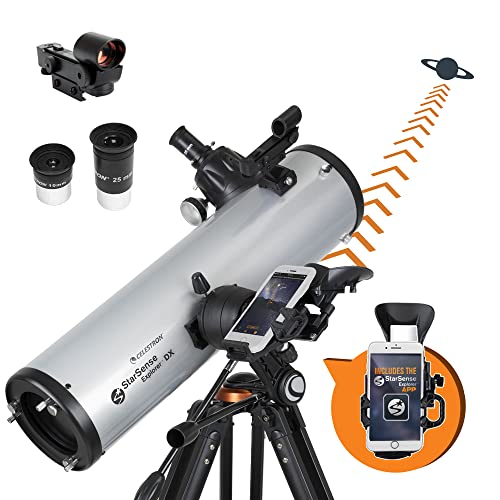
- StarSense app helps locate planets with on-screen guidance
- 130mm reflector supports bright Moon and planet views
- Dual-axis slow-motion controls improve manual tracking
Best For: Beginners who want app-assisted locating and good planetary views
High-Power Refractor Pick

- 90mm aperture and 800mm focal length suit planetary viewing
- 3x Barlow lens expands magnification up to 240X
- Phone adapter and carry bag add portability
Best For: Beginners wanting a simple refractor with strong included magnification
Equatorial Classic Pick

- 130mm optics provide strong light-gathering ability
- Equatorial mount and slow-motion knobs aid tracking
- Includes 20mm and 10mm eyepieces plus StarPointer
Best For: Beginners who want a stable, classic reflector for planets and deep-sky viewing
Portable Budget Pick

- 80mm aperture with fully multi-coated optics
- Includes 3x Barlow lens, phone adapter, and remote
- No-tool setup and carry bag improve portability
Best For: Beginners who want a compact telescope with helpful accessories
Smartphone-Guided Planet Finder
Celestron StarSense Explorer LT 114AZ
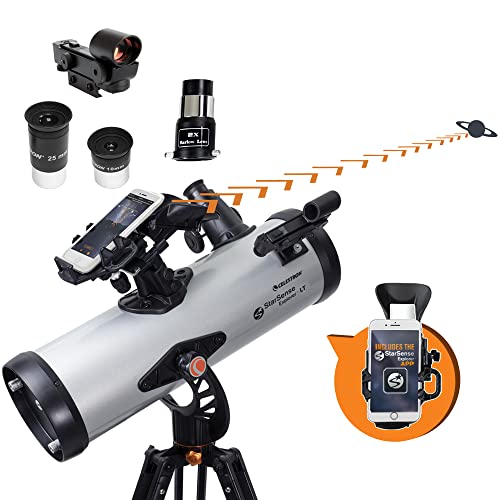
- StarSense app guides you to planets and bright objects
- 114mm reflector is built for Moon, Jupiter, and Saturn views
- Manual altazimuth mount with slow-motion adjustment
Best For: Beginners who want app-guided planet finding
High-Aperture Refractor Pick

- 90mm aperture and 800mm focal length for brighter views
- Includes eyepieces, 3× Barlow lens, phone adapter, and bag
- Quick setup design with stainless steel tripod
Best For: Beginners and families wanting a portable refractor
Portable Starter Refractor
Koolpte 80mm/600mm AZ Telescope
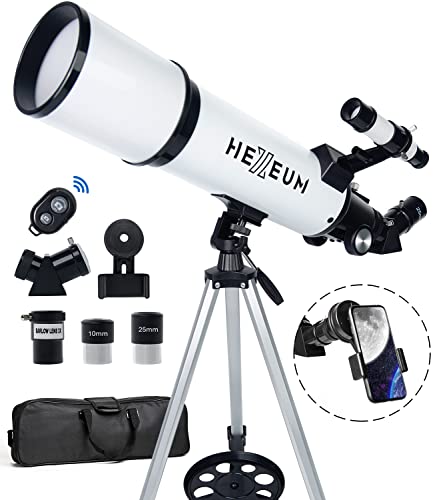
- 80mm aperture with fully multi-coated optics
- Tool-free setup with tripod, remote, and carry bag
- Includes 3× Barlow lens and 5x24 finder scope
Best For: First-time users wanting a compact, easy-to-set-up telescope
Large Aperture Planetary Pick
MEEZAA 150EQ Newtonian Reflector
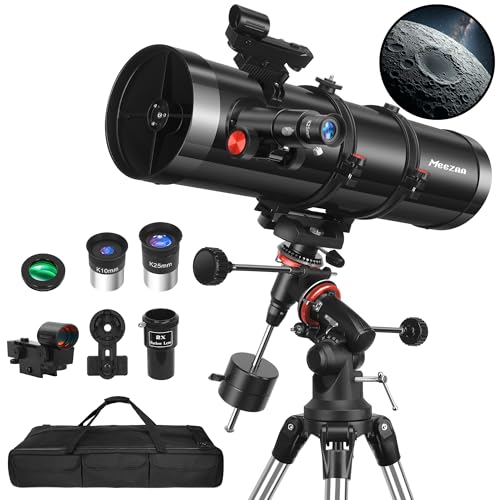
- 150mm aperture for strong light gathering
- 26X to 130X magnification with Barlow lens
- Equatorial mount aids planet tracking
Best For: Adults and beginners who want a larger telescope for planets and the Moon
Portable Family Starter
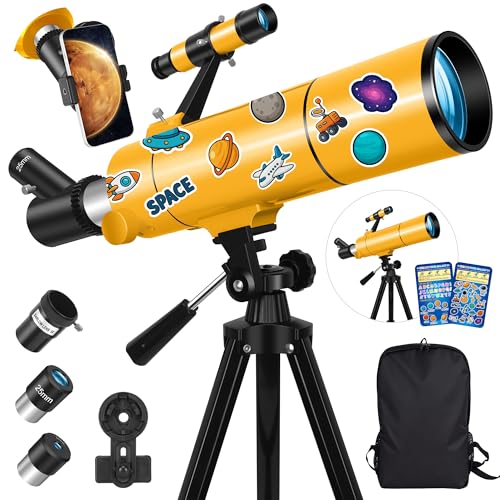
- 80mm aperture with fully multi-coated optics
- 20X to 150X magnification range
- Includes backpack, phone adapter, and tripod
Best For: Families and beginners who want a portable telescope for planets and travel
Budget Planet Watcher
Celticbird 80mm 600mm Refractor

- 80mm aperture with 600mm focal length
- Comes with moon filter and phone adapter
- Backpack and adjustable tripod improve portability
Best For: Beginners and kids who want an easy telescope for the Moon and planets
Smartphone-Guided Pick – Celestron StarSense Explorer DX 130AZ
For telescopes for planets, the Celestron StarSense Explorer DX 130AZ is a practical choice if you want help finding targets without needing advanced astronomy experience. The phone-guided StarSense system gives you on-screen arrows and a curated list of tonight’s best objects, while the 130mm reflector provides strong views of the Moon and bright planets like Jupiter and Saturn.
Best For: Beginners who want smartphone guidance and solid planetary views from a 130mm reflector.
Pros:
- StarSense app uses sky recognition to help locate planets and other targets.
- 130mm Newtonian reflector is built for sharp, vivid views of the Moon and planets.
- Manual altazimuth mount includes dual-axis slow-motion controls for smoother tracking.
- Comes with 25mm and 10mm eyepieces plus a red dot finderscope.
Cons:
- Requires a smartphone for the guided locating system.
- Manual operation means you still control aiming and tracking.
This is a strong all-around starter scope if you want a modern, guided way to observe planets without giving up a larger aperture. It balances usability with enough optical size to make planetary observing rewarding.
High-Power Refractor Pick – MEEZAA 90mm 800mm Refractor
If you’re shopping for telescopes for planets and want a straightforward high-power refractor, the MEEZAA 90mm 800mm model offers a good mix of aperture, magnification, and included accessories. Its 90mm aperture and 800mm focal length are paired with 10mm and 25mm eyepieces plus a 3x Barlow lens, giving you a wide magnification range for lunar and planetary observing.
Best For: Beginners who want a simple refractor with strong included magnification options.
Pros:
- 90mm aperture and fully multi-coated optics help improve image brightness and clarity.
- Includes 10mm and 25mm eyepieces plus a 3x Barlow lens for 32X-240X magnification.
- Phone adapter and carry bag make it easier to observe and share images outdoors.
- Most users can assemble it in about 10 minutes, according to the product notes.
Cons:
- Manual altazimuth mount means you’ll be doing all the pointing and tracking yourself.
- The highest magnification is accessory-driven, so stability matters.
This is a sensible option if you want an easy-to-set-up refractor that comes with the basics for planetary viewing right out of the box. It’s especially appealing for newcomers who value convenience and included accessories.
Equatorial Classic Pick – Celestron AstroMaster 130EQ
The Celestron AstroMaster 130EQ is a classic option for telescopes for planets if you want a stable, manually controlled setup with a larger reflector. Its 130mm optics and equatorial mount are built to make aiming smoother, and the included slow-motion knobs help you center planets and other celestial objects with more precision.
Best For: Beginners ready for a more stable mount and a larger reflector for planets and deep-sky targets.
Pros:
- 130mm Newtonian reflector offers strong light-gathering ability for bright celestial views.
- Equatorial mount with slow-motion control knobs supports accurate manual pointing.
- Quick setup with no tools required, according to the product notes.
- Includes 20mm and 10mm eyepieces plus a StarPointer red dot finderscope.
Cons:
- Manual equatorial mounts take a little more learning than basic altazimuth mounts.
- It does not include smartphone-guided object location.
If you want a more traditional telescope that can handle planetary observing while also reaching into deep-sky objects, this is a well-rounded pick. The larger reflector and steady mount make it a confident step up for new observers.
Portable Budget Pick – Koolpte 80mm 600mm Telescope
For buyers comparing telescopes for planets on a budget, the Koolpte 80mm 600mm telescope focuses on portability and ease of use. It includes two eyepieces, a 3x Barlow lens, a phone adapter, a wireless remote, and a carry bag, making it a convenient starter setup for casual lunar and planetary sessions.
Best For: Beginners who want a compact, easy-to-carry telescope with useful accessories.
Pros:
- 80mm aperture and fully multi-coated optics help capture more light and improve clarity.
- Includes 25mm and 10mm eyepieces plus a 3x Barlow lens for higher magnification options.
- Phone adapter, wireless remote, and carrying bag support easy travel and image capture.
- No-tool setup is designed to be simple for novices.
Cons:
- 80mm aperture is smaller than the 130mm reflectors in this roundup.
- Manual altazimuth mount means tracking planets is hands-on.
This is the most portable of the group and a good match if you want a simple telescope to take outside quickly. It’s not the largest optic here, but the accessory bundle makes it appealing for first-time observers who value convenience.
Smartphone-Guided Planet Finder – Celestron StarSense Explorer LT 114AZ
If you’re shopping for telescopes for planets and want an easier way to start, the Celestron StarSense Explorer LT 114AZ makes finding targets much more approachable. Its smartphone-guided system uses the StarSense app to point you toward planets and other bright objects, while the 114mm Newtonian reflector is built to deliver sharp views of the Moon, Jupiter, Saturn, and more.
Best For: Beginners who want app-guided object finding with solid planet views from a manual telescope.
Pros:
- StarSense Explorer app helps locate planets and other targets with on-screen guidance.
- 114mm reflector aperture is designed for bright views of the Moon and planets like Jupiter and Saturn.
- Includes 25mm and 10mm eyepieces plus a 2x Barlow lens for viewing flexibility.
- Manual altazimuth mount with slow-motion adjustment keeps tracking straightforward.
Cons:
- Requires your smartphone for the guided locating system.
- Manual mount means you still track targets by hand.
This is a practical pick if you want a beginner-friendly telescope that makes planet hunting easier without adding a lot of setup complexity. It balances guided navigation and a capable reflector design, which is especially useful for first-time observers focused on the brighter solar system targets.
High-Aperture Refractor Pick – Dianfan 90mm/800mm Telescope
For buyers comparing telescopes for planets, the Dianfan 90mm/800mm refractor stands out for its larger aperture and long focal length. The fully coated 90mm objective lens is intended to gather more light for brighter, clearer views, and the package includes eyepieces plus a 3× Barlow lens for a wide magnification range that can help when viewing the Moon and other bright celestial targets.
Best For: Beginners and families who want a portable refractor with more light-gathering power.
Pros:
- 90mm fully coated objective lens helps gather more light for brighter views.
- 800mm focal length and included eyepieces plus 3× Barlow lens provide flexible magnification.
- Quick setup is advertised at about 15 minutes, which is friendly for new users.
- Includes a stainless steel tripod, phone adapter, and carry bag for portability.
Cons:
- Manual focus and altazimuth mount mean it is not automated.
- Bulky enough that it still requires a tripod and transport bag to move around comfortably.
If you want a straightforward refractor with a larger aperture than many entry-level models, this one is easy to consider. It leans toward convenience and portability while still offering the viewing flexibility that makes it useful for beginner planet observation.
Portable Starter Refractor – Koolpte 80mm/600mm AZ Telescope
The Koolpte 80mm/600mm AZ refractor is a simple option to consider when looking at telescopes for planets without overcomplicating the setup. Its 80mm aperture and fully multi-coated optics are designed to improve brightness and clarity, while the included 25mm and 10mm eyepieces, 3× Barlow lens, and 5×24 finder scope make it easier to locate and magnify targets.
Best For: First-time users who want a compact, portable telescope with easy setup.
Pros:
- 80mm aperture and fully coated optics are meant to improve image brightness and clarity.
- Includes two eyepieces, a 3× Barlow lens, and a 5×24 finder scope for viewing flexibility.
- Comes with a phone adapter, wireless remote, tripod, and carrying bag for convenience.
- Tool-free setup keeps assembly simple for beginners.
Cons:
- Manual altazimuth mount requires hands-on tracking.
- Best suited to entry-level observing rather than advanced astronomy.
This model is a practical starter telescope if portability and ease of use matter most. It gives you the basics needed for casual planet viewing and simple astrophotography support, all in a package that is designed to be quick to assemble and easy to carry.
Large Aperture Planetary Pick – MEEZAA 150EQ Newtonian Reflector
If you want telescopes for planets that can show crisp detail, this 150mm Newtonian reflector is built around light-gathering power. Its 650mm focal length, equatorial mount, and included moon filter make it a strong choice for viewing the Moon, Jupiter, Saturn, and other bright targets with smoother manual tracking.
Best For: Astronomy beginners and adults who want a larger-aperture telescope for planets, the Moon, and learning manual tracking.
Pros:
- Large 150mm aperture captures plenty of light for brighter, clearer views.
- 26X to 130X magnification range with 25mm, 10mm, and 2X Barlow lens.
- Equatorial mount with slow-motion controls helps track objects more smoothly.
- Includes moon filter, phone adapter, tripod, and carry bag for a complete setup.
Cons:
- Equatorial mounts can take a little more learning than simple alt-az designs.
- Best suited to users who want a larger, less portable setup.
Overall, this is the most capable option here for buyers prioritizing planetary viewing and brighter image brightness from a bigger aperture. It trades portability for a more serious observing experience and more room to grow with the hobby.
Portable Family Starter – MEEZAA 80mm Refractor
For telescopes for planets that are easy to take anywhere, this 80mm refractor offers a practical balance of portability and useful magnification. The 500mm focal length, fully multi-coated optics, and included 3X Barlow lens make it a friendly starter setup for moon and planet viewing, plus daytime nature use.
Best For: Families, kids, and beginners who want a lightweight travel telescope with simple setup and extra accessories.
Pros:
- 80mm aperture and multi-coated optics help produce bright, sharp views.
- 20X to 150X magnification range gives flexibility for lunar and planetary observing.
- Adjustable tripod and foldable design make it easy to carry and set up.
- Includes phone adapter, waterproof backpack, and stickers for a complete beginner kit.
Cons:
- Altazimuth mount is simpler, but not as precise for tracking as an equatorial mount.
- Best for casual observing rather than a more advanced planetary rig.
This model stands out if convenience matters as much as viewing power. It is easy to pack, easy to assemble, and comes with enough extras to make it appealing for family astronomy and beginner photography.
Budget Planet Watcher – Celticbird 80mm 600mm Refractor
If you’re shopping for telescopes for planets and want something straightforward, this 80mm refractor is built for easy setup and dependable daytime or night viewing. Its 600mm focal length, coated optics, and included moon filter make it a practical option for looking at the Moon, Saturn, and Jupiter without a complicated learning curve.
Best For: Beginners, kids 8-12, and casual observers who want an easy-to-use telescope with travel-friendly accessories.
Pros:
- 80mm aperture and 600mm focal length are a solid starting point for bright targets.
- Includes 20mm and 9mm eyepieces, 5×24 finderscope, and moon filter.
- Adjustable aluminum tripod and backpack make it easy to carry and store.
- Phone adapter lets you capture photos through your smartphone.
Cons:
- Two-eyepiece setup keeps the accessory package simpler than some competitors.
- Altazimuth mount is convenient, but not ideal for precision tracking.
As an approachable starter telescope, this one focuses on ease of use and portability more than advanced features. It makes sense for shoppers who want a lower-stress way to get into lunar and planetary viewing.
How We Picked the Best Telescopes for Planets
For Telescopes for Planets, we looked first at aperture, optical design, and mount quality, since those factors have the biggest effect on detail and usability. We also considered ease of setup, portability, and whether a telescope is better suited to manual aiming or guided finding.
Planet viewing rewards steady mounts and decent optics more than extreme magnification. A well-built 80mm to 130mm telescope can often outperform a larger but shaky setup if it is easier to align and keep on target.
Quick Comparison
In this group, refractors tend to be the simplest choices for newcomers, while Newtonian reflectors usually offer more aperture for the money. Smartphone-guided models can make finding planets easier, especially if you are just starting out or observing from light-polluted areas.
If you want the most straightforward setup, look toward alt-azimuth mounts and compact tubes. If you want finer tracking and more control during higher magnification viewing, an equatorial mount can be a smart step up.
Key Buying Factors for Telescopes for Planets
Aperture
Aperture is one of the most important specs because it controls how much light the telescope collects. For planets, that means better brightness and more visible detail on Jupiter, Saturn, and Mars. In general, 80mm is a good starter size, 90mm to 130mm is stronger for planetary observing, and larger apertures can help if the mount is stable enough to support them.
Focal Length and Optical Design
Longer focal lengths usually make it easier to reach useful magnification with common eyepieces, which is helpful for planetary work. Refractors often deliver crisp, contrasty views with minimal maintenance, while reflectors can offer more aperture per dollar. The right choice depends on whether you value convenience or raw light-gathering ability.
Mount Stability
A shaky mount can ruin planetary detail fast. Look for a tripod and mount that feel solid, move smoothly, and do not vibrate excessively when adjusted. For beginners, a stable alt-az mount is often easier to learn, while more advanced users may appreciate the tracking control of an equatorial mount.
Ease of Finding Targets
For beginners, a telescope that helps you locate planets quickly is a major advantage. Smartphone-guided systems and simple finder scopes can reduce frustration and make the observing session more productive.
Who Should Buy Which Telescopes for Planets?
If you are a first-time observer, choose a compact, easy-to-use model with a stable mount and a straightforward setup. If you want the best chance of seeing more planetary detail, consider a larger aperture in the 90mm to 130mm range.
If portability matters, smaller refractors are the easiest to carry and store. If you plan to observe often and want to improve over time, a reflector or equatorial-mounted telescope may offer more room to grow.
Ultimately, the best Telescopes for Planets balance aperture, stability, and convenience. Pick the option that fits your space, patience level, and observing style, and you will get far better results than chasing high magnification alone.