If you need reliable machine health readings in tight or hard-to-reach spots, vibration meters with external probe designs are a smart upgrade. They let you place the sensor where it matters most while keeping the display and controls easy to read.
In this roundup, we focus on models that suit maintenance teams, technicians, and plant operators who want practical tools for quick fault checks, trend monitoring, and on-site diagnostics.
Best 10 Vibration Meters with External Probe Picks for 2026
Industrial Contact Meter
VM-424 Remote Probe Vibration Meter

- External sensor reaches tight machine points.
- Measures acceleration, velocity, and displacement.
- Magnetic, short, and long probe tips included.
Best For: Periodic machine inspections where access is limited.
On-Site Diagnostics Meter
VM-6320 Mechanical Vibration Analyzer

- Covers acceleration, velocity, and displacement.
- Built for periodic rotating-machine measurements.
- Uses a dedicated high-quality accelerometer.
Best For: Routine field diagnostics on rotating machinery.
Advanced Analyzer
VM-428 External Sensor Vibration Meter
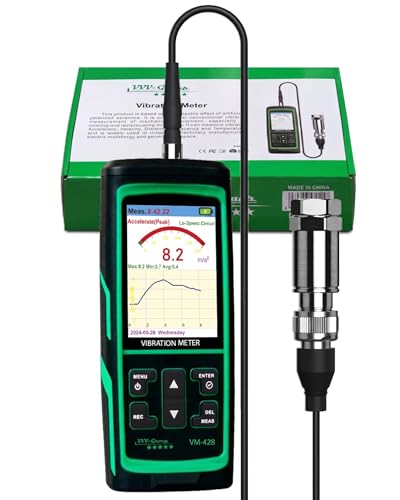
- Adds temperature measurement and PC connectivity.
- Stores data for trend comparison and export.
- Remote magnetic probe helps with stable readings.
Best For: Condition monitoring with logging and PC review.
Split Portable Tester
RZ63A Smart Split Vibration Meter

- Separate probe design improves measurement flexibility.
- Measures displacement, velocity, and acceleration.
- Compact 230g body is easy to carry.
Best For: Lightweight fault inspection with flexible probe placement.
Industrial 5-in-1 Analyzer
SWANSOFT 5-in-1 Vibration Meter with Remote Sensor

- Measures acceleration, velocity, displacement, frequency, and temperature.
- External magnetic probe helps access hard-to-reach points.
- Stores data and exports CSV/BMP via PC software.
Best For: Predictive maintenance, workshops, and general machine condition checks
Detached-Probe Handheld

- Detached probe setup with magnetic, long, and L/S probes included.
- Measures acceleration, velocity, and displacement.
- Adds LCD backlight, max hold, and auto power-off.
Best For: Basic handheld machine checks with a simple external probe
Memory-Ready Vibrometer
VM-422 Industrial Vibration Meter

- Measures acceleration, velocity, and displacement.
- Stores up to 500 readings for trend comparison.
- Color LCD with severity bar helps quick inspections.
Best For: Recurring machine inspections and trend tracking
Field-Ready Triple-Mode Meter
Digital Vibration Meter with Probe Tips for Maintenance

- Measures acceleration, velocity, and displacement
- Easy one-hand operation with backlit LCD
- Compact design for motors, pumps, and fans
Best For: Routine maintenance on rotating equipment
Compact LCD Analyzer
AS63B Portable LCD Vibration Analyzer Tester

- Shows acceleration, speed, and distance
- Large backlit LCD for low-light use
- Compact pickup-based design
Best For: Basic industrial vibration checks
Dual-Probe Inspection Meter
High-Precision Digital Vibration Meter with Dual Probes

- Three probe tip options for different access needs
- Measures acceleration, velocity, and displacement
- Backlit LCD with simple A/V/D controls
Best For: Inspection work with varied probe contact needs
Industrial Contact Meter – VM-424 Remote Probe Vibration Meter
If you need vibration meters with external probe for routine machine checks, the VM-424 is built for awkward access points on motors, pumps, compressors, gearboxes, fans, and other rotating equipment. Its remote sensor lets you keep the main display in a comfortable viewing position while the probe reaches narrow or recessed test spots.
Best For: Maintenance technicians who want a simple contact meter for periodic machine inspections and quick condition screening.
Pros:
- Measures acceleration, velocity, and displacement for 3-in-1 vibration checks.
- External shear-type probe with magnetic, short, and long tips for different surfaces.
- Backlit LCD includes data hold and max hold for stable or peak readings.
- Dual acceleration frequency modes help with general and higher-frequency checks.
Cons:
- It is a periodic inspection tool, not a full FFT analyzer.
- Not intended to replace permanent online monitoring systems.
Overall, the VM-424 is a practical pick if you want straightforward contact vibration readings with an external probe and don’t need advanced spectrum analysis. It fits preventive maintenance workflows well, especially where probe placement is the main challenge.
On-Site Diagnostics Meter – VM-6320 Mechanical Vibration Analyzer
HOJILA Digital Vibration Meter VM-6320 Vibration Analysis Meter Mechanical Vibration Meters
Check Price On AmazonAmong vibration meters with external probe, the VM-6320 is aimed at on-site checks of rotating machinery where you want a dedicated accelerometer and a wide measurement span. It covers acceleration, velocity, and displacement for periodic vibration work in quality control, commissioning, and predictive maintenance.
Best For: Users who need a straightforward portable vibration meter for routine rotating-machine diagnostics.
Pros:
- Measures acceleration, true-RMS velocity, and displacement.
- Wide acceleration frequency range from 10Hz to 10kHz.
- Designed for periodic measurements and ISO 2954 use cases.
- Individual high-quality accelerometer supports repeatable readings.
Cons:
- No external software or PC connectivity is listed in the supplied notes.
- Fewer advanced diagnostic features are mentioned than on analyzer-style models.
This is a solid choice if your priority is dependable field vibration measurement rather than data logging or deeper analysis. It keeps the workflow focused on quick inspection and fault detection for rotating equipment.
Advanced Analyzer – VM-428 External Sensor Vibration Meter
If you want vibration meters with external probe for more detailed machine checks, the VM-428 adds higher ranges, temperature sensing, and PC software support. Its remote magnetic sensor is meant for stable placement on metal housings, making it useful for motors, turbines, pumps, compressors, and other rotating machinery.
Best For: Technicians who need a handheld vibration analyzer with data logging and PC export for condition monitoring.
Pros:
- Measures acceleration, velocity, displacement, frequency, and temperature.
- External magnetic sensor supports repeatable contact on metal surfaces.
- Internal memory and USB PC software help with documentation and trend comparison.
- Color LCD shows real-time graphs plus max, min, and average values.
Cons:
- It is still a handheld periodic tool, not a permanently installed monitoring system.
- Not a multi-channel laboratory spectrum analyzer.
The VM-428 stands out when you want more than basic readings and need something that can support longer-term recordkeeping. It is a stronger fit for diagnostic workflows that benefit from both onsite measurement and exported data.
Split Portable Tester – RZ63A Smart Split Vibration Meter
The RZ63A is a split-design option in vibration meters with external probe, built for flexible measurement on machinery faults. Its separate probe layout and compact body make it easier to position during inspections while still covering displacement, velocity, and acceleration readings.
Best For: Buyers who want a lightweight split portable vibration tester for flexible machinery fault inspection.
Pros:
- Separate probe design offers flexible measurement positioning.
- Measures displacement, velocity, and acceleration.
- Compact and lightweight at 230g.
- Wide measurement range with reliable accuracy is noted in the supplied specs.
Cons:
- The supplied notes do not list advanced analysis features or connectivity.
- No display or logging details are provided in the available information.
This model makes sense if portability and probe flexibility matter more than advanced diagnostics. It looks suited to quick fault inspections where a lighter split-format tool is easier to carry and position.
Industrial 5-in-1 Analyzer – SWANSOFT 5-in-1 Vibration Meter with Remote Sensor
If you want vibration meters with external probe for routine maintenance and quick condition checks, this SWANSOFT model is built for practical field use. It covers acceleration, velocity, displacement, frequency, and temperature, while the remote sensor helps you reach tighter spots and keep handling effects down.
Best For: Technicians, engineers, and QC teams who want a broad-feature handheld analyzer for motors, pumps, fans, and similar equipment.
Pros:
- 5-in-1 measurements: acceleration, velocity, displacement, frequency, and temperature.
- Separate probe with a strong magnetic sensor for hard-to-reach areas.
- Stores up to 8 MB of data and supports CSV/BMP transfer with PC software.
- Backlit display shows graphs plus max/min/average readings for easier interpretation.
Cons:
- Not intended as a permanent online monitoring system.
- Not a multi-channel laboratory FFT diagnostic tool.
Overall, this is a versatile handheld option when you need more than basic vibration readings but still want an easy-to-use route for predictive maintenance. The included storage and external sensor make it especially useful for logging and access in awkward machine locations.
Detached-Probe Handheld – AS63B Digital Vibration Meter
For buyers comparing vibration meters with external probe, the AS63B keeps things straightforward: it measures acceleration, velocity, and displacement in a handheld format with a detached probe setup. It also adds an LCD backlight and max-value hold, which can make quick spot checks easier in typical maintenance work.
Best For: Users who want a simple, probe-based vibration meter for basic handheld machine checks.
Pros:
- Detached probe design with included magnetic probe, long probe, and L/S probes.
- Measures acceleration, velocity, and displacement.
- LCD backlight and max value hold support easier readings.
- Includes auto power-off and °C/°F selection.
Cons:
- More limited frequency details than higher-spec industrial analyzers.
- No built-in storage or trend logging features mentioned.
This is a practical pick if you need a basic handheld tester with an external probe and a lean feature set. It looks best suited to straightforward spot measurements rather than deeper diagnostics or long-term record keeping.
Memory-Ready Vibrometer – VM-422 Industrial Vibration Meter
If you’re shopping vibration meters with external probe for repeat inspections, the VM-422 is aimed at structured maintenance work. It combines 3-in-1 vibration measurement with onboard memory, a color LCD, and a severity bar so you can compare readings and review condition changes over time.
Best For: Maintenance teams and technicians who need stored readings for recurring machine inspections.
Pros:
- Measures acceleration, velocity, and displacement with 3-in-1 coverage.
- Stores up to 500 readings for later review and grouped comparison.
- Color LCD includes a vibration severity bar for quick condition checks.
- High-sensitivity piezoelectric sensor supports stable handheld capture.
Cons:
- Not a replacement for laboratory multi-channel FFT analyzers.
- Not a permanently installed monitoring system.
For preventive maintenance routes, the VM-422 stands out most for its storage and simple on-device review tools. It is a sensible choice when you want a handheld meter that supports repeated inspections without stepping up to full diagnostic lab gear.
Field-Ready Triple-Mode Meter – Digital Vibration Meter with Probe Tips for Maintenance
If you need vibration meters with external probe support for routine machine checks, this handheld model covers the essentials in one tool. It measures acceleration, velocity, and displacement, with LO/HI frequency selection, a backlit LCD, and simple one-key operation for faster field use.
Best For: Maintenance teams and technicians who want a compact vibration meter for motors, bearings, pumps, fans, and general rotating equipment inspections.
Pros:
- 3-in-1 measurement modes: acceleration, velocity, and displacement
- Easy switching with MEAS/ON and A/V/D controls
- Backlit LCD and HI/LO frequency selection for field readings
- Compact body with anti-slip texture and wrist strap
Cons:
- Best suited to inspection tasks rather than advanced analysis
- Specific probe-tip configuration details are limited in the notes
Overall, this is a practical pick if you want a straightforward vibration checker for everyday maintenance. Its strength is simple operation and broad machine-use coverage rather than a complex feature set.
Compact LCD Analyzer – AS63B Portable LCD Vibration Analyzer Tester
For buyers comparing vibration meters with external probe-style pickups, this portable analyzer focuses on clear readout and basic vibration severity testing. It uses a piezoelectric acceleration transducer, shows acceleration, speed, and distance, and includes a large backlit LCD for lower-light work.
Best For: Users who want a simple, portable vibration tester for industrial environments such as power, petrochemical, machinery, metallurgy, and vehicles.
Pros:
- Displays acceleration, speed, and distance
- Large LCD with backlight for easier reading
- Compact and portable design
- Uses a piezoelectric accelerometer pickup
Cons:
- Notes emphasize basic measurement, not advanced analysis features
- Product details are more limited than some newer models
This model makes sense if your priority is a straightforward gauge with a readable display and a simple pickup-based design. It is aimed at practical field checks rather than a feature-heavy diagnostic workflow.
Dual-Probe Inspection Meter – High-Precision Digital Vibration Meter with Dual Probes
If you are shopping for vibration meters with external probe flexibility, this handheld analyzer stands out for its included probe options. It measures acceleration, velocity, and displacement, while the flat, short, and long tips help match different contact points on machines and equipment.
Best For: Technicians who need probe options for surface, recessed, or hard-to-reach vibration testing on motors, pumps, bearings, fans, and compressors.
Pros:
- 3-in-1 measurement: acceleration, velocity, and displacement
- Includes flat, short, and long probe tips for different contact needs
- Backlit LCD and A/V/D switching for easy daily operation
- Compact, anti-slip handheld build for stable handling
Cons:
- Designed for inspection convenience, not deep diagnostic analysis
- Dual-probe wording is less specific than the included tip set in the notes
For hands-on equipment inspection, the main advantage here is probe versatility. If your work involves a mix of open surfaces and awkward access points, this model offers a practical fit without complicating the workflow.
How We Picked the Best Vibration Meters with External Probe
We prioritized Vibration Meters with External Probe options that balance measurement range, ease of use, and field practicality. Important factors included sensor design, supported measurement modes, display clarity, portability, data functions, and whether the tool is better suited to basic screening or more detailed analysis.
Quick Comparison
For fast shop-floor checks, simpler handheld meters are usually the easiest to deploy. For maintenance programs that track repeat readings or export data, analyzer-style models with memory, software, or broader ranges can be the better fit. If access is limited, a detachable or remote probe is often the most valuable feature.
Key Buying Factors for Vibration Meters with External Probe
Probe Style and Access
Look at whether the unit uses a remote probe, detached probe, or dual-probe setup. A more flexible probe helps when testing guards, housings, motors, bearings, and other crowded machinery surfaces.
Measurement Modes and Range
Most buyers should confirm the meter supports the three core vibration readings: acceleration, velocity, and displacement. Wider measurement ranges can be useful for larger industrial equipment, while smaller ranges may be enough for lighter machinery inspections.
Readout, Memory, and Data Handling
A clear LCD, hold function, memory storage, or PC software can make repeat testing easier. If you need to compare readings over time, these features matter more than extra accessories.
Build Quality and Workflow
Since these tools are often used in industrial settings, favor models that feel durable and are easy to carry. Simple button layouts and quick startup are especially helpful for routine inspections.
Who Should Buy Which Vibration Meters with External Probe?
If you want straightforward fault screening, choose a basic handheld model with a detached or remote probe. If you need to document readings or support maintenance records, pick a meter with memory or software. If your work involves challenging access points or more advanced diagnostics, higher-feature Vibration Meters with External Probe configurations are the better long-term choice.
For most buyers, the best option is the one that matches your access needs, measurement depth, and reporting requirements without adding unnecessary complexity.