Choosing among ultrasonic thickness gauges under 500 can be surprisingly difficult because range, probe quality, and material compatibility vary a lot from model to model.
This roundup focuses on practical options for shop, field, and maintenance use, with an emphasis on usable accuracy, display clarity, and features that matter on real inspections.
Best 10 Ultrasonic Thickness Gauges Under 500 Picks for 2026
Through-Coating Industrial Inspector

- Measures through paint and protective coatings
- Includes Pulse-Echo and VERI modes
- Stores readings on-device without PC export
Best For: Coated pipelines, tanks, and industrial equipment
Wide-Range Shop Gauge
UTG300 with Storage and Alarms

- Measures many metals plus glass
- Continuous mode with min/max/avg readings
- Stores 300 records and supports alarms
Best For: General-purpose shop and field thickness checks
Color LCD Maintenance Gauge
Industrial-882 for Metal Inspections

- One-sided measurement for solid materials
- Color LCD with adjustable sound velocity
- Stores readings for inspection routines
Best For: Routine inspection of steel, pipes, and tanks
PC-Ready Precision Gauge
Industrial-884X with Expandable Probes

- 0.85-400 mm range with fine resolution
- Exports readings to PC for reporting
- Supports multiple probe types and 2,000 readings
Best For: Data-driven inspection and quality-control workflows
Compact All-Purpose Pick
BSIDE Ultrasonic Thickness Gauge Meter

- 1-300mm range for metal and non-metal materials
- 0.01mm resolution below 10mm with saved/readable results
- Rechargeable design with color TFT display and test modes
Best For: General-purpose thickness checks across varied materials
Feature-Rich Shop Choice
LATNEX LAT-US100 Ultrasonic Thickness Gauge

- 0.5-second readings with 0.01mm resolution
- Adjustable sound velocity and high/low limit alarms
- Stores up to 500 readings with calibration support
Best For: Inspection work that needs alarms, storage, and calibration tools
Portable Data-Logging Pick
PM1301 Ultrasonic Thickness Gauge

- Lightweight 5.57 oz body with rechargeable battery
- Measures in 0.5 seconds with color backlight display
- Data storage plus computer software for analysis
Best For: Portable inspections with logging and computer analysis
Shop-Focused Gauge
Ultrasonic Thickness Gauge Meter with Data Storage

- 1 to 300 mm range for many common materials
- 1500-point storage with USB transfer
- 12 presets plus 3 custom sound velocities
Best For: Mixed-material inspections that need flexible settings and data storage
Inspection-Ready Meter
Bonvoisin Ultrasonic Thickness Gauge
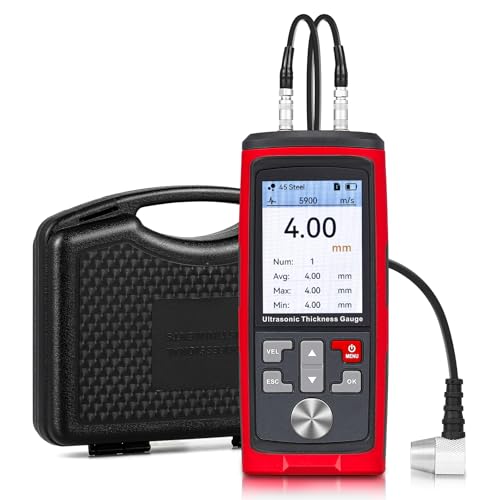
- 1 to 300 mm range with 0.01 mm resolution
- 1500-point storage plus software graph output
- Includes calibration block and USB cable
Best For: Inspection tasks that benefit from color display and data analysis
Color Display Pick
Industrial-882X Ultrasonic Thickness Gauge

- 1 to 300 mm range for compatible materials
- HD color screen with adjustable interface colors
- Sound velocity adjustable from 1000 to 9999 m/s
Best For: Industrial users who want a handheld meter with a color display
Through-Coating Industrial Inspector – Echo-Echo, Pulse-Echo & VERI
If you’re comparing ultrasonic thickness gauges under 500 for coated assets, this model stands out because it can read through paint and protective layers in Echo-Echo mode. It also switches to Pulse-Echo for uncoated metal and rough industrial surfaces, giving maintenance teams one handheld tool for several inspection jobs.
Best For: Inspectors who need through-coating measurement on pipelines, tanks, marine structures, and other coated metal surfaces.
Pros:
- Echo-Echo mode measures base metal thickness without removing coatings.
- Pulse-Echo mode handles uncoated materials, including cast iron and rough surfaces.
- VERI mode adds material-consistency checking for precious metals.
- Built-in memory stores results directly on the device.
Cons:
- Does not support PC connectivity or software export.
- Focused on industrial inspection rather than casual home use.
Overall, this is the most specialized pick in the group if coating-through inspection is your priority. The three-in-one mode set makes it versatile for corrosion monitoring, but its offline design means it is best suited to users who want self-contained field measurements.
Wide-Range Shop Gauge – UTG300 with Storage and Alarms
For buyers looking at ultrasonic thickness gauges under 500, the Triplett UTG300 offers a broad measurement range and a practical layout for routine inspection work. It handles common metals and even glass, with single-shot or continuous reading modes plus simple alarm and storage features.
Best For: Users who want a straightforward handheld gauge for general thickness checks across multiple materials.
Pros:
- Measures steel, stainless steel, brass, copper, iron, lead, glass, and more.
- Single measurement and continuous mode with real-time min/max/avg.
- Stores up to 300 records with measured values and sound velocity.
- High/low alarms help flag readings outside set limits.
Cons:
- Display is a small monochrome dot-matrix screen.
- Includes fewer advanced workflow features than PC-export models.
The UTG300 is a solid all-around option when you want basic inspection tools without overcomplicating the interface. Its wide material support and easy record storage make it a practical fit for shop and field use.
Color LCD Maintenance Gauge – Industrial-882 for Metal Inspections
This Industrial-882 is a practical choice if you want ultrasonic thickness gauges under 500 for standard metal inspection tasks. It measures from one side only, supports adjustable sound velocity, and is aimed at maintenance, diagnostics, and quality control on steel structures, pipes, tanks, and similar solid materials.
Best For: Maintenance crews and inspectors checking steel, pipes, tanks, and other solid materials from one side.
Pros:
- One-sided ultrasonic measurement for non-destructive inspection.
- Wide 1-225 mm range covers thin sheets through pipeline walls.
- Color LCD display improves readability in workshop settings.
- Stores measurements for inspection routines and comparison.
Cons:
- Not designed to measure paint or coating thickness.
- Not intended for cast iron.
In use, this model stays focused on conventional thickness testing rather than specialty coating-through work. That makes it a sensible pick for users who need a portable, easy-to-read gauge for routine metal inspections.
PC-Ready Precision Gauge – Industrial-884X with Expandable Probes
Among ultrasonic thickness gauges under 500, the Industrial-884X is built for users who want measurement depth and data handling in one handheld unit. It covers a wide range of homogeneous materials, supports several probe options, and can export saved readings to a computer for reporting.
Best For: Technicians and quality-control users who need saved readings, PC transfer, and flexible probe support.
Pros:
- Wide 0.85-400 mm range with 0.01 mm resolution.
- PC data export supports documentation and report generation.
- Stores up to 2,000 readings across multiple memory groups.
- Supports multiple probe types for thin, thick, and high-temperature work.
Cons:
- More feature-rich than a basic entry-level gauge.
- Advanced probe setup may be unnecessary for simple one-off checks.
This is the best fit if your workflow depends on organized records and material verification rather than just quick spot checks. The combination of memory, probe flexibility, and PC export gives it a strong advantage for structured inspection programs.
Compact All-Purpose Pick – BSIDE Ultrasonic Thickness Gauge Meter
If you want ultrasonic thickness gauges under 500 for mixed-material work, the BSIDE T7 is a flexible option with a 1-300mm range and support for metal and non-metal surfaces. It’s geared toward quick everyday measurements on materials like steel, aluminum, PVC, glass, ceramics, and plastics, while the color display helps keep readings easy to see in different lighting.
Best For: Users who need a rechargeable, general-purpose thickness gauge for both shop and field use.
Pros:
- Measures a wide range of metal and non-metal materials, including steel, aluminum, PVC, glass, and ceramics
- 1-300mm range with 0.01mm resolution below 10mm for fine readings
- Color TFT display is easy to read from different angles and in bright or low light
- Includes single and continuous test modes plus MIN/MAX/AVG functions
Cons:
- Accuracy and resolution vary by thickness range, so it’s not uniform across all measurements
- Best results still depend on proper probe calibration and suitable surface contact
This is a practical pick if you want broad material support and straightforward features without overcomplicating the workflow. Its rechargeable design and readable screen make it especially convenient for routine thickness checks.
Feature-Rich Shop Choice – LATNEX LAT-US100 Ultrasonic Thickness Gauge
Among ultrasonic thickness gauges under 500, the LATNEX LAT-US100 stands out for its combination of fast readings, adjustable sound velocity, and a color screen with multiple display colors. It covers 1-300mm on steel with 0.01mm resolution, and the included calibration block, stored readings, and limit alarms make it well suited to repeatable inspection tasks.
Best For: Workshop and industrial users who want more control over calibration, alarms, and saved measurements.
Pros:
- Fast 0.5-second readings with 0.01mm resolution over a 1-300mm range
- Adjustable sound velocity from 1000-9999 m/s for different materials
- Stores up to 500 readings and includes min/max, calibration, and high/low alarms
- Comes with a probe, built-in calibration block, USB cable, and rechargeable batteries
Cons:
- Requires parallel top and bottom surfaces for proper measurement
- More settings may be more than casual users need
This model is a strong fit if you need a gauge that does more than simply show thickness. The broader control set and data storage features make it especially useful for organized inspection work.
Portable Data-Logging Pick – PM1301 Ultrasonic Thickness Gauge
If you’re comparing ultrasonic thickness gauges under 500 and want a lightweight handheld unit, the PM1301 is built for portability and repeat measurements. It offers a 0.039 to 11.811 inch steel range, automatic probe recognition, adjustable sound velocity, and computer software support for recording and statistical analysis.
Best For: Users who want a compact gauge with data storage and computer-based analysis support.
Pros:
- Lightweight 5.57 oz body with a built-in 1000mAh rechargeable battery
- 0.5-second measurements with color backlight for use in different lighting
- Includes min/max/average mode, data storage, and high/low limit alarms
- Supports computer software for data recording and statistical analysis
Cons:
- Best performance depends on parallel surfaces and proper probe setup
- Its advanced software and customization features may be unnecessary for simple spot checks
This is a practical option if you want a small, rechargeable gauge that still offers serious tracking features. It balances field portability with logging and analysis tools that can matter in maintenance or production environments.
Shop-Focused Gauge – Ultrasonic Thickness Gauge Meter with Data Storage
If you want one of the more flexible ultrasonic thickness gauges under 500, this model is built around a wide 1 to 300 mm range, custom sound velocities, and straightforward data handling. It suits users who need a practical meter for steel, metals, plastic, glass, PVC, and pipes without giving up useful memory and alarm features.
Best For: Users who want a versatile thickness gauge with strong storage and customization options for mixed-material work.
Pros:
- Measures 1.00 to 300.0 mm with fine 0.01 mm resolution on thinner readings.
- Includes 12 preset sound velocities plus 3 custom slots for user-defined settings.
- Stores up to 1500 data points across 15 files with max/min/average viewing.
- Features a bright LCD backlight, audible limit alarms, and USB data transfer.
Cons:
- Resolution steps change to 0.1 mm above 100 mm.
- Best suited to materials with suitable ultrasonic response, not porous or unsuitable surfaces.
Overall, this is a strong general-purpose pick if you value measurement range and recordkeeping more than a stripped-down interface. The included probe and rechargeable design make it a practical option for ongoing inspection tasks.
Inspection-Ready Meter – Bonvoisin Ultrasonic Thickness Gauge
Among ultrasonic thickness gauges under 500, this Bonvoisin model stands out for its color screen, built-in calibration block, and measurement analysis features. It covers steel, copper, plastics, glass, PVC, and other conductive materials with a 1 to 300 mm range and adjustable sound speed for more accurate readings.
Best For: Buyers who want a compact gauge with helpful accessories and analysis tools for inspection work.
Pros:
- Wide 1 to 300 mm range with 0.001 in / 0.01 mm resolution.
- Stores 1500 data points and can output line graphs through computer software.
- Includes a built-in metal calibration block, USB cable, coupling agent, and rechargeable battery.
- Color screen with adjustable backlight brightness improves visibility.
Cons:
- Designed for materials that conduct ultrasonic waves well.
- Feature set is more inspection-oriented than ultra-minimalist.
This is a well-rounded option if you want a thickness gauge that feels ready for field use and basic data analysis. The included accessories and software output make it especially appealing for users who need more than just a live reading.
Color Display Pick – Industrial-882X Ultrasonic Thickness Gauge
If you are comparing ultrasonic thickness gauges under 500 and want a compact industrial option, the Industrial-882X offers a 1 to 300 mm measurement range, customizable sound velocity, and an HD color screen. It is built for measuring metals, plastics, ceramics, and glass, with a design aimed at maintenance, manufacturing, and corrosion checks.
Best For: Professionals who want a handheld gauge with a color display and industrial inspection features.
Pros:
- Measures 1 to 300 mm with 0.001 in resolution for 45# steel.
- Supports sound speed adjustment from 1000 to 9999 m/s.
- HD color screen with adjustable backlight and multiple interface colors.
- Suitable for pipelines, pressure vessels, and corrosion assessment tasks.
Cons:
- Not recommended for porous materials like cast iron or carbon fiber.
- Accuracy depends on proper calibration and material compatibility.
As a professional-style meter, this model emphasizes readability and adjustment flexibility over simplicity. It is a solid fit when you need a handheld gauge for routine industrial inspection across compatible materials.
How We Picked the Best Ultrasonic Thickness Gauges Under 500
For this roundup of Ultrasonic Thickness Gauges Under 500, we prioritized measurement range, supported materials, ease of calibration, display readability, data functions, and overall value. We also looked for models that suit common jobs like steel inspection, pipe checks, tank maintenance, and general industrial thickness testing.
Because buyers often use these tools in mixed environments, we gave extra weight to units with flexible velocity settings, dependable probes, and the ability to handle coated or nonuniform surfaces where applicable.
Quick Comparison
Some gauges in this group are better for basic steel and pipe work, while others add broader material support, PC connectivity, or extra measuring range. If you need a straightforward shop tool, a simpler meter may be enough. If you want reporting, storage, or wider application coverage, look for models with memory and custom sound velocity settings.
In practice, the best choice often comes down to how often you measure, what materials you test most, and whether you need portability or data management more than advanced functions.
Key Buying Factors for Ultrasonic Thickness Gauges Under 500
Material Compatibility
Check whether the gauge is intended for steel only or for a broader set of materials such as copper, aluminum, plastics, glass, or PVC. Material range matters because ultrasonic readings depend on the correct velocity setting and probe performance.
Measurement Range and Resolution
Choose a range that fits your work. Narrower ranges can be fine for common metal inspection, but broader-range gauges are more versatile for mixed-use buyers. Resolution is important when you need to spot thin-wall wear or small changes over time.
Probe Quality and Coupling
The probe affects repeatability as much as the main unit does. A better probe can improve contact consistency on curved or rough surfaces. If you frequently inspect pipes or uneven stock, probe quality should be near the top of your list.
Functions That Improve Workflow
Features like data storage, PC connection, customizable sound velocities, and backlit color screens can save time in the field. If you only need occasional spot checks, you may not need the extras. If you document results, those features are worth paying for.
Who Should Buy Which Ultrasonic Thickness Gauges Under 500?
Buyers doing general steel or pipe inspection should favor a simple, accurate model with a dependable range and easy calibration. Maintenance teams and inspectors who work across several materials should choose one of the more versatile Ultrasonic Thickness Gauges Under 500 with adjustable velocity and broader compatibility.
If you need to capture readings for records or reporting, prioritize units with data storage or PC output. For users who care most about portability and fast field checks, a lightweight gauge with a clear display and rechargeable power is usually the best fit.