Choosing the right gauge matters when tank integrity, corrosion monitoring, and maintenance decisions depend on reliable wall readings. The best ultrasonic thickness gauges for tanks help you check metal loss without cutting, removing, or damaging the surface.
Below, you’ll find a focused roundup of 10 options suited to industrial tank work, plus a practical buying guide to help you match range, mode, and material compatibility to your inspection needs.
Best 10 Ultrasonic Thickness Gauges for Tanks Picks for 2026
Industrial Field Inspector
GOYOJO UTG-2 Ultrasonic Thickness Gauge

- 1.0–300 mm steel range with 5MHz probe
- Through-coating mode for suitable surfaces
- Stores 1500 results with stats and PC support
Best For: Maintenance crews inspecting tanks, pipes, and metal walls
Color-Screen Generalist
Wintact Digital Ultrasonic Thickness Gauge

- 1 to 300 mm range with 0.01 mm resolution
- 2.4-inch color screen with backlight
- Stores 500 readings and supports alarms
Best For: Inspectors who need a readable, versatile gauge for multiple materials
Simple Metal Inspector
TM-8812 Ultrasonic Thickness Gauge

- 1.2–200 mm one-side measurement
- 11 preset material sound velocities
- LCD with backlight and USB/RS-232C support
Best For: Routine tank and pipe checks on common compatible materials
High-Range Coating Checker
Industrial-888X Ultrasonic Thickness Gauge
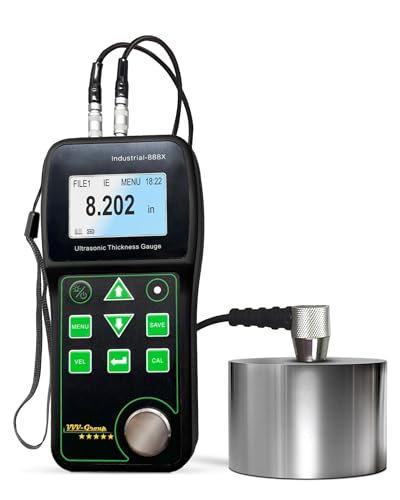
- Echo-echo mode measures through coatings
- 1 to 500 mm PE-mode range for 45# steel
- Exports data to XLSX or PDF
Best For: Coated tank inspections and documentation-heavy industrial work
Budget-Friendly General-Purpose Gauge
TM-8816 Ultrasonic Wall Thickness Gauge

- Measures 1.0 to 200 mm with 0.1 mm resolution
- Supports many metals and some rough surfaces
- Sound velocity range covers 500 to 9000 m/s
Best For: General industrial checks on tanks and mixed materials
Through-Coating Tank Inspector
Industrial-888 Ultrasonic Thickness Gauge

- Echo-Echo mode measures through coatings up to 500 μm
- Pulse-Echo handles uncoated cast iron and rough surfaces
- Stores results locally without PC software
Best For: Coated tanks and industrial maintenance inspections
High-Range Inspection Meter
Industrial-886 Digital Metals Thickness Gauge

- Measures from 1 to 400 mm with fine 0.01 mm resolution
- Stores up to 100 measurement groups
- Single and continuous modes support routine inspections
Best For: Larger tanks and routine industrial wall-thickness checks
Heavy-Duty Wide-Range Pick
Industrial-882X Ultrasonic Thickness Gauge

- 1–300 mm range on 45# steel
- Color LCD with adjustable backlight
- Works with steel, plastic, glass, PVC
Best For: Wide-range tank and industrial inspection
Tank Inspection Utility
Industrial-882 Metal Thickness Tester

- One-side-only thickness inspection
- Stores readings for routine checks
- Color LCD and auto calibration
Best For: Routine tank and pipe maintenance checks
Feature-Rich Field Choice
PM1301 Ultrasonic Thickness Gauge

- Fast non-destructive readings
- Data storage and alarm functions
- Lightweight with up to 8 hours battery life
Best For: Light field use with documentation features
Industrial Field Inspector – GOYOJO UTG-2 Ultrasonic Thickness Gauge
If you need ultrasonic thickness gauges for tanks that can handle routine inspection and maintenance work, the GOYOJO UTG-2 is built for practical on-site measuring. It checks wall thickness from one side, supports through-coating mode when the surface is suitable, and stores readings for later review, making it useful for corrosion checks and repair decisions.
Best For: Maintenance teams and inspectors who want a portable gauge for tank walls, pipes, and other metal parts with data storage.
Pros:
- Measures steel from 1.0 to 300 mm with a 5MHz standard probe
- Through-coating mode can reduce prep time on suitable coated surfaces
- Stores up to 1500 measurement groups for records and comparisons
- Rechargeable, compact, and lightweight for field use
Cons:
- Through-coating mode depends on the surface being suitable for use
- Designed for thickness measurement, not coating thickness
- Advanced data and PC features may take some setup for new users
Overall, this is a solid choice if you want a thickness tester that focuses on inspection workflow, not just raw measurement. Its storage, portability, and coating-friendly mode make it a practical fit for tank and pipe maintenance.
Color-Screen Generalist – Wintact Digital Ultrasonic Thickness Gauge
Among ultrasonic thickness gauges for tanks, the Wintact model stands out for fast readings, a wide material list, and a colorful display that makes field checks easier to read. It measures metal and nonmetal materials from 1 to 300 mm, supports adjustable sound velocity, and offers data storage plus alarm functions for inspection work.
Best For: Users who want a versatile gauge with a clear display and broad material compatibility.
Pros:
- Measures 1 to 300 mm with 0.01 mm resolution
- Adjustable sound velocity helps improve accuracy on different materials
- 2.4-inch HD color screen with backlight and selectable color themes
- Stores up to 500 readings and includes high/low thickness alarms
Cons:
- Uses AAA batteries rather than a built-in rechargeable pack
- Best results still depend on the material being a good ultrasonic conductor
- Some users may not need the extra display and menu features
This is a practical pick if you want a flexible gauge that can do more than basic tank checks. The range, memory, and display features make it easy to use for mixed inspection jobs where readability matters.
Simple Metal Inspector – TM-8812 Ultrasonic Thickness Gauge
The TM-8812 is a straightforward option for ultrasonic thickness gauges for tanks when you mainly need one-side thickness measurement on compatible metal parts. It covers 1.2 to 200 mm, includes preset sound velocities for common materials, and offers thickness and velocity modes for routine industrial inspection.
Best For: Users who want a simple, metal-focused gauge for tanks, pipes, and machine parts.
Pros:
- One-side measurement for compatible materials from 1.2 to 200 mm
- 11 material presets cover common metals and plastics
- Thickness and velocity modes add flexibility for inspection tasks
- Clear LCD with backlight and selectable mm/inch display
Cons:
- Resolution is 0.1 mm, so it is less fine than 0.01 mm models
- PC software is not included for the optional data connection
- Powered by AAA batteries instead of rechargeable power
This model works well if you value simplicity and a familiar industrial layout over extra features. It is a sensible fit for maintenance work where preset materials and one-side access are the main needs.
High-Range Coating Checker – Industrial-888X Ultrasonic Thickness Gauge
If you are comparing ultrasonic thickness gauges for tanks and other coated metal surfaces, the Industrial-888X is designed to measure through coatings without removing the surface layer. It combines echo-echo and pulse-echo modes, a very wide measurement range, and data export options, which makes it useful for demanding inspection workflows.
Best For: Inspectors who need through-coating measurement, large range coverage, and exportable data.
Pros:
- Echo-echo mode measures through coatings up to 20 mils
- Wide 1 to 500 mm range in PE mode for 45# steel
- Supports PC export to XLSX or PDF with included software cable and flash drive
- Saves 500 measurement groups and shows detailed status information
Cons:
- Some listed capabilities are material-specific, such as the 45# steel range
- Best suited to technical users who need export and mode selection
- Not focused on basic, no-frills everyday measurement
This is the most specialized option in the group, especially if coating preservation matters during tank inspections. Its export tools and broad range make it a strong fit for documentation-heavy industrial environments.
Budget-Friendly General-Purpose Gauge – TM-8816 Ultrasonic Wall Thickness Gauge
If you need ultrasonic thickness gauges for tanks that can also handle a wide mix of materials, the TM-8816 is a straightforward option. It measures from 1.0 to 200 mm and supports a broad sound velocity range, so it fits basic wall-thickness checks across steel, cast iron, aluminum, brass, and more.
Best For: General industrial thickness checks on tanks, pipes, and mixed materials.
Pros:
- Wide measuring range from 1.0 to 200 mm for many inspection tasks
- High resolution of 0.1 mm for practical wall-thickness readings
- Broad sound velocity support from 500 to 9000 m/s
- Works with rough surfaces and materials like cast iron
Cons:
- No mention of through-coating measurement mode
- Basic feature set compared with more advanced industrial models
For buyers who want a versatile gauge without specialized inspection features, the TM-8816 covers a lot of common use cases. It is best viewed as a dependable general-purpose thickness meter rather than a coating-aware inspection tool.
Through-Coating Tank Inspector – Industrial-888 Ultrasonic Thickness Gauge
For ultrasonic thickness gauges for tanks where paint or protective coating may stay in place, the Industrial-888 is built around Echo-Echo inspection. It can measure base metal thickness through coatings up to 19.7 mils (500 μm), while also offering Pulse-Echo mode for uncoated cast iron and rough industrial surfaces.
Best For: Inspecting coated tanks, pipelines, and other industrial equipment without stripping paint.
Pros:
- Echo-Echo mode measures through coatings up to 19.7 mils / 500 μm
- Pulse-Echo mode supports uncoated materials and rough surfaces
- Includes VERI mode for checking metal consistency
- Built-in memory stores inspection results on the device
Cons:
- Does not support PC connectivity or software export
- More specialized than basic thickness gauges
This model stands out when coating removal is impractical and you still need meaningful wall-loss readings. Its mix of inspection modes makes it a strong fit for maintenance work on tanks and similar industrial assets.
High-Range Inspection Meter – Industrial-886 Digital Metals Thickness Gauge
If your search for ultrasonic thickness gauges for tanks is focused on range and simple operation, the Industrial-886 is a solid fit. It measures from 1 to 400 mm, uses ultrasonic pulse-echo technology for true material thickness, and supports manual sound velocity settings for different materials.
Best For: Larger tanks, structural components, and routine industrial thickness checks.
Pros:
- Wide 1 to 400 mm measuring range suits thin and thick components
- Resolution up to 0.01 in / 0.01 mm for fine readings
- Stores up to 100 measurement groups with average, min, and max values
- Supports single and continuous measurement modes
Cons:
- No through-coating capability mentioned
- More focused on standard thickness testing than specialized inspection modes
The Industrial-886 is a practical choice when you want a wide measurement window and basic data handling in one handheld unit. It looks especially useful for routine inspections where repeatability and easy setup matter more than advanced coating features.
Heavy-Duty Wide-Range Pick – Industrial-882X Ultrasonic Thickness Gauge
If you need ultrasonic thickness gauges for tanks, the Industrial-882X is a flexible option for checking solid materials one side at a time. It covers a broad range from 1 mm to 300 mm on 45# steel and is also suited to metals, plastics, ceramics, and glass, making it useful when tank work involves more than just steel surfaces.
Best For: Technicians who want a wide-range handheld gauge for tank walls, pipelines, and mixed-material inspection jobs.
Pros:
- Wide 0.039 to 11.811 in measurement range on 45# steel.
- Adjustable sound velocity and easy calibration with a reference block.
- HD color screen with adjustable backlight for easier reading.
- Compact handheld design for portable industrial use.
Cons:
- Not recommended for porous materials like cast iron or carbon fiber.
- Best suited to solid materials that transmit ultrasonic waves clearly.
For tank inspection and corrosion checks, the Industrial-882X stands out for its range and display flexibility. It is a practical field tool when you need one gauge that can handle a variety of common inspection materials.
Tank Inspection Utility – Industrial-882 Metal Thickness Tester
Among ultrasonic thickness gauges for tanks, the Industrial-882 is built around one-sided inspection for solid materials. It is positioned for maintenance and technical inspection work on steel structures, pipes, tanks, and other metal components, with a range that supports both thinner sections and heavier wall checks.
Best For: Maintenance crews and inspectors measuring tank walls and metal structures during routine field checks.
Pros:
- Designed for one-side-only thickness inspection.
- 0.039 to 8.858 in range suits many maintenance tasks.
- Adjustable sound velocity supports steel, aluminum, copper, plastic, and glass.
- Can store measurement results for inspection routines.
Cons:
- Does not measure paint or coating thickness.
- Not designed for cast iron.
- Smaller range than some wider-coverage models.
This model is a straightforward choice when you mainly need dependable tank and pipe wall readings rather than advanced extras. Its portable design and stored readings make it useful for repeated inspection rounds.
Feature-Rich Field Choice – PM1301 Ultrasonic Thickness Gauge
The PM1301 is a strong candidate if you want ultrasonic thickness gauges for tanks with more measurement features built in. It offers fast non-destructive readings, adjustable sound speed, and multiple presets, plus storage and alarm functions that can help streamline repeated tank inspections.
Best For: Users who want a lightweight, feature-rich gauge for tank corrosion checks and field documentation.
Pros:
- Fast, non-destructive readings with up to 0.0003 in resolution.
- Multiple modes including Min/Max/average, alarms, and data storage.
- Lightweight handheld body with a rechargeable battery rated up to 8 hours.
- Supports steel, PVC, glass, plastic, rubber, and ceramics.
Cons:
- Range is listed for steel, so material type affects the usable span.
- Feature set may be more than needed for simple spot checks.
For inspectors who value documentation and quick workflow, the PM1301 offers a good balance of portability and measurement tools. It is especially appealing when tank work requires repeated readings, limits, and data capture.
How We Picked These Ultrasonic Thickness Gauges for Tanks
We looked for gauges that make sense for tank inspection workflows: useful measurement ranges, strong suitability for metal surfaces, and features that help with real-world conditions such as coatings, curved walls, and routine NDT use. We also favored models with practical displays, data handling, and broad material support where relevant.
Because tank inspections often involve steel or other metals, we prioritized instruments that can handle wall thickness measurement accurately and consistently rather than general-purpose meters with limited industrial value.
Quick Comparison: What Matters Most
For most buyers, the biggest differences come down to three things: measurement range, through-coating capability, and compatibility with the tank materials you inspect most often. If you work on painted or coated tanks, echo-echo or through-coating modes can save prep time. If you inspect a variety of assets, broader range and multi-material support may be more useful than a single-purpose unit.
Key Buying Factors for Ultrasonic Thickness Gauges for Tanks
Measurement Range
Choose a range that comfortably covers the thinnest and thickest tank walls you expect to inspect. A wider range offers flexibility, but only if the gauge still provides dependable resolution in your target thickness band.
Mode and Surface Conditions
For painted, coated, or hard-to-clean tanks, through-coating or echo-echo modes can reduce surface prep. If your inspections are mostly on bare metal, a standard pulse-echo gauge may be enough.
Material Compatibility
Most tank work centers on steel and other metals, but some environments include plastics, pipes, glass, or specialty materials. Verify the gauge is calibrated for the materials you actually test.
Resolution, Accuracy, and Stability
Tank monitoring often depends on spotting gradual corrosion, so fine resolution and stable repeat readings matter. A smaller measurement increment can be helpful, but real-world consistency matters just as much.
Data Features and Usability
Look for features that support field work, such as backlit screens, simple calibration, memory storage, and PC export if you need to document inspections or track corrosion over time.
Who Should Buy Which Ultrasonic Thickness Gauges for Tanks?
If you need fast checks on coated tanks, prioritize a through-coating model. If your work is mostly standard steel tank walls, a straightforward ultrasonic thickness gauge with a suitable range may offer the best value. For teams doing repeated inspections and reporting, choose a model with data export and easy calibration. For broader maintenance crews, a multi-material gauge can be the most flexible option, even if it is more than you need for tank-only work.
In short, the best choice depends on how often you inspect, what the tank surface looks like, and whether you need basic spot checks or documented thickness trending.