Choosing among today’s telescopes is easier when you know what matters most: aperture, mount stability, portability, and how simple it is to use under the stars.
This roundup focuses on beginner-friendly and enthusiast-ready models that balance image quality, setup time, and value so you can pick the right scope with confidence.
Best 10 Telescopes Picks for 2026
Beginner Travel Refractor
Gskyer 70mm Kids Travel Telescope

- 70mm aperture with fully coated optics
- Includes 2 eyepieces, 3x Barlow, and finder scope
- Carry bag, phone adapter, and wireless remote
Best For: Kids and beginners wanting a portable starter scope
Smartphone-Guided Reflector
Celestron StarSense Explorer DX 130AZ
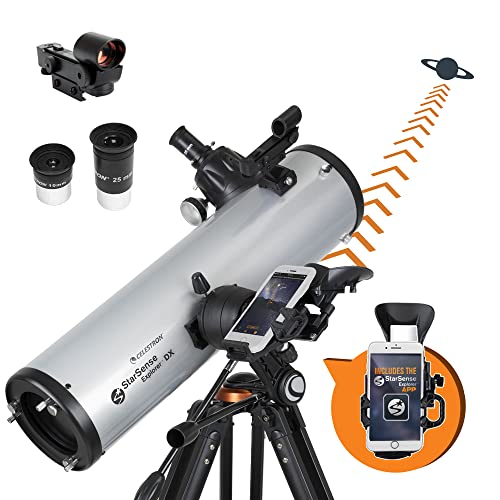
- StarSense app guides target finding on your phone
- 130mm reflector for Moon, planets, and deep-sky viewing
- Dual-axis slow-motion controls on a manual mount
Best For: Beginners who want smartphone-assisted sky navigation
Portable Beginner Refractor

- 80mm aperture with fully multi-coated optics
- Includes 2 eyepieces, 3x Barlow, and finder scope
- No-tool setup with phone adapter and remote
Best For: Beginners wanting a portable scope with easier setup
Computerized Deep-Sky SCT
Celestron NexStar 8SE Computerized Telescope

- 8-inch Schmidt-Cassegrain optics for strong light gathering
- GoTo mount with 40,000+ object database
- SkyAlign and NexStar+ hand control simplify setup
Best For: Observers ready for a computerized upgrade with big aperture
High-Power 90mm Starter Pick

- 90mm aperture with fully coated optics
- 32x-240x magnification range
- Tripod, phone adapter, and carry bag included
Best For: Beginners who want more viewing power and portability
Travel-Friendly Beginner Choice

- 70mm aperture with fully coated lenses
- No-tool setup and backpack included
- Two eyepieces plus Starry Night software
Best For: Travelers and beginners who want a compact, easy-to-pack telescope
Accessory-Rich 90mm Upgrade

- Fully multi-coated 90mm optics
- 32x-240x viewing with Barlow lens
- Phone adapter, tripod, and carry bag included
Best For: Beginners who want a well-equipped 90mm telescope kit
Smartphone-Guided Beginner Telescope
Celestron StarSense Explorer LT 114AZ
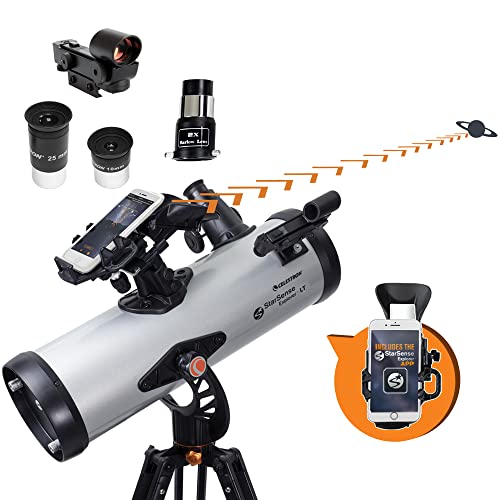
- StarSense app guides you to targets
- 114mm reflector for Moon and planets
- Includes eyepieces, Barlow, and tripod
Best For: Beginners who want app-assisted object finding
Portable Refractor Starter Telescope

- 80mm aperture with fully coated optics
- Backpack, tripod, phone adapter included
- Simple tool-free setup for beginners
Best For: Families and travelers needing a lightweight starter scope
Complete Beginner Astronomy Kit

- 90mm aperture with multi-coated optics
- Includes stool, bag, tripod, and adapter
- 3X Barlow reaches up to 180X
Best For: Beginners wanting a full portable astronomy bundle
Beginner Travel Refractor – Gskyer 70mm Kids Travel Telescope
If you want a simple telescope for casual moon, star, and nature viewing, this Gskyer refractor is built to be beginner-friendly. The 70mm aperture, 400mm focal length, and included 3x Barlow lens give it enough flexibility for first-time observers, while the phone adapter and wireless remote add basic smartphone imaging convenience.
Best For: Kids, beginners, and families who want a lightweight, travel-ready starter scope.
Pros:
- 70mm aperture with fully coated optics for brighter views
- Includes two eyepieces plus a 3x Barlow lens for more magnification options
- Phone adapter and wireless remote support simple smartphone viewing and photos
- Carry bag and adjustable aluminum tripod make storage and travel easier
Cons:
- Manual altazimuth mount means you’ll be moving and tracking objects by hand
- Best suited to beginner-level observing rather than advanced deep-sky use
This is a practical entry-level option if you want telescopes that are easy to pack, set up, and use without much learning curve. It focuses on convenience and basic astronomy rather than premium optics.
Smartphone-Guided Reflector – Celestron StarSense Explorer DX 130AZ
This Celestron telescope stands out if you want help finding targets without needing a lot of experience. The StarSense Explorer app uses smartphone sky recognition to guide you to planets, nebulae, galaxies, and clusters, while the 130mm Newtonian reflector provides a solid visual step up for moon and deep-sky viewing.
Best For: Beginners and backyard observers who want smartphone-guided object location with a larger reflector.
Pros:
- StarSense Explorer app helps locate targets with on-screen guidance
- 130mm reflector is suited to the Moon, planets, and brighter deep-sky objects
- Manual altazimuth mount includes dual-axis slow-motion controls
- Includes 25mm and 10mm eyepieces plus a red dot finderscope
Cons:
- Still requires manual movement and focus, not full automation
- Smartphone-dependent navigation may not appeal to users who prefer traditional star-hopping
Among beginner-friendly telescopes, this one balances guidance and aperture well. It’s a strong choice if you want easier target finding without jumping straight to a fully computerized system.
Portable Beginner Refractor – Koolpte 80mm 600mm Telescope
If you’re comparing telescopes for mixed beginner use, this Koolpte model offers a useful middle ground between portability and light-gathering ability. Its 80mm aperture and 600mm focal length are paired with multi-coated optics, while the included phone adapter, wireless remote, and carrying bag make it easy to take out and use.
Best For: Adults and beginners who want a portable, easy-setup telescope with a slightly larger aperture.
Pros:
- 80mm aperture and fully multi-coated optics for brighter, clearer viewing
- Two eyepieces and a 3x Barlow lens increase magnification options
- Phone adapter, wireless remote, and carrying bag improve convenience
- No-tool setup and adjustable tripod make it beginner-friendly
Cons:
- Manual altazimuth mount requires hands-on tracking
- Included eyepieces and accessories keep it in the beginner category rather than advanced observing
This is a sensible choice if you want telescopes that are easy to carry and quick to set up, but with a bit more aperture than the smallest starter scopes. It leans practical rather than specialized.
Computerized Deep-Sky SCT – Celestron NexStar 8SE Computerized Telescope
If you want a more advanced telescope that automates much of the target-finding process, the NexStar 8SE is a major step up from beginner scopes. Its 8-inch Schmidt-Cassegrain optics, computerized GoTo mount, and 40,000+ object database are built for users who want serious visual observing with less manual searching.
Best For: Experienced beginners and adults ready for a computerized telescope with strong light-gathering power.
Pros:
- Large 8-inch aperture gathers significantly more light than entry-level scopes
- Fully computerized GoTo mount automatically slews to targets
- 40,000+ object database and SkyAlign speed up setup and observing
- Compact Schmidt-Cassegrain design keeps it relatively portable for its size
Cons:
- More complex and expensive than basic manual telescopes
- Requires power sources and batteries for computerized operation
This is the kind of telescope to consider when you want to move beyond simple starter telescopes and into automated observing. It’s best for users who value convenience, aperture, and long-term room to grow.
High-Power 90mm Starter Pick – Dianfan 90mm 800mm Refractor
If you want telescopes that balance beginner-friendly setup with stronger light gathering, the Dianfan 90mm refractor is a practical place to start. Its 800mm focal length and fully coated 90mm aperture are aimed at brighter moon views, clear daytime spotting, and a more capable all-around first scope.
Best For: Beginners and families who want a portable telescope with more viewing power than an entry-level travel model.
Pros:
- 90mm objective lens and fully coated optics for brighter, clearer images
- 32x-240x magnification with two eyepieces and a 3x Barlow lens
- Upright image from the 45° zenith mirror, useful for terrestrial viewing
- Includes stainless steel tripod, phone adapter, and carry bag for easier transport
Cons:
- Manual focus means you’ll be adjusting by hand as you observe
- Higher magnification ranges may be harder for complete beginners to use steadily
Overall, this model stands out among beginner telescopes if you want a stronger aperture and a more complete accessory set. It’s built for learning the sky, but it also stays flexible enough for birdwatching, wildlife, and casual travel use.
Travel-Friendly Beginner Choice – Celestron Travel Scope 70
For shoppers comparing telescopes that are easy to pack and use on the move, the Celestron Travel Scope 70 keeps things simple. Its 70mm aperture, fully coated lenses, and no-tool setup make it a straightforward option for moon viewing, daytime scenery, and casual stargazing.
Best For: Travelers, kids, and first-time users who want a lightweight telescope with fast setup.
Pros:
- Lightweight, travel-ready design with a padded backpack included
- No-tool setup and preassembled parts make assembly quick
- Two eyepieces provide both wide and closer views
- Includes finderscope, star diagonal, and free Starry Night software
Cons:
- 70mm aperture is smaller than 90mm models and gathers less light
- Built for easy portability, not maximum magnification or advanced observing
This is a solid pick if convenience matters more than raw power. Among portable telescopes, it’s especially appealing for newcomers who want a complete kit that can go from storage to observing in minutes.
Accessory-Rich 90mm Upgrade – MEEZAA 90mm 800mm Refractor
If you’re shopping for telescopes with a fuller accessory bundle, the MEEZAA 90mm refractor offers a strong beginner package. It combines a 90mm aperture, fully multi-coated glass, and a 3x Barlow lens for brighter views and a wider practical range for moon and sky watching.
Best For: Astronomy beginners who want a 90mm telescope with a strong accessory set and easy setup.
Pros:
- 90mm aperture and 800mm focal length for brighter, clearer images
- 32x-240x magnification with 10mm and 25mm eyepieces plus a 3x Barlow lens
- Adjustable stainless steel tripod and carry bag improve portability
- Phone adapter included for capturing photos and videos
Cons:
- Manual focus and altazimuth mount require hands-on tracking
- Best suited to beginner and casual use rather than advanced observing
Among beginner telescopes, this one is attractive when you want useful accessories bundled in from the start. It’s a practical choice for backyard sessions, camping nights, and sharing views with family or friends.
Smartphone-Guided Beginner Telescope – Celestron StarSense Explorer LT 114AZ
If you want one of the more beginner-friendly telescopes for finding objects fast, the Celestron StarSense Explorer LT 114AZ stands out for its smartphone-guided sky navigation. The app helps point you toward tonight’s best targets based on your location and time, while the 114mm Newtonian reflector delivers bright views of the Moon, planets, and brighter deep-sky objects.
Best For: Beginners who want app-assisted targeting and a straightforward first telescope for Moon, planet, and basic deep-sky viewing.
Pros:
- StarSense Explorer app uses sky recognition to help locate targets with on-screen arrows.
- 114mm reflector is suited to bright lunar and planetary views, plus favorites like Orion Nebula and Andromeda Galaxy.
- Includes 25mm and 10mm eyepieces, a 2x Barlow lens, and a preassembled mount and tripod.
- Manual altazimuth mount with slow-motion altitude adjustment keeps tracking simple.
Cons:
- Requires a compatible smartphone to get the guided-navigation experience.
- Manual focus and manual mount mean it is not fully automated.
- Best results are aimed at bright objects rather than faint, highly detailed deep-sky viewing.
For shoppers comparing telescopes for easy first-time use, this model’s main advantage is how much it reduces the guesswork of locating objects. It pairs that guidance with solid starter optics and a practical accessory set, making it a strong choice for casual backyard observing.
Portable Refractor Starter Telescope – Celticbird 80mm Travel Scope
The Celticbird 80mm refractor is built as a portable, easy-to-set-up option among telescopes for adults, beginners, and kids. Its 80mm aperture and fully coated optics are designed to deliver bright, clear images, while the included backpack, phone adapter, and adjustable tripod make it simple to carry and use on the go.
Best For: Families, beginners, and travelers who want a lightweight refractor with basic astronomy essentials and phone-photo support.
Pros:
- 80mm aperture and 600mm focal length with fully multi-coated optics for brighter viewing.
- Includes a backpack, phone adapter, adjustable tripod, and 5×24 finderscope.
- Easy assembly with no tools required, plus clear setup guidance in the manual and video.
- Two eyepieces provide 30X and 66X magnification, with a moon filter for better contrast.
Cons:
- Manual operation means you’ll need to learn basic aiming and focusing.
- Best suited to moon and planetary viewing rather than advanced deep-sky observing.
- Smaller aperture than 90mm models, so light gathering is more limited.
This is a practical pick if you want a travel-friendly telescope that does not require a complicated setup. The included accessories add real convenience, and the overall design favors easy observing sessions over more advanced astronomy features.
Complete Beginner Astronomy Kit – Feicosky 90mm Refractor Kit
If you are shopping telescopes for a first family observing kit, the Feicosky 90mm refractor offers a lot in one package. It combines a 90mm aperture and 600mm focal length with a tripod, phone adapter, carry bag, folding stool, and extra accessories, making it a versatile setup for backyard stargazing and casual daytime viewing.
Best For: Beginners, families, and gift shoppers who want a complete portable telescope kit with extra comfort and accessories.
Pros:
- 90mm aperture and fully multi-coated optics for brighter, clearer views.
- Includes a folding stool, carry bag, tripod, phone adapter, and 25mm/10mm eyepieces.
- 3X Barlow lens expands magnification from 24X to 180X.
- 5×24 finder scope helps make aiming easier for first-time users.
Cons:
- Manual altazimuth design means you must move and focus the telescope by hand.
- Higher magnification is available, but you’ll still want to start at lower power to center targets.
- The included sticker sets are fun, but they do not add optical performance.
As a practical all-in-one option, this telescope is appealing because it bundles the gear many beginners end up buying separately. The 90mm aperture gives it a step up in light gathering over smaller starter scopes, while the stool and bag make it easier to use on longer outings.
How We Picked These Telescopes
We focused on real-world usability first: optical performance, mount type, ease of setup, portability, and how well each model suits beginners versus more experienced observers. We also prioritized options that offer a clear path from casual backyard viewing to more serious astronomy without forcing you to overpay for features you may not use.
Because many buyers want Telescopes for planets, the Moon, bright deep-sky objects, or family stargazing, we looked for a mix of aperture sizes, focal lengths, and tracking or smartphone-guided features.
Quick Comparison of the Main Types
Refractors are typically the simplest Telescopes to use and are great for crisp views of the Moon, planets, and daytime targets. Newtonian reflectors often deliver more aperture for the money, which helps with faint deep-sky objects. Computerized or smartphone-guided models reduce the learning curve, while portable travel scopes trade some performance for convenience.
If you want a grab-and-go option, choose a lighter refractor or travel model. If you want the most capability for observing from home, a larger-aperture reflector or Schmidt-Cassegrain is usually the stronger long-term choice.
Key Buying Factors for Telescopes
Aperture
Aperture is the most important spec for light gathering. Larger apertures generally reveal brighter, more detailed views, especially on dimmer objects. For beginners, 70mm to 90mm refractors are approachable, while 114mm and up can offer a noticeable jump in performance.
Mount Stability
A shaky mount can make even good Telescopes frustrating to use. Alt-azimuth mounts are intuitive and fast to aim, while computerized mounts add convenience but usually cost more and need power or alignment steps.
Focal Length and Intended Use
Longer focal lengths often make it easier to magnify planets and the Moon, while shorter setups can be better for wider views. Think about what you want to observe most often before choosing.
Accessories and Ease of Setup
Look for included eyepieces, finders, phone adapters, backpacks, or carrying cases if portability matters. For first-time users, a telescope that is quick to assemble and easy to collimate or align can save a lot of frustration.
Who Should Buy Which Telescopes?
Beginners and kids usually do best with a lightweight refractor or travel scope that is easy to point and store. Families who want guided observing may prefer smartphone-assisted models that help identify targets faster. Serious hobbyists or anyone planning to observe regularly from a backyard will benefit most from larger-aperture Telescopes with sturdier mounts and better light gathering.
If you are torn between convenience and performance, start by deciding whether you value portability or deeper views more. That one choice will narrow the field quickly and help you buy a telescope you’ll actually use.