The best solar system models for classrooms make abstract astronomy concepts easier to see, discuss, and remember. The options in this roundup range from magnetic and orbital demonstrations to inflatable planets, project kits, and interactive teaching tools.
We compared these models for classroom usability, age range, durability, engagement, setup, and the concepts they help students explore. Whether you need a display model, a group activity, or a hands-on demonstration, this guide helps you choose the right fit.
Best 10 Solar System Models for Classrooms Picks for 2026
Best Magnetic Demonstration Model

- Large magnetic pieces for whiteboards
- Includes planets, Pluto, Moon, and asteroid belt
- Durable, hands-on classroom display
Best For: Teacher-led demonstrations and ages 4–10
Best Creative Project Kit
64-Piece Solar System Model Kit

- Includes foam pieces, paints, and tools
- Students build and color the planets
- Combines science, art, and coordination
Best For: Classroom project activities for ages 6–12
Best Interactive Orbiting Model
GeoSafari Orbiting Solar System

- Eight planets move around the Sun
- Projects 32 space images
- Includes a facts guide and four discs
Best For: Interactive indoor science centers and ages 5+
Best Glow-in-the-Dark Build
National Geographic Solar System Model

- Builds and paints eight planets and the Sun
- Includes glow paint, decals, and fact poster
- Movable arms support rearrangement
Best For: Astronomy projects and ages 8 and up
Best for Orbit Demonstrations
EISCO 13-Inch Solar System Model

- Movable planets demonstrate relative motion
- Monthly labels support position lessons
- Experiment guide includes classroom activities
Best For: Structured lessons on planetary motion and observation
Best Interactive Learning Station
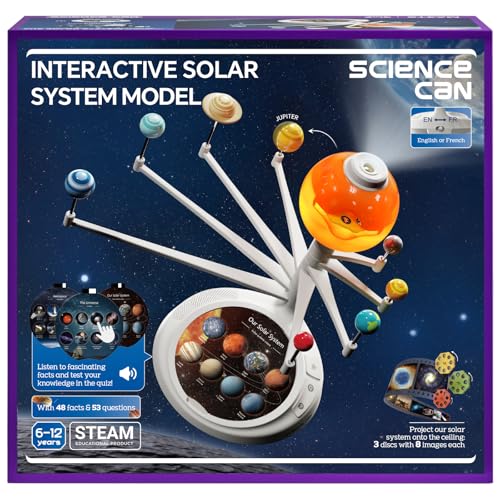
- Includes 48 facts and 53 quiz questions
- Projects 24 colorful space images
- Supports English and French learning
Best For: Interactive STEM centers and small-group activities
Best Inflatable Classroom Display
Inflatable Solar System Model Kit

- Includes the Sun, nine planets, and Pluto
- Large 8- to 28-inch inflatable pieces
- Uses regular air; no helium required
Best For: Early elementary displays and hands-on astronomy activities
Best Compact Demonstration Tool

- Rotating three-sphere educational design
- Demonstrates motion and eclipses
- Compact plastic model for desks or demonstrations
Best For: Small-group astronomy and Earth-Moon-Sun lessons
Best Hands-On Seasons and Eclipse Kit

- Explores seasons, moon phases, and eclipses
- Includes a seasonal plate and assembly instructions
- Supports student-built, rotating demonstrations
Best For: School projects and guided Earth-Moon-Sun lessons
Best Magnetic Demonstration Model – Giant Magnetic Solar System
For classrooms that need a reusable visual aid, the Learning Resources Giant Magnetic Solar System is a practical choice among solar system models for classrooms. Its large magnetic pieces let teachers arrange the planets, Sun, Moon, asteroid belt, and Pluto on whiteboards or other metal surfaces while discussing planetary order and relative size.
Best For: Teacher-led demonstrations, whiteboard lessons, and hands-on activities for children ages 4–10.
Pros:
- Large 12-piece magnetic set includes planets, Sun, Moon, asteroid belt, and Pluto.
- Realistic NASA satellite images provide a visually engaging classroom aid.
- Flexible magnetic material is designed for repeated classroom handling.
- Includes an educational guide with space facts.
Cons:
- Requires a magnetic surface for display.
- Designed primarily for flat-surface demonstrations rather than a freestanding orbit model.
This is especially useful when visibility and quick classroom setup matter more than building or painting. The oversized pieces make planetary sequencing and comparisons easy to demonstrate.
Best Creative Project Kit – 64-Piece Solar System Model Kit
The wookidel 64-piece kit is a strong option for classrooms seeking solar system models for classrooms that combine science with art. Students paint and assemble foam planets using the included colors, brushes, palette, sticks, flags, and instructions, creating a project they can study and display.
Best For: Guided classroom craft projects, small-group activities, and children ages 6–12 exploring planets through making.
Pros:
- Includes foam discs, balls, stars, bamboo sticks, flags, paints, brushes, and palette.
- Smooth polystyrene foam surfaces are designed for coloring.
- Hands-on construction supports coordination, focus, creativity, and astronomy learning.
- Instructions introduce relevant solar system details.
Cons:
- Students must paint and assemble the model, so it needs class time and supervision.
- Foam construction may be less suitable for frequent rough handling than magnetic pieces.
This kit works best when the learning goal includes both planet recognition and a finished student-made project. Its 64 pieces provide plenty of materials for an organized science or art activity.
Best Interactive Orbiting Model – GeoSafari Orbiting Solar System
The Educational Insights GeoSafari combines a rotating 3D model with a built-in projector, making it a more immersive choice among solar system models for classrooms. Students can observe eight planets on moving arms and view 32 images covering planets, constellations, asteroids, and other space topics.
Best For: Interactive science centers, indoor astronomy exploration, and learners ages 5 and up.
Pros:
- Eight planets move on orbiting arms around the Sun.
- Includes 32 images on four projector discs, including NASA images.
- Projects space imagery and includes a guide with fun facts.
- Provides both hands-on model interaction and visual exploration.
Cons:
- Requires three AA batteries, which are not included.
- Manual operation may require teacher guidance during demonstrations.
- Its indoor projector function may be less useful in brightly lit rooms.
This model is a good fit for classrooms that want more than a static display. The orbiting arms support discussions of planetary movement, while the projector adds variety to space-themed lessons.
Best Glow-in-the-Dark Build – National Geographic Solar System Model
The National Geographic kit gives students a build-and-paint approach to solar system models for classrooms, with a finished display that glows in the dark. It includes the planets and Sun, paints, glow-in-the-dark accent paint, decals, a brush, palette, poster, and kid-friendly instructions.
Best For: Older elementary students, astronomy STEM projects, and classroom displays for ages 8 and up.
Pros:
- Includes supplies for customizing all eight planets and the Sun.
- Glow-in-the-dark paint creates an engaging finished display.
- Movable arms allow students to adjust and rearrange the planets.
- Poster and instructions add solar system facts to the building activity.
Cons:
- Recommended for ages 8 and up, so it may not suit younger classes.
- Assembly and painting require preparation, workspace, and drying time.
- The compact model may be better for a display station than whole-class visibility.
This is a compelling choice when students should create, customize, and continue interacting with their model. The movable arms and glow effect add display value beyond a one-time construction activity.
Best Immersive Display – Inflatable Solar System Planets
For classrooms seeking hands-on solar system models for classrooms, this inflatable set turns planetary learning into a visual and tactile activity. It includes the Sun, all eight planets, hanging strings, and learning cards, making it easy to create an interactive space display.
Best For: Elementary classrooms, science-themed room décor, and interactive lessons for children ages 5 to 8.
Pros:
- Includes the Sun and all eight planets for a complete classroom display.
- Hanging loops and included strings support suspended, room-scale demonstrations.
- Learning cards add planet facts and visuals to hands-on play.
- Deflates for compact storage and repeated use.
Cons:
- Inflatable construction is less suited to precise scale or orbit demonstrations.
- Requires manual inflation and available ceiling or room space.
This is a strong choice when engagement and visibility matter more than mechanical movement or detailed astronomy modeling. Its reusable design also works well for rotating classroom displays and space-themed activities.
Best for Orbit Demonstrations – EISCO 13-Inch Solar System Model
Teachers comparing solar system models for classrooms may prefer this three-dimensional EISCO model for lessons focused on planetary positions and motion. Its manually movable planets, labeled monthly base, and included experiment guide support structured demonstrations.
Best For: Classroom instruction on relative planetary motion, positions, observation, and exploratory science activities.
Pros:
- Shows the Sun and all eight planets in a three-dimensional format.
- Metal rods let students manually move planets around the Sun.
- Base labeled with the months helps connect planetary positions to the calendar.
- Experiment guide includes activities, exploration topics, a grading rubric, and planet location table.
Cons:
- Manual movement does not represent an automated or continuously running orbit.
- The model is designed for tabletop use and may not provide room-scale visibility.
With its sturdy base and lesson-oriented guide, this model is particularly useful when a teacher wants a focused demonstration tool rather than decorative classroom décor. It provides more structured interaction than a static display.
Best Interactive Learning Station – Talking Solar System Model
For classrooms that want solar system models for classrooms with built-in digital engagement, this talking model combines knowledge cards, quizzes, lighting, and projection. It offers bilingual English and French options and can turn a lesson area into a compact space-learning station.
Best For: Interactive STEM centers and lessons for children ages 6 to 12 that benefit from audio, quiz, and visual activities.
Pros:
- Includes three knowledge cards with 48 space facts.
- Provides 53 quiz questions for interactive review.
- Projects 24 full-color space images using three included disks.
- Offers English and French language options, with a light-up Sun feature.
Cons:
- Requires three AA batteries, which are not included.
- Projection and talking features may be less suitable for quiet, display-only areas.
- It is a compact model rather than a large-scale classroom planet display.
This model is a good fit for technology-friendly classrooms, small-group stations, or enrichment activities. Its combination of facts, quizzes, and projection provides more varied engagement than a conventional physical model.
Best Inflatable Classroom Display – Inflatable Solar System Model Kit
For classrooms needing a flexible, highly visible option among solar system models for classrooms, this inflatable 10-piece set offers all nine planets, Pluto, and the Sun. The lightweight pieces can be filled with regular air and hung for displays or used during hands-on lessons.
Best For: Early elementary classrooms, interactive astronomy activities, and space-themed displays.
Pros:
- Includes the Sun, all nine planets, and Pluto for a complete set.
- Large inflatable pieces support size comparisons, with diameters from 8 to 28 inches.
- Requires regular air rather than helium and can be reused for multiple displays.
Cons:
- Inflatable pieces require setup before classroom use.
- The recommended age range is 3 to 7 years, so it may be less suitable for older students.
This is a practical choice when visibility and interactive display matter most. Its inflatable design makes it especially useful for ceiling-hung classroom decor and introductory lessons.
Best Compact Demonstration Tool – Sun Earth Moon Orbital Model
This compact Sun-Earth-Moon model is a focused option among solar system models for classrooms. Its rotating three-sphere design helps teachers demonstrate planetary relationships, motion, and eclipses without requiring a large display area.
Best For: Small-group demonstrations, astronomy lessons, home study, and science clubs.
Pros:
- Demonstrates relationships and movement among the Sun, Earth, and Moon.
- Rotating design supports explanations of planetary motion and lunar or solar eclipses.
- Compact, lightweight plastic construction measures approximately 8.26 by 6.69 by 4.13 inches.
Cons:
- Shows only the Sun, Earth, and Moon rather than the full planetary system.
- The supplied notes do not specify detailed assembly or operating instructions.
Choose this model when the lesson centers on Earth-Moon-Sun mechanics rather than planet identification. Its small footprint makes it convenient for desk demonstrations and limited classroom space.
Best Hands-On Seasons and Eclipse Kit – Earth Moon Sun Orbital Model
For teachers seeking solar system models for classrooms that support guided experimentation, this DIY orbital model focuses on the Earth, Moon, and Sun. Students can rotate the components to explore seasons, day and night, moon phases, and solar and lunar eclipses.
Best For: School projects and lessons requiring student assembly and demonstrations of seasonal or eclipse mechanics.
Pros:
- Supports demonstrations of seasons, day and night, moon phases, and both eclipse types.
- Includes a seasonal plate with season names, dates, and traditional Chinese calendar terms.
- Provides assembly instructions and measures approximately 15.2 by 7.87 by 11.02 inches.
Cons:
- Requires assembly before use.
- The kit focuses on the Sun, Earth, and Moon rather than representing all planets.
- At about 0.91 kg, it is less lightweight than the compact model in this roundup.
This is the strongest fit for activity-based instruction because students can build and manipulate the model. It offers more lesson-specific functionality than a decorative planetary display, particularly for seasons and eclipses.
How We Picked the Best Solar System Models for Classrooms
We focused on models that support real instruction rather than simply functioning as decorative displays. Key considerations included how clearly each model presents planetary order, relative position, orbital motion, and basic space science concepts. We also considered classroom practicality: assembly, storage, visibility, durability, included instructions, and suitability for different age groups.
Hands-on value was another priority. Magnetic pieces, movable planets, orbital mechanisms, projectable images, inflatable designs, and interactive features can help students participate in lessons instead of only observing. Because classroom needs vary, the selection includes both compact tabletop models and larger options suited to group demonstrations.
Quick Comparison
Choose a magnetic or tabletop model when you need a reusable visual aid for everyday lessons. Orbital models are better for demonstrating movement between the Sun, Earth, and Moon, while inflatable sets can make planetary comparisons easier for larger groups. Project kits are useful for student-led activities, and glow-in-the-dark or interactive models may add engagement during enrichment lessons.
Before buying, check the listed dimensions, included components, recommended age range, and whether batteries, tools, paint, or assembly are required. A model with fewer features may be more useful if it is easier to set up and store.
Key Buying Factors for Solar System Models for Classrooms
Learning Objective
Decide what students should understand first. Some models emphasize planet order and identification, while others are designed to show orbit, rotation, relative placement, or the Earth-Moon-Sun relationship. Select the format that directly supports your lesson plan.
Scale and Visibility
Small models work well at individual desks or science stations, but larger planets are easier to see during whole-class instruction. Keep in mind that many classroom models are not to scale; their purpose is usually to clarify relationships rather than reproduce astronomical distances accurately.
Age Appropriateness and Durability
For younger students, choose sturdy pieces, simple controls, and clear labeling. Older students may benefit from experiment guides, construction kits, or models that encourage discussion about motion and observation. Avoid fragile components if the model will be handled frequently.
Storage and Maintenance
Inflatable models need space and may require pumping, while multi-piece kits need labeled storage. Interactive products may require batteries. Confirm that the setup and cleanup demands fit your classroom routine.
Who Should Buy Which Solar System Models for Classrooms?
Teachers seeking a dependable daily visual aid should consider a magnetic or compact three-dimensional model. For lessons focused on orbital relationships, an operational Sun-Earth-Moon model is the most relevant choice. Large inflatable sets suit demonstrations, activity centers, and classrooms where visibility from the back of the room matters.
Choose a project kit for guided student activities, model-building, or take-home assignments. A projector or talking model may be worthwhile for teachers who want extra multimedia engagement, while glow-in-the-dark designs can work well for astronomy displays and informal learning. If you teach multiple grades, prioritize a flexible model with clear visual information and enough durability for repeated use.